
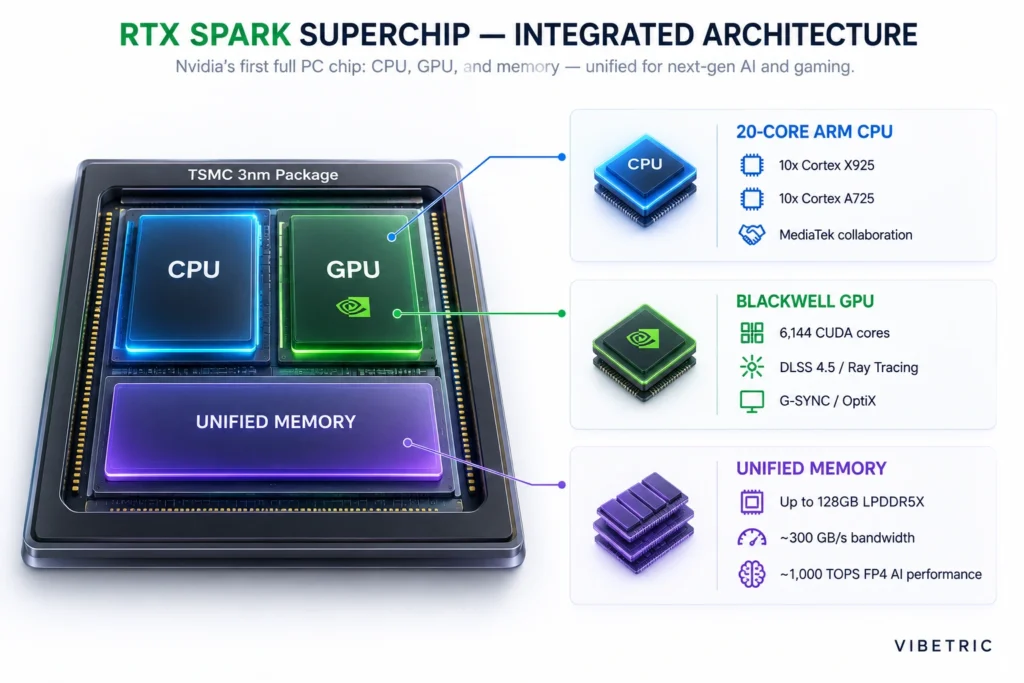
Nvidia RTX Spark laptop — confirmed May 31, 2026 at Computex. The nvidia rtx spark laptop is Nvidia’s first complete PC chip: Grace Blackwell superchip on TSMC 3nm, 20-core ARM CPU, Blackwell RTX GPU with 6,144 CUDA cores, up to 128GB unified LPDDR5X. DGX server architecture in a laptop TDP.
Eight confirmed laptops. Thirty total designs. The rtx spark laptop release date 2026 window is fall 2026. These are the best upcoming laptop fall 2026 options at the premium AI tier — no retail prices confirmed by any OEM as of July 2026.
Quick Take: The Nvidia RTX Spark laptop is a 20-core ARM + Blackwell GPU superchip launching fall 2026, delivering ~RTX 5070 gaming performance and 1,000 TOPS AI compute in ultrabook-thin chassis. Eight confirmed models from ASUS, Dell, HP, Lenovo, Microsoft, and MSI ship fall 2026. N1X starting price: ~$2,500–$3,000. No independent benchmarks exist yet — Nvidia’s claims are strong, but every performance figure cited here comes directly from Nvidia’s own announcements.
The Evening Jensen Huang Changed the Laptop Conversation
May 31, 2026. Computex, Taipei. The audience expects a GPU update. Huang delivers RTX Spark instead — framed explicitly as Nvidia’s M1 moment. A 120-billion-parameter model runs on a laptop with no network connection. Adobe confirms it is rebuilding Photoshop and Premiere natively for RTX Spark, targeting 2x AI and graphics performance gains.
The market reaction is immediate: Intel drops 6 percent, AMD falls 5 percent, Qualcomm loses roughly 10 percent in pre-market trading. Eight laptop makers commit to fall 2026 launch products the same day. Market reaction is the clearest pre-benchmark signal that the announcement is serious.
What Analysts and Early Testers Are Actually Saying About RTX Spark
Community and analyst reaction to RTX Spark is more nuanced than the headlines suggest. Enthusiasm for AI compute coexists with genuine questions about CPU performance, memory bandwidth, price, and Windows ARM compatibility.
| Discussion Theme | Sentiment | Key Observation |
| Raw AI compute (1,000 TOPS vs 38 TOPS) | Excited — but contextualised | TOPS is a ceiling, not a daily speed — model size and bandwidth define real LLM throughput |
| GPU gaming vs RTX 5070 laptop | Positive with caveats | DLSS 4.5 gives Nvidia a driver advantage; but no independent benchmarks yet exist |
| $2,500–$3,000 estimated price | Cautious | Premium over equivalently specced Intel/AMD gaming laptops — needs to prove efficiency delta |
| CPU single-core vs Apple M5 / Snapdragon X2 | Critical | N1X single-core is ~30% below Apple M5 Max and ~20% below Snapdragon X2 Elite in comparable tests |
| Memory bandwidth (300 GB/s vs Apple’s 546 GB/s) | Underreported concern | Apple M5 Max’s 546 GB/s vs RTX Spark’s 300 GB/s creates a gap for sustained LLM inference despite higher TOPS |
| Windows ARM app compatibility | Mixed | Windows Prism emulator handles most apps; niche software, some game launchers, hardware-locked enterprise tools remain risks |
| Adobe Photoshop/Premiere native support | Positive | Adobe confirmed native RTX Spark builds with 2x claimed AI and graphics improvement — creator case is concrete |
| Nvidia vs Qualcomm for agentic AI | Genuine debate | Qualcomm’s Snapdragon X2 Elite Extreme may have better single-core responsiveness for conversational AI agents; Nvidia wins on bulk inference |
| Fall 2026 launch realism | Cautiously optimistic | ASUS and MSI lead; HP and Microsoft follow — staggered launch reduces day-one risk |
The most underreported concern is memory bandwidth. Nvidia’s 300 GB/s LPDDR5X compares to Apple M5 Max’s 546 GB/s. TOPS measures peak compute; bandwidth determines how fast data feeds those compute units. For 120B parameter models under sustained inference, the gap will be measurable.
Nvidia RTX Spark Superchip — Full Confirmed Specifications
Specifications confirmed by Nvidia at Computex 2026 and SIGGRAPH 2026. Price estimates from Morgan Stanley analyst reports — not OEM-confirmed. All benchmark claims from Nvidia unless marked otherwise.
| Specification | RTX Spark N1X (Flagship) | RTX Spark N1 (Lower-tier) |
| Chip family | Nvidia RTX Spark — Grace Blackwell Superchip | Nvidia RTX Spark — Grace Blackwell (cut-down) |
| CPU | 20-core ARM (10x Cortex X925 + 10x Cortex A725), ~4.1GHz | Fewer cores — exact count not yet confirmed |
| GPU | Blackwell RTX — 6,144 CUDA cores, DLSS 4.5, G-SYNC, ray tracing | Blackwell RTX — reduced CUDA core count (TBC) |
| GPU Performance | ~RTX 5070 laptop GPU equivalent — ~100 FPS at 1440p (Nvidia claim) | Lower GPU tier — benchmarks not yet available |
| Unified Memory | Up to 128GB LPDDR5X | Up to 64GB LPDDR5X (expected) |
| Memory Bandwidth | ~300 GB/s | Lower (TBC) |
| AI Performance | ~1 petaflop (1,000 TOPS) FP4 | Lower TOPS — figures TBC |
| Process Node | TSMC 3nm | TSMC 3nm |
| CPU Co-designer | MediaTek | MediaTek |
| Windows Support | Windows 11 with Prism x86 emulator, Copilot+ PC | Same |
| Linux Support | Not confirmed at launch | Not confirmed |
| Thickness (OEM laptops) | As slim as 13.53mm (HP OmniBook X 14) | Similar target |
| Weight (OEM laptops) | ~1.36 kg (lightest confirmed model) | Similar target |
| Estimated Price (N1X) | ~$2,500–$3,000 (analyst estimates — not OEM-confirmed) | ~$1,800+ (analyst estimates — not OEM-confirmed) |
| Announced | May 31, 2026 — Computex / Nvidia GTC Taipei | Same announcement |
| Launch window | Fall 2026 (confirmed at SIGGRAPH 2026) | Fall 2026 or later |
What RTX 5070-Level Performance in an ARM Laptop Actually Means
RTX Spark delivers performance comparable to an RTX 5070 laptop GPU — Nvidia’s own claim, not yet independently benchmarked. This is the nvidia arm gaming laptop coming claim that defines or disappoints the product. Here is the technical context.
The Blackwell GPU carries 6,144 CUDA cores with DLSS 4.5 multi-frame generation, hardware ray tracing, and G-SYNC. DLSS 4.5 reconstructs frames via AI, making raw rasterisation less of a ceiling. Analysis of comparable DGX Spark hardware places the GPU between Apple M5 Pro and M5 Max in synthetics. That upscaling pipeline is the structural gaming advantage Apple and Qualcomm cannot replicate.
The thermal ceiling is the honest limitation. RTX Spark’s 80W TDP vs Snapdragon X2’s 23W and Apple M5 Pro’s 30W means eight sub-16mm laptops need serious vapour chamber engineering. Whether 100 FPS at 1440p holds under real thermal load in a thin chassis is the question fall 2026 reviews will answer.
The RTX Spark Roadmap and Why Nvidia Is in This for the Long Term
Nvidia has confirmed a four-generation RTX Spark roadmap. Generation 1 (N1X, Blackwell, LPDDR5X) ships fall 2026. Generation 2 (Rubin, 2027) moves to LPDDR6, directly addressing the 300 GB/s bandwidth ceiling. Generations Rosa and Feynman follow in 2028 and beyond.
The DGX connection is architecturally literal. CUDA, TensorRT, and cuDNN transfer intact to RTX Spark from day one — the same tools that run on Nvidia’s data-centre nodes run on RTX Spark laptops without recompilation. That is the moat Apple and Qualcomm cannot cross: 40 million CUDA developers.
The broader implications of ARM’s ascent across every Windows laptop category — including where Qualcomm’s Snapdragon X2 Elite currently sits before RTX Spark arrives — are covered in the Vibetric Snapdragon X Elite Gen 2 Laptops deep-dive, which maps the Windows ARM landscape RTX Spark is entering and the specific gaps it is designed to close.
Every Confirmed RTX Spark Laptop Fall 2026 — Models, Specs, and What Sets Each Apart
Eight laptops are confirmed for fall 2026 launch. Thirty total designs (laptops and compact desktops) have been committed by ASUS, Dell, HP, Lenovo, Microsoft, and MSI, with Acer and GIGABYTE following later. No retail prices have been confirmed by any OEM as of July 2026.
| Model | Brand | Form Factor | Display | Key Differentiator | Price / Status |
| Surface Laptop Ultra | Microsoft | Clamshell laptop | TBC | First Surface with Nvidia chip — Copilot+ flagship | TBC — fall 2026 |
| ASUS ProArt P16 | ASUS | 16-inch creator clamshell | 4K 120Hz OLED | Best display in launch lineup — DCI-P3, colour-calibrated | TBC — fall 2026 |
| ASUS ProArt P14 | ASUS | 14-inch creator clamshell | OLED (res TBC) | Most portable ASUS creator option | TBC — fall 2026 |
| Dell XPS 16 Creator Edition | Dell | 16-inch clamshell | Tandem OLED | Dell framed as ‘portability + performance’ — 17h battery claimed | TBC — fall 2026 |
| HP OmniBook Ultra 16 | HP | 16-inch clamshell | TBC | 15.73mm thin — 2x Thunderbolt 4, 4x 4K display support | TBC — fall 2026 |
| HP OmniBook X 14 | HP | 14-inch clamshell | TBC | Thinnest confirmed model at 13.53mm | TBC — fall 2026 |
| Lenovo Yoga Pro 9n | Lenovo | 2-in-1 convertible (only confirmed) | OLED (specs TBC) | Only 2-in-1 in launch lineup — extended unplugged runtime | TBC — fall 2026 |
| MSI Prestige N16 Flip AI+ | MSI | 16-inch 2-in-1 flip | UHD+ Tandem OLED, VRR, 1,000+ nits, 100% DCI-P3, Delta-E<1 | 99.9Wh battery, Calman Verified display — best-spec display confirmed | TBC — fall 2026 |
The eight models segment clearly: Surface Laptop Ultra and Dell XPS 16 target premium enterprise; ASUS ProArt P16 and MSI Prestige N16 Flip target creators; HP OmniBook X 14 and Lenovo Yoga Pro 9n are portable daily drivers. No sub-14-inch model exists — RTX Spark’s 80W TDP makes that form factor thermally unviable for generation one.
RTX Spark vs Apple M5 Pro vs Snapdragon X2 Elite — Which ARM Chip Wins Where
The best upcoming laptop fall 2026 chip comparison requires separating four independent performance dimensions: CPU speed, GPU capability, AI throughput, and memory bandwidth. No single chip leads across all four.
| Metric | Nvidia RTX Spark N1X | Apple M5 Pro | Snapdragon X2 Elite |
| CPU cores | 20 ARM (10x X925 + 10x A725) | 12-core (8P + 4E) Apple Silicon | 18-core Oryon Gen 3 (Qualcomm custom) |
| CPU single-core (GB6 est.) | ~30% behind Apple M5 Max; roughly level with Intel/AMD | Among the strongest — leads RTX Spark by ~20–30% | Leads RTX Spark N1X in early estimates; close to M4 Pro |
| GPU | Blackwell RTX, 6,144 CUDA, DLSS 4.5 | Apple GPU (14-core in M5 Pro) | Adreno — significantly weaker GPU |
| GPU gaming | ~100 FPS at 1440p (Nvidia claim); DLSS 4.5 advantage | Strong — but no DLSS, no CUDA | Significantly weaker — not a gaming chip |
| Memory bandwidth | ~300 GB/s | ~546 GB/s (M5 Max) / ~273 GB/s (M5 Pro) | ~152 GB/s |
| AI TOPS | ~1,000 TOPS (FP4) | ~38 TOPS (Neural Engine) | ~80 TOPS (Hexagon NPU) |
| CUDA ecosystem | Yes — full CUDA, TensorRT, OptiX compatibility | No CUDA — Core ML only | No CUDA |
| Local LLM capacity | Up to 128GB unified — runs 120B parameter models locally | Up to 128GB (M5 Ultra) / 64GB (M5 Max) | Up to 64GB LPDDR5X |
| x86 app compatibility | Via Prism emulator (Windows 11) — same caveats as Snapdragon | Via Rosetta 2 (macOS) — mature, proven | Via Windows ARM emulation — mature for this architecture |
| Memory bandwidth vs AI TOPS | Lower bandwidth vs Apple M5 Max despite higher TOPS | Higher bandwidth favours large-model sustained inference | Highest battery efficiency per TOPS |
| Price tier (laptop est.) | $2,500–$3,000+ (N1X) | ~$1,999+ (MacBook Pro M5 Pro) | ~$799–$1,299 (Snapdragon X2 laptops) |
RTX Spark N1X leads on AI TOPS (1,000 vs 80 vs 38) and GPU gaming via DLSS 4.5. Apple M5 Pro leads on CPU single-core and memory bandwidth (546 GB/s vs 300 GB/s). Snapdragon X2 Elite leads on price and efficiency (23W vs 80W TDP). RTX Spark is right for AI developers and CUDA creators. It is not the obvious choice for anyone else.
For a full technical breakdown of how ARM laptop architectures compare across CPU, GPU, and efficiency dimensions — including the Apple M4 vs Snapdragon X Elite analysis that predates RTX Spark — Vibetric’s ARM Laptop Processor Comparison provides the foundational context for understanding where RTX Spark fits within the broader shift away from x86.
Why RTX Spark Might Not Be the Right Buy — Even If the Benchmarks Deliver
The nvidia rtx spark laptop may well achieve everything Nvidia claims — the architecture is credible, the developer ecosystem is real, the roadmap is committed. The case for buying one is still not obvious for most users.
At $2,500 to $3,000, RTX Spark competes against RTX 5070 Ti gaming laptops at $1,400 and MacBook Pro M5 Pro at $1,999 — both available with independent benchmarks now. RTX Spark premium buys: CUDA on Windows, 128GB unified memory, committed roadmap. A gamer wanting 100 FPS at 1440p gets it from a $1,400 RTX 5070 Ti laptop. A creator needing Adobe today gets it from the M5 Pro without ARM risk.
Windows ARM compatibility has improved since Snapdragon X launched in 2024 but is not resolved. Prism handles most mainstream apps; niche software, some game launchers, hardware-locked enterprise tools, and some AutoCAD workflows still have gaps. RTX Spark inherits this ecosystem debt without the two years of refinement Qualcomm’s platform has accumulated.
RTX Spark Laptop — Who Should Wait and Who Should Buy Something Else Right Now
| Your profile | Buy RTX Spark — Wait | Consider now instead | Reason |
| AI developer / CUDA researcher | RTX Spark (N1X) | Mac Studio M5 Ultra (if budget allows) | Only Windows laptop with full CUDA, TensorRT, 128GB unified — runs 120B models locally |
| Creator: Photoshop + Premiere heavy | RTX Spark N1X | MacBook Pro M5 Pro (available now) | Adobe confirmed 2x AI gains on RTX Spark; but MacBook Pro M5 Pro delivers excellent results today |
| AAA gamer in an ultrabook | RTX Spark N1X | Current RTX 5070 Ti gaming laptop (~$1,400–1,800) | DLSS 4.5 + 100 FPS 1440p claim is strong — but a $2,500 ultrabook vs $1,500 gaming laptop needs benchmarks to justify |
| Productivity / daily driver | Snapdragon X2 (available now) | Intel Core Ultra 9 (available now) | RTX Spark CPU single-core is behind Snapdragon X2 Elite for everyday tasks; ARM compatibility risk remains |
| Student / budget buyer | Not this generation | Vivobook S16 OLED Snapdragon (~$799) | RTX Spark starts at ~$1,800+ — not a budget product |
| Battery-first mobile worker | Snapdragon X2 laptops (available now) | MacBook Air M5 (available now) | RTX Spark thermal load at 80W TDP will challenge battery life; no confirmed figures from OEMs yet |
| Vision Pro / Apple ecosystem user | MacBook Pro M5 Pro | AirPods Ultra, iPhone 18 (fall) | RTX Spark is Windows-only; Apple ecosystem users gain nothing from switching |
If you are evaluating the ASUS Vivobook S16 OLED (Snapdragon X2 SKU) as the buy-now Windows ARM alternative while waiting for RTX Spark, Vibetric’s full ASUS Vivobook S16 OLED 2026 Review covers six months of Snapdragon X2 Elite real-world performance, battery life testing, and ARM compatibility data — exactly the context needed to decide whether to wait for RTX Spark or buy the best Windows ARM laptop available today.
Back to That Stage in Taipei in May
Jensen Huang finishes the demo. A 120-billion-parameter model ran on a laptop without a data centre. The audience reaction is genuine recalibration, not polite applause. The best upcoming laptop fall 2026 conversation changed that evening — the specifications, CUDA ecosystem, and OEM response are all real.
The rtx spark laptop release date 2026 is fall 2026. Eight models. The nvidia arm gaming laptop coming argument is at its most credible: a 1.36 kg machine running DLSS 4.5 at 100 FPS at 1440p. Whether sub-16mm chassis thermals sustain that is what reviews will determine. Treat $2,500 to $3,000 as a first-generation premium.
Vibetric Verdict: The Nvidia RTX Spark laptop is real, architecturally credible, and launching fall 2026 from eight major OEMs. Buy it if CUDA development, local 120B parameter AI models, or DLSS-enabled 1440p gaming in an ultrabook form factor describes your actual workflow. Wait for independent benchmark data before purchasing — every performance claim cited here comes from Nvidia, not a third-party lab. Skip it this generation if CPU single-core speed, battery life, or price-to-gaming-performance ratio are your primary metrics.
Want to Know the Exact RTX Spark Laptop Release Date the Moment It Drops?
Follow Vibetric on Instagram @vibetric_official for real-time coverage as fall 2026 RTX Spark laptops begin shipping and independent benchmarks arrive from labs.
Bookmark Vibetric — we update our nvidia rtx spark laptop tracker as OEMs confirm retail prices, release dates, and battery life figures closer to launch.
Subscribe for in-depth first-week reviews of every RTX Spark laptop model, with thermal testing, gaming benchmarks, and Windows ARM compatibility data from real-world use.
Everything Confirmed and Still Unanswered About the Nvidia RTX Spark Laptop
1. What is the Nvidia RTX Spark laptop release date?
The rtx spark laptop release date 2026 is fall 2026, confirmed at SIGGRAPH. ASUS and MSI lead, followed by Acer, GIGABYTE, HP, and Microsoft Surface. Announced May 31, 2026 at Computex. No specific month or day has been confirmed by any OEM as of July 2026.
2. What is the Nvidia RTX Spark laptop price?
No OEM has confirmed retail prices. Morgan Stanley analyst estimates place N1X (flagship chip) laptops at approximately $2,500 to $3,000. N1 (lower-tier chip) laptops are estimated to start above $1,800. These are analyst projections, not manufacturer pricing. Prices will be confirmed closer to individual product launch dates in fall 2026.
3. Which laptops will have Nvidia RTX Spark?
Eight confirmed RTX Spark laptops as of July 2026: Surface Laptop Ultra, ASUS ProArt P16, ASUS ProArt P14, Dell XPS 16 Creator Edition, HP OmniBook Ultra 16, HP OmniBook X 14, Lenovo Yoga Pro 9n, MSI Prestige N16 Flip AI+. Acer and GIGABYTE have additional models in development. Nvidia confirmed 30+ total designs across all OEM partners.
4. How does RTX Spark gaming performance compare to RTX 5070?
Nvidia claims RTX Spark targets 100 FPS at 1440p on AAA titles, comparable to an RTX 5070 laptop GPU. The 6,144 CUDA core Blackwell GPU with DLSS 4.5 has a structural gaming advantage over Apple and Qualcomm — neither has an upscaling equivalent. No independent benchmark has confirmed any of these figures yet.
5. Is the Nvidia RTX Spark an ARM chip?
Yes. The RTX Spark is an ARM-based SoC co-developed with MediaTek. The CPU uses 10 Cortex X925 extreme cores and 10 Cortex A725 performance cores — a standard ARM core layout rather than a custom architecture like Qualcomm’s Oryon or Apple’s Silicon. Laptops run Windows 11 on ARM with the Prism x86 emulator for backward compatibility. Linux support has not been confirmed by Nvidia for the initial launch.
How does RTX Spark compare to Apple M5 Pro for creative work?
RTX Spark leads on AI TOPS (1,000 vs 38) and GPU gaming. Apple M5 Pro leads on CPU single-core (~20–30%), memory bandwidth (M5 Max: 546 GB/s vs 300 GB/s), and ARM maturity. Adobe claims 2x AI gains on RTX Spark — from Nvidia-managed demos. Apple ecosystem creators: M5 Pro is safer in 2026. CUDA-dependent AI work on Windows: RTX Spark is the only credible option.
What is the difference between RTX Spark N1X and N1?
N1X is the flagship chip: 20-core ARM CPU, Blackwell GPU with 6,144 CUDA cores, up to 128GB LPDDR5X, ~1,000 TOPS AI, ~$2,500–$3,000 laptop price. N1 is the lower-tier variant with fewer cores and reduced memory capacity (expected up to 64GB). Nvidia has not published official N1 specifications. The N1 targets a price point estimated above $1,800 for laptops. Performance figures for N1 are not yet available.
Will RTX Spark laptops have good battery life?
No OEM has confirmed battery life figures. RTX Spark’s 80W TDP is significantly above Snapdragon X2’s 23W and Apple M5 Pro’s 30W, making sustained battery life in sub-16mm chassis the primary unresolved question. The nvidia arm gaming laptop coming claim of thin + fast + long-lasting will be tested by thermal design, not spec sheets.
Should I wait for RTX Spark or buy a laptop now?
Need a laptop now: the ASUS Vivobook S16 OLED (Snapdragon X2 Elite, ~$799–$999) is the best Windows ARM laptop available. The MacBook Air M5 ($1,299) covers it for Apple users. Wait for RTX Spark only if CUDA development, 120B parameter local AI, DLSS gaming in an ultrabook, or a specific confirmed OEM model is the actual reason you are buying.
Community Triage (0)