
Wireless Gaming Gear Latency: The Definitive Truth Behind the Long-Standing Myth
There was a time when plugging in a cable felt like a competitive ritual. You didn’t just connect your mouse or headset—you reassured yourself that nothing invisible was getting in the way. Wireless was convenient, sure, but it carried a quiet anxiety: What if the delay costs me the moment?
That anxiety has faded faster than most people realize. Not because gamers lowered their standards—but because the technology underneath wireless gaming gear changed fundamentally. The real story isn’t marketing bravado or esports sponsorships. It’s how engineering quietly erased the latency gap while most users were still arguing about batteries.
The Old Fear Wasn’t Imaginary—It Was Architectural
Wireless gaming gear latency used to be real, measurable, and hard to ignore. Early wireless peripherals relied on protocols never designed for rapid, deterministic input. Bluetooth stacks prioritized compatibility and power efficiency over timing precision. Signal scheduling was loose. Retransmissions were common. Interference was treated as an acceptable side effect, not a design failure.
Meanwhile, wired gear had a brutally simple advantage: electrical signals traveling directly through copper with predictable timing. Fewer variables. Fewer failure points.
So when competitive players dismissed wireless, they weren’t being stubborn—they were being rational.
The shift happened when manufacturers stopped trying to adapt consumer wireless standards and started building their own.
What Actually Changed Inside Modern Wireless Gear
Most conversations about wireless gaming gear latency stall at surface-level claims like “1 ms response.” The deeper truth is more interesting: latency didn’t drop because radios got faster—it dropped because the entire input pipeline was rebuilt.
Here’s where the real progress happened:
Deterministic Transmission Replaced Best-Effort Delivery
Modern gaming-focused wireless protocols use fixed polling intervals and tightly controlled packet timing. Instead of asking, “Can I send this now?” the device already knows when it will send.
This eliminates jitter—the inconsistency that made older wireless feel “off” even when average latency looked acceptable.
Dedicated 2.4 GHz Channels Beat Shared Bluetooth Traffic
Rather than competing with phones, watches, and keyboards, gaming peripherals now reserve narrow, high-priority channels. Frequency hopping isn’t random anymore; it’s predictive. Interference is anticipated, not reacted to.
Firmware Became as Important as Hardware
Latency is no longer just about the radio. Input processing, debounce algorithms, and packet aggregation all live in firmware. Manufacturers began optimizing these layers as aggressively as sensor hardware—sometimes more.
That’s why two wireless mice using similar sensors can feel radically different in play.
Why Perception Lagged Behind Reality
Interestingly, wireless gaming gear latency reached “wired parity” before most players believed it had.
There are three reasons perception didn’t keep up:
- Early bad experiences lingered
Once a player misses a clutch moment due to input delay—even once—that memory sticks. - Latency feels nonlinear to humans
Humans are far more sensitive to inconsistency than raw delay. Early wireless felt uneven, which the brain interprets as slow. - Marketing blurred the technical truth
Overuse of vague terms like “ultra-fast” made serious gains sound like hype.
As a result, many players continued buying cables for peace of mind long after the technical advantage disappeared.
The Latency Pipeline, Simplified
To understand why modern wireless works, it helps to see where latency actually comes from:
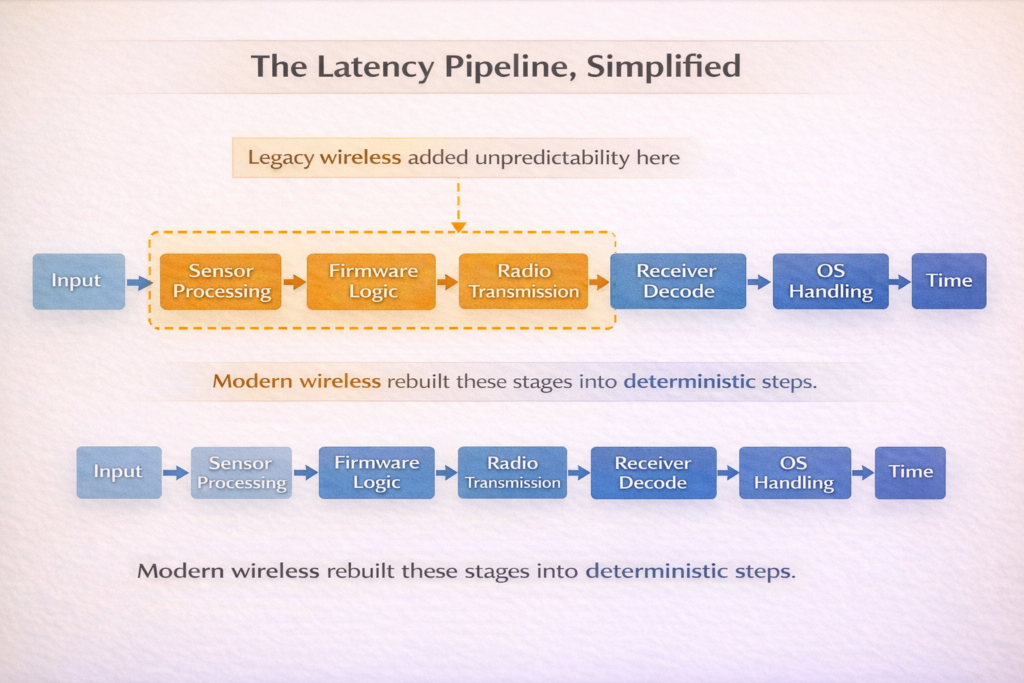
Older wireless designs added delay and unpredictability in three places: firmware logic, transmission timing, and retransmission handling. Today’s designs compress those weak points into deterministic steps. That’s why the total system delay now mirrors—or occasionally beats—wired setups under real conditions.
Where Wireless Quietly Surpassed Wired
This is where the story becomes uncomfortable for cable loyalists.
Wired gear still depends on USB polling stability, motherboard quality, and system-level scheduling. Under heavy CPU load, USB latency can spike. Wireless receivers, by contrast, often bypass some of that congestion with dedicated interrupt handling.
In clean test environments, wired and wireless are equals. In messy, real-world systems, high-end wireless can be more consistent.
That consistency—not raw speed—is why professional players began switching.
Real-World Scenarios Where the Gap Disappeared
Consider three everyday gaming contexts:
Competitive FPS sessions
Players running high refresh-rate monitors often attribute smoother aim to wired mice. In blind testing, many fail to distinguish modern wireless counterparts once cable drag is removed. The reduction in physical resistance offsets any remaining micro-latency.
Late-night multiplayer with crowded Wi-Fi
Older wireless would crumble here. Modern receivers dynamically adjust channels, maintaining stable response even when networks spike.
Laptop gaming setups
Wireless peripherals eliminate USB hub latency and power delivery inconsistencies—ironically producing cleaner input paths.
These aren’t edge cases anymore. They’re normal usage.
What the Data Actually Suggests (Without the Hype)
While manufacturers avoid publishing full latency breakdowns, independent testing consistently shows:
| Factor | Older Wireless | Modern Wireless | Wired |
|---|---|---|---|
| Transmission jitter | High | Extremely low | Very low |
| Average input delay | Noticeable | Near-identical | Near-identical |
| Consistency under load | Poor | Strong | Variable |
| Interference handling | Reactive | Predictive | N/A |
The takeaway isn’t that wireless is “faster.” It’s that wireless gaming gear latency is no longer the bottleneck.
The Human Impact No One Talks About
Latency isn’t just about reaction time—it’s about confidence.
When players trust their gear, they commit harder to actions. They flick without hesitation. They stop compensating subconsciously. That mental overhead matters more than a fraction of a millisecond.
Wireless gear also changes posture and desk ergonomics. Less tension. Fewer micro-adjustments. Over long sessions, that translates into steadier performance.
This is why many players report “playing better” after switching—even when benchmarks say nothing changed.
Choosing Wireless Without Regret: A Practical Framework
Not all wireless gear is equal. The gap closed—but only at the top end.
Everyday Players
- Look for proprietary 2.4 GHz wireless, not standard Bluetooth
- Prioritize battery stability over raw lifespan
- Ignore headline latency numbers—focus on consistency claims
Competitive Gamers
- Choose gear with proven tournament adoption
- Ensure firmware update support
- Pair with high-refresh displays to feel the benefit
Creators and Hybrid Users
- Multi-device pairing matters more than absolute latency
- Consider dongle placement flexibility to reduce interference
Future-Proof Buyers
- Modular receivers and firmware roadmaps matter
- Avoid designs locked to aging wireless standards
Quick Pros & Cons Snapshot
| Wireless Today | Wired Today |
|---|---|
| Cleaner desk, less drag | Zero charging |
| Comparable latency | Simpler troubleshooting |
| Better mobility | Predictable power |
| Firmware-dependent | Cable wear over time |
When Wired Still Makes Sense
There are still cases where wireless isn’t ideal.
LAN tournaments with strict RF environments may restrict wireless usage. Ultra-minimalist setups that never move benefit little from cutting the cord. And budget peripherals often cut corners on wireless implementation, reintroducing old problems under a new label.
The mistake is assuming all wireless behaves the same—positive or negative.
What Gamers Are Actually Saying
Across forums and long-term user discussions, patterns repeat:
| User Theme | Sentiment |
|---|---|
| Initial skepticism | Common |
| Adjustment period | Short |
| Aim consistency | Improved |
| Battery anxiety | Fades |
| Return to wired | Rare |
The most telling trend? Players who switch for convenience stay for performance neutrality. They stop thinking about latency altogether.
Where Wireless Goes Next
The next evolution isn’t about shaving microseconds—it’s about resilience.
Expect smarter interference avoidance, adaptive polling tied to game engines, and tighter OS integration. Wireless gaming gear latency will become context-aware, adjusting behavior based on load and environment.
At that point, the conversation shifts from “Is wireless good enough?” to “Why would I accept physical constraints at all?”
Vibetric Ending
That early fear—the one that made cables feel like safety nets—was justified once. It just isn’t anymore.
Wireless gaming gear latency didn’t vanish overnight. It was engineered away, layer by layer, until the argument collapsed under its own weight. What remains is habit, not evidence.
And habits change—especially when the cord stops pulling back.
Curious About the Science Behind Wireless Gaming Performance?
- Follow vibetric_official on Instagram to keep up with the latest trends and insights into gaming technology.
- Bookmark Vibetric.com we continuously update our analysis as new developments emerge in wireless peripherals and performance engineering.
Subscribe for updates and receive ongoing, in-depth breakdowns and expert opinions on gaming hardware evolution.
Questions Players Still Ask About Wireless Latency
Yes, with modern gaming-focused wireless gear, real-world latency and consistency are effectively identical to wired. Any remaining differences are below human perception and often offset by reduced cable drag.
Bluetooth prioritizes power efficiency and compatibility, not precise timing. That design introduces variability, which is why serious gaming gear relies on proprietary wireless instead.
In some setups, yes. Wireless can avoid USB congestion and eliminate cable resistance, leading to steadier input under real-world conditions.
On quality devices, performance remains stable until the battery is critically low. Poorly designed gear may degrade earlier, which is why implementation matters.
Modern receivers actively manage interference and adjust channels dynamically. Most users won’t notice latency changes during normal home use.
Many have, especially for mice and headsets. Adoption is driven by consistency and freedom of movement, not convenience alone.
Polling rate, firmware tuning, and consistency matter more than connection type. A well-optimized wireless device can outperform a poorly tuned wired one.
Yes, but future gains focus on stability and resilience rather than shaving off microseconds.
Not always. Lower-cost models often compromise on firmware or radios, which can reintroduce jitter and inconsistency.
No—but its performance advantage is gone. Wired now competes on simplicity, not speed.
What’s your take on this?
At Vibetric, the comments go way beyond quick reactions — they’re where creators, innovators, and curious minds spark conversations that push tech’s future forward.
NVIDIA RTX 5090 (2026): The Powerful AI GPU Redefining Modern Rendering
NVIDIA RTX 5090 (2026): The Powerful AI GPU Redefining Modern Rendering Gaming used to be about frames per second. Now it’s about
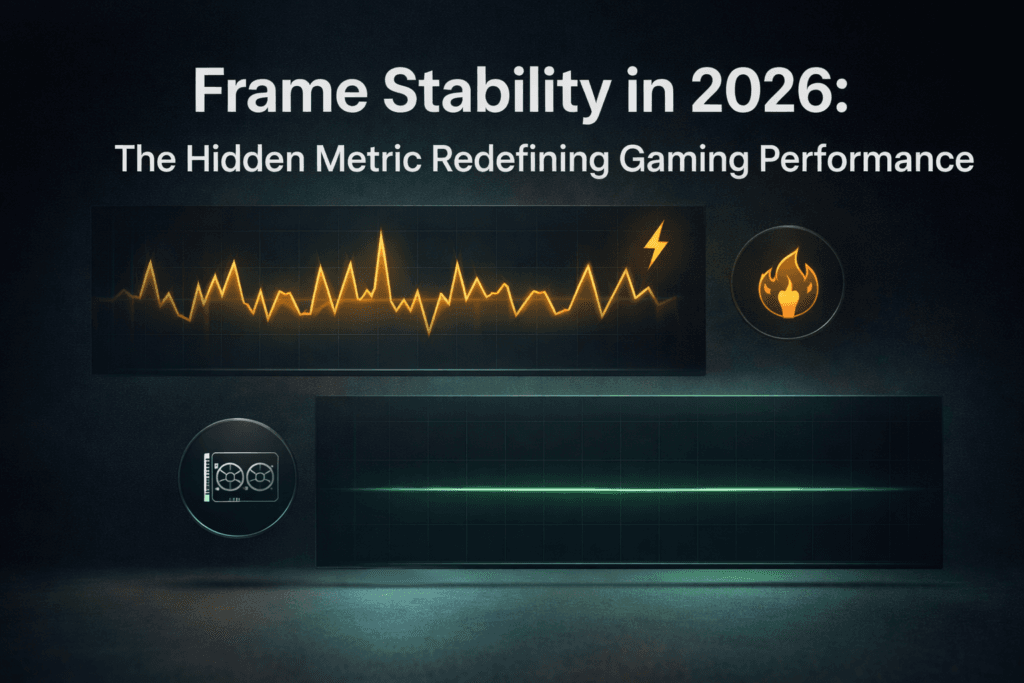
Frame Stability in 2026: The Hidden Metric Redefining Gaming Performance
Frame Stability in 2026: The Hidden Metric Redefining Gaming Performance For years, gaming conversations revolved around one number: frames per second. Higher