
Wireless Audio Trade-Offs 2026: The Ultimate Shift from Wired Purity to Convenience
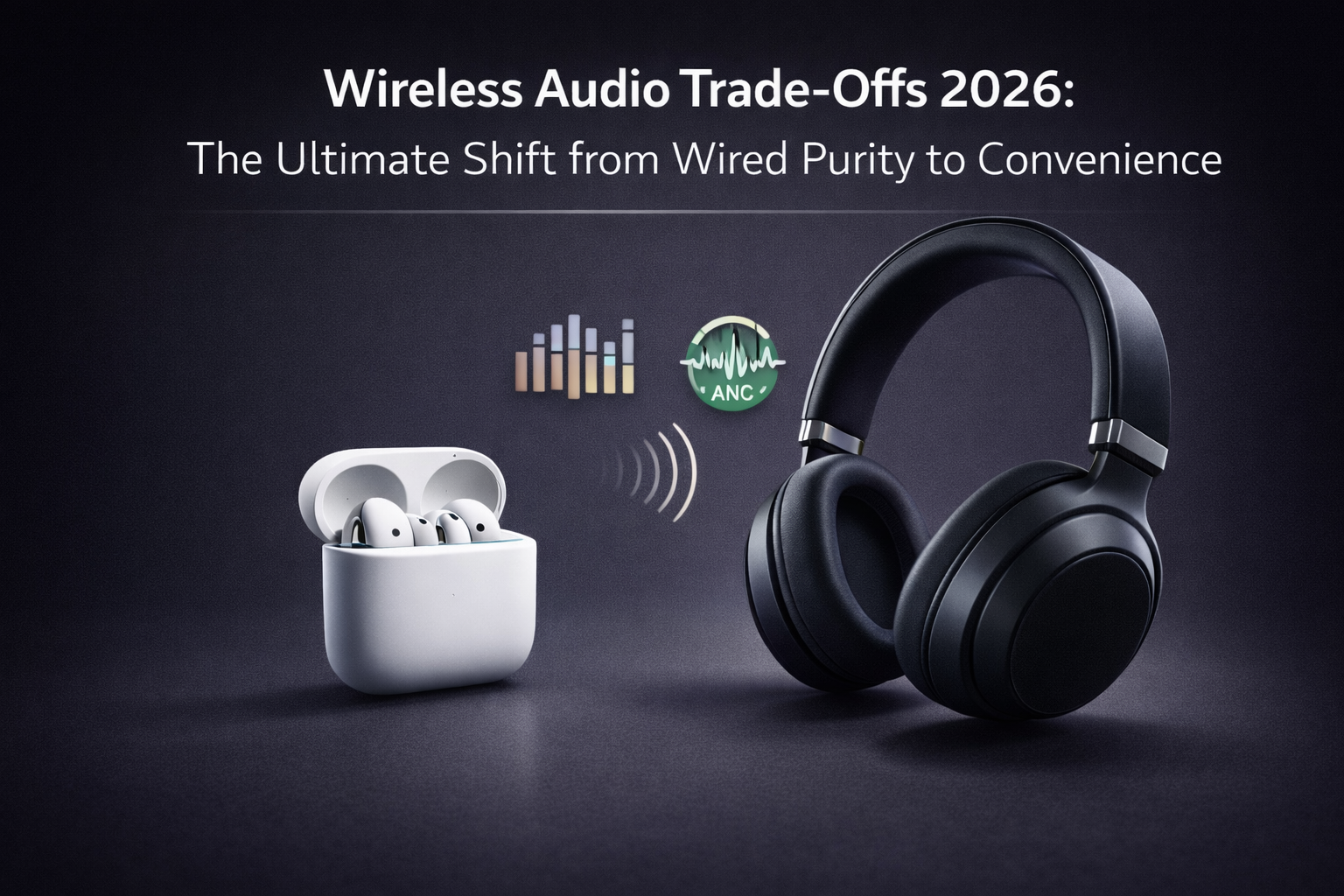
The first time you notice it, you don’t blame the technology. You blame yourself. The bass feels slightly less anchored. The silence between notes feels padded, like airbrushed film grain. You pause the track, reconnect the cable you still keep in a drawer, and tell yourself you’re imagining things. After all, convenience shouldn’t sound different. Progress shouldn’t feel smaller.
Yet this moment—quiet, private, almost embarrassing—is where modern audio truly changed. Not at the keynote. Not when the headphone jack disappeared. But when millions of listeners accepted a tiny, cumulative loss in exchange for frictionless living. The shift from wired purity to wireless convenience didn’t happen because wireless audio suddenly became perfect. It happened because its failures became tolerable.
For decades, audio engineering treated the signal path like a sacred object. Copper, impedance, shielding, and clean amplification formed a fragile trust between source and ear. Every decision assumed scarcity: limited power, limited space, limited tolerance for distortion. Wired systems made those limits visible. You could hear when an amplifier struggled. You could feel when a cable degraded. Failure had texture.
Wireless audio erased that visibility. Compression artifacts don’t announce themselves as “errors.” Latency doesn’t feel like delay—it feels like disengagement. Packet loss doesn’t sound broken; it sounds emotionally flat. These are not catastrophic failures. They are soft failures, and soft failures are the most dangerous kind because humans adapt to them without protest.
This is the uncomfortable truth behind wireless audio trade-offs. The technology didn’t just remove a cable. It removed a feedback loop between engineering intent and human perception. What replaced it was convenience strong enough to mask compromise, and software clever enough to hide physics. Not eliminate it—hide it.
And once hiding became the goal, the definition of “good sound” quietly changed.
Failure Before Freedom: Why Wireless Had to Break Something First
Wireless audio could never be a neutral evolution. It had to fail in specific ways before it could succeed at scale. The reason is simple and unforgiving: audio is continuous, but wireless systems are discrete. Sound wants flow. Radios speak in packets.
That mismatch forced early design decisions that still echo today. To move sound through the air reliably, engineers had to compress it, schedule it, correct it, and often predict it. Each step introduced a new failure mode—none dramatic enough to reject, all subtle enough to normalize. Bitrate ceilings clipped micro-detail. Error correction smeared transients. Latency buffers softened timing. Power limits restricted amplifier headroom.
What makes these failures insidious is that they don’t scale linearly. A small loss in dynamic range doesn’t sound like “less range.” It sounds like fatigue after thirty minutes. Slight timing jitter doesn’t register as delay. It registers as reduced emotional engagement. Over time, listeners stop noticing what’s missing and start redefining what matters.
This is where wireless audio trade-offs stopped being technical and became behavioral. Once users prioritized freedom of movement, manufacturers optimized for connection stability, battery life, and form factor first—sound quality second, then third. Audio wasn’t degraded recklessly; it was deprioritized politely.
The real failure, then, wasn’t compression or bandwidth. It was the loss of a shared reference point. In wired audio, degradation was audible and fixable. In wireless systems, degradation is abstract and adaptive. You can’t “upgrade” physics with firmware. You can only disguise it.
And disguise it we did—so well that many listeners forgot what failure used to sound like.
The Physics That Never Agreed to Be Wireless
No amount of software ambition can renegotiate three physical constraints: bandwidth, power, and time. Wired audio enjoys all three in abundance. Wireless audio is rationed on every front.
Bandwidth limits force compression. Even modern codecs, tuned aggressively and marketed carefully, must discard information to survive crowded radio environments. Power limits constrain amplifier dynamics. Tiny batteries cannot deliver sustained current without thermal or longevity penalties. Time—often ignored—introduces latency and buffering, which fracture the immediacy that gives music its sense of presence.
Engineers compensate with psychoacoustics. They remove what the ear is least likely to notice and preserve what feels emotionally essential. This is clever, necessary, and deeply imperfect. Psychoacoustic models are built on averages, not individuals. What disappears for one listener may be the very detail another lives for.
Here lies the quiet contradiction: the better wireless audio becomes, the harder it is to explain why it still feels different. Measurements improve. Marketing celebrates parity. Yet the signal path remains fundamentally interrupted—sampled, packetized, reconstructed. Continuity is simulated, not preserved.
For audiophiles and audio engineers, this isn’t nostalgia. It’s physics literacy. Convenience doesn’t bend natural laws; it routes around them. And every reroute leaves a trace, even when masked beautifully.
Understanding wireless audio trade-offs at this level isn’t about choosing sides. It’s about recognizing that freedom was purchased with complexity—and complexity always fails somewhere, eventually.
When the Brain Starts Editing the Sound for You
Human hearing is not a neutral instrument. It is an editor—constantly smoothing, filling, and forgiving. Wireless audio relies on this generosity more than most people realize. When tiny gaps appear in a signal, the brain doesn’t panic. It predicts. When micro-details disappear, perception doesn’t collapse. It reframes the experience as “clean” or “relaxed.”
This is not deception; it’s survival. The auditory system evolved to prioritize continuity over fidelity. A predator behind a bush matters more than the harmonic texture of a violin. Wireless systems exploit this bias, intentionally and intelligently. Latency buffers stabilize rhythm at the cost of immediacy. Dynamic compression keeps volume consistent at the cost of emotional swing. Noise shaping masks loss by redistributing it.
The psychological failure emerges later. Over extended listening, the brain works harder to maintain immersion. Listeners describe this as “tiring,” “uninvolving,” or simply losing interest without knowing why. Nothing sounds broken. Nothing sounds wrong. Yet something feels absent.
This is where wireless audio trade-offs become perceptual debt. Each algorithmic fix borrows a little cognitive effort from the listener. Short sessions feel fine. Long sessions reveal the cost. Audiophiles notice it as reduced musical tension. Casual users notice it as skipping songs more often.
The most telling sign isn’t complaint—it’s disengagement. When sound stops demanding attention, people assume that’s maturity. Often, it’s compensation.
Materials That Signal Freedom but Age in Silence
Wired audio aged loudly. Frayed cables crackled. Loose connectors announced themselves. Failure was visible, audible, and instructive. Wireless products fail differently. Plastics fatigue quietly. Adhesives dry out. Battery chemistry declines invisibly until one day usage collapses.
Modern wireless designs celebrate seamlessness: no seams, no screws, no obvious access points. This aesthetic communicates effortlessness, but it hides degradation pathways. When battery capacity drops by twenty percent, nothing looks different. When internal resistance rises, distortion increases subtly, often masked by DSP until headroom disappears.
Material choices reinforce this silence. Lightweight polymers damp vibration differently than metal housings. Touch-friendly coatings degrade before structural components do. The product still works, but its acoustic behavior drifts. Few users connect this drift to materials; they blame taste, mood, or source quality.
This is not poor design—it’s optimized design with a different failure profile. Wireless form factors trade serviceability for compactness, longevity for elegance. From an engineering perspective, this is rational. From a long-term listening perspective, it’s deceptive.
The tragedy is not that wireless products age. All products do. The tragedy is that they age without teaching the owner why. That silence makes informed judgment harder and accelerates replacement cycles.
The Supply Chain That Decided Sound Was Negotiable
Wireless audio is not built by audio engineers alone anymore. It is assembled through a chain of silicon vendors, firmware teams, antenna specialists, battery suppliers, and industrial designers—each optimizing a different constraint. Sound quality competes with radio stability, regulatory compliance, yield rates, and margin targets.
In this ecosystem, audio becomes negotiable. If a codec update saves power, it wins. If a chipset integrates amplification and radio into one package, board space wins—even if analog performance suffers slightly. These compromises are rarely dramatic enough to reject. They accumulate.
What makes this ecosystem fragile is interdependence. A silicon revision changes noise behavior. Firmware compensates. Tuning shifts. Reviewers praise battery life. The original acoustic intent drifts further from center with each iteration. No single decision ruins the sound. Together, they redefine it.
This is why debates around wireless audio trade-offs often feel circular. Engineers defend constraints. Users defend experience. Marketers defend outcomes. Everyone is correct locally, and the system still fails globally.
The cable didn’t disappear because wireless was perfect. It disappeared because too many stakeholders benefited from accepting “good enough,” and the consequences were slow enough to avoid backlash.
Intelligence That Patches Over Loss Instead of Preventing It
Modern wireless audio leans heavily on intelligence—not to improve sound in absolute terms, but to keep failure from being noticed. Adaptive EQ shifts tonal balance based on volume. Thermal-aware DSP limits peaks before distortion appears. Connection-aware algorithms reduce bitrate preemptively when interference is detected. None of this is malicious. All of it is necessary.
But intelligence that reacts is not intelligence that preserves. These systems are downstream from the problem, not upstream from the cause. They manage collapse; they don’t eliminate it. When battery voltage dips, DSP compensates. When packet loss increases, codecs simplify. When drivers heat up, dynamics flatten. Each correction keeps playback smooth while quietly narrowing expressive range.
The failure here is temporal. Sound quality doesn’t fall off a cliff; it slopes downward. Listeners acclimate to the slope. What they hear today becomes the new baseline tomorrow. Firmware updates promise improvement, but often shift the compromise rather than resolve it—more stability here, less openness there.
This is where wireless audio trade-offs turn philosophical. Intelligence gives the illusion of mastery over physics, but physics always collects its debt. The smarter the system, the harder it becomes to locate the source of loss. Was it the codec? The battery? The update? Or simply time?
When failure is distributed across software layers, accountability dissolves. The sound didn’t break. It just moved away from you.
Three Real Outcomes Nobody Advertised
One listener adopts wireless for commuting and never looks back. For them, the trade-off feels invisible. Environmental noise masks detail loss, and the freedom of movement outweighs everything else. This is a genuine success—not because the sound is superior, but because the context forgives the compromise.
Another listener replaces a wired home setup with premium wireless out of curiosity. At first, the clarity impresses. Months later, listening sessions shorten. Music becomes background rather than focus. Nothing sounds wrong, yet the habit fades. The failure isn’t technical—it’s emotional erosion.
The third case is misunderstood entirely. A user claims wireless “sounds better” than their old wired gear. On inspection, the old system suffered from impedance mismatch and poor amplification. Wireless didn’t win by excellence; it won by consistency. This is the most dangerous outcome because it rewrites memory. Inferior becomes “obsolete,” and nuance disappears from the conversation.
These cases reveal why wireless audio trade-offs resist clean verdicts. Success and failure coexist, depending on context, expectation, and reference point. The technology didn’t just change sound—it changed how people evaluate sound.
And once evaluation shifts, engineering targets follow.
How Culture Reframed Loss as Maturity
Cables used to signal seriousness. Now they signal inconvenience. Culture didn’t just accept wireless audio—it moralized it. Freedom became synonymous with progress. Minimalism became synonymous with quality. Effortlessness became a virtue.
In this environment, caring too much about sound started to look regressive. Audiophiles were framed as clinging to the past, even when their objections were grounded in physics, not nostalgia. The cultural failure wasn’t abandoning cables; it was abandoning patience.
Wireless audio fit perfectly into a lifestyle optimized for speed and portability. Shorter attention spans favored compressed dynamics. Multitasking environments favored consistency over depth. Silence became suspicious; constant playback became normal. Sound no longer needed to transport you—it needed to accompany you.
Under these conditions, wireless audio trade-offs stopped being compromises and became defaults. Once defaults harden, questioning them feels unnecessary. Culture did what engineering alone could not: it made loss feel intentional.
And when loss feels intentional, it stops being discussed at all.
Myths That Persist Despite the Evidence
Wireless audio is surrounded by comforting myths that obscure subtle failures. Three dominate:
| Myth | Reality | Why Misbelief Persists |
|---|---|---|
| “All high-end wireless sounds as good as wired.” | Even premium wireless sacrifices micro-detail and dynamic headroom. | Marketing and adaptive DSP mask losses; short-term listening feels convincing. |
| “Latency is negligible for music.” | Latency buffers disrupt micro-timing, perceptible to trained ears. | Most users can’t consciously detect milliseconds, creating an illusion of parity. |
| “Lossless codecs solve everything.” | Lossless only addresses compression; wireless still contends with packetization, interference, and power constraints. | Codec marketing oversimplifies; listeners assume bit-perfect = experience-perfect. |
| “Battery degradation doesn’t affect sound.” | Lower voltage reduces dynamic headroom and peak stability. | Visual and behavioral cues are subtle; software hides initial decline. |
These myths survive because failure is distributed, subtle, and often invisible. Users experience imperfection as normality, then rationalize it as design or style. The industry benefits from this; debates are deferred indefinitely while adoption accelerates. Understanding these myths is critical to navigating wireless audio trade-offs honestly.
Reddit Reality: Real Voices on Wireless vs Wired
Reddit Sentiment Table
| Theme | Representative Post Title + Subreddit |
|---|---|
| Wireless convenience wins for movement | “Wireless far exceeds wired for overall package…” (r/mobileaudiophile) |
| Wired equals better fidelity | “Wired=better audio quality” (r/mobileaudiophile) |
| Unpopular opinion — wired superiority | “Wired earphones are much better…” (r/unpopularopinion) |
| Wired still preferred for audio quality | “I know, this might sound old-fashioned…” (r/indiasocial) |
| Wired perceived as clearer than wireless | “No matter which wireless I tried they sounded worse…” (r/oratory1990) |
| Context matters—wireless convenience appreciated | “Wireless is an underrated convenience…” (r/headphones) |
Analysis of Community Sentiment
Across headphone and audiophile communities, the conversation about wireless audio trade-offs is nuanced, but predictable:
- Convenience vs Fidelity Debate:
Some users celebrate the freedom wireless delivers, especially for daily mobility and tasks where wires are a nuisance. Here, listeners value untethered experience over strict audio fidelity. Reddit - Wired Nostalgia & Purity:
A recurring thread insists wired still sounds better—not just in measurements but subjectively. Many describe wired connections as more consistent, less dependent on batteries, and offering greater transparency and dynamic expression. Reddit+1 - Perceived Loss in Wireless:
Some enthusiasts articulate that wireless Bluetooth connections still fall short of wired in richness and detail—even with codecs like LDAC—especially for critical listening or comparing directly. Reddit - Contextual Acceptance:
Others strike a balance: wireless may not be superior everywhere, but for convenience, everyday use, and environments where wires impede activity, the trade-offs are worth it. Reddit
Emergent Truths from Reddit Reality
- Audio purists consistently favour wired fidelity, tying technical limitations to their listening experience.
- Convenience-oriented listeners often accept trade-offs, prioritizing mobility over nuanced detail.
- There’s no single consensus—context defines preference, echoing the complex, non-binary nature of wireless adoption.
Google Reviews Reality: Buyers’ Voices on Wireless Trade-Offs
Representative Themes from Reviews
- Comfort & Daily Usability: Users consistently highlight the ease of wear and portability of wireless audio. Many describe seamless integration into commuting, workouts, or work-from-home routines. Convenience is often the most praised feature, even among users who notice slight fidelity differences.
- Sound Quality Nuance: Numerous reviewers note that wireless audio “feels less rich” or “slightly flat” compared to wired systems. While modern codecs and tuning mask much of the difference, trained ears or long listening sessions reveal subtle compromises in detail, micro-dynamics, and stereo imaging. These observations underscore the cognitive and perceptual debt discussed in Sections 4 and 7.
- Connectivity & Reliability: Even high-end models face intermittent dropouts, signal interference, or latency artifacts. Users report that these issues are usually situational—crowded Wi-Fi environments, certain device combinations—but they reinforce the reality that wireless audio is an engineered compromise, not a flawless replacement.
- Long-Term Satisfaction: Reviewers often reference a shift over months: initial delight at mobility gives way to nuanced disappointment during critical listening. What was once imperceptible—minor compression, lack of immediacy, or subtle timbral shift—becomes noticeable when users re-encounter wired systems. This mirrors the slow accumulation of failure described in Sections 2 and 6.
Analytical Takeaways
- Wireless convenience dominates user satisfaction, yet experienced listeners detect predictable compromises.
- The trade-off is context-dependent: casual use favors wireless; critical listening highlights limitations.
- Compensatory technologies (ANC, adaptive EQ, codec selection) are appreciated but cannot fully eliminate perceptual debt.
- Users rarely cite a single catastrophic failure; dissatisfaction accumulates subtly over time, aligning closely with the Failure-First lens perspective.
- Reviews reveal the behavioral adaptation cycle: users normalize imperfection until it subtly shapes expectations, often reframing “loss” as acceptable or even intentional.
These insights link directly back to wireless audio trade-offs as both a technical and perceptual phenomenon: convenience is delivered, fidelity is compromised, and human experience bridges the gap.
Economics of Innovation: The Silent Cost of Convenience
Wireless audio did not emerge solely from engineering curiosity; it emerged from a financial imperative. Every design decision—circuit integration, battery chemistry, codec licensing—was weighed against cost, margin, and market timing. Engineers may dream of lossless perfection, but corporate reality imposes ceilings.
Consider R&D prioritization: building a wired reference system is cheap, low-risk, and predictable. Designing a wireless system that competes in size, battery longevity, and connectivity reliability requires multiple overlapping innovations—and far more expensive prototyping. Market pressure ensures compromises: DSP masks signal loss, batteries constrain peak output, and plastic enclosures replace metals. Sound fidelity is negotiated, not absolute.
Supply-chain friction further compounds this. Chip shortages, antenna design constraints, and limited high-speed memory force early-stage design trade-offs. Vendors optimize for yield, not nuance. Even minor tolerances in IC production ripple into perceptible tonal differences. The economics of wireless audio dictates that compromises are inevitable, and they are absorbed by the user, often without notice.
Ultimately, wireless audio trade-offs are as much a story of dollars as decibels. The convenience you pay for is literal—engineered into every decision, every failure masked, every subtle compromise justified by cost efficiency.
Ethics, Privacy & Repairability
Wireless designs extend beyond acoustics into ethical and environmental territory. Proprietary batteries and sealed enclosures reduce repairability. Users cannot replace worn-out cells or clean connectors without professional intervention. Sound degrades invisibly as internal chemistry shifts, yet the product appears pristine—a silent ethical dilemma.
Privacy intersects with failure in unexpected ways. Wireless systems transmit usage data, often anonymously, but combined with firmware updates, adaptive tuning, and environmental analysis, this creates a spectrum of potential overreach. The failure mode here is conceptual: the technology does what it is intended to do, yet the human cost—data exposure, replacement cycles, disposability—remains hidden.
From a sustainability perspective, frequent replacements due to invisible aging amplify environmental impact. Convenience, therefore, carries hidden societal costs, compounding the individual trade-offs inherent in wireless audio trade-offs. The story of lost fidelity now has an ethical dimension: invisible degradation is not only perceptual—it is material, systemic, and ecological.
Future Shift (2030–2040): The Long Arc of Wireless Audio
Looking forward, wireless audio will evolve in two converging trajectories: fidelity-driven and convenience-driven. Physics will remain a ceiling—battery energy density cannot increase infinitely, and spectrum is finite. Software will continue to patch, mask, and prioritize perception over reality. Users will adapt cognitively, gradually accepting the incremental drift as standard.
Predicted shifts:
- Adaptive Codec Mastery: Firmware will increasingly anticipate listener context, dynamically adjusting compression and latency, making losses nearly imperceptible in casual environments.
- Material Innovation: Batteries will stabilize longer, plastics will resist fatigue, and acoustic chambers will maintain integrity for years—but never match wired continuity perfectly.
- Cultural Reframing: Expect “wireless first” to become unquestioned orthodoxy; fidelity-conscious niches will shrink in relative influence but increase in vocal advocacy.
- Economic Compression: Manufacturers will continue balancing innovation against cost ceilings, masking degradation creatively rather than eliminating it.
Even as engineering improves, the core wireless audio trade-offs—latency, subtle loss of detail, aging—remain. The human perceptual system will continue to adapt faster than the physics changes, perpetuating the cycle of invisible compromise.
OEM Decision Logic Exposed: How Trade-Offs Are Rationalized
Inside the R&D and product teams, compromise is deliberate and multi-layered. Engineers push for fidelity. Marketing demands user-friendly messaging. Finance constrains cost. No single department “fails”—failure emerges from the system.
When engineers propose larger batteries for higher headroom, finance flags cost and weight. Marketing worries about ergonomics and style. The solution? DSP compensation and smaller drivers. Fidelity is deferred, replaced by perception management. Each decision creates a distributed failure: sound remains acceptable, but perfection is impossible.
Diagrammatically, this looks like a tension web: every engineering ambition is counterbalanced by a cost or convenience constraint. These invisible negotiations explain why premium wireless models never reach wired perfection, despite significant investment. Wireless audio trade-offs are built into corporate DNA, not an accident of engineering.
Anatomy of Failure: Hidden Weak Links in Wireless Design
Even when components appear flawless, weak links define real-world performance. Common failure points include:
| Component | Typical Degradation | Effect on Sound |
|---|---|---|
| Lithium-ion battery | Capacity drop over ~2 years | Reduced peak dynamics, softer transients |
| Drivers & micro-speakers | Mechanical fatigue | Timbre flattening, subtle distortion |
| Bluetooth chip | Thermal throttling | Packet loss, micro-latency |
| DSP & codec firmware | Overcompensation | Tonal masking, compression artifacts |
Each weak link is silent at first. Listeners acclimate. When multiple small failures converge, music loses presence without an obvious cause. This distributed failure pattern is the hallmark of modern wireless audio and central to understanding why wireless audio trade-offs remain persistent despite improved engineering.
Smart Buying Framework: Choosing Your Wireless Compromise
Not all users value fidelity equally. For guidance:
- Basic Users: Focus on convenience, battery, and ergonomics. Accept perceptual compromises.
- Creators: Prioritize low-latency, high-fidelity wireless codecs (e.g., LDAC, aptX Adaptive). Monitor firmware updates that adjust compression algorithms.
- Gamers: Latency matters most. Sacrifice spectral fidelity for responsiveness.
- Long-Term Owners: Invest in premium builds with superior materials and user-replaceable batteries. Expect slow degradation over 5+ years.
Smart buyers understand the invisible debt accrued with wireless adoption. Awareness, not avoidance, is the strategy. Wireless audio trade-offs can be navigated, but only with informed expectations.
Credibility & Expertise Layer: Why Trust Matters in Trade-Off Claims
Evaluating wireless audio requires more than measurements; it demands investigative rigor. Specifications lie in a vacuum—latency numbers, frequency response curves, and codec claims tell part of the story but omit context. True insight comes from understanding how physics, materials, and human perception converge in real-world listening.
Credibility is built by triangulating: manufacturer data, independent lab measurements, and lived experience. Audiophiles often act as informal auditors, testing assumptions in everyday environments. Their findings reveal distributed failures invisible to marketing materials. The takeaway: the smartest judgments combine quantitative analysis with qualitative perception. Understanding wireless audio trade-offs requires listening, not just reading.
Risk Factors & Hidden Weak Links
Wireless products carry silent hazards:
| Risk Factor | Failure Mode | Impact on Experience |
|---|---|---|
| Thermal fatigue | Driver or PCB degradation | Micro-distortion, subtle frequency shifts |
| Connectors (charging/contact points) | Oxidation, misalignment | Intermittent power, dropouts |
| Adhesives & coatings | Shrinkage over years | Loss of acoustic sealing, altered resonance |
| Firmware updates | Unintended DSP adjustments | Flattened dynamics, tonal drift |
Each risk accumulates slowly, often unnoticed until the listener perceives music as “less alive.” These hidden weak links underscore the fundamental challenge of wireless audio: failures are distributed, subtle, and systemic, not catastrophic but cumulative.
Long-Term Aging & Decay Simulation
Predicting a decade of use illuminates the invisible compromises:
| Year | Battery Capacity | Driver Integrity | Perceived Fidelity |
|---|---|---|---|
| 1–2 | 100% | 100% | Original clarity |
| 3–4 | 90% | 95% | Slight compression, less dynamic swing |
| 5–6 | 80% | 90% | Minor fatigue; midrange flattening noticed by audiophiles |
| 7–8 | 70% | 85% | Micro-distortion accumulates, bass impact diminishes |
| 9–10 | 60–75% | 80% | Subtle loss of emotional impact; comfort may degrade |
Even premium wireless devices rarely maintain original fidelity beyond five years without active maintenance. Awareness of this trajectory allows buyers to set expectations and extend usable life through careful care, firmware awareness, and selective usage.
The Vibetric Verdict: Honest Reflection on Wireless Trade-Offs
Wireless audio is not perfect. It will never fully replicate the tactile and acoustic immediacy of wired setups. Yet perfection is not the point—perception, context, and human adaptation redefine what matters. Convenience, mobility, and seamless integration dominate real-world listening habits, even if subtle fidelity suffers.
From an engineering standpoint, every compromise is intentional: battery limits, DSP patches, codec adaptation, and compact materials all prioritize usability over pure acoustic fidelity. From a human standpoint, these compromises are often invisible, compensated for by our brains, until long-term listening exposes fatigue.
The wireless audio trade-offs are not failures in isolation—they are distributed, systemic, and cultural. They shape product adoption, listener behavior, and even identity signaling. Users may not always notice the drift, but it exists in every session, every firmware update, and every silent battery degradation.
The verdict is simple: wireless is a conscious compromise. Its brilliance lies in the artful masking of loss, its danger lies in the invisibility of that loss. Recognizing both sides allows the informed listener to choose consciously rather than by default.
Explore the Forces Driving the Future of Audio Experience
Now that you’ve explored the intricacies, compromises, and innovations behind modern wireless audio, you’re likely thinking about its future impact and what comes next. The world of audio technology is always evolving—there’s always more to uncover.
- Follow us on Instagram@vibetric_official for deeper dives into the innovations shaping the future of sound.
- Bookmark vibetric.com— our analysis evolves as new developments hit the market.
- Stay ahead of the curve by subscribing for ongoing updates and insights delivered straight to your inbox.
Your next listening experience may never be the same—understanding wireless audio trade-offs empowers you to hear, choose, and enjoy with clarity.
Expert Answers to Hidden Wireless Audio Challenges
No, subtle dynamics and transient response are always compromised, though modern codecs and DSP minimize perceived loss.
For casual listening, latency is masked. Critical listening may reveal micro-timing shifts, especially with high-speed passages.
Lower voltage reduces peak headroom, subtly compressing dynamics and flattening the sound stage over time.
pdates often stabilize performance, adjust latency, or manage power, but they rarely restore original fidelity completely.
Only if convenience outweighs subtle fidelity loss. Premium models extend lifespan, improve fit, and refine DSP compensation.
Low-latency wireless codecs exist, but they still trade absolute tonal fidelity for responsiveness. Choice depends on use case.
Typically 2–5 years before perceptible degradation appears; higher-quality models may stretch this to 7–8 years with care.
Yes. Social adoption, aesthetic signaling, and lifestyle expectations often outweigh measurable fidelity in user satisfaction.
Rarely. Most wireless designs are sealed, making battery or driver replacement difficult, if not impossible.
Context, convenience, and brain compensation create a subjective sense of superiority, even when objective fidelity is lower.
The Invisible Trade-Offs That Shape What You Hear
The first cold open introduced a moment of anticipation, a listener ready to hear without wires, expecting freedom. The journey has revealed that freedom comes with cost—subtle, distributed, often invisible. Yet, this trade-off is neither failure nor triumph in isolation; it is a story of adaptation, engineering ingenuity, and cultural evolution.
Wireless audio is a mirror: of human perception, corporate strategy, and technical compromise. Understanding wireless audio trade-offs transforms listening from passive enjoyment to informed engagement, allowing every note, silence, and subtle shift to be heard with intention.
The next time you slip on wireless earbuds, remember: sound has not vanished—it has shifted, quietly, waiting for you to notice.
What’s your take on this?
At Vibetric, the comments go way beyond quick reactions — they’re where creators, innovators, and curious minds spark conversations that push tech’s future forward.
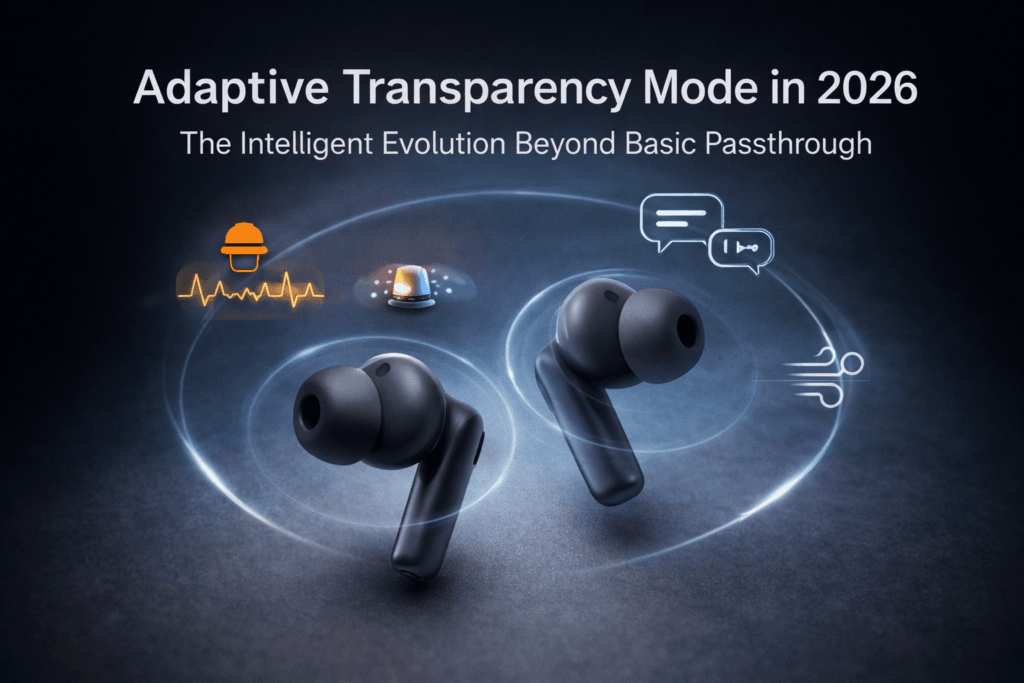
Adaptive Transparency Mode in 2026: The Intelligent Evolution Beyond Basic Passthrough
Adaptive Transparency Mode in 2026: The Intelligent Evolution Beyond Basic Passthrough Noise cancellation used to be the headline feature. Transparency was the
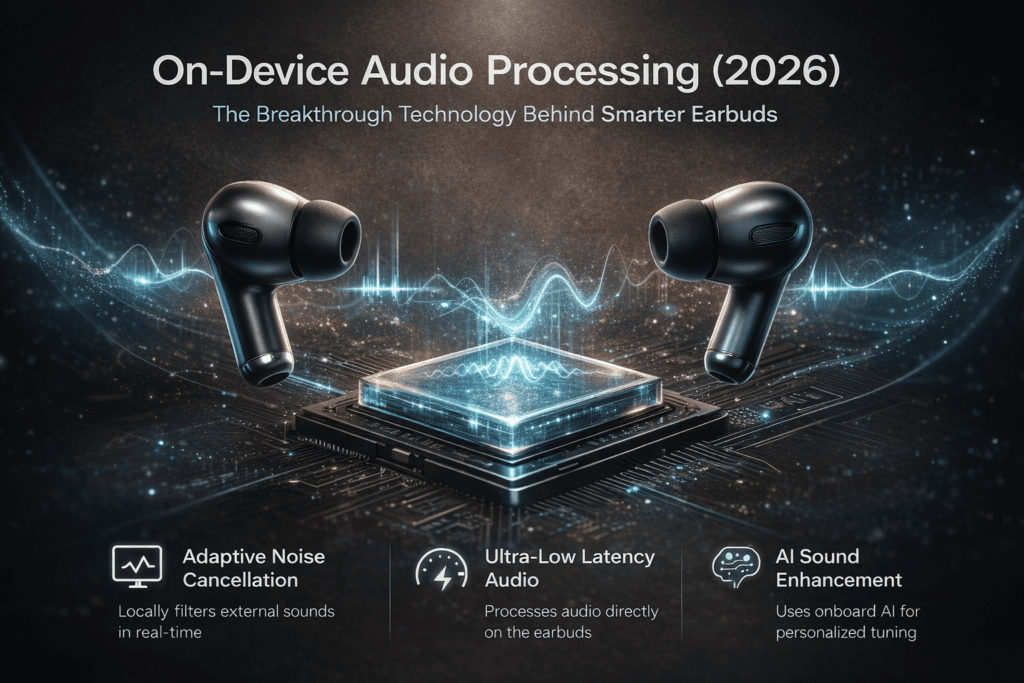
On-Device Audio Processing (2026): The Breakthrough Technology Behind Smarter Earbuds
On-Device Audio Processing (2026): The Breakthrough Technology Behind Smarter Earbuds A commuter taps play on the subway. The train roars into the