
WH-1000XM7 ANC Improvements — The Real Problem Sony Must Fix
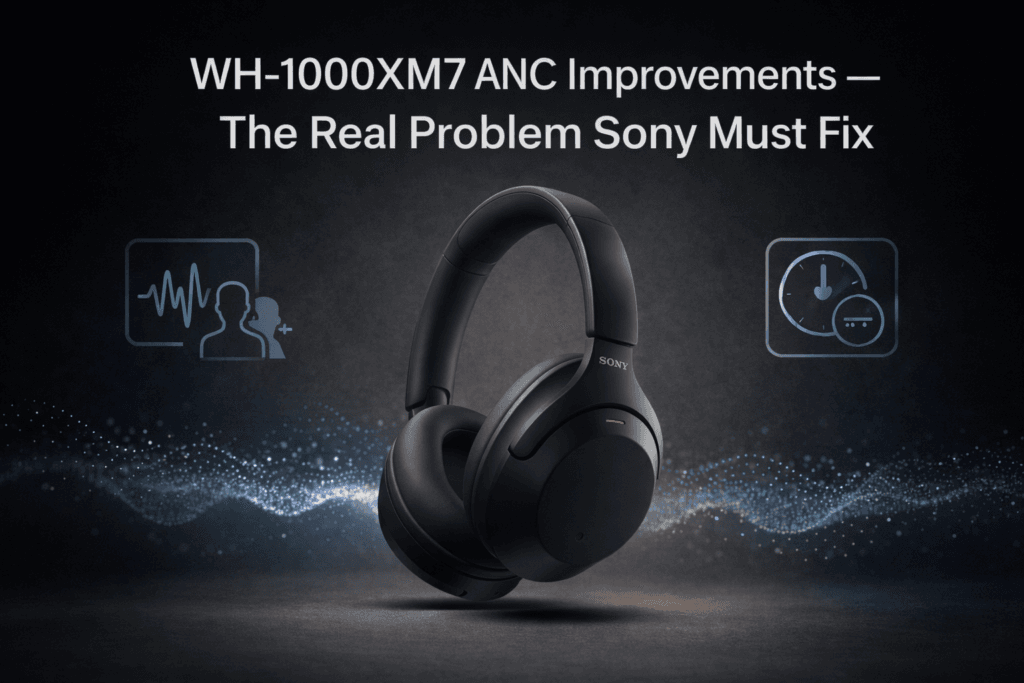
Every new generation of flagship noise-canceling headphones promises “better ANC,” yet recent upgrades across the category have often delivered incremental rather than transformative gains. The reason is simple: traditional active noise cancellation systems are already highly effective at eliminating predictable low-frequency sounds such as aircraft cabin hum or air-conditioning noise. The next stage of innovation must therefore address the situations where ANC still struggles—dynamic environments, voice interference, and comfort-related fatigue. This is where expectations surrounding WH-1000XM7 ANC improvements become particularly significant, signaling a shift from stronger cancellation to smarter cancellation.
The Remaining Weak Points in Modern Noise Cancellation
Even the best current-generation headphones show limitations when handling sudden environmental changes—passing vehicles, intermittent announcements, or fluctuating crowd noise. Conventional ANC algorithms operate by predicting and counteracting repeating sound patterns, which means unpredictable noise bursts often slip through partially filtered.
The next phase of WH-1000XM7 ANC improvements is expected to focus on adaptive environmental modeling rather than raw cancellation power. By increasing processing speed and sensor sampling precision, future ANC systems can respond faster to irregular noise signatures, allowing the headphones to adjust cancellation parameters in real time instead of relying primarily on pre-trained environmental profiles.
Why Processing Intelligence Matters More Than Microphone Count
Earlier marketing cycles emphasized the number of microphones integrated into headphone housings, suggesting that more microphones directly equated to stronger cancellation. In practice, microphone quantity alone offers diminishing returns without corresponding advances in signal processing intelligence.
The anticipated WH-1000XM7 ANC improvements are likely to center on more advanced neural noise-filtering models running on dedicated low-power processing chips. These systems can differentiate between environmental noise types—mechanical sounds, human voices, or wind turbulence—and apply targeted filtering strategies instead of uniform cancellation. The result is not only quieter backgrounds but also more natural audio playback, since excessive blanket cancellation sometimes alters tonal balance or creates pressure-like sensations for listeners.
Comfort Fatigue: The Hidden ANC Problem
Strong ANC performance sometimes introduces subtle discomfort during extended listening sessions, often described as ear pressure or spatial disorientation. This sensation is not purely psychological; it can occur when aggressive low-frequency cancellation interacts with ear-cup sealing characteristics.
A key area of WH-1000XM7 ANC improvements may involve dynamic pressure-balancing algorithms that maintain effective noise suppression while adjusting cancellation intensity according to ear-cup seal variations and environmental conditions. Instead of maintaining constant maximum cancellation, the system can continuously optimize the balance between comfort and suppression, reducing long-session fatigue without sacrificing effectiveness.
Real-World Listening Scenarios That Could Benefit Most
While travelers remain the most visible audience for ANC headphones, hybrid work and urban commuting environments now represent equally important use cases. Offices with intermittent conversations, cafés with layered background chatter, and public transit systems with varying acoustic profiles create complex soundscapes that traditional ANC was not originally designed to manage.
Future-focused WH-1000XM7 ANC improvements are expected to emphasize multi-layer sound classification—distinguishing persistent noise from conversational frequencies and dynamically adjusting how each is treated. This would allow users to maintain situational awareness when needed while still reducing disruptive environmental sounds, offering a more context-aware listening experience.
Battery Efficiency and ANC Consistency
Another challenge in earlier ANC systems has been the balance between processing power and battery consumption. More advanced cancellation algorithms typically require greater computational resources, which historically translated into reduced battery endurance. Advances in low-power AI processing hardware are gradually removing this trade-off.
Improved efficiency means WH-1000XM7 ANC improvements could deliver stronger adaptive noise cancellation while maintaining long playback durations. Instead of selecting between “maximum ANC” and “battery-saving” modes, users may experience consistently optimized cancellation throughout the listening cycle without noticeable runtime penalties.
The Competitive Landscape Is Raising Expectations
The premium ANC headphone segment has become increasingly competitive, with multiple manufacturers refining algorithmic cancellation rather than focusing solely on hardware changes. This competition is accelerating the shift toward context-aware ANC systems that learn from user environments over time, refining performance based on recurring listening conditions.
In this landscape, the next generation of Sony’s flagship lineup is expected to emphasize software intelligence as much as acoustic engineering. The companies that successfully combine adaptive processing, ergonomic comfort tuning, and efficient power management will define the next performance benchmark for the entire category.
Where the Real Upgrade Will Be Felt
Consumers often expect new headphone generations to deliver dramatic specification jumps, yet the most meaningful WH-1000XM7 ANC improvements will likely appear in subtle daily-use scenarios—fewer moments where sudden noise interrupts immersion, reduced listening fatigue during long sessions, and smoother transitions between environments without manual mode switching. These refinements may not be immediately obvious in short demonstrations but become increasingly noticeable over extended real-world usage.
Adaptive Noise Control Becomes the Real Upgrade
The evolution of noise cancellation is moving away from the simple objective of blocking more sound and toward the more complex goal of managing sound intelligently. As processing systems become faster and more context-aware, ANC performance will increasingly feel adaptive rather than static, adjusting continuously to user environments without requiring manual intervention. The next generation of flagship headphones will likely be judged less by how aggressively they cancel noise and more by how seamlessly they maintain acoustic comfort across changing situations. If these expectations materialize, the coming wave of WH-1000XM7 ANC improvements could represent one of the most practical usability upgrades the category has seen in years.
Stay in the Vibetric Loop
- Follow our Instagram @vibetric_official for precision-driven audio technology coverage.
- Bookmark vibetric.com to keep track of next-generation headphone innovation.
- Watch for upcoming deep dives into evolving ANC engineering trends.
What’s your take on this?
At Vibetric, the comments go way beyond quick reactions — they’re where creators, innovators, and curious minds spark conversations that push tech’s future forward.
AI Audio Tuning in 2026: The Intelligent Shift Redefining Sound
AI Audio Tuning in 2026: The Intelligent Shift Redefining Sound The next major leap in audio isn’t louder drivers or wider frequency
Compact Earbuds Technology 2026 — The Powerful Shift Toward Smaller, Smarter Audio
Compact Earbuds Technology 2026 — The Powerful Shift Toward Smaller, Smarter Audio Minimalism in audio design used to mean compromise. Smaller shells