
Upcoming Laptops in 2025: The Next Wave of AI Power & ARM Innovation
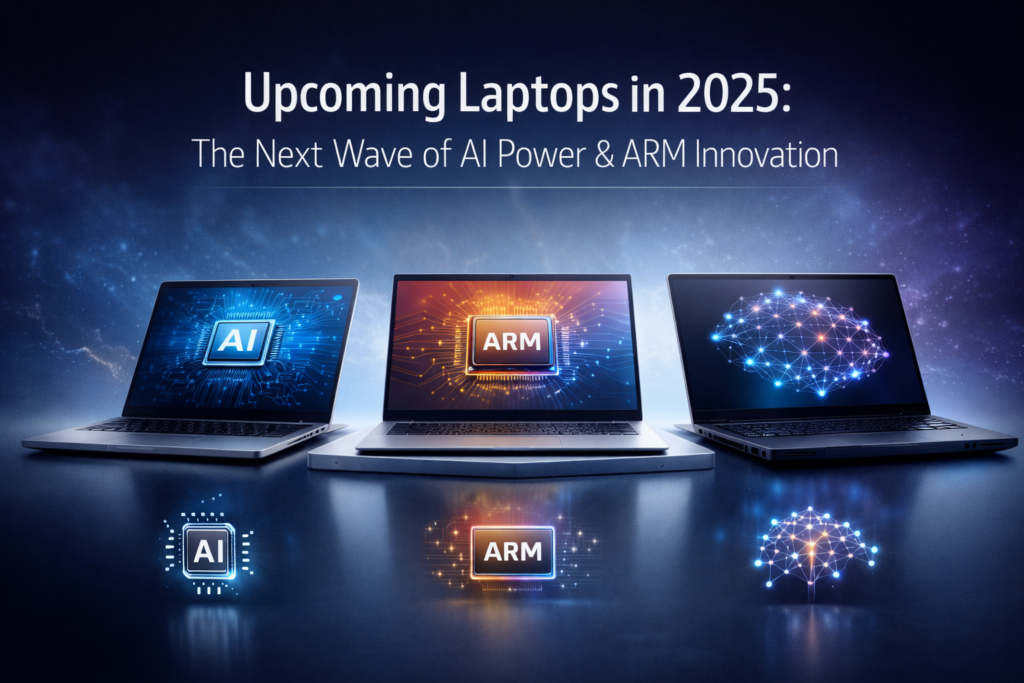
You’re scrolling through spec sheets again — wondering when a true leap in laptop performance finally arrives. The year-over-year bumps in CPU clocks and GPU shaders feel incremental. But everything changes when the architecture itself shifts: new silicon paradigms, on-device AI accelerators, and ARM designs promising laptop longevity. What does this mean for everyday work, creative workflows, and power users alike? The real transformation isn’t incremental — it’s foundational, and it’s already starting with the upcoming laptops of 2025.
The Quiet Revolution: Why 2025 Is Different for Laptops
For years, we’ve been conditioned to chase GHz and benchmarks. But beneath that surface lies a tectonic shift in how portable computing is engineered. In 2025, upcoming laptops aren’t just faster — they’re fundamentally smarter, more efficient, and architected for AI-first workloads.
Where once performance was synonymous with raw clock speed, today it’s measured in how well a machine anticipates tasks, manages power, and accelerates emergent workflows like real-time content generation, neural inference, and multimodal applications.
Beyond the Spec Sheet: What “Upcoming Laptops” Really Represents
Misconceptions — What People Assume About Next-Gen Laptops
A common belief is that laptop progress is linear: more cores, higher clocks, better battery life. But upcoming laptops in 2025 are non-linear — meaning the improvements are systemic, not incremental.
- CPU clocks matter less than AI throughput.
- Discrete GPUs aren’t always the performance bottleneck.
- Battery longevity is derived from silicon synergy, not just mAh.
Consumers still equate MHz with power, but modern workloads — especially AI — leverage specialized accelerators. That makes traditional benchmarks less predictive of real-world performance.
Technical Reality — The Triad Shaping 2025 Laptops
There are three forces reshaping portable computing:
- AI Chips Integrated at the Silicon Level
New processors (both Intel and AMD) embed AI accelerators — dedicated matrix engines and neural cores purpose-built for inference. These aren’t optional add-ons; they’re central to how power management, security, and creative workflows function.
Traditional CPUs were designed for serial logic. AI engines are designed for matrix math, the backbone of deep learning. So when an upcoming laptop executes a generative AI prompt locally (without cloud latency), it’s because these accelerators are doing thousands of operations in parallel — far beyond what general-purpose cores can achieve.
- ARM’s Growing Influence
ARM laptops — historically niche due to software compatibility — are now mainstream contenders. Apple’s transition to custom ARM silicon (M-series) forced the industry to pay attention. Other manufacturers are following with hybrid designs, where efficiency cores handle background tasks and high-performance cores awaken when demanded.
That means:
- Longer battery life in thin designs
- Lower thermal ceilings without throttling
- More predictable performance per watt
- Software Optimization as a First-Class Citizen
Hardware without software adaptation is like a sports car without roads. Microsoft’s evolving Windows support for ARM and AI workloads, plus native optimization in key creative suites, means that upcoming laptops will feel faster not just benchmarked faster.
What Brands Are Betting On in 2025
| Brand / Platform | Strategic Focus | AI Integration | Expected Strength |
|---|---|---|---|
| Apple (ARM) | Custom silicon + Neural engines | Very high | Efficiency + AI creativity |
| Intel (x86 + AI accelerators) | Heterogeneous cores + vPro AI | High | Versatility + broad software support |
| AMD (x86 + XDNA AI) | AI cores + optimized graphics | Mid-High | Balanced power + AI |
| Microsoft (Surface) | ARM + Windows on ARM | Mid | Design + ecosystem |
| Others (Qualcomm, Lenovo, Samsung) | Snapdragon/Custom SoCs | Varies | Mobile-first efficiency |
That diversity means 2025’s upcoming laptops will feel different depending on your workflows — not just faster.
Where the Market Is Headed — Strategic Positioning
Why Brands Are Pushing Hard on AI
Not because AI is a buzzword, but because modern applications are architected around neural models:
- Real-time translation and transcription
- On-device generative multimedia
- Intelligent resource allocation
- Context-aware power scaling
These aren’t fringe use cases — they’re becoming baseline expectations, especially in productivity, content creation, and communication.
Why ARM Matters Now
ARM’s ability to deliver high performance at low power is no longer theoretical. Apple proved that laptops can deliver sustained performance without fans or power spikes. Others are following suit, which will diversify the laptop ecosystem for the first time in over a decade.
Spotlight on 2025’s Most Promising Upcoming Laptops
Scenario 1: The Creative Professional
A hybrid ARM/x86 machine with on-device AI acceleration will deliver:
- Faster local rendering and preview
- Real-time generative content assistance
- Longer battery life during editing sessions
Scenario 2: The Remote Worker
Battery endurance + intelligent task scheduling means less focus on charging and more on flow state.
Scenario 3: The Gamer on the Go
Next-gen discrete GPUs will still matter, but AI offloading will redefine texture scaling, NPC behavior, and physics offload — improving perceived performance without spiking power draw.
Quick Snapshot: Expected 2025 Laptops (Hypothetical)
| Model (Tentative) | Platform | Core Focus | Best For |
|---|---|---|---|
| Apple Pro 15 (2025) | ARM | Neural + graphics | Creators & pros |
| Intel Evo Ultra 16 | x86 + AI | Balanced AI + classic workloads | Multitaskers |
| AMD AI-X Laptop | x86 + XDNA | AI + GPU | Gaming + creation |
| Surface Neo Pro | ARM | Efficiency + versatility | Mobile professionals |
| Snapdragon Ultra | ARM | Connectivity + battery | Travelers |
Patterns Defining the Upcoming Laptop Generation
AI Everywhere, Not Just in Marketing
On-device AI accelerators will handle:
- Background efficiency optimizations
- Predictive task loading
- Security and privacy enforcement
- Feature-rich user experiences without cloud latency
This approach flips the classic tradeoff: performance vs privacy.
Battery Life Isn’t About mAh
Battery endurance will be driven by system synergy — how silicon, OS, and apps distribute workloads across cores and accelerators.
Thermals Are Invisible to Users
AI-driven thermal prediction will smooth fan curves and reduce throttling, so laptops feel consistently fast rather than peaky.
Human Impact — What Users Will Actually Notice
Creatives & Professionals
Expect less waiting:
- Faster file indexing
- Real-time previews
- AI-assisted editing tools that don’t require cloud uploads
The difference isn’t incremental — it’s perceptual.
Remote Workers
Tasks that once required cloud services will be local:
- Smarter summaries of meetings
- Live captions without network lag
- Adaptive battery savings based on user patterns
Students & Everyday Users
Longer battery life + smarter task switching means:
- Less anxiety over charging
- Apps that adapt to usage patterns
- Portable creativity at lower cost thresholds
Buyer Guide — Choosing Among 2025’s Upcoming Laptops
Pros & Cons of Major Architectures
| Architecture | Pros | Cons |
|---|---|---|
| ARM (Custom) | Exceptional battery + AI | Some software compatibility gaps |
| x86 + AI | Broad app support | Traditional power draw |
| Hybrid (ARM/x86) | Best of both worlds | Early transition complexity |
| AI-specialized | Superior inference performance | Niche optimization needs |
Counter-Perspective — Not All Users Need AI Silicon Yet
There’s a narrative that everyone must have the latest AI silicon. That’s not true — essential productivity (email, docs, spreadsheets) won’t break on older hardware. If your usage is traditional office work, stable performance matters more than bleeding-edge features.
For many users, the value ceiling of upcoming laptops might arrive later in 2026–27 when software ecosystems fully adopt AI capabilities.
Reddit/User Reality: How Are People Reacting to Upcoming Audio Trends?
On platforms like Reddit, discussions around the future of audio technology have been lively. While some users are excited about the innovations, others are skeptical about the complexities involved in such adaptive systems.
| User Type | Feedback Summary | Relevance |
|---|---|---|
| Creators | Excited about on-device AI | High |
| Gamers | Curious but cautious | Mid |
| Students | Want longer battery life | High |
| Professionals | Prioritize compatibility | High |
| Enthusiasts | Focus on cutting-edge specs | Mid |
| Remote Workers | Appreciate efficiency gains | High |
Across discussions, the excitement centers on what real tasks AI silicon can speed up, not just benchmarks. Skepticism exists where apps aren’t yet optimized — a transitional gap rather than a terminal flaw.
Future Forecast — Where Laptops Go After 2025
Models Will Optimize Around Workload Specificity
Instead of broad horsepower tiers, laptops will be tuned for:
- AI Creatives
- Hybrid Workflows
- Mobile Productivity
- Gaming with Intelligence Offload
Software Ecosystems Will Catch Up
App developers will increasingly adopt native AI APIs, reducing reliance on cloud services and unlocking local acceleration.
Battery Life Will Be Redefined
Not by capacity, but by workload forecasting and AI task distribution across heterogeneous cores.
Thermals Will Become Dynamic Shields
Real-time heat prediction algorithms will reduce fan use and extend component lifespan.
Closing Narrative — A New Benchmark of Experience
When we look back at laptops from 2020 vs those in 2025, it won’t be about MHz or shader count. It’ll be about responsiveness, adaptability, and how soon a machine fades into the background of your workflow. That’s the promise of the upcoming laptops of 2025: not simply more power, but more intelligence, more efficiency, and more presence in every task you care about.
Vibetric Ending
In an era where context matters more than raw numbers, the real performance leap is measured in how technology understands you — not just how fast it computes.
Curious About the Future of Upcoming Laptops?
- Follow vibetric_official on Instagram to keep up with the latest trends and insights into next-gen computing.
- Bookmark Vibetric.com we continuously update our analysis as new developments emerge in laptops and silicon evolution.
Subscribe for updates and receive ongoing, in-depth breakdowns and expert opinions on the evolving laptop landscape.
FAQ — Upcoming Laptops in 2025
- What makes the upcoming laptops in 2025 different?
They integrate AI accelerators, leverage ARM efficiency, and redefine performance metrics beyond traditional specs. - Will traditional benchmarks still matter?
Partially — but AI throughput and task responsiveness will matter more for real-world workflows. - Are ARM laptops compatible with all apps?
Compatibility has improved, especially with native ARM support in major suites, but some legacy software may still lag. - Do upcoming laptops mean shorter battery life?
No — efficiency cores and AI power management aim to extend real-world battery endurance. - Should everyday users upgrade now?
If your workflows are traditional, not necessarily; but if you use AI tools locally, the value is higher. - Will AI silicon replace discrete GPUs?
Not fully — GPUs remain important for graphics-intensive tasks, but AI engines will offload complementary workloads. - What should students prioritize?
Battery life, ecosystem support, and build quality over bleeding-edge silicon unless AI workflows are critical. - How will software evolve with AI laptops?
More native acceleration, reduced cloud dependency, and real-time intelligent features across productivity and creativity apps.
What’s your take on this?
At Vibetric, the comments go way beyond quick reactions — they’re where creators, innovators, and curious minds spark conversations that push tech’s future forward.
Spatial Audio Default in 2026: The Quiet Shift Redefining Immersive Sound
Spatial Audio Default in 2026: The Quiet Shift Redefining Immersive Sound There was a time when surround sound required a living room
Fanless Laptops 2026 — The Powerful Rise of Silent Performance
Fanless Laptops 2026 — The Powerful Rise of Silent Performance For decades, laptop performance and cooling were inseparable. Faster processors generated more