
The 2025 UltraBook Review — Are Thin-and-Light Laptops Finally Powerful Enough?
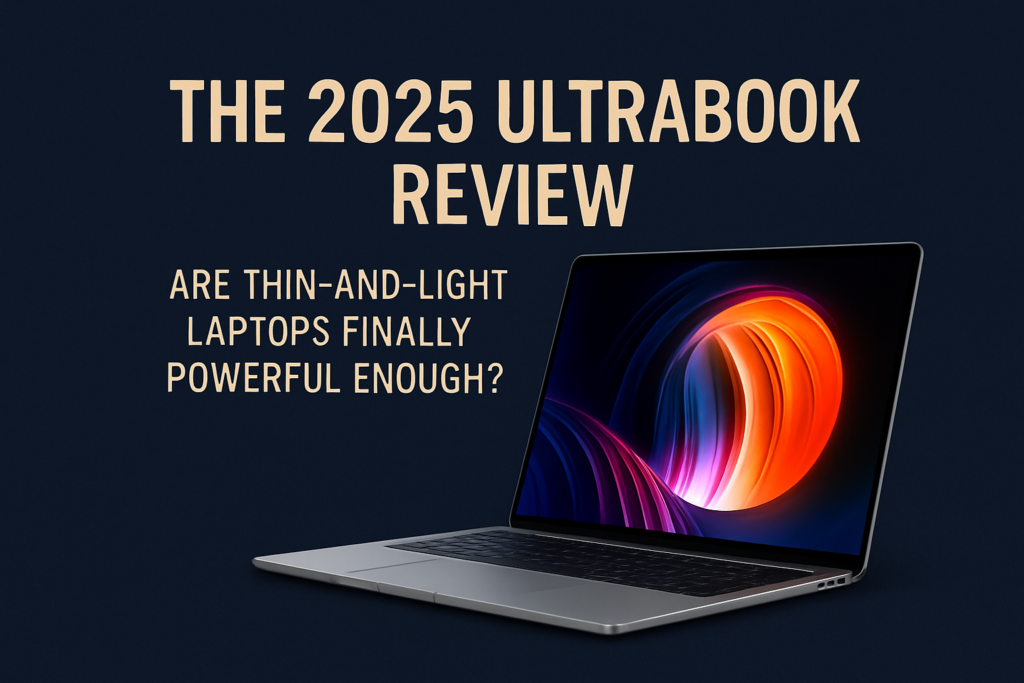
For years, ultrabooks have walked the tightrope between portability and power. In 2025, as we’re greeted with next-gen models boasting improved processors, stunning displays, and enhanced battery life, the question remains: Are these thin-and-light laptops finally powerful enough to meet the demands of power users? With slim designs still dominating the market, is it possible to get true performance without sacrificing form? Let’s dig deeper into the ultrabook evolution and see if the premium price is truly justified.
The Search for the Perfect Balance
It’s 2025, and you’ve just picked up the latest ultrabook, sleek, feather-light, and built with all the futuristic charm you’d expect—an Intel Core Ultra chip, an OLED screen, and ultra-long battery life. But as you fire it up, there’s an undercurrent of skepticism. Is it really going to handle everything I throw at it? After all, ultrabooks have always made compromises in the pursuit of portability. They excel in everyday tasks like web browsing and media consumption, but when it comes to heavy workloads—like video editing, software development, or gaming—their performance often falls short.
That was true in the past. But in 2025, brands are promising breakthroughs: “Now, ultrabooks can do it all!” But can they? Let’s explore the state of ultrabooks and whether they’ve truly evolved into the powerhouse laptops we’ve been waiting for.
The New Ultrabook Standard — More Than Just a Pretty Face
For years, ultrabooks have been defined by their slim profile and lightweight nature, but at the cost of high-end performance. In 2025, manufacturers have started addressing this imbalance. Equipped with the latest Intel Core Ultra processors, integrated GPUs, and more powerful cooling solutions, these ultrabooks are entering new territory. But is all this enough to rival traditional laptops that have always been the go-to for performance-heavy tasks?
Let’s dive deeper into the most notable ultrabooks of 2025 to see whether this is finally the moment when thin-and-light laptops break free from their performance limitations.
Deep-Dive Explanation
Misconceptions: What We’ve Been Led to Believe About Ultrabooks
For the longest time, ultrabooks were regarded as “lightweight” alternatives for users who didn’t require heavy-duty performance. Their charm lay in their portability, but that also meant compromises—slower processors, less powerful GPUs, and less expansive cooling systems. In other words, they were designed to be good at the basics, but not much more.
However, many people assumed that the ultrabook category was limited to this narrow band of use cases. But with the 2025 releases, ultrabooks are starting to blur the lines between lightweight portability and full-on performance. With hardware innovations like Intel’s 13th-gen Core Ultra chips and Apple’s M3 Pro, ultrabooks are now delivering higher clock speeds, more cores, and increased efficiency without the bulk of traditional laptops.
Technical Reality: The Power Behind 2025 Ultrabooks
To understand the true evolution of ultrabooks, we need to look at the hardware improvements. The most notable change has been in the processor. Intel’s 13th-gen Core Ultra series and Apple’s M3 Pro chips have redefined what ultrabooks can do. These chips are capable of handling more demanding tasks, like video rendering and 3D modeling, while maintaining exceptional battery life.
Another key improvement is the integration of more powerful integrated GPUs. The Intel Iris Xe and Apple’s integrated GPU are now capable of supporting light gaming, creative workloads, and even some professional-grade applications. This marks a shift from the past, where ultrabooks could barely run graphics-heavy programs without significant performance throttling.
Thermal management has also seen huge improvements. With more advanced cooling solutions, ultrabooks now sustain peak performance without overheating, even during long sessions of multitasking or heavy workloads. The downside, however, is that these systems still lack the true dedicated GPUs found in more traditional laptops, meaning that for ultra-demanding tasks like 4K video editing or AAA gaming, they still fall short.
Industry Behavior: The Ultrabook Race to Performance
Manufacturers have been scrambling to address the ultrabook “performance gap,” and the 2025 models reflect a broader trend of industry-wide innovation. While ultrabooks used to be seen as “luxury” options for professionals and casual users, now they’re becoming mainstream for people who want a balance of portability, performance, and battery life.
But there’s a catch. In the pursuit of ultra-thin designs, some compromises still exist. For example, many ultrabooks sacrifice ports (USB-A, HDMI) or have smaller battery capacities compared to their bulkier counterparts. While Apple’s MacBook Air M3 Pro and Dell’s XPS 13 continue to make headway in delivering performance within a thin chassis, not all users will appreciate the trade-offs made in favor of a thinner profile. This dynamic suggests that the race for the “perfect ultrabook” is still ongoing, with different brands vying for a combination of performance, style, and practicality.
Future Trajectory: What’s Next for Ultrabooks?
Looking ahead, ultrabooks are likely to continue evolving in response to growing demand for hybrid devices—products that combine portability with performance. The next-generation ultrabooks could include more powerful integrated GPUs, even better cooling mechanisms, and faster processors that better handle tasks like gaming and heavy editing. By 2027, we may even see ultrabooks that can seamlessly handle workflows currently reserved for gaming laptops or desktop workstations, all while maintaining their slim, elegant design.
Another major trend will be in battery life. As processors become more energy-efficient and display technologies improve, future ultrabooks will likely offer even more extended use time, possibly reaching 20–30 hours of real-world use. This will make them a genuine alternative to traditional laptops for road warriors and content creators who need reliable performance without the bulk.
Real-World Examples: Are 2025 Ultrabooks Ready for Power Users?
Example 1: MacBook Air M3 Pro vs. MacBook Pro 14-inch
The MacBook Air with the M3 Pro chip has now entered the realm of high-performance ultrabooks, handling tasks that once required the MacBook Pro’s heavy-duty hardware. While the MacBook Pro 14-inch still outperforms in graphics-intensive applications like 3D modeling and gaming, the MacBook Air now offers enough horsepower for video editing, coding, and multitasking.
Example 2: Dell XPS 13 vs. Dell XPS 15
The Dell XPS 13 ultrabook with the 13th-gen Intel Core Ultra i7 and integrated Intel Iris Xe GPU is more than capable of handling creative workloads like Photoshop, video editing, and light gaming. However, the XPS 15 still reigns supreme for users who need dedicated graphics and a larger screen for detailed work like 4K rendering and gaming.
Quick Snapshot Table:
| Product | Key Feature | Price Range | Performance Level | Best For |
|---|---|---|---|---|
| MacBook Air M3 Pro | Ultra-thin with M3 Pro chip | $1,399 | Great | Professionals, Creators |
| Dell XPS 13 | Compact power with Core Ultra | $1,399–$1,699 | Very Good | Road Warriors, Creators |
| MacBook Pro 14-inch | Powerful with dedicated GPU | $1,999–$2,399 | Excellent | Heavy Multitaskers |
| Dell XPS 15 | Larger display, GTX GPU | $1,999–$2,599 | Excellent | Creators, Power Users |
Data-Backed Insight: Performance Gains and User Demands
Looking at trends, the shift in ultrabooks’ capabilities can be attributed to key advances in CPU and GPU technologies. Intel’s shift to the 13th-gen Core Ultra series has increased performance by up to 30% compared to previous generations, while maintaining power efficiency. Apple’s M3 Pro chip, with its advanced neural engine, has taken ultrabook performance to new heights, allowing for professional-level tasks on a lightweight device.
However, for users engaged in tasks like 3D rendering or gaming, dedicated GPUs remain the gold standard, which ultrabooks, despite their advancements, still lack.
Human Impact: The Shift in How We Work and Play
For years, ultrabooks were the go-to choice for professionals who prioritized portability but were willing to sacrifice power. But in 2025, many ultrabooks have evolved into versatile machines that can handle most of the heavy lifting. Whether you’re a creative working on multimedia projects or a developer juggling multiple environments, today’s ultrabooks offer a much more fulfilling experience without the need to carry a clunky, full-size laptop.
However, the limitations still impact power users. Gamers and heavy-duty professionals (e.g., those working with 3D modeling or video rendering) will continue to need beefier laptops for the most intensive tasks, though ultrabooks are fast approaching the point where they can serve as all-in-one solutions for many people.
Solution Framework: Should You Buy a 2025 Ultrabook?
- Everyday Users: If you’re a casual user who wants a laptop that can do it all—surf the web, run office apps, and handle streaming—2025 ultrabooks will suit you just fine.
- Creators/Professionals: For those in creative fields or tech roles that require moderate to heavy multitasking, ultrabooks like the MacBook Air M3 Pro and Dell XPS 13 are a great balance of performance and portability.
- Gamers/Enthusiasts: While ultrabooks have made strides, serious gamers will still need a gaming laptop for smooth 1080p or 1440p gaming with high frame rates.
- Future-Proof Buyers: If you’re looking for a laptop that balances portability and future-proof performance, consider investing in the latest ultrabooks with Core Ultra or Apple M3 chips, as they will continue to offer great value for several years.
Counter-Perspective: When Should You Skip the Ultrabook?
If your work requires dedicated GPU performance or you need a large display for detailed editing tasks, ultrabooks may not be enough. For example, professionals in 4K video production, high-end 3D modeling, or those who game at a competitive level will still need a laptop with a dedicated GPU and a higher processing power threshold, which ultrabooks cannot provide.
Reddit / User Reality Section
Across Reddit, discussions around ultrabooks in 2025 highlight that while these laptops have evolved, users still note that performance limitations are apparent when pushing them to their limits.
User Feedback Table:
| User Type | Feedback Summary | Relevance |
|---|---|---|
| Professional Creator | "The Air M3 Pro handles my video editing fine, but I still miss the dedicated GPU for rendering." | High |
| Casual User | "Perfect for everyday tasks. Battery life is a dream!" | Medium |
| Developer | "Multitasking is a breeze on the XPS 13, but I wish it had more ports." | High |
Future Forecast: The Road Ahead for Ultrabooks
As ultrabooks continue to close the performance gap, we’ll likely see more breakthroughs in processor technology, integrated GPUs, and battery efficiency. In the coming years, ultrabooks may even be able to rival the performance of heavier laptops in terms of raw power.
Expect more innovations in hybrid displays, longer battery life, and seamless AI-assisted optimizations. However, the ultrabook’s core appeal—its balance between portability and power—will remain its biggest selling point.
Closing Narrative: The Future of ANC Earbuds
As we wrap up this review, it’s clear that ultrabooks in 2025 have come a long way. They’re not quite ready to replace every laptop—especially for power users—but for most consumers, they represent the ideal fusion of performance and portability. The question now isn’t if ultrabooks are powerful enough, but how far can they go?
Vibetric Ending
The 2025 ultrabook lineup signals a bright future where power and portability are no longer mutually exclusive. Still, for the most demanding tasks, the ultrabook may only be a stepping stone to something more powerful—but it’s a worthy step.
Ready for the Next Big Leap in Ultrabooks?
- Follow vibetric_official on Instagram for more cutting-edge reviews and tech insights.
- Bookmark Vibetric.com for the latest updates on ultrabooks and all things tech.
- Stay tuned for our in-depth comparison of the top ultrabooks of 2025!
Frequently Asked Questions About 2025 Ultrabooks
- Can an ultrabook handle video editing?
With the latest Intel Core Ultra and Apple M3 Pro chips, 2025 ultrabooks can handle video editing fairly well for most users. However, for heavy-duty tasks, a laptop with a dedicated GPU will still outperform ultrabooks. - Do ultrabooks have a dedicated graphics card?
Most ultrabooks in 2025 rely on integrated GPUs, which are adequate for light gaming and creative tasks, but if you need the best performance for 3D rendering or gaming, a dedicated GPU is still necessary. - Are ultrabooks good for gaming?
Ultrabooks can handle light gaming, but they lack the dedicated GPUs necessary for a smooth, high-quality gaming experience. - How long does the battery last on a 2025 ultrabook?
Battery life on 2025 ultrabooks can last between 12 to 20 hours depending on the model, with power-saving features significantly improving longevity. - What’s the best ultrabook for creators?
The MacBook Air M3 Pro and Dell XPS 13 are both excellent choices for creators who need a balance of power and portability, but the MacBook Pro 14-inch is still a better option for heavy multimedia work. - Are ultrabooks future-proof?
Ultrabooks with 13th-gen Intel Core Ultra or Apple M3 Pro chips will be reliable for years to come, as they’re optimized for power and energy efficiency, but dedicated graphics may still be needed for intensive tasks. - What’s the difference between ultrabooks and traditional laptops?
Ultrabooks are designed to be lightweight and thin, sacrificing some ports and raw power for portability. Traditional laptops, while bulkier, tend to offer more robust performance and better thermal management. - Can I upgrade an ultrabook?
Most ultrabooks have limited upgradability. While some allow RAM upgrades, many have soldered memory and storage, meaning you’re stuck with the configuration you buy.
What’s your take on this?
At Vibetric, the comments go way beyond quick reactions — they’re where creators, innovators, and curious minds spark conversations that push tech’s future forward.
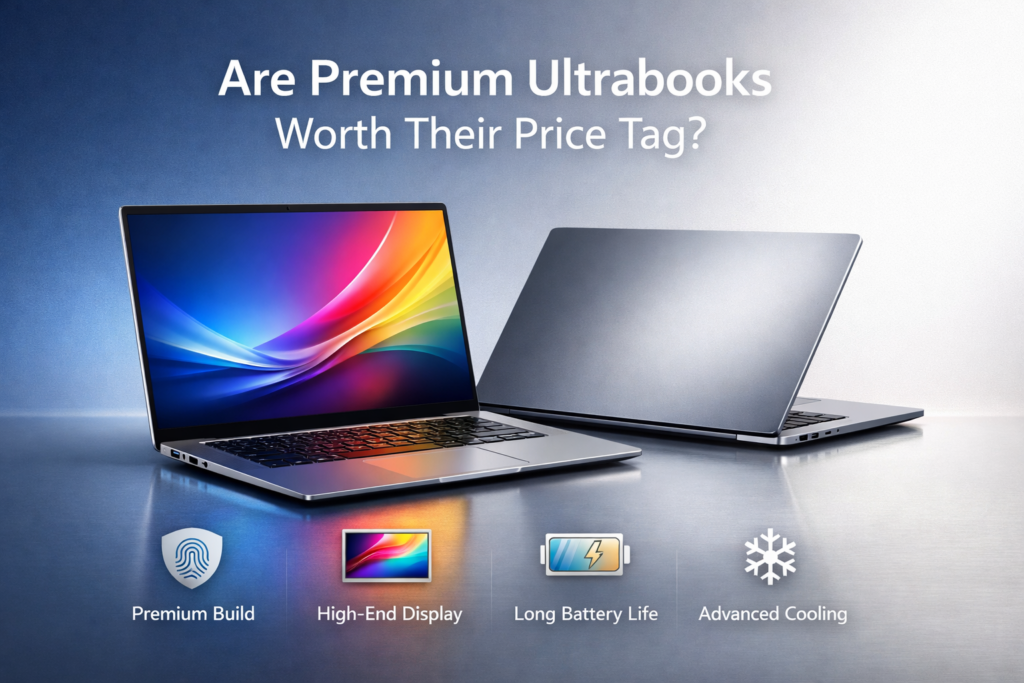
Are Premium Ultrabooks Worth Their Price Tag?
Are Premium Ultrabooks Worth Their Price Tag? In 2025, the laptop market is crowded with capable machines at every price point, yet

Are Phones Actually Getting Faster in 2025?
Are Phones Actually Getting Faster in 2025? Every year, smartphone makers announce new processors, higher RAM, and faster storage. But if you’ve