
The Hidden Cost of Ultra-Thin Laptop Trade-Offs: Why Thinner Isn’t Always Better
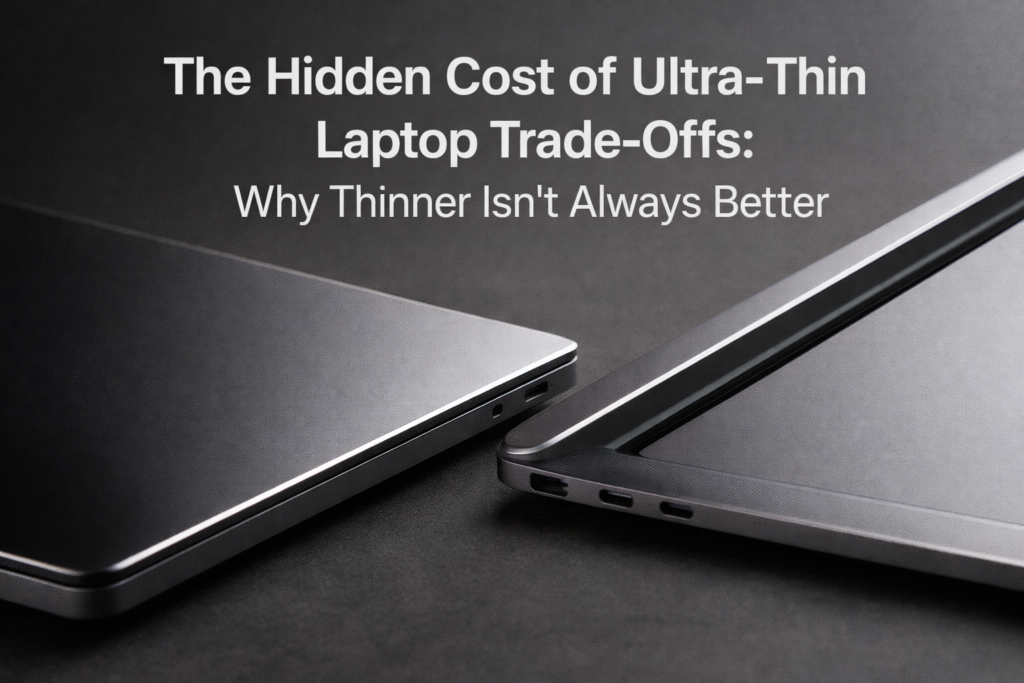
Ultra-thin laptops sell a promise that feels modern and inevitable. Less weight, cleaner lines, quieter presence on a desk. They photograph well, travel easily, and signal progress in a way thicker machines no longer do. Yet beneath that visual refinement, the trade-offs have grown sharper—and more structural—than most buyers realize. The conversation around ultra-thin laptop trade-offs is no longer about personal preference. It’s about engineering limits quietly reshaping ownership itself.
Thinness Changed the Buying Psychology Before It Changed the Hardware
Slim laptops didn’t win on performance; they won on perception. Over time, thinness became shorthand for advancement, even when actual gains slowed. Consumers learned to associate bulk with inefficiency, regardless of what was happening under the chassis.
This shift altered expectations in subtle ways. Buyers began tolerating sealed designs, fewer ports, and reduced upgrade paths because the external experience felt premium. The industry noticed. Once thinness became a default desire, compromises stopped being framed as compromises—they were rebranded as design intent.
That psychological shift matters, because it normalized decisions that would have felt unacceptable a decade earlier.
Repairability Wasn’t Lost by Accident
Ultra-thin laptop trade-offs become most visible when something breaks. Soldered memory, proprietary batteries, glued components, and layered internal assemblies aren’t just cost-saving measures—they’re spatial necessities.
When thickness margins shrink to millimeters, modularity disappears first. Removable RAM slots, accessible cooling systems, and standardized connectors all demand vertical space. Remove that space, and repairability becomes an obstacle, not a goal.
The result is a quiet inversion of ownership. Many ultra-thin laptops are effectively appliances: reliable when new, uneconomical when damaged, and difficult to extend beyond their original configuration. Longevity becomes dependent not on build quality alone, but on whether the device ever needs intervention.
Where Thermals Quietly Redefine Performance
Thin laptops don’t overheat because engineers don’t understand cooling. They overheat because physics doesn’t negotiate.
Smaller heat pipes, lower-profile fans, and reduced airflow volume force modern ultra-thin designs into tighter thermal budgets. Performance is still high—briefly. Sustained workloads tell a different story.
Thermal throttling isn’t a flaw; it’s a survival mechanism. CPUs and GPUs in thin laptops are tuned to spike fast, then retreat before heat saturates the chassis. For everyday tasks, this feels fine. For prolonged creative, analytical, or gaming workloads, it creates inconsistency rather than outright slowness.
This is where ultra-thin laptop trade-offs stop being abstract. You’re not buying less power—you’re buying power that behaves differently over time.
A Practical Snapshot of the Trade-Offs
| Design Priority | Immediate Benefit | Long-Term Cost |
|---|---|---|
| Ultra-thin chassis | Portability, aesthetics | Limited cooling headroom |
| Soldered components | Compact layout | No upgrades, harder repairs |
| Smaller batteries | Lighter weight | Faster capacity degradation |
| Minimal airflow | Silent operation | Thermal throttling |
Placed here intentionally, this snapshot reframes thinness not as a flaw, but as a series of calculated exchanges—each with consequences that compound over years, not months.
Lifespan Is Now a Thermal Story
Battery health, component wear, and internal adhesives all age faster in consistently warm environments. Ultra-thin laptops operate closer to their thermal ceilings by design, which accelerates that aging process.
Even when performance feels acceptable, internal stress accumulates. Fans run harder, batteries cycle more aggressively, and materials experience more thermal expansion and contraction. None of this causes immediate failure—but it shortens the comfortable middle of a laptop’s life.
This is why two laptops with similar specs can feel dramatically different after three years. Thickness quietly buys thermal forgiveness, and forgiveness buys time.
The Industry’s Unspoken Trade Agreement
Manufacturers aren’t hiding these realities—they’re optimizing around market signals. Thin laptops sell better, ship cheaper, and align with shorter upgrade cycles. Repairability and lifespan, while valued in theory, don’t move units at the same scale.
This creates a feedback loop. As fewer consumers expect long-term serviceability, fewer designs prioritize it. Ultra-thin laptop trade-offs become normalized, then invisible.
Interestingly, some recent designs are subtly reversing course—not by getting thick again, but by reclaiming millimeters for better cooling or slightly modular layouts. It’s a quiet acknowledgment that the limit was reached.
Choosing Thin with Open Eyes
The problem isn’t ultra-thin laptops. It’s buying them under assumptions they were never built to satisfy.
If your usage is bursty, mobile, and time-limited, thinness works beautifully. If your work is sustained, upgrade-driven, or lifespan-focused, thickness is not inefficiency—it’s capacity. Understanding ultra-thin laptop trade-offs allows you to choose based on behavior, not branding.
Progress isn’t always subtraction. Sometimes it’s knowing what space is still worth keeping.
Stay Connected with Vibetric
- Follow our Instagram @vibetric_official for deeper design and engineering insights.
- Bookmark vibetric.com to track how tech decisions shape long-term ownership.
- Keep up with our analysis as form factors continue to evolve.
What’s your take on this?
At Vibetric, the comments go way beyond quick reactions — they’re where creators, innovators, and curious minds spark conversations that push tech’s future forward.
MacBook Pro M4 (2026): The Smart Efficiency Breakthrough in Modern Laptops
MacBook Pro M4 (2026): The Smart Efficiency Breakthrough in Modern Laptops There’s a moment every serious laptop user recognizes. The export bar
Performance Per Watt in 2026: The Critical Benchmark Redefining Computing
Performance Per Watt in 2026: The Critical Benchmark Redefining Computing For years, performance was measured in absolutes. Faster processors won. Higher benchmark