
Are Touchscreens on Laptops Still Worth It?
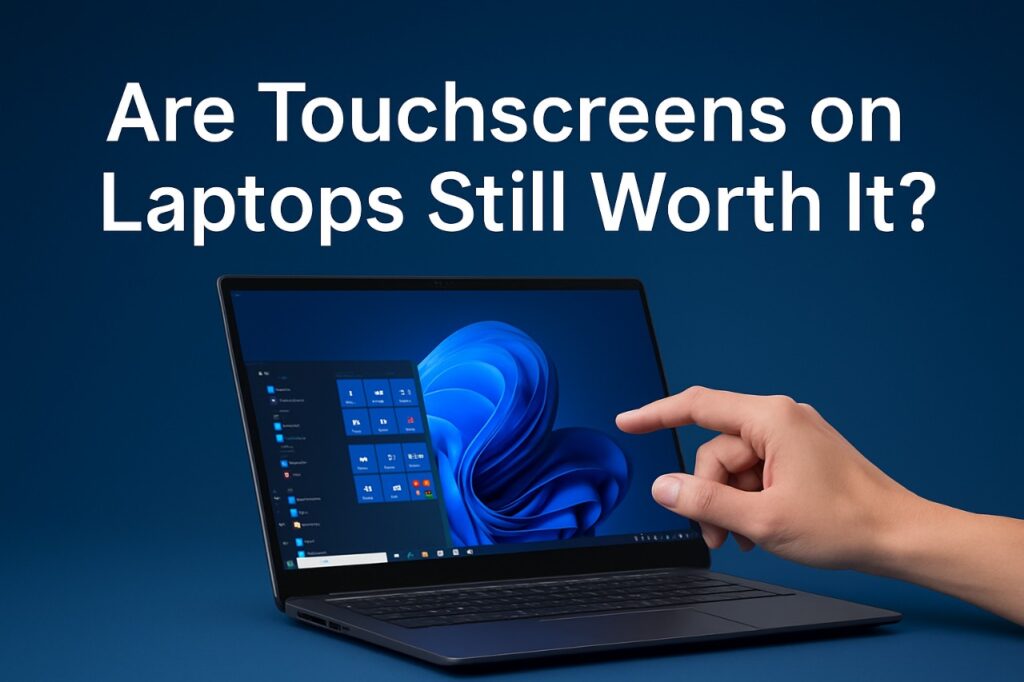
For years, touchscreen laptops felt like the future — fast, fluid, and intuitive. Tap to scroll, pinch to zoom, draw directly on the display. They promised to merge the convenience of a tablet with the productivity of a PC.
But in 2025, something changed.
Laptops evolved. Workflows shifted. AI stepped in.
And suddenly, a question resurfaced:
Are touchscreens on laptops still worth it today — or are they a leftover trend?
This blog breaks down the real value of touchscreens, the hidden drawbacks brands don’t talk about, and who should actually buy them in 2025.
⚙️ Core Insight (Depth + Clarity)
Touchscreens aren’t outdated — but their value has become narrow, specialised, and workflow-dependent.
Three forces define their relevance today
1. Interaction Freedom — But Only for Creative Tasks
When used right, touchscreens unlock natural, fluid control:
- sketching diagrams
- editing photos
- annotating PDFs
- signing documents
- navigating interfaces with simple finger swipes
This makes touchscreen laptops legitimately better for:
- students
- designers
- illustrators
- digital planners
- business users who annotate often
Touch adds a layer of control the trackpad can’t replicate.
But outside these use cases, the difference becomes surprisingly small
2. The Battery Tradeoff Laptops Can’t Escape
The part no brand highlights:
Touchscreens reduce battery life.
The digitizer layer, brighter glass, and touch sampling all consume extra power.
In most 2025 models, the difference is:
1–2 hours less battery life compared to the non-touch version.
With modern laptops boasting 15–20-hour claims, that’s not a small hit. If endurance matters, touch works against you.
3. Higher Cost With Uneven Value
Touchscreen laptops always cost more — usually ₹4,000–₹12,000 extra.
And here’s the uncomfortable industry truth:
Most people stop touching the screen after the first week.
The premium you pay is often for a feature that slowly fades out of your workflow — unless you specifically need it.
📊Bite-Sized Data Table
| Factor (2025) | Impact | Why It Matters |
|---|---|---|
| Battery life | High | Touch drains more power |
| Display type | Medium | Touch = glossy, reflective |
| Price | High | Touchscreen laptops cost more |
| Creative use | High | Better for drawing/annotation |
| Everyday use | Low | Minor real-world benefit |
| Durability | Medium | Touch panels are more fragile |
Chromebooks aren’t universal machines — they’re optimized tools for focused use.
🔍 Micro Analysis
1. The Everyday Reality Check
Touchscreens feel futuristic — until you start working.
For daily productivity:
- writing
- coding
- spreadsheets
- researching
- multitasking with windows
…the keyboard + trackpad remain faster, cleaner, and more ergonomic.
Touch becomes useful only when:
- you’re in tablet mode
- you’re reading long documents
- you’re annotating or highlighting
- you want a fast zoom or swipe
It’s not a disadvantage — but it’s not a universal advantage either.
2. The Unspoken Engineering Reality
Touchscreens require:
- a glass panel instead of matte
- a digitizer grid under the display
- extra manufacturing steps
- more fragile front materials
- thicker adhesive layers
This makes touchscreen laptops:
- heavier
- more reflective
- more fragile
- costlier to repair
These tradeoffs rarely appear in marketing materials — but they have real-world impact.
3. The Cultural Shift of 2025
Touch input now lives on phones and tablets — not laptops.
People use laptops differently:
- long typing sessions
- focused productivity
- AI-assisted workflows
- cloud-based editing
AI is accelerating this shift.
Tasks that once required touch — photo cleanup, PDF extraction, handwriting conversion — are now automated:
- voice commands
- predictive text
- AI summarisation
- auto-selection tools
The more AI grows, the less manual touch input matters.
Touchscreens aren’t less useful — the world around them has simply changed.
🌍 Culture Angle
Chromebooks represent a cultural preference emerging in 2025:
Minimal tech. Minimal noise. Minimal maintenance.
Users don’t want bulky Windows updates, thermal issues, or driver conflicts.
They want a clean digital life — email, docs, videos, learning, browsing.
Chromebooks fit the lifestyle of:
- students
- remote learners
- multi-device households
- people avoiding tech complexity
- users who want reliability over raw power
It’s not just a device — it’s a philosophy:
Do the basics extremely well, and don’t pretend to do everything.
🧠 Quick Vibetric Takeaway
- Touchscreens add value only for creative or annotation-heavy users.
- They drain more battery than non-touch variants.
- Glossy panels make outdoor and bright-room use harder.
- Touchscreen laptops cost more due to engineering complexity.
- Everyday productivity doesn’t benefit as much as expected.
- AI reduces the need for manual touch interactions.
- For pure efficiency, non-touch models win in 2025.
- Touchscreens are not obsolete — they’re special-purpose.
💬 Vibetric Verdict
Vibetric Verdict: Touchscreen laptops are absolutely worth it — but only if your workflow demands them.
For designers, illustrators, students, and annotators, touch elevates the experience, making creativity feel natural and direct.
But for writers, coders, business professionals, and battery-focused users, a touchscreen adds cost, glare, and power loss — without improving daily productivity.
In 2025, touchscreens are no longer “the future.”
They’re a tool, not a trend.
A feature with clear value — but even clearer limitations.
The laptops of the future won’t be defined by how you touch the screen…
but by how the system thinks, adapts, and automates your work.
🔗 Stay in the Loop
We don’t sell hype — we explain it.
- Follow @vibetric_official for grounded laptop insights, deep-tech breakdowns, and real-world testing.
- Bookmark vibetric.com to stay ahead of the tech curve.
- No hype. No bias. Just facts — the Vibetric way.
💬 What’s your take on this?
The comment section at Vibetric isn’t just for reactions — it’s where creators, thinkers, and curious minds exchange ideas that shape how we see tech’s future.
AI Intelligence Race in 2026: The Real Battle Beyond Speed
AI Intelligence Race in 2026: The Real Battle Beyond Speed For years, consumer technology sold us speed. Every keynote celebrated higher clock
Smartphone Stagnation 2026: The Hidden Shift Behind Slower Upgrade Cycles
Smartphone Stagnation 2026: The Hidden Shift Behind Slower Upgrade Cycles The review unit arrived on schedule, exactly as expected — sealed packaging,