
Spatial Audio Default in 2026: The Quiet Shift Redefining Immersive Sound
There was a time when surround sound required a living room full of speakers. Later, spatial audio became a marketing badge — a premium toggle reserved for flagship headphones and select streaming tiers.
That framing is dissolving.
The transition toward spatial audio default isn’t about luxury positioning anymore. It’s about baseline expectation. As hardware, content pipelines, and processing frameworks mature, immersive audio is quietly shifting from feature to foundation.
And once something becomes foundational, the industry behaves differently.
The Psychological Shift: From “Wow” to “Why Isn’t This Standard?”
Early demonstrations of spatial rendering were designed to impress. Sounds moved around the head. Voices appeared above or behind. The effect was theatrical.
But theatrical features don’t always scale.
What’s happening now is subtler. Spatial rendering is being embedded directly into operating systems and streaming platforms. Companies like Apple and Sony have integrated head tracking and 3D mixing frameworks into mainstream products rather than isolating them as elite options.
When immersive playback becomes consistent across devices, it stops being a novelty. Users begin to assume dimensionality the way they once assumed stereo.
The surprise factor fades. The expectation remains.
That is how defaults are born.
The Infrastructure Enabling the Shift
Spatial audio’s movement toward default status isn’t accidental. Several technical constraints that once limited adoption are weakening:
- Improved onboard processors handling real-time 3D rendering
- Lower-latency head tracking sensors
- Object-based audio formats replacing fixed channel mixing
- Streaming platforms optimizing bandwidth for immersive codecs
The ecosystem now supports consistent implementation. When encoding, decoding, and rendering pipelines align, spatial audio default becomes feasible at scale.
The transition looks like this:
| Earlier Model | Emerging Standard |
|---|---|
| Channel-based surround mixes | Object-based spatial mixes |
| Manual feature toggle | Automatic immersive rendering |
| Premium-tier exclusivity | Platform-wide integration |
| Static soundstage | Dynamic head-tracked positioning |
The more friction disappears, the more immersive playback becomes invisible — and therefore essential.
Why Platforms Are Incentivized to Normalize It
There’s a strategic logic behind making spatial audio default.
First, differentiation. If every competing device delivers similar stereo clarity, immersive rendering becomes a subtle but persistent edge.
Second, ecosystem lock-in. Spatial mixes optimized for one platform’s rendering engine often perform best within that ecosystem. Once listeners acclimate to dimensional sound, reverting to flat stereo can feel like a downgrade.
Third, future compatibility. As augmented and mixed reality devices expand, 3D audio becomes foundational rather than optional. Building that foundation early simplifies cross-device continuity.
Spatial audio default is less about current headphones and more about preparing for multi-device spatial computing environments.
A Necessary Reality Check
Despite progress, not all content benefits equally from immersive mixing.
Dialogue-driven podcasts may gain little from elaborate spatial staging. Poorly engineered spatial tracks can introduce phase issues or unnatural imaging. Over-processing can fatigue listeners rather than immerse them.
There’s also a philosophical tension. Some artists mix intentionally for stereo intimacy. Translating everything into a 3D field risks altering creative intent.
Making spatial audio default should not mean forcing it universally. Intelligent rendering must respect context.
Default does not have to mean mandatory.
The Role of AI in Refining the Experience
As immersive playback expands, static spatial rendering will not be enough. Context matters — head orientation, room acoustics, listening posture.
Companies like Samsung and Dolby Laboratories are refining object-based systems that adjust dynamically rather than relying on fixed virtualization presets.
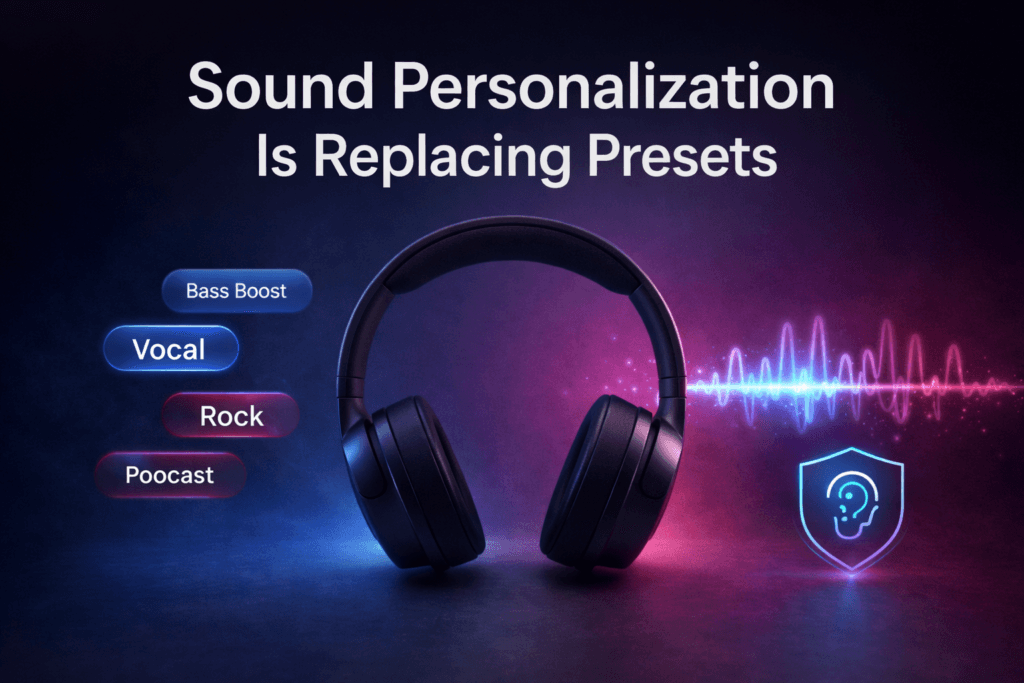
This is where spatial audio default intersects with adaptive processing. AI-driven calibration can compensate for ear shape, device placement, and environmental reflections. The goal is consistent dimensional perception, not exaggerated motion.
Immersion should feel natural, not theatrical.
The Cultural Normalization of Immersion
Visual technology followed a similar path. High refresh rates were once enthusiast territory; now they’re common in mid-range devices. HDR was once premium; now it’s expected.
Audio is tracing that curve.
As more listeners consume media through headphones — commuting, working remotely, gaming — spatial cues enhance clarity and realism in subtle ways. Depth separation can reduce cognitive strain by isolating elements within a mix.
Over time, flat stereo may feel compressed rather than classic.
Cultural normalization doesn’t happen overnight. It happens when the absence of a feature becomes noticeable.
Where This Evolution Leads
If spatial audio default becomes fully realized, the premium tier will shift elsewhere — perhaps toward adaptive personalization, biometric tuning, or hyper-precise object tracking.
Immersion will no longer sell devices. It will be assumed.
The industry’s challenge now is restraint. Implement immersion thoughtfully. Preserve artistic intent. Avoid over-engineering subtle experiences into spectacle.
When spatial audio becomes default, it stops shouting.
It simply surrounds you — and that quiet ubiquity is what makes it powerful.
Stay Immersed with Vibetric
- Follow our Instagram @vibetric_official for sharp analysis on spatial audio default and immersive tech trends.
- Bookmark vibetric.com to track how audio infrastructure is evolving.
- Return for perspective-driven insights on where consumer technology is heading.
What’s your take on this?
At Vibetric, the comments go way beyond quick reactions — they’re where creators, innovators, and curious minds spark conversations that push tech’s future forward.

Sony WH-1000XM6 ANC Headphones: Powerful Silence or Overhyped Upgrade in 2026?
Sony WH-1000XM6 ANC Headphones: Powerful Silence or Overhyped Upgrade in 2026? For years, noise-canceling headphones have chased the same promise: silence on
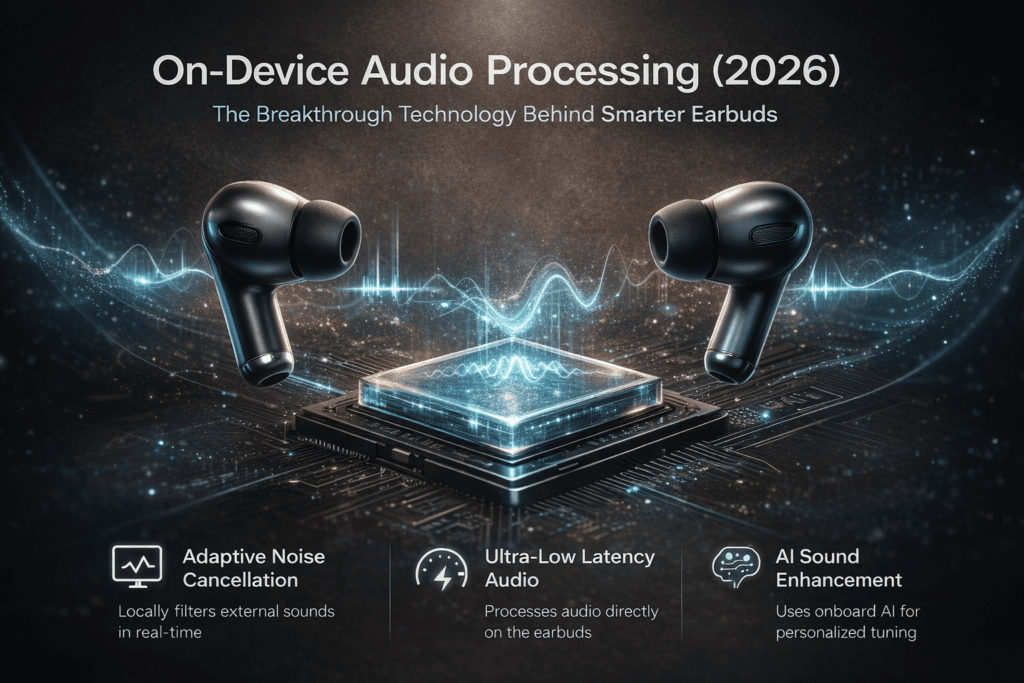
On-Device Audio Processing (2026): The Breakthrough Technology Behind Smarter Earbuds
On-Device Audio Processing (2026): The Breakthrough Technology Behind Smarter Earbuds A commuter taps play on the subway. The train roars into the