
Sound Quality Perception: Why Loud Isn’t Always Better
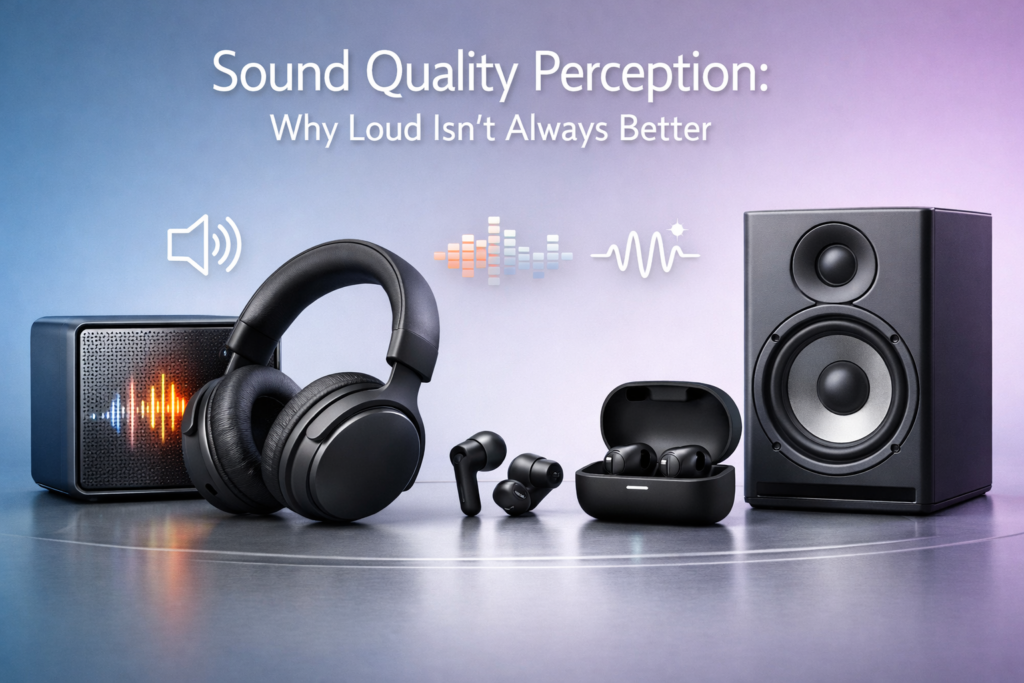
Most people believe they know what good sound is. They recognize clarity, they notice bass, and they react instinctively when something sounds “off.” Yet when you examine how listeners actually evaluate audio, a gap emerges between perception and reality. Sound quality perception is shaped less by accuracy and more by shortcuts—mental, environmental, and psychological—that quietly distort judgment. The result is a market where louder, brighter, or more aggressive sound is often mistaken for better sound, even when fidelity suffers.
The Hidden Role of Context in What We Hear
Sound never exists in isolation. It’s filtered through context before it reaches conscious evaluation. Background noise, listening duration, and even visual cues influence how audio is judged. A speaker that sounds impressive in a noisy store may feel overwhelming at home. Earbuds that feel exciting for a minute can become exhausting over an hour.
This context dependency explains why sound quality perception is unstable. The brain prioritizes what helps it cut through the environment. In loud spaces, boosted treble and compressed dynamics feel clearer. In quiet settings, those same traits reveal themselves as harshness or imbalance. Most listeners don’t misjudge sound because they lack taste—they misjudge it because the conditions keep changing.
Why the Brain Prefers “More” Over “Correct”
At a neurological level, louder and brighter sounds trigger stronger responses. They activate attention faster and register as more detailed, even when they’re not. This is why two identical audio tracks played at different volumes will almost always lead listeners to prefer the louder one.
Manufacturers understand this bias well. Many consumer audio products are tuned to exploit it, leaning into elevated bass and forward mids. These choices improve instant appeal but reduce accuracy. Over time, this shapes expectations. Listeners begin associating emphasis with quality, training their ears away from balance. Sound quality perception becomes anchored to intensity rather than fidelity.
Clean Sound Is Quieter Than You Expect
One of the most counterintuitive truths in audio is that clean sound doesn’t announce itself. It reveals itself gradually. Systems with low distortion and controlled dynamics don’t push details forward unnaturally. Instead, they allow recordings to unfold with their original contrast intact.
For listeners accustomed to exaggerated tuning, this can feel underwhelming at first. Clean audio may seem less exciting because it isn’t constantly stimulating. But extended listening exposes the difference. Vocals remain stable. Instruments occupy consistent space. Fatigue doesn’t build. What initially felt “less” becomes more believable over time.
A Simple Framework for Recalibrating Your Ears
Rather than relying on gut reactions, it helps to reframe how you evaluate sound. The following framework highlights common misjudgments in sound quality perception:
| Evaluation Habit | What It Favors | What It Misses |
|---|---|---|
| Quick demos | Loudness, punch | Long-term comfort |
| Bass focus | Impact | Texture and control |
| Bright clarity | Detail illusion | Natural timbre |
| Short listening | Excitement | Balance over time |
This framework isn’t about rules—it’s about awareness. Once listeners slow down and listen longer, preferences often shift.
The Industry Incentive to Keep You Misjudging
Audio products are rarely designed for extended, critical listening. They’re designed to win comparisons—on shelves, in reviews, and in brief online clips. Louder tuning performs better in these scenarios. It stands out immediately and feels impressive without context.
Clean tuning, by contrast, is harder to sell. Its advantages emerge with time, not shock value. This creates a feedback loop: consumers reward exaggerated sound, brands deliver it, and balanced sound becomes niche. Sound quality perception is shaped less by engineering truth and more by marketing survival.
The Contrarian Truth: Your Preferences Aren’t Fixed
Many assume their taste is stable—that they simply like “fun” or “punchy” sound. In reality, preferences adapt quickly. When listeners spend time with balanced systems, exaggerated ones start to feel artificial. The brain recalibrates once it’s no longer overstimulated.
This is why experienced listeners often describe clean audio as addictive. It doesn’t rely on tricks. It builds trust. Once that trust forms, inflated sound signatures lose their appeal. Misjudgment fades not through education, but through exposure.
Why This Matters More Now
As recording quality improves and spatial audio becomes more common, the cost of misjudging sound increases. Over-tuned systems flatten these advances, reducing complex mixes to noise. Clean reproduction preserves intent, letting modern audio formats actually matter.
Understanding sound quality perception isn’t about chasing neutrality for its own sake. It’s about recognizing how easily judgment can be manipulated—and choosing gear, tuning, and listening habits that respect your ears over time.
Where Better Listening Begins
- Follow our Instagram @vibetric_official for grounded audio and tech insight.
- Bookmark vibetric.com to keep your reference point sharp.
- Stay updated as sound trends evolve beyond surface-level loudness.
What’s your take on this?
At Vibetric, the comments go way beyond quick reactions — they’re where creators, innovators, and curious minds spark conversations that push tech’s future forward.
Sennheiser Momentum 5 Review (2026): Acoustic Engineering Meets Adaptive AI
Sennheiser Momentum 5 Review (2026): Acoustic Engineering Meets Adaptive AI Noise-canceling headphones have reached a point of saturation. Every flagship promises deeper
AI Audio Tuning in 2026: The Intelligent Shift Redefining Sound
AI Audio Tuning in 2026: The Intelligent Shift Redefining Sound The next major leap in audio isn’t louder drivers or wider frequency