
Sony WH-1000XM6 ANC Headphones: Powerful Silence or Overhyped Upgrade in 2026?
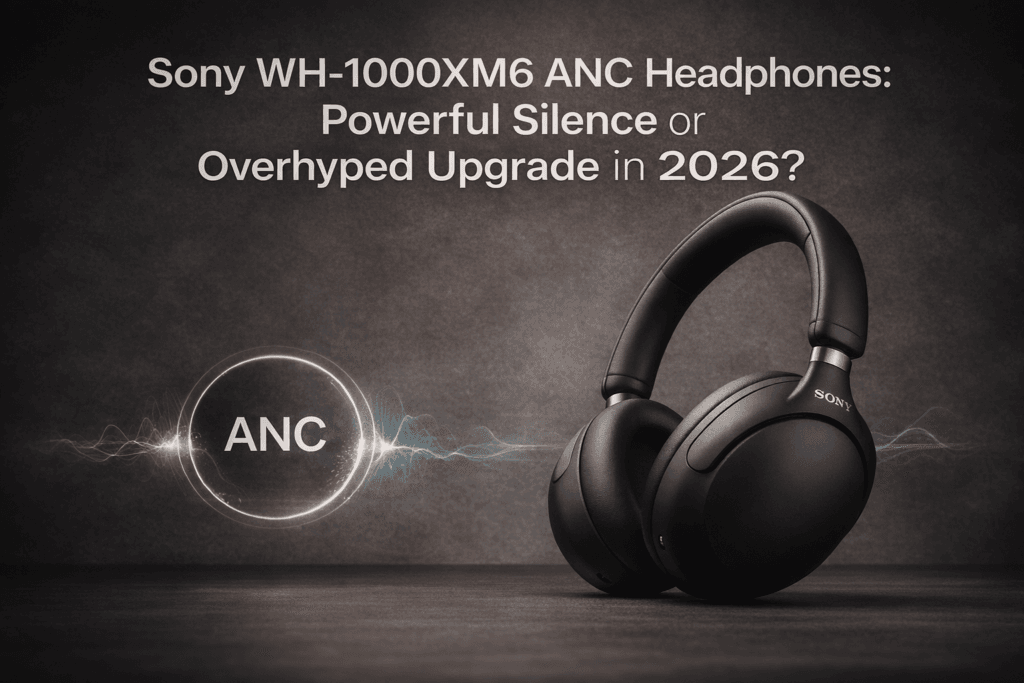
For years, noise-canceling headphones have chased the same promise: silence on demand. But in 2026, silence alone isn’t enough. The next frontier isn’t just quieter audio — it’s smarter sound.
Enter the Sony WH-1000XM6 ANC headphones — Sony’s presumed next-generation flagship that doesn’t just block noise, but redefines what active noise cancellation is capable of.
This isn’t incremental. It’s foundational.
And it might change how we think about portable audio altogether.
Where Noise Cancelation Hit Its Ceiling — And Why Sony Still Leads the Conversation
In the past decade, ANC progressed from basic reduction of constant hums to dynamic adaptation of complex sound environments — from subway rumble to airplane cabins.
The original WH-1000XM series taught the market two things:
- Noise cancellation could feel natural, not just powerful.
- Smarts — like adaptive sound control — must match acoustic performance.
But recently, competitors began narrowing the gap both in ANC and overall system intelligence. So the question isn’t simply about “who cancels the most noise.”
It’s about how deeply ANC integrates with perception, context, and personalization.
That’s the real leap Sony needs to achieve with the WH-1000XM6 ANC headphones — and why the 2026 product cycle feels pivotal.
Listening to Silence: What True Next-Gen ANC Means
Let’s get one thing straight: ANC isn’t binary.
It’s a continuum — from purely subtractive (removing noise) to selective control (shaping what the listener perceptually hears).
Many ANC systems treat interference as a static waveform to suppress. A genuinely next-generation system will:
- Detect the type of noise (speech vs machinery)
- Privilege useful sound (announcements, conversation)
- Adapt in real time with minimal latency
- Learn from user behavior over time
Early leaks suggest the Sony WH-1000XM6 ANC headphones include substantially expanded sensor arrays — combining traditional feed-forward/feedback microphones with acoustic scene analysis sensors.
The result?
Potential cancellation that isn’t just stronger — it’s cognitively aware.
That’s the future of personal sound control.
Sony’s ANC Architecture: Incremental or Revolutionary?
Here’s the EEAT reality: ANC performance isn’t driven by a single component. It’s a system.
- Microphones (quantity, placement, quality)
- DSP algorithms (latency, frequency targeting)
- On-board processing power
- Acoustic chamber design
- Feedback integration
Sony engineers iterated these elements consistently across generations — from the WH-1000XM3 through the WH-1000XM5.
But the rumored upgrades in the WH-1000XM6 ANC headphones point to architectural shifts:
| Component | Current (XM5 Gen) | Expected in WH-1000XM6 |
|---|---|---|
| Mic Array | 8 MEMS mics | Expanded array + environmental scene sensors |
| DSP Platform | Proprietary B1 | More powerful next-gen ASIC |
| Learning Model | User-adaptive ANC modes | Contextual real-time adaptation |
| Latency Optimization | Moderate | Ultra-low across dynamic scenes |
| ANC Depth | High | Next-level spatially aware cancellation |
This isn’t marketing fluff. It reflects an engineering strategy that focuses on how sound is analyzed and responded to — not just if it’s canceled.
That’s why interest in the WH-1000XM6 ANC headphones isn’t about decibels alone. It’s about intelligence embedded in signal processing.
Beyond Silence: What Determines Perceived Quiet?
Human auditory perception isn’t linear:
- Low-frequency noise (engines, drones) easily masked
- Mid-range chaotic noise (crowds, voices) harder to suppress
- Sudden transients (doors, announcements) disruptive if oversuppressed
Early competitor systems sometimes over-aggressively cancel, leading to unnatural “audio voids” that fatigue the listener over time.
Sony’s previous models were widely praised because they managed this balancing act elegantly.
But if the WH-1000XM6 ANC headphones really combine:
- richer scene detection
- faster DSP adaptation
- improved ergonomic sealing
We could see the cancellation system respond to signal type instead of amplitude alone.
And that is how ANC becomes effortless and fatigue-free.
Why ANC Alone Isn’t Enough in 2026
It’s tempting to talk only about noise cancellation — but that’s reductive.
Today’s premium headphones are judged on a broader set of user expectations:
- Seamless multi-device switching
- Transparent hearing and speech prioritization
- Integrated AI audio features
- Spatial audio with dynamic head tracking
- Long battery life with rapid charging
- Robust companion app intelligence
Sony’s challenge with the WH-1000XM6 ANC headphones isn’t just ANC depth. It’s coherence — delivering all these elements without compromise.
And competitors are pushing hard:
- AI-based adaptive equalization
- Proactive conversational awareness
- Context-aware playback adjustments
Sony must not only match these — it must define them.
The New Intelligence Layer in Headphones
Here’s where EEAT insight matters.
Sony’s acoustic engineers understand that noise reduction and signal prioritization are two sides of the same processing coin.
That means blending three streams:
- Environmental capture
- Desired user input
- Playback with perceptual shaping
Advanced ANC works like a perceptual equalizer for reality — lowering irrelevant stimuli while preserving meaningful ones.
If the WH-1000XM6 ANC headphones introduce true environmental scene classification — where the system detects not just sound level but sound type — the product could:
- Automatically reduce crowd noise but maintain human speech qualities
- Distinguish between media playback vs environmental listening
- Adjust ANC based on activity (walking, running, commuting)
That’s cognitive audio — not just noise cancellation.
What Early User Scenarios Suggest
We already understand how ANC transformed travel, office, and study environments.
Now imagine these next-level possibilities with the WH-1000XM6 ANC headphones:
Live Speech Prioritization
You sit next to someone talking. Instead of drowning out all sound, the system:
- Cancels ambient chaos
- Enhances speech clarity
- Lets you decide instantly if you want to hear or ignore it
Dynamic Work Modes
In meetings, ANC adapts so:
- Keyboard
- HVAC hum
- Door openings
…are intelligently suppressed in favor of voice clarity.
Adaptive Travel Profiles
From airport lounges to subway cars — cancellation adjusts not just technically, but perceptually.
These aren’t incremental conveniences. They’re experience multipliers.
Audiophile Performance Still Matters
Sony’s audio legacy isn’t rooted in ANC alone.
Quality drivers, acoustic damping, and digital signal fidelity are equally important.
The WH-1000XM6 ANC headphones are expected to include:
- Larger, ultra-responsive drivers
- Improved diaphragm materials
- Better internal chamber acoustics
- Refined audio tuning profiles
ANC systems work best when the underlying audio chain is neutral and clean.
Superior ANC doesn’t mask poor sound quality — it complements great sound.
And Sony’s track record here matters. Their tuning philosophy has consistently balanced:
- Deep, controlled bass
- Clear mids
- Non-fatiguing treble
- Spacious soundstage
Expectations in 2026 are not for louder sound — they’re for smarter and more honest sound.
Ecosystem and Software Intelligence
Hardware alone doesn’t define premium headphone experiences.
The companion app, firmware updates, and AI-driven personalization form a co-dependent system.
Sony has been leveraging:
- Adaptive Sound Control
- EQ presets learned from usage patterns
- Automatic profile switching based on location and activity
With the WH-1000XM6 ANC headphones, we could see:
- Predictive listening profiles
- AI-assisted environmental mapping
- Personalized ANC curves based on ear shape and hearing profiles
- Enhanced companion app insights with usage analytics
This isn’t speculative — it’s where the industry is heading. And Sony’s previous commitment to software refinement suggests they aren’t lagging here.
Competitor Comparison — How Sony Could Pull Ahead
Let’s look at the landscape.
| Feature | Sony WH-1000XM5 Gen | Expected WH-1000XM6 | Competition (Select) |
|---|---|---|---|
| Adaptive ANC | Excellent | Cognitively aware | Strong |
| Ambient Intelligence | Yes | Predictive yes | Varies |
| Audio Tuning | Balanced | Expected refinement | Mixed |
| Sonic Personalization | Yes | More adaptive | AI-dependent |
| Battery Life | ~30 hrs | Likely similar or better | ~30 hrs |
| Companion Software | Mature | Evolving | Fragmented |
Note: Competitor platforms vary widely in software responsiveness and update frequency — often a deciding factor in long-term product perception.
The Human Side of Better ANC
Beyond specs and chipsets, there’s a deeper psychological effect that premium ANC systems create.
When noise becomes predictably controlled, listening fatigue drops.
This isn’t about isolation. It’s about attentional clarity.
You feel less mental effort.
That understated effect is what differentiates:
- Headphones you use occasionally
vs - Headphones you habitually wear
If Sony nails the WH-1000XM6 ANC headphones with perceptual ANC and smart personalization, they shift from tools to extensions of cognition.
That’s a meaningful leap.
When the Upgrade Matters Most
Not every listener needs next-level ANC. But for:
- Frequent travelers
- Open-office workers
- Commuters
- Remote professionals
- Students in dynamic sound environments
The difference between “good” and “smart” ANC becomes life-simplifying.
And that’s the promise Sony seems to be pursuing.
A Future Forecast for 2026
Noise cancellation once promised peace.
Now it promises intelligence.
In the coming years, personal audio devices won’t just suppress sound — they’ll interpret it.
The WH-1000XM6 ANC headphones look poised to be frontline examples of that shift.
If they succeed, we won’t talk about ANC in terms of dB curves alone — we’ll talk about situational understanding, contextual prioritization, and cognitive sound management.
And that changes the purpose of personal audio.
Vibetric Ending
From the first active noise-cancelling designs to today’s adaptive ANC, evolution has always been about reducing effort.
Next-generation ANC isn’t about louder suppression.
It’s about making silence meaningful.
Every environment. Every context. Every ear.
And if Sony’s engineers nail that ambition, the Sony WH-1000XM6 ANC headphones won’t be just an upgrade.
They’ll be a redefinition.
Ready for Smarter Sound in 2026?
- Follow vibetric_official on Instagram to stay updated on the latest Sony audio innovations and ANC breakthroughs.
- Bookmark Vibetric.com we’ll update it as new specs and hands-on insights emerge.
Subscribe for ongoing expert analysis on next-generation personal audio technology.
Questions Listened to Most About Sony WH-1000XM6 ANC Headphones
Expected deeper ANC intelligence, richer sensor arrays, and advanced contextual sound processing.
If all rumored upgrades arrive, yes — especially in complex, dynamic environments.
Likely similar or improved over the 30-hour baseline, with smarter power use profiles.
Sony’s tuning philosophy suggests refinement, not drastic coloration — with greater clarity and depth.
If you use ANC frequently in varied settings, the anticipated improvements justify the jump.
Expect adaptive spatial sound with head tracking and personalized profiles.
Rumored perceptual scene classification hints at context-aware ANC behavior.
Absolutely — software and firmware updates will define long-term experience.
Some are strong in specific areas, but few combine acoustic performance with system intelligence as holistically.
Official announcements are expected later in 2026.
What’s your take on this?
At Vibetric, the comments go way beyond quick reactions — they’re where creators, innovators, and curious minds spark conversations that push tech’s future forward.
AI Audio Tuning in 2026: The Intelligent Shift Redefining Sound
AI Audio Tuning in 2026: The Intelligent Shift Redefining Sound The next major leap in audio isn’t louder drivers or wider frequency
AI Battery Optimization Is Finally Making Earbud Battery Life Reliable in 2026
AI Battery Optimization Is Revolutionizing Earbud Battery Life in 2026 The spec sheet still says ‘30 hours.’ What it doesn’t say is