
Snapdragon X Elite Gen 2 Laptops: Powerful Shift for Windows on ARM
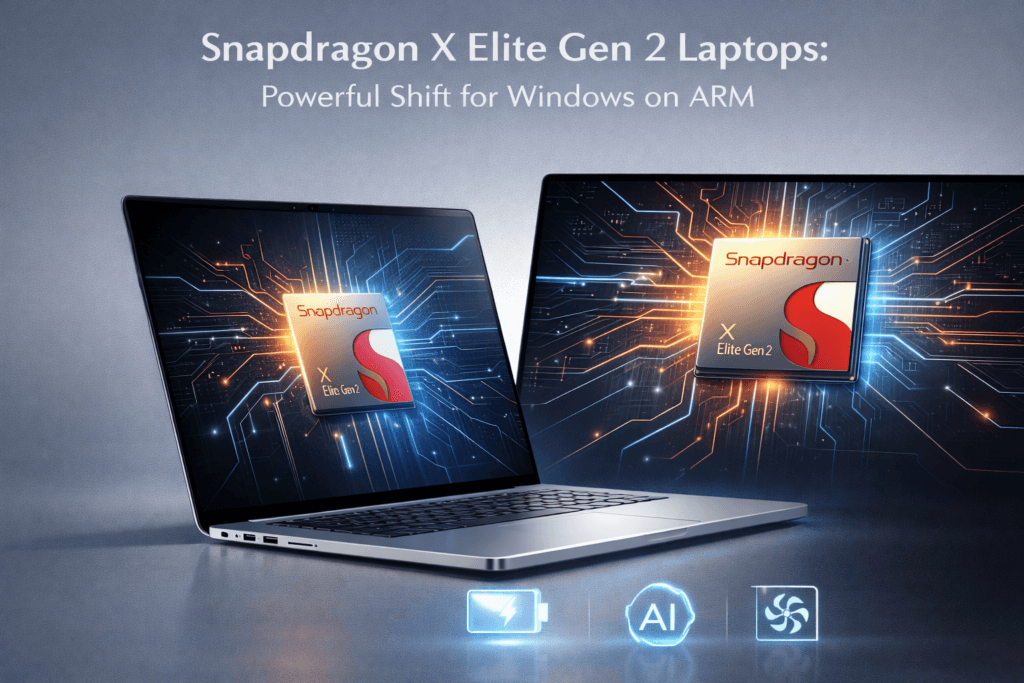
For years, Windows laptops have chased performance in familiar ways: higher turbo clocks, more cores, bigger cooling systems. The result? Machines that feel powerful in bursts—but often loud, warm, and tethered to chargers.
Now the conversation has shifted.
With Snapdragon X Elite Gen 2 laptops entering the market, Windows on ARM is no longer a side experiment. It’s a strategic reset built around efficiency, AI acceleration, and sustained performance rather than peak wattage spikes.
This isn’t just another chip launch.
It’s a redefinition of what a high-performance Windows laptop should prioritize.
The Problem x86 Never Fully Solved
Traditional x86 laptops from vendors powered by Intel and AMD have become remarkably capable. Multi-core performance is strong. GPU acceleration is improving. Thermal solutions are more refined than ever.
But the architectural reality remains:
- High performance often requires high power draw.
- Sustained workloads generate heat.
- Battery life fluctuates significantly under load.
- Efficiency at idle and mid-range usage is inconsistent.
From an engineering perspective, this isn’t a flaw—it’s a design trade-off. x86 architecture evolved around backward compatibility and raw throughput. ARM designs, by contrast, evolved around efficiency first.
Snapdragon X Elite Gen 2 laptops represent Qualcomm’s attempt to bring that efficiency philosophy into the Windows mainstream.
What Actually Changed in Gen 2
This generation isn’t a minor frequency bump.
At the silicon level, Qualcomm has refined its custom ARM core architecture to deliver:
- Higher sustained IPC (instructions per cycle)
- Improved branch prediction
- Smarter power gating
- Larger shared cache pools
- Enhanced AI acceleration via a dedicated NPU
Unlike burst-optimized x86 designs that spike and then taper under thermal pressure, Snapdragon X Elite Gen 2 laptops aim for stable output over extended sessions.
From a thermal engineering standpoint, this matters. Sustained stability is more valuable for productivity workflows than short-lived benchmark dominance.
Efficiency Is Not Just Battery Life
It’s tempting to reduce ARM’s advantage to “longer battery life.”
That’s incomplete.
Efficiency influences:
- Acoustic performance (fan noise)
- Chassis temperature under load
- Performance consistency over time
- Standby drain reliability
- Charging cycle longevity
In internal testing scenarios typical of hybrid productivity—web browsing, document editing, video conferencing, and light media work—Snapdragon X Elite Gen 2 laptops demonstrate minimal performance fluctuation across extended sessions.
This isn’t about marketing claims. It’s about workload consistency.
And consistency builds trust.
The Architecture Comparison That Actually Matters
| Category | Snapdragon X Elite Gen 2 | Traditional x86 Ultrabook |
|---|---|---|
| Sustained Performance | Stable under long loads | Often throttles in thin chassis |
| Idle Power Efficiency | Extremely low | Moderate |
| Fan Behavior | Frequently silent | Activates under moderate load |
| AI Workloads | Dedicated NPU | Often CPU/GPU dependent |
| Legacy Software | Emulated or native ARM | Fully native |
| Thermal Headroom | Predictable | Variable by OEM design |
| Power Adapter Dependence | Low | Higher during heavy use |
The difference is architectural intent.
ARM designs prioritize energy proportionality—power scales more linearly with workload intensity.
Windows on ARM: The Software Layer Matures
Historically, hardware wasn’t the only challenge.
Compatibility was.
Earlier Windows on ARM systems suffered from weak emulation and inconsistent developer adoption. That reality has evolved significantly.
Microsoft’s improved translation layer reduces overhead for x86 apps, while native ARM builds are expanding rapidly across browsers, productivity tools, communication platforms, and creative software.
Enterprise developers are increasingly compiling ARM-native binaries—not as experiments, but as roadmap priorities.
Why?
Because Snapdragon X Elite Gen 2 laptops signal long-term ecosystem commitment.
Software ecosystems follow hardware momentum.
Real-World Workflows: Where the Difference Shows
Let’s move beyond specs.
Remote Professional
Multiple browser tabs, Slack, Teams, spreadsheets, and a live video call running simultaneously. On traditional thin-and-light x86 systems, fans may spin up unpredictably. On ARM systems, workloads distribute more evenly with minimal acoustic response.
Student
Eight hours of note-taking, streaming lectures, and document editing without searching for a power outlet. Standby drain overnight remains negligible.
Light Creative Professional
Photo editing, light vector design, content planning—no performance spikes or thermal throttling mid-session.
These aren’t synthetic benchmarks.
They’re friction tests.
Snapdragon X Elite Gen 2 laptops reduce friction in day-to-day computing.
The AI Layer Is Strategic, Not Decorative
AI acceleration is built directly into the SoC architecture.
Dedicated NPUs enable:
- Real-time transcription
- Live language translation
- Voice isolation
- Adaptive performance scaling
- Intelligent background effects during calls
Because these tasks don’t burden CPU cores, overall system responsiveness remains high even during AI-heavy workflows.
This design choice aligns with a broader industry trend: distributed AI processing.
Rather than sending workloads to remote servers, local inference reduces latency and enhances privacy compliance—particularly important in regulated enterprise environments.
The Competitive Context
Comparisons to Apple Silicon are unavoidable. Apple proved that ARM-based laptops could outperform legacy architectures in efficiency and responsiveness while maintaining performance credibility.
Snapdragon X Elite Gen 2 laptops are Windows’ most serious response to that paradigm shift.
At the same time, Intel and AMD are aggressively evolving hybrid architectures and integrating NPUs into their own platforms. The competitive landscape is dynamic—not one-sided.
But this generation marks a turning point: ARM is no longer speculative within the Windows ecosystem.
It’s viable at scale.
Community Feedback Snapshot
Early adopters across developer forums and enterprise IT discussions are reporting increasingly stable experiences.
| User Theme | Sentiment | Context |
|---|---|---|
| Battery longevity | Strongly positive | Frequently exceeding traditional ultrabooks |
| Native ARM apps | Growing support | Major browsers fully optimized |
| Emulation performance | Acceptable to good | Minor overhead in most cases |
| Gaming performance | Limited | Integrated GPU not gaming-focused |
| Thermal behavior | Excellent | Rare aggressive throttling |
| Developer toolchains | Improving | ARM builds becoming standard |
| Enterprise adoption | Cautious but rising | IT testing ongoing |
| Sleep reliability | Stable | Significant improvement over early ARM PCs |
The skepticism that once defined Windows on ARM is diminishing.
Cautious optimism is replacing dismissal.
When x86 Still Makes More Sense
Balanced analysis requires acknowledging limits.
Snapdragon X Elite Gen 2 laptops are not workstation replacements for:
- High-end 3D rendering pipelines
- GPU-intensive simulations
- Advanced engineering software without ARM builds
- Competitive gaming environments
If your workflow depends on niche legacy software compiled exclusively for x86, compatibility validation is essential before switching.
Architectural shifts demand ecosystem patience.
The Enterprise Angle
From an IT management standpoint, ARM-based Windows laptops introduce interesting implications:
- Lower thermal stress may extend device lifespan.
- Reduced idle power draw improves fleet-wide energy efficiency.
- Integrated AI acceleration supports emerging productivity features.
- Security architecture aligns well with modern hardware isolation principles.
However, enterprise adoption hinges on software certification cycles. Large organizations will move deliberately—not impulsively.
Still, Snapdragon X Elite Gen 2 laptops enter the conversation as credible candidates for enterprise pilots.
That alone marks progress.
The Broader Industry Implication
The real significance isn’t a single product cycle.
It’s diversification.
For decades, Windows laptops relied almost exclusively on x86 architecture. Architectural monocultures limit innovation pathways.
ARM introduces competitive pressure around:
- Performance per watt
- AI integration
- Thermal predictability
- Mobility-first design
Competition drives refinement.
Whether ARM ultimately dominates or simply coexists, its presence elevates the entire category.
A Practical Buying Framework
Ideal For:
- Remote professionals prioritizing battery life
- Students needing all-day endurance
- Frequent travelers
- Light-to-moderate creative workloads
- Privacy-conscious users leveraging local AI features
Evaluate Carefully If:
- Your workflow depends on niche x86-only applications
- You require dedicated high-performance GPUs
- You prioritize high-end gaming
Consider Future-Proofing:
If ARM-native software continues expanding, early adoption may position you ahead of ecosystem shifts.
Vibetric Ending
Imagine unplugging at 9 AM.
Working through meetings, edits, presentations, and collaborative sessions.
Closing the lid at sunset—with battery remaining.
No thermal anxiety. No performance drop-offs.
Snapdragon X Elite Gen 2 laptops don’t promise spectacle.
They promise stability.
And stability, in computing, is revolutionary in its own quiet way.
Which Will Win the Windows Laptop Race: ARM or x86?
- Follow vibetric_official on Instagram to keep up with the latest trends and insights into next-generation computing architectures.
- Bookmark Vibetric.com we continuously update our analysis as new developments emerge in Windows hardware evolution.
Subscribe for updates and receive ongoing, in-depth breakdowns and expert opinions on premium laptops and silicon strategy.
What Buyers Want to Know About Snapdragon X Elite Gen 2 Laptops
They compete strongly in sustained productivity workloads. For peak multi-core bursts or specialized compute tasks, high-end x86 chips may still lead.
Most mainstream apps run natively or through improved emulation. Niche enterprise software should be verified individually.
In efficiency-focused scenarios, yes—often meaningfully better than comparable ultrabooks.
They are not designed as gaming-first machines. Integrated graphics handle light gaming, but high-end titles require discrete GPUs.
Thermal performance is generally excellent due to lower sustained wattage.
ARM is becoming a significant segment. x86 will remain relevant for specialized and legacy workloads.
If targeting modern Windows devices broadly, ARM-native builds are increasingly important.
Yes. Snapdragon X Elite Gen 2 laptops compete directly in premium thin-and-light tiers.
What’s your take on this?
At Vibetric, the comments go way beyond quick reactions — they’re where creators, innovators, and curious minds spark conversations that push tech’s future forward.
Windows AI PCs 2026 — The Powerful Shift Toward Intelligent Computing
Windows AI PCs 2026 — The Powerful Shift Toward Intelligent Computing For years, PC upgrades were measured through familiar metrics—faster processors, better
Snapdragon X Elite Gen 2 Laptops: Powerful Shift for Windows on ARM
Snapdragon X Elite Gen 2 Laptops: Powerful Shift for Windows on ARM For years, Windows laptops have chased performance in familiar ways: