
Smartphones as Lifestyle Products 2026: Shocking Shift Beyond Specs
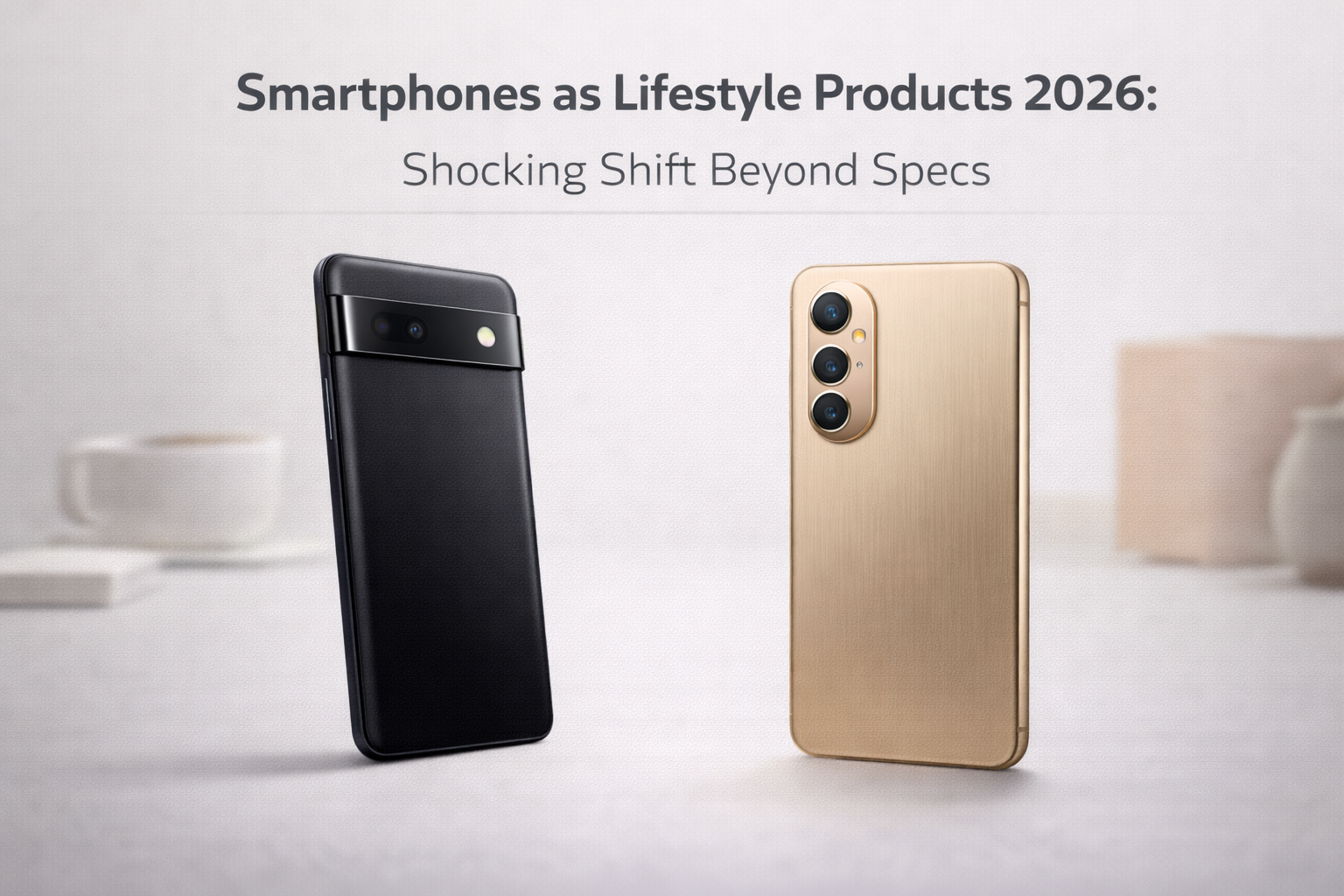
The phone didn’t change overnight. It happened quietly, in pockets and palms, during moments that never made it into spec sheets. A commuter checks their reflection in a blackened screen before stepping into a meeting. A teenager flips a phone face-down on a café table, the camera ring still visible, deliberately seen. A traveler photographs a meal they will forget eating but remember sharing. None of this behavior depends on chip architecture or sensor size. Yet it defines why the device matters.
For years, smartphones were explained as convergence machines—camera plus computer plus communicator. That framing made sense when progress was obvious and mechanical. Faster processors shaved seconds. Better cameras replaced point-and-shoots. Larger batteries reduced anxiety. But as these gains normalized, something subtler took over. The phone stopped asking to be evaluated and started asking to be identified with. People no longer compared devices only by what they could do, but by what owning them said.
This shift wasn’t driven by a single brand or moment. It emerged from saturation. When nearly everyone has a capable smartphone, capability loses its signaling power. What replaces it is meaning. The phone becomes a proxy for taste, values, and belonging. Minimalism versus maximalism. Privacy-conscious versus socially expressive. Workhorse versus fashion object. The object remains the same size, but its cultural weight multiplies.
What’s striking is how instinctively users adapted. They learned which phones could be placed on a table without explanation. Which ones implied creativity. Which ones implied pragmatism. Which ones suggested wealth without shouting it. These interpretations weren’t taught through manuals; they were absorbed through imagery, influencers, retail design, and social repetition. Over time, the phone became less like a gadget and more like clothing—changed annually, discussed emotionally, judged socially.
This is where the idea of smartphones as lifestyle products stops being a metaphor and starts being observable behavior. People forgive flaws in devices that align with their identity and magnify minor issues in devices that don’t. They defend brands the way they defend personal choices. They stay loyal even when rational comparisons suggest they shouldn’t. The phone, once a neutral tool, now participates in the story users tell about themselves—quietly, constantly, and everywhere.
When a Rectangle Became a Social Signal
A smartphone today is read the way shoes or watches once were. Not consciously, but fluently. People notice finishes, camera layouts, interface animations, even notification sounds. These cues form quick judgments: professional, creative, trend-aware, frugal, status-seeking. None of this requires explicit logos. In fact, the strongest signals often come from restraint rather than branding.
This interpretive layer varies globally, but the mechanism is universal. In dense urban markets, slimness and visual calm signal sophistication. In emerging creator cultures, camera performance implies ambition. In privacy-aware circles, software philosophy carries more weight than megapixels. The same device can mean innovation in one context and conformity in another. Culture doesn’t just receive the product; it reshapes its meaning.
What matters is that users participate willingly. They curate wallpapers, cases, fonts, and camera habits as extensions of self. They post mirror selfies where the phone is intentionally visible. They discuss updates not as features but as feelings—“it feels faster,” “it feels cleaner,” “it feels old now.” This language reveals the truth: evaluation has moved from function to experience to identity.
In this environment, smartphones as lifestyle products isn’t a marketing invention—it’s a social agreement. Brands that understand this design for coherence rather than excess. Those that don’t keep shouting specifications into a culture that has stopped listening. The phone’s success is no longer decided at launch events, but in cafés, offices, and group chats where it’s silently judged.
Why the Smartphone Had to Evolve This Way
Once performance crossed a certain threshold, progress became invisible. Apps opened instantly. Photos looked “good enough.” Screens became uniformly sharp. At that point, continuing to compete on raw capability risked diminishing returns. Adding more power didn’t change daily life in proportion to its cost or complexity. Something else had to carry differentiation forward.
The answer was narrative. Not storytelling in the advertising sense, but narrative embedded in the object itself. Materials began to signal values—glass for elegance, matte finishes for seriousness, bold colors for youth. Software choices became philosophical statements: customization versus control, openness versus curation. Even packaging shifted, stripped down to imply environmental awareness or premium restraint.
This evolution wasn’t optional. It was structural. When a category matures, it either commoditizes or culturalizes. Smartphones avoided becoming generic slabs by absorbing the language of fashion, lifestyle, and personal tech ecosystems. They learned to age symbolically, not just physically. A two-year-old phone doesn’t feel obsolete because it can’t perform; it feels obsolete because it no longer aligns with current aesthetic or social norms.
That’s why discussions around smartphones as lifestyle products persist even during economic slowdowns. People may delay upgrades, but when they do upgrade, they choose meaning over marginal gains. The product exists now to help users locate themselves within a fast-moving cultural landscape—not just to compute faster than last year.
Why “Feel” Beats Specs in Everyday Judgment
Human perception is biased toward immediacy and coherence. Users don’t experience phones as a list of attributes; they experience them as a continuous sensation. Smooth scrolling creates trust. Consistent animations create calm. Subtle haptics create confidence. These sensations form emotional judgments long before rational comparison begins.
Once a device feels “right,” confirmation bias takes over. Users reinterpret flaws as quirks and strengths as intentional design. Conversely, when something feels off, even excellent specifications struggle to redeem it. This is why two phones with similar hardware can evoke completely different loyalty levels. The brain prioritizes comfort and identity alignment over measurable advantage.
Psychologically, lifestyle framing reduces cognitive load. Choosing a phone becomes less about research and more about self-recognition. “This one is for people like me.” That shortcut is powerful, and it’s why smartphones as lifestyle products remain resilient even as feature gaps shrink. The decision feels personal, not technical—so it’s defended personally.
| Emotion Triggered | What Users Think Is Happening | What’s Actually Driving Behavior |
|---|---|---|
| Smoothness | “This phone is faster” | Animation pacing & task prioritization |
| Camera confidence | “I’m better at photography” | Predictable color science |
| Calm UI | “It’s simpler” | Reduced cognitive friction |
| Consistency | “It’s reliable” | Trust formed through repetition |
The Invisible Network That Taught Phones How to Behave
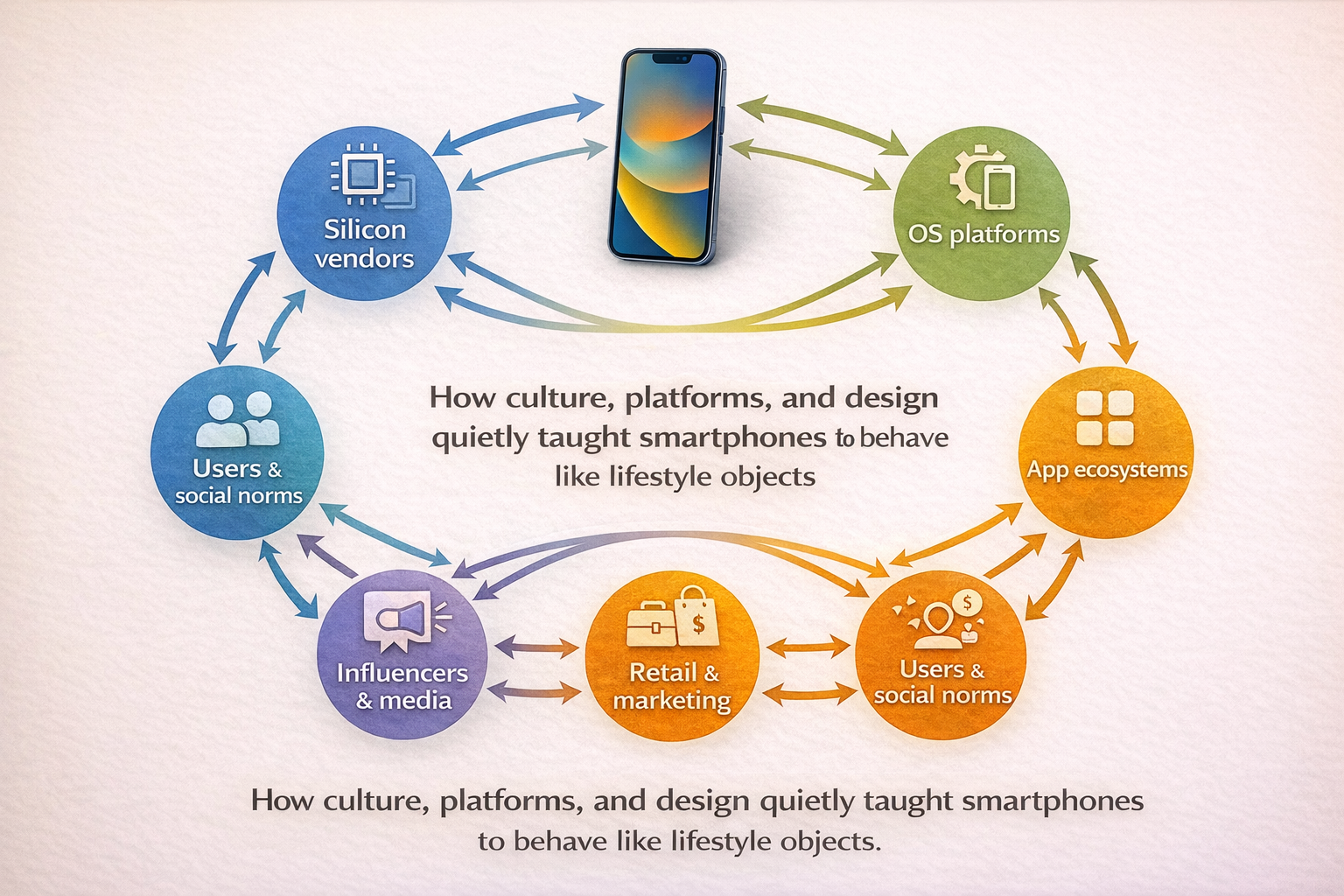
Smartphones didn’t become lifestyle objects in isolation. They were trained into it by an ecosystem that quietly aligned incentives across silicon vendors, OS developers, fashion cycles, retail design, and content platforms. Each layer reinforced the idea that the phone is not finished at purchase—it’s activated socially.
Chipmakers optimized not just for speed, but for sustained feel: smoother animations, faster wake times, better image pipelines. OS platforms standardized gestures and visual language so users could “read” a device instantly, even before touching it. App developers followed these cues, designing interfaces that reward aesthetic coherence over raw density of features. Over time, friction became culturally unacceptable.
Retail environments completed the loop. Phones were no longer sold like electronics stacked by specification. They were displayed like jewelry—isolated, lit, spaced, and contextualized. Marketing pipelines echoed the same shift, using lifestyle photography instead of technical diagrams. Influencers replaced benchmarks. Camera samples replaced spec tables.
What emerges is a circular influence loop: culture tells brands what feels aspirational, brands signal that aspiration through design, platforms normalize the behavior, and users reinforce it socially. This loop explains why smartphones as lifestyle products matured globally despite different price sensitivities and cultural norms. The ecosystem didn’t just respond to demand; it shaped the very criteria by which phones are judged.
When Branding Stopped Selling Features and Started Selling Alignment
Modern smartphone branding rarely argues anymore. It aligns. Instead of convincing users that a phone is better, brands frame it as belonging. The device becomes a badge of shared values—creativity, privacy, ambition, minimalism, rebellion, refinement. Once alignment is established, rational comparison becomes secondary.
This is why brand tone now matters as much as product design. Language choices, update philosophy, even how bugs are acknowledged contribute to perceived character. Some brands cultivate authority and calm. Others emphasize experimentation and self-expression. Neither approach is inherently superior, but inconsistency is fatal. A phone that looks restrained but behaves chaotically breaks trust.
Long-term consequences emerge here. Brands that successfully position smartphones as lifestyle products gain resilience. Users tolerate slower innovation cycles because the relationship feels emotional rather than transactional. But the risk is stagnation. When alignment turns into dogma, brands can misread cultural shifts and double down on identities users are outgrowing.
The most effective strategies leave room for evolution without betrayal. They let users age with the product. In a lifestyle-driven market, loyalty isn’t earned by perfection—it’s earned by continuity of values under change.
Why Materials Started Carrying Meaning
Materials are no longer neutral. Glass suggests elegance but fragility. Matte metal suggests seriousness and durability. Bold colors suggest confidence or youth. Even weight communicates intention—lightness implies effortlessness, heft implies substance. These interpretations are learned culturally, then applied instinctively.
Form factor plays a similar role. Flat edges feel deliberate and modern. Curved edges feel comfortable and familiar. Camera modules have become visual signatures, instantly recognizable at a distance. These decisions rarely change functionality in meaningful ways, yet they dramatically affect how a phone is read socially.
What’s notable is how users internalize these signals. A scratch on a glossy phone feels like damage; on a rugged-looking one, it feels like character. The same physical wear tells different stories depending on material language. This is a hallmark of lifestyle products: aging becomes symbolic, not just physical.
In this context, smartphones as lifestyle products demand material honesty. When finish, form, and messaging disagree, users sense it immediately. The phone may still function perfectly, but it feels wrong—and wrongness spreads faster than dissatisfaction.
Three Real Outcomes Brands Didn’t Fully Anticipate
One success story comes from phones that leaned into creator identity. Strong cameras mattered, but what truly resonated was how effortlessly the device fit into creative routines—color science that felt cinematic, editing tools that felt native, and communities that celebrated output. Users felt seen, not sold to.
A failure case often emerges from over-specification. Devices packed with features but lacking a clear identity struggle to inspire loyalty. Users appreciate them intellectually but rarely form attachment. They’re recommended less, defended less, and replaced sooner—even if objectively capable.
The misunderstood outcome is minimalism. Some brands assumed reducing complexity would alienate power users. Instead, many users interpreted restraint as confidence. Fewer options signaled thoughtful curation. The phone felt calmer, more intentional. What looked like limitation on paper became relief in daily use.
Across all three, the pattern is consistent: when phones behave like lifestyle products, success depends less on what they include and more on what they imply. Culture fills in the rest.
The Economics That Quietly Pushed Phones Toward Lifestyle Status
Once smartphone hardware matured, the economics of improvement became unforgiving. Each incremental gain in performance demanded disproportionate investment—in R&D, fabrication, thermal mitigation, and software optimization—while delivering diminishing perceptual returns. Users didn’t feel twice the value from twice the effort. Finance teams noticed long before users articulated it.
Lifestyle differentiation offered a way out. Cultural value scales more efficiently than engineering value. A new colorway, finish, or identity-driven feature can reset desire without resetting the bill of materials. Software aesthetics and ecosystem positioning stretch product relevance without stressing supply chains. From an economic perspective, meaning is cheaper to scale than physics.
This doesn’t imply deception. It implies survival. Mature markets reward emotional resonance over raw advancement because margins depend on replacement cycles, not breakthroughs. When users upgrade because their phone feels culturally outdated—not technically broken—brands regain control over timing.
That’s why smartphones as lifestyle products are not a trend but an economic adaptation. The category didn’t abandon innovation; it reallocated it. Innovation moved from measurable superiority to symbolic relevance, where the return on investment remains visible to both shareholders and users.
When Intelligence Became Invisible but Influential
Modern smartphones make thousands of micro-decisions per day without asking permission. They manage heat to preserve comfort. They prioritize tasks to maintain the illusion of speed. They tune images toward moods users prefer rather than optical accuracy. This intelligence is deliberately quiet, because visibility would break the spell.
From a cultural standpoint, invisible intelligence supports lifestyle framing. The phone doesn’t feel like a machine negotiating constraints; it feels like an object that “understands.” Users rarely credit algorithms directly, but they reward the emotional outcome—calmness, consistency, predictability.
There are limits. When intelligence misaligns with user intent—over-processing photos, aggressive background management, unwanted suggestions—it feels intrusive rather than helpful. Lifestyle products require consent by coherence. Intelligence must reinforce identity, not interrupt it.
In this sense, AI didn’t elevate phones into lifestyle objects by adding features. It did so by removing friction silently. That invisibility is the point. The smarter the system, the less users want to notice it.
Myths That Persist Because They Feel Comforting
| Myth | What Actually Happens | Why the Belief Survives |
|---|---|---|
| Better specs guarantee longer satisfaction | Emotional alignment decays faster than performance | Specs are easy to compare, feelings aren’t |
| Lifestyle focus means weaker engineering | Engineering is redirected, not reduced | Users equate visibility with effort |
| Customization equals freedom | Too many options increase fatigue | Control feels empowering until it overwhelms |
| Premium design is superficial | Design shapes daily perception | Function is assumed once trust exists |
These myths endure because they simplify decision-making. They reduce a complex cultural shift into something measurable. But they fail to explain real behavior—why users defend brands irrationally, forgive flaws selectively, and abandon technically superior devices without regret.
Understanding smartphones as lifestyle products requires accepting discomfort: that logic follows emotion more often than the reverse. Brands that acknowledge this design more honestly. Those that deny it keep chasing ghosts in benchmark charts.
Inside the Room Where Smartphone Decisions Actually Get Made
Internally, smartphone design is rarely a unified vision. Engineering worries about thermals and longevity. Marketing worries about narrative clarity. Finance worries about margin stability. Product leadership sits between them, negotiating trade-offs that users will never see—but will feel.
Lifestyle framing simplifies these conflicts. It gives teams a shared north star: coherence. Decisions aren’t judged only by performance impact, but by whether they dilute or strengthen identity. This lens resolves debates faster than raw metrics ever could.
The tension remains. Push lifestyle too far, and credibility erodes. Ignore it, and relevance fades. The most successful OEMs don’t eliminate conflict—they institutionalize it. They allow friction early so the product feels effortless later.
This is the hidden machinery behind smartphones as lifestyle products: not aesthetic obsession, but disciplined compromise in service of meaning.
When Lifestyle Products Fail, They Fail Emotionally First
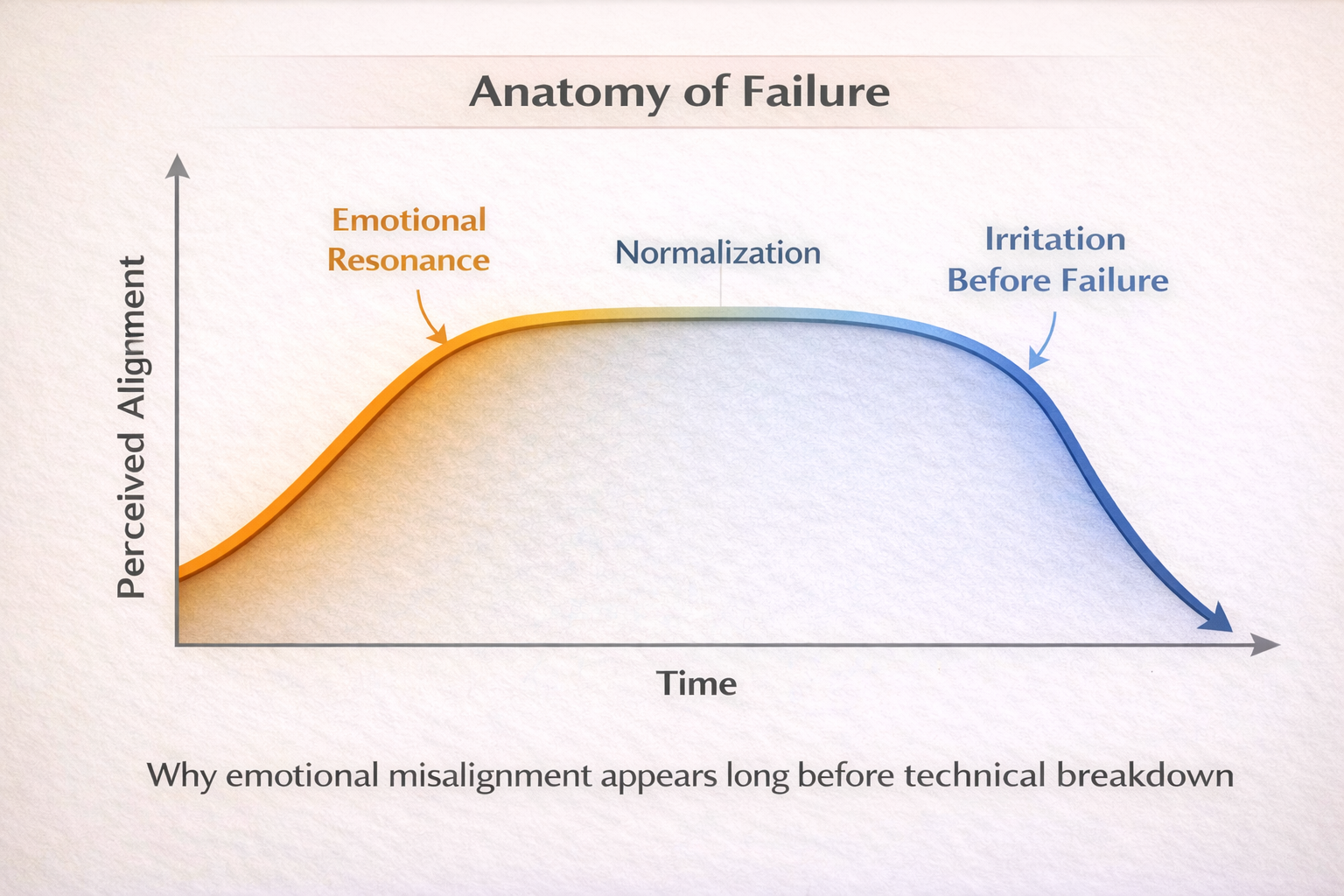
Smartphones rarely fail in a dramatic way. Screens don’t shatter daily. Processors don’t suddenly stop computing. What fails first is the relationship. The device starts feeling slightly irritating, slightly embarrassing, slightly out of sync with who the user has become. That emotional drift precedes any measurable malfunction.
A camera that once felt expressive now feels overprocessed. A design that once felt bold now feels loud. An interface that once felt intuitive now feels busy. None of these are catastrophic flaws. But together, they erode trust. Users begin to notice friction they once ignored. They become receptive to alternatives—not because their phone is bad, but because it no longer feels right.
This is the unique fragility of smartphones as lifestyle products. Functional products fail when they stop working. Lifestyle products fail when they stop resonating. The irony is that the better a phone performs technically, the more likely its eventual replacement is driven by identity fatigue rather than necessity.
Brands that misunderstand this keep optimizing durability while losing relevance. Brands that understand it monitor sentiment, tone, and cultural alignment as closely as failure rates. Because once emotional permission is withdrawn, no update can fully restore it.
The Weak Links Users Don’t Notice Until Meaning Breaks
| Hidden Weak Link | What Users Experience | Why It Undermines Lifestyle Trust |
|---|---|---|
| Thermal throttling | Phone feels “slower over time” | Breaks illusion of effortlessness |
| Battery aging | Anxiety replaces confidence | Reliability is emotional currency |
| Camera inconsistency | Unpredictable results | Creativity feels interrupted |
| Hinge / port wear | Subtle looseness | Physical decay signals neglect |
| Software clutter | Cognitive fatigue | Calm identity dissolves |
These weaknesses don’t announce themselves. They whisper. And because lifestyle products are judged holistically, a small inconsistency can contaminate the entire experience. Users may not articulate the cause, but they register the effect: discomfort, doubt, detachment.
In purely functional devices, these issues are tolerable. In lifestyle-driven ones, they feel like betrayal. That’s why long-term owners become the most critical voices—not because expectations were unrealistic, but because the emotional contract was stronger.
Understanding smartphones as lifestyle products means recognizing that reliability is not just uptime. It’s the preservation of trust under aging.
How Lifestyle Phones Age When Nobody Is Watching
In the first year, a phone’s lifestyle identity feels fresh and affirming. Users notice compliments, enjoy coherence, and forgive quirks. Between years two and three, the device enters normalization. It still performs well, but cultural novelty fades. This is where alignment either stabilizes or begins to slip.
By years four to six, decay becomes symbolic. The phone may still function, but it feels behind the times—thicker, slower to update visually, less aligned with current norms. Even users who claim indifference absorb this drift subconsciously. By years seven to ten, only emotionally resilient devices survive daily use without irritation.
What’s important is that this curve is not purely technical. A well-designed phone with modest specs but strong identity can age more gracefully than a technically superior device with confused positioning. Longevity in smartphones as lifestyle products depends on whether the original narrative can stretch without snapping.
That’s why some older phones feel “classic” while others feel simply old.
| Phase | User Perception | Cultural Status |
|---|---|---|
| Year 1–2 | Affirming, confident | Current |
| Year 3–4 | Familiar | Normalized |
| Year 5–6 | Slightly dated | Quietly aging |
| Year 7+ | Irritating | Symbolically old |
Buying a Phone When You’re Actually Buying a Signal
Basic users benefit most from lifestyle coherence they don’t have to think about. A calm, reliable identity reduces friction and decision fatigue. Creators should prioritize phones whose cultural positioning supports expression, not just output. The feeling of flow matters more than peak capability.
Gamers often misjudge their needs. Performance matters, but so does thermal consistency and ergonomic comfort. A phone that looks powerful but feels awkward erodes long sessions. Long-term owners should bias toward brands with restrained identities—those that age quietly rather than chase trends.
Across all personas, the smartest choice comes from recognizing what you’re signaling to yourself as much as to others. In a mature market, buying into smartphones as lifestyle products is unavoidable. The mistake is pretending you’re immune to it, rather than choosing alignment consciously.
How This Analysis Separates Signal from Story
Understanding smartphones at this stage requires resisting two easy traps: nostalgia for engineering purity and cynicism about marketing manipulation. Neither explains real behavior. Credibility here doesn’t come from insider access or teardown numbers alone—it comes from pattern recognition across markets, product cycles, and user adaptation.
The method is comparative and behavioral. When similar hardware produces different loyalty curves, the explanation isn’t technical. When users describe devices with emotional language despite rational parity, something cultural is at work. When brands survive missteps because identity remains intact, trust—not performance—is doing the labor.
This analysis treats smartphones as lifestyle products not as a slogan but as a testable framework. It asks whether predictions about behavior, aging, and loyalty hold across geographies and economic tiers. When they do repeatedly, the framework earns its place. When they don’t, it gets revised.
That discipline matters, because lifestyle framing without rigor becomes hype. Rigor without cultural awareness becomes irrelevant. The value lives in between.
The Ethical Tension of Turning Identity into Infrastructure
When a phone becomes part of identity, the ethical stakes rise. Data collection feels more intimate. Design lock-in feels more coercive. Repair barriers feel less like inconvenience and more like control. Lifestyle products blur the line between choice and dependence.
Privacy is no longer just a policy issue—it’s a cultural promise. Users forgive complexity if they believe intent is respectful. They revolt when they sense exploitation. Similarly, repairability isn’t evaluated only on cost, but on dignity. Can the object age with me, or am I being pushed out?
Sustainability narratives also shift here. Minimal packaging and recycled materials signal virtue, but long software support signals commitment. In smartphones as lifestyle products, ethics must be practiced consistently, not performed occasionally. Inconsistency is noticed faster than absence.
The deeper risk is normalization. When identity-bound devices quietly erode user agency, resistance weakens. Brands that take ethics seriously do so not because it’s fashionable, but because lifestyle trust collapses instantly once moral alignment breaks.
Where Lifestyle Phones Are Headed Between 2030 and 2040
The next decade won’t be defined by form-factor revolutions alone. Instead, meaning will fragment. Phones will become less universal symbols and more precise identity tools—optimized for different philosophies of living rather than one-size-fits-all aspiration.
Some devices will emphasize calm and cognitive relief, acting as buffers against digital overload. Others will lean into visibility and creation, becoming constant companions to public self-expression. Hardware differentiation will remain subtle; narrative differentiation will become sharper.
Physics still matters. Batteries, thermals, and materials will constrain ambition. But culture will decide which constraints users accept. Smartphones as lifestyle products will succeed by making limitation feel intentional rather than imposed.
By 2040, the most valuable phones may not be the most powerful, but the ones that users feel understood them for the longest time.
Reddit Reality: Users Wrestling with Meaning and Meaninglessness
Reddit Sentiment Snapshot
- “Were you happier before owning a smartphone?” — posters express nostalgia for simpler cell phones and reflect on mental health vs device omnipresence. Reddit nostalgia debate on smartphones
- “Social status of expensive smartphones” — one long-standing thread highlights how premium phones become status symbols, with peer judgment tied to ownership. Reddit on social signaling of smartphone brands
- Some users reject modern smartphones entirely as conveniences that became necessities, arguing life was simpler without them. Reddit unpopular opinion — smartphones as unnecessary
- “Smartphones … making us lonelier?” — mixed commentary about tech’s social effect, with some blaming screen overuse and others defending connectedness. Reddit discussion on loneliness and smartphones
Reddit Sentiment Table
| Theme | Dominant Tone | Cultural Implication |
|---|---|---|
| Lifestyle impact | Mixed; pragmatic vs critical | Phones as central yet distracting tools |
| Nostalgia/pre-smartphone era | Reflective, sometimes negative | Older “identity” without smartphones |
| Status signaling | Critical, humorous | Phones as social currency |
| Necessity vs convenience | Disagreement | Questions about compulsion |
| Mental health | Concerned | Emotional burden vs benefit |
Analysis
- Reddit threads make one thing clear: smartphones are not just commodities but lived cultural artifacts that users consciously interpret in their social world. Some see them as extensions of identity and tools of convenience; others see them as distractions that threaten intentionality and mental focus. In minimalist-oriented threads, participants dissect how smartphones shape behavior more than they serve tasks—a direct reflection of how culture now interprets the role of these devices. reddit
- A recurring theme is nostalgia for simpler devices. Some users explicitly lament the shift from analog simplicity to digital saturation—suggesting that modern phones demand attention and foreclose the kind of space older tech allowed. This tension highlights why many feel both attached to and fatigued by smartphones, a duality that lies at the heart of their cultural meaning. reddit
- Discussions about status and judgment are especially telling. Posts that critique the social pressure to own the latest flagship illustrate how phones function as social signals; users call out the phenomenon humorously but also with genuine frustration when they feel judged for choices based on brand or specs. This aligns with the broader cultural reading that phones signal identity, not just performance. reddit
- Not all conversations celebrate smartphones. Some communities—even those far from mainstream tech fandom—debate whether the device should ever have become ubiquitous at all. These reflections reveal discomfort with the societal assumption that smartphones are essential, bluntly questioning the ethics and lived consequences of that evolution. reddit
- Others link excessive use with mental load and loneliness, pointing to patterns of compulsive checking and distraction that affect well-being. These narratives are cultural rather than technical—they don’t assess CPUs or megapixels but lived experience of attention, connection, and meaning in everyday life. reddit
Overall, Reddit’s landscape shows that cultural discourse around smartphones transcends mere tech debate. It’s about identity, lifestyle, expectations, and emotional experience—a reality that brands must engage with if they want to influence perception, not just purchase.
Global Review Reality: What Buyers Actually Say
Google & Online Review Trends
Instead of raw star listings, online review sentiment around smartphones demonstrates how performance and perceived value interact with lifestyle perception:
- Users often praise devices not just for specs but for camera performance that fits social sharing habits and ecosystem coherence—e.g., natural color science on iPhones vs. Pixel computational photography. Alibaba
- Sentiment threads show brand loyalty driven by user experience, not purely by hardware performance—consistent with cultural identity framing. GummySearch
- Review comparisons highlight durability and longevity experiences as part of satisfaction; devices that stay relevant longer emotionally get more favorable long-term reviews. Alibaba
| Brand / Device Perception | Common Review Themes | Cultural Layered Meaning |
|---|---|---|
| Premium Flagships (iPhone, Galaxy S) | Smooth ecosystem, camera quality, social status | Signals aspiration, lifestyle identity |
| Balanced Midrange | Value for money, solid daily use | Practical identity, sensibility |
| Value-focused Brands | Functional satisfaction, less emphasis on “prestige” | Utility-first identity |
| Older or Non-flagship models | Nostalgic enjoyment, emotional attachment | Personal meaning beyond currency |
Review Reality
- Across aggregated reviews, users rarely celebrate smartphones solely for raw specs. What dominates sentiment is whether a device feels right in daily life—a smooth interface, cameras that produce sharable images without fuss, reliability that reduces cognitive friction. These affective signals are more predictive of satisfaction than headline specs. Alibaba
- Premium devices—despite their higher prices—garner favorable reviews not just because of superior hardware but because reviewers often frame them in terms of ecosystem coherence and lifestyle fit. Reviewers emphasize seamless integration into daily habits and social platforms—a reflection of how reviews now encode emotional as much as functional judgment. GummySearch
- Conversely, reviews of devices seen as “practical” but not aspirational—while positive—lack the emotional resonance of flagship models. Users describe them as dependable but not definitional, which aligns with culture-centric interpretations that lifestyle products require narrative as well as functionality. Alibaba
- Durability and long-term satisfaction appear frequently in review discussions. Users reference how devices hold up physically and perceptually over time; longevity becomes both a functional and an emotional marker of value. This reinforces the idea that lifestyle perception extends beyond launch hype into lived experience. Alibaba
Taken together with Reddit data, reviews amplify a clear pattern: purchasing satisfaction is not just a sum of measurable features but an emotional endorsement rooted in daily life—and that emotional endorsement is the currency of smartphones as lifestyle products.
The Vibetric Perspective: Smartphone Innovation Has Reached Strategic Maturity
The smartphone did not become a lifestyle product because brands decided it should. It happened because users stopped needing proof of capability and started seeking coherence. Once phones became universally competent, the emotional question replaced the technical one: Does this device feel like it belongs in my life?
Seen this way, the industry’s most misunderstood shift is not away from engineering, but away from visible engineering. Performance didn’t disappear; it retreated behind sensation, consistency, and narrative. What looks like superficial differentiation from the outside is, in practice, a deep negotiation between culture, psychology, and constraint.
The uncomfortable truth is that smartphones as lifestyle products are neither shallow nor manipulative by default. They are mirrors. They reflect how users want to be seen, how they want to feel, and how much friction they’re willing to tolerate in exchange for alignment. When brands get this right, loyalty follows even through imperfections. When they get it wrong, no amount of specification can save them.
This isn’t the end of the smartphone’s evolution. It’s the phase where meaning, not mechanics, carries the most weight.
Ready to Rethink the Future of Smartphones?
Now that you’ve explored the forces that reshaped smartphones from tools into cultural artifacts, you’re likely thinking about where this evolution leads next—and what it means for brands, designers, and buyers alike. The world of consumer technology doesn’t slow down; it simply changes what matters.
- Follow us on Instagram@vibetric_official for deeper dives into the cultural, engineering, and behavioral forces shaping modern technology.
- Bookmark vibetric.com— our analysis evolves as smartphones, platforms, and user expectations shift.
- Stay ahead of the curve by subscribing for ongoing insights delivered straight to your inbox.
Want to dive even deeper? Stay with Vibetric as we continue decoding the systems behind the products you live with every day.
FAQ: What People Still Get Wrong
They become lifestyle products not because brands label them that way, but because users use them that way. When people choose a phone based on how it feels, what it signals socially, or how well it fits their daily rhythm—rather than raw capability—the product has crossed into lifestyle territory. Marketing may amplify this shift, but it did not create it. Behavior did.
No. It means performance has moved from being a differentiator to being a baseline expectation. Modern smartphones must work well by default; otherwise, they never reach the lifestyle conversation at all. Lifestyle positioning only becomes possible after performance is good enough to fade into the background.
Because specs reduce uncertainty only on paper. Emotional alignment reduces uncertainty in real life. When a brand consistently behaves, looks, and evolves in a way that matches a user’s identity, switching feels risky—even if the alternative is objectively stronger. Loyalty persists because trust feels safer than optimization.
Yes, but only if they embrace clarity instead of imitation. Devices that clearly stand for practicality, durability, simplicity, or value often build stronger emotional attachment than those pretending to be something they’re not. Lifestyle status doesn’t require luxury—it requires honesty and coherence.
Long-term satisfaction depends less on peak performance and more on how gracefully the relationship ages. Phones that feel culturally stable—even if technically average—often generate less irritation over time than feature-packed devices that age awkwardly. Emotional durability matters as much as physical durability.
Only to a limited degree. Customization creates a sense of ownership, but too much choice creates fatigue and regret. The most successful lifestyle phones offer guided flexibility—enough room for self-expression without forcing users to constantly manage their experience.
Because cultural relevance decays independently of technical capability. Design language, interface behavior, and brand narrative age at different speeds. A phone can remain powerful yet feel outdated if its aesthetic or interaction style no longer aligns with current expectations.
They can be—if lifestyle is used to justify frequent replacement. But they can also support sustainability when brands emphasize longevity, repairability, and long-term software support as part of the identity. Sustainability fails not because of lifestyle framing, but because of short-term narrative exploitation.
Designers must think less about feature checklists and more about emotional continuity. Every decision—material, animation, sound, interaction—should reinforce a single, stable identity. In a lifestyle-driven market, restraint often communicates confidence better than novelty.
The framing will evolve, but it will not disappear. As long as technology is worn, carried, and constantly visible, it will participate in identity. Even future form factors will be judged through cultural meaning first and technical justification second.
The Quiet Moment After the Screen Goes Dark
Eventually, every phone ends up face-down on a table or dark in a pocket. In that moment, what remains isn’t the processor or the camera—it’s the feeling the device left behind. Comfort, irritation, pride, indifference. Those emotions decide what comes next.
The smartphone’s journey from tool to lifestyle object wasn’t dramatic. It was gradual, absorbed into habit and culture until it felt inevitable. And perhaps that’s the most revealing part: the devices we rely on most rarely announce their influence.
They simply become part of who we are—until one day, they don’t anymore.
What’s your take on this?
At Vibetric, the comments go way beyond quick reactions — they’re where creators, innovators, and curious minds spark conversations that push tech’s future forward.
Smartphone Stagnation 2026: The Hidden Shift Behind Slower Upgrade Cycles
Smartphone Stagnation 2026: The Hidden Shift Behind Slower Upgrade Cycles The review unit arrived on schedule, exactly as expected — sealed packaging,
AI Intelligence Race in 2026: The Real Battle Beyond Speed
AI Intelligence Race in 2026: The Real Battle Beyond Speed For years, consumer technology sold us speed. Every keynote celebrated higher clock