
Smartphone Stagnation 2026: The Hidden Shift Behind Slower Upgrade Cycles
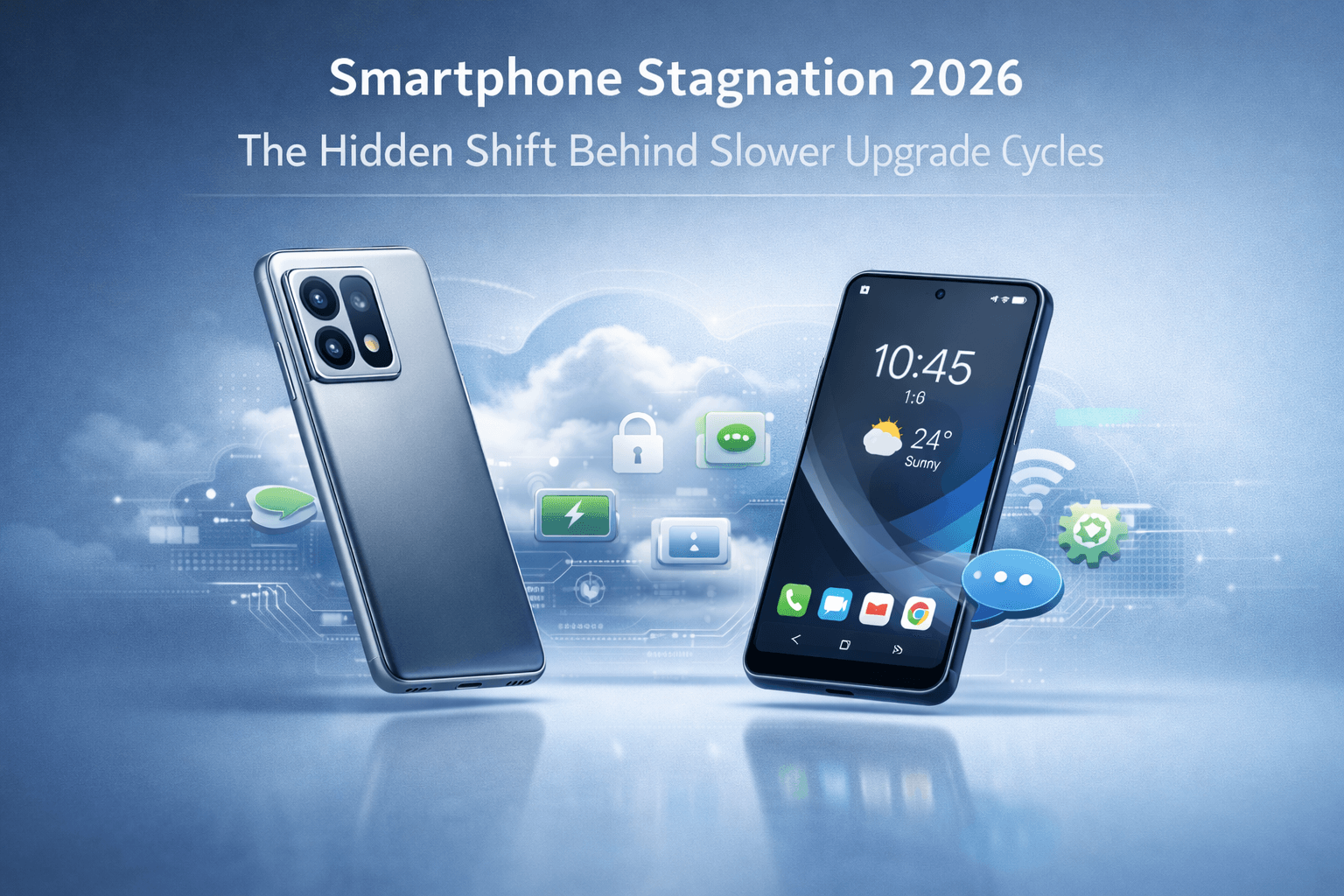
The review unit arrived on schedule, exactly as expected — sealed packaging, polished presentation, a familiar sense that another year in mobile technology had officially begun. The device powered on instantly, restoring messages and photos from the cloud within minutes. Within an hour, it felt indistinguishable from the phone it replaced. Apps opened at nearly identical speeds, gestures behaved the same way, and the camera produced images that looked reassuringly familiar rather than startlingly new.
For many industry observers, this moment marked a subtle turning point. The annual launch event still carried theatrical importance, yet the practical meaning of a new generation felt harder to define. Improvements existed — better image processing, slightly brighter displays, more efficient processors — but the experience no longer shifted in obvious ways. The excitement surrounding releases began to depend more on narrative than necessity, as if the industry were preserving a ritual whose original purpose had quietly faded.
This is where the idea of smartphone stagnation began to sound convincing even among people who understood the technology deeply. If each new generation felt similar to the last, it seemed reasonable to conclude that innovation had slowed. Yet inside the devices themselves, engineering teams were still solving difficult problems: reducing power leakage at advanced process nodes, training image models for new lighting conditions, and optimizing radio systems for increasingly crowded spectrum.
What changed was not the pace of innovation but the location where innovation happened. Features that once demanded new hardware generations started appearing through software updates and cloud-based improvements. A device purchased two years earlier could gain new photography modes or security features without ever leaving a user’s pocket.
The annual upgrade cycle assumed progress arrived in bursts. Modern smartphones instead evolve through accumulation, where hundreds of small changes gradually reshape the experience without announcing themselves as revolutions.
From a distance, this continuity resembles smartphone stagnation. Up close, it looks more like maturity — the point where a technology becomes stable enough that improvement no longer requires constant reinvention.
Stable technologies rarely produce dramatic chapters.
They produce long, quiet continuities.
The Device Became a Gateway Rather Than a Destination
A modern smartphone no longer defines its own capabilities. Much of what users perceive as device performance now depends on infrastructure operating far beyond the hardware itself — identity services, synchronization systems, remote storage, and machine learning models that evolve independently of product releases. The physical device remains essential, but its role has shifted from being the primary source of innovation to acting as a stable gateway into a constantly changing ecosystem.
This transformation became especially visible as companies such as Apple Inc. and Google extended software support timelines and integrated devices more tightly with cloud services. A phone could remain relevant for years because critical improvements arrived through operating systems and online services rather than new hardware. Capabilities once tied to specific models — image processing techniques or voice recognition improvements — gradually became platform features instead of device features.
Semiconductor firms including Qualcomm and manufacturing partners like TSMC reinforced this shift by focusing on efficiency and specialization. Instead of dramatic leaps in general-purpose performance, new chips introduced dedicated subsystems for photography, artificial intelligence, and connectivity. These subsystems improved the overall experience without producing a single headline feature that defined a generation.
Innovation became distributed across layers.
Software updates delivered interface changes.
Cloud services delivered new capabilities.
Silicon improvements delivered efficiency.
The device itself increasingly served as a synchronization point where these independent streams met.
This diffusion of progress helps explain why smartphone stagnation appears plausible when observed through the lens of annual releases. The traditional cycle assumed meaningful improvements would cluster around launch events, creating clear generational boundaries. In practice, improvements now arrive continuously, making those boundaries less meaningful each year.
There is no simple diagram that captures this shift because the system no longer moves in a single direction. New capabilities can originate in cloud infrastructure, chip design, or software frameworks, and each path influences the others in unpredictable ways.
The smartphone became less like a finished product and more like an interface to an evolving environment.
Interfaces change slowly because stability is their primary purpose.
When Breakthroughs Had Obvious Shapes
Early generations of smartphones advanced through visible breakthroughs because fundamental problems remained unsolved. Displays lacked clarity, processors struggled with multitasking, and wireless networks imposed strict limits on what devices could accomplish. Each new generation addressed obstacles that users encountered daily, creating a strong connection between technological progress and perceived improvement.
Under those conditions, the annual release schedule served a practical engineering function. Hardware components required coordinated development cycles, and suppliers needed predictable demand forecasts. The yearly cadence synchronized design, manufacturing, and software development into a rhythm that made rapid advancement possible.
As core limitations disappeared, the nature of progress changed. Instead of enabling entirely new uses, improvements began refining experiences that already worked reliably. Camera systems improved dynamic range rather than basic functionality. Displays gained incremental brightness rather than transformative clarity. Processors optimized efficiency rather than simply achieving usability.
Where visible breakthroughs once reshaped daily use
| When the change arrived | What users suddenly noticed | Why replacement felt justified |
|---|---|---|
| Multi-touch interfaces became reliable | Interaction felt direct instead of mechanical | Older devices felt immediately outdated |
| Mobile broadband stabilized | Web services became practical everywhere | Connectivity transformed usage habits |
| All-day battery life became normal | Charging anxiety disappeared | Convenience improved dramatically |
| Advanced computational photography emerged | Phones replaced dedicated cameras | New creative possibilities appeared |
| Secure biometric unlocking matured | Security became effortless | Daily friction was reduced |
These transitions created strong generational identities. Each release could be associated with a defining improvement that distinguished it from previous models.
Once those defining problems were solved, the rhythm persisted even as its original purpose weakened. Observers began interpreting the resulting continuity as smartphone stagnation, mistaking the disappearance of dramatic breakthroughs for a decline in innovation itself.
In reality, the technology had simply reached a phase where progress became less visible.
Mature systems tend to improve quietly because stability becomes more valuable than novelty.
The smartphone eventually reached that phase.
Why Continuous Improvement Feels Like No Improvement
Human perception favors contrast over continuity. People remember moments of change far more clearly than gradual refinement, which makes steady technological progress difficult to recognize. Once performance crosses a threshold where everyday tasks feel effortless, additional improvements often register as abstractions rather than experiences.
This perceptual bias strongly influences how users interpret smartphone stagnation. Processing speed increases may reduce delays by fractions of a second, yet those reductions rarely produce memorable differences. Display improvements can enhance color accuracy and brightness while leaving casual viewing experiences largely unchanged. Battery efficiency gains often translate into safety margins rather than dramatic extensions of usage time.
How perception drifts away from engineering reality
| What users tend to conclude | What engineers actually improved | Why the difference goes unnoticed |
|---|---|---|
| "Performance is basically the same" | Efficiency and background processing | Tasks already feel instantaneous |
| "Cameras stopped improving" | Image processing and low-light handling | Improvements appear subtle in good lighting |
| "Battery life hasn't changed" | Power management algorithms | Gains appear as reliability instead of duration |
| "Old phones still feel modern" | Long-term software optimization | Updates blur generational boundaries |
Software updates intensify this effect by extending the useful life of older devices. New interface features and security improvements can make a multi-year-old phone feel contemporary, weakening the psychological distinction between generations. The result is a gradual shift in expectations, where users come to assume that devices should remain capable for longer periods.
Continuous improvement produces fewer memorable milestones.
Milestones are what defined earlier innovation cycles.
Without those moments, progress becomes harder to narrate, and the idea of smartphone stagnation gains credibility even when technical advancement continues at a steady pace.
Innovation did not disappear.
It became harder to perceive.
Intelligence Moved Off the Device Before Anyone Noticed
One of the least visible transformations in modern smartphones is the gradual relocation of intelligence away from the hardware itself. Early devices depended almost entirely on local processing, which meant meaningful improvements required new chips and new hardware generations. Today, much of what users experience as intelligence is distributed across software layers and remote systems that evolve independently of product releases.
Photography illustrates this shift clearly. Image quality once depended heavily on sensor size and optics, but modern pipelines increasingly rely on machine learning models that continue improving after devices ship. Updates refine noise reduction, subject detection, and tone mapping without requiring new hardware. A phone released years earlier can sometimes produce better images after a software update than it did at launch.
Voice recognition and language processing followed a similar path. Improvements now depend largely on evolving models and cloud infrastructure rather than device replacement. The smartphone acts as a local interface to systems that improve continuously in the background.
This distributed intelligence plays a major role in how smartphone stagnation is perceived. Because improvements arrive quietly through updates, they rarely align with hardware release cycles. Users may notice that their devices gradually become more capable without associating those changes with a new generation.
Innovation becomes ambient rather than episodic.
The traditional upgrade model depended on discrete improvements that could be demonstrated on stage during product announcements. Continuous intelligence improvements resist that format because they unfold over months or years rather than appearing at a single moment.
The more intelligence moves into software and services, the less meaningful the concept of a hardware-driven innovation cycle becomes.
Progress continues, but it becomes harder to package into a yearly narrative.
Hardware Reached the Point Where Limits Became Subtle
Modern smartphones operate within physical constraints that have become increasingly difficult to push without trade-offs. Earlier generations benefited from dramatic improvements in semiconductor scaling and battery efficiency, but recent progress has required more careful balancing between performance, heat, and power consumption. Engineering teams now operate closer to practical limits, where improvements often appear as optimizations rather than revolutions.
Thermal management illustrates this reality. Processors can achieve higher peak performance than most users will ever require, but sustaining that performance requires dissipating heat within extremely small volumes. Increasing power consumption risks uncomfortable temperatures and reduced battery life, forcing designers to prioritize efficiency over raw speed.
Display technology follows a similar pattern. Brightness and refresh rates have improved significantly, yet further gains require additional power that must be balanced against battery capacity. Each improvement introduces trade-offs that become harder to resolve without increasing device size or weight.
Where engineering progress now involves negotiated compromises
| Where engineers push forward | What improvement becomes possible | What constraint pushes back | How the result appears to users |
|---|---|---|---|
| Processor efficiency tuning | Faster sustained performance | Thermal limits in thin enclosures | Devices feel consistently fast rather than dramatically faster |
| Display brightness increases | Better outdoor visibility | Higher energy consumption | Screens appear clearer only in challenging conditions |
| Camera sensor expansion | Improved low-light capture | Physical thickness constraints | Camera bumps grow gradually |
| Battery density improvements | Longer operational margins | Charging safety requirements | Reliability improves more than duration |
| Radio optimization | More stable connectivity | Spectrum congestion | Fewer dropouts rather than faster speeds |
These negotiated constraints shape the experience of modern devices. Instead of dramatic breakthroughs, improvements appear as refinements that preserve stability while gradually extending capability.
This environment reinforces perceptions of smartphone stagnation, even though engineering teams continue solving complex problems. The solutions simply produce smoother experiences rather than disruptive changes.
Mature technologies often reach a stage where progress becomes increasingly expensive while visible improvements become smaller.
Smartphones have entered that stage.
Inside the Meetings Where Cycles Are Quietly Rewritten
Innovation cycles rarely change through explicit decisions. More often they evolve through a series of incremental choices made inside product planning meetings, where engineering priorities, financial constraints, and market expectations intersect. Over time these decisions reshape how products develop, even if no single moment marks the transition.
Within large manufacturers, product teams must coordinate long-term roadmaps across multiple departments. Engineering groups propose new technologies, financial planners evaluate costs, and marketing teams assess whether proposed features can be communicated clearly to customers. The resulting compromises determine which innovations reach production and which remain experimental.
This process has gradually shifted the industry toward stability. Predictable improvements reduce risk and simplify supply chains, making it easier to coordinate global manufacturing. Radical changes introduce uncertainty that can disrupt production schedules or create compatibility issues across ecosystems.
How competing priorities reshape innovation decisions
| Who pushes for change | What they typically want | What limits the proposal | What finally reaches production |
|---|---|---|---|
| Engineering teams | New architectures and components | Manufacturing readiness | Incremental hardware revisions |
| Financial planners | Cost stability and margins | Market competition | Controlled bill-of-material increases |
| Software teams | Long support lifetimes | Hardware fragmentation | Stable platform baselines |
| Marketing divisions | Clear upgrade stories | Technical reality | Select headline features |
| Supply-chain managers | Predictable component demand | Innovation uncertainty | Gradual transitions |
These dynamics help explain why smartphone stagnation often appears structural rather than temporary. When multiple departments independently favor stability, the resulting products naturally evolve through refinement rather than disruption.
Innovation still occurs, but it must fit within systems optimized for reliability.
Reliability favors continuity.
Continuity weakens cycles.
When Annual Launches Became Narrative Infrastructure
Smartphone manufacturers continue releasing devices on predictable schedules even as the meaning of those releases has changed. The annual launch cycle now functions as a form of narrative infrastructure — a way to maintain visibility and reinforce brand identity rather than simply delivering technological breakthroughs.
Companies such as Samsung Electronics and Xiaomi rely on regular releases to sustain attention in highly competitive markets. Even modest improvements can be framed as meaningful progress when presented within a structured story about innovation. Launch events create moments of focus that keep brands relevant even during periods of gradual technological change.
This narrative role helps explain why the traditional cycle persists despite weakening technical justification. Regular releases maintain relationships with carriers, retailers, and media organizations that depend on predictable product timelines. The cycle supports an entire ecosystem of reviews, comparisons, and promotional campaigns.
How the launch cycle functions beyond technology
| What the launch promises publicly | What the release achieves internally | What the ecosystem gains |
|---|---|---|
| A new generation of devices | Predictable revenue intervals | Stable supplier planning |
| Visible innovation | Platform continuity | Reliable media coverage |
| Clear upgrade choices | Inventory turnover | Retail engagement |
| Competitive positioning | Market presence | Consumer awareness |
| Technological leadership | Brand reinforcement | Industry momentum |
This structure shapes how progress is perceived. When improvements are presented within a yearly narrative, smaller changes can appear significant, while continuous improvements that occur between releases remain largely invisible.
The persistence of this narrative contributes to interpretations of smartphone stagnation because expectations remain tied to an older model of innovation. Observers still look for dramatic generational leaps even though the industry increasingly delivers gradual evolution.
The launch cycle survives because it organizes attention.
But attention is no longer where innovation lives.
Innovation Means Different Things Depending on Where You Stand
The meaning of technological progress changes dramatically depending on social and economic context. In saturated markets where most users already own capable devices, innovation is often judged by the extent to which it reshapes daily routines. In emerging markets, the same improvements may represent meaningful increases in access, reliability, or longevity. A feature that appears incremental in one region can feel transformative in another, even when the underlying technology is identical.
This divergence complicates the narrative around smartphone stagnation because observers often interpret global markets through local expectations. Analysts in mature markets tend to focus on the absence of dramatic upgrades, while users in rapidly growing markets may value stability and durability more highly than novelty. Longer software support, improved battery management, and durable components can represent significant advances even if they attract little attention during product launches.
In many regions, the smartphone has shifted from being an aspirational technology to a dependable utility. When a product becomes essential infrastructure, innovation begins to emphasize reliability rather than spectacle. Devices are expected to function consistently across years of use, which encourages manufacturers to prioritize predictable improvements over risky experiments.
How the meaning of progress shifts across usage contexts
| Where innovation is judged | What people expect improvement to look like | What manufacturers increasingly deliver | Why interpretations diverge |
|---|---|---|---|
| Saturated premium markets | Dramatic generational leaps | Incremental refinement | High baseline expectations |
| Cost-sensitive segments | Better value per device | Efficiency improvements | Replacement cycles are longer |
| Professional workflows | Stable performance | Consistency and reliability | Interruptions carry real costs |
| Infrastructure-dependent users | Long-term usability | Extended support periods | Devices function as essential tools |
| Technology enthusiasts | Visible breakthroughs | Platform-level improvements | Improvements occur outside hardware |
The gap between expectation and delivery strengthens the perception of smartphone stagnation, particularly among audiences accustomed to earlier periods of rapid change. When innovation becomes distributed across infrastructure and services, it becomes harder to evaluate through product comparisons alone.
Progress continues, but its meaning becomes less universal.
Different users begin measuring improvement with different yardsticks.
Three Stories That Reveal How Cycles Actually Changed
Understanding the transformation of smartphone innovation cycles requires looking beyond aggregate trends to examine specific outcomes. Individual product experiences often reveal structural changes more clearly than industry-wide statistics, especially when expectations collide with reality in unexpected ways.
One clear example of success involves long-term software support. Devices that continue receiving major updates several years after release often feel surprisingly current, extending their useful lives well beyond earlier norms. Owners who expected to replace their phones quickly instead discovered that performance and features remained adequate, reshaping expectations about replacement timelines. What once would have counted as rapid obsolescence became sustainable longevity.
A contrasting example comes from experimental form factors. Devices that attempted to introduce radically different designs often encountered durability challenges or limited software adaptation. Even when the underlying technology proved promising, practical concerns slowed adoption. The experience demonstrated that innovation must align with ecosystem readiness rather than simply demonstrating technical feasibility.
A third example involves misunderstood improvements in efficiency. Many users underestimate the significance of incremental gains in battery management and processor optimization because these improvements reduce problems rather than creating new capabilities. Reliability increases gradually without producing dramatic moments of discovery.
Where expectations met reality in unexpected ways
| What observers predicted | What actually happened in practice | What explains the gap |
|---|---|---|
| Rapid replacement cycles would continue | Devices remain usable for many years | Software support extended lifetimes |
| New form factors would quickly dominate | Adoption progressed gradually | Ecosystem adaptation takes time |
| Faster processors would transform usage | Everyday behavior changed little | Performance already exceeded needs |
| Camera improvements would plateau | Quality improved subtly | Algorithms continued evolving |
| Annual launches would define progress | Improvements spread across updates | Innovation became asynchronous |
These patterns reinforce the structural nature of smartphone stagnation as a perception rather than a literal slowdown. Many changes still occur, but they unfold across longer timelines and multiple layers, making them less visible through traditional product comparisons.
Innovation cycles did not disappear.
They expanded beyond the boundaries of individual devices.
The Stories We Tell About Progress Versus What Actually Changed
Public discussions about smartphone innovation often rely on simplified narratives that obscure the complexity of technological change. These narratives persist because they provide clear explanations for subtle trends, even when they fail to capture the underlying dynamics accurately. Over time, repeated assumptions harden into widely accepted beliefs that shape how new developments are interpreted.
The idea of smartphone stagnation fits this pattern particularly well. It offers a straightforward explanation for why new devices appear similar to older ones, even though the underlying causes involve multiple interacting factors. Once the narrative becomes familiar, new product releases are interpreted through that lens, reinforcing the impression that progress has slowed.
Where common assumptions diverge from observable reality
| What people assume about the industry | What careful observation shows instead | Why the belief continues |
|---|---|---|
| Innovation slowed dramatically | Improvement became distributed across layers | Hardware comparisons dominate coverage |
| New devices offer little value | Benefits accumulate gradually | Improvements appear subtle individually |
| Technology reached a ceiling | Constraints shifted toward efficiency | Limits appear similar to stagnation |
| Replacement cycles collapsed unexpectedly | Devices became more durable and supported | Longevity reduces urgency |
| Software matters less than hardware | Platforms shape most experiences | Hardware launches receive attention |
Misinterpretations tend to persist because they align with visible evidence. When successive devices appear similar, it is natural to infer that technological change has slowed. The deeper explanation — that innovation now occurs continuously across ecosystems — requires more effort to observe and communicate.
The narrative of smartphone stagnation survives because it simplifies a complicated transformation into a single idea.
Simple explanations travel farther than nuanced ones.
Innovation Became More Expensive Than It Looks
Behind the apparent continuity of modern smartphones lies an economic environment that increasingly favors incremental development. As technologies mature, the cost of achieving measurable improvements rises, requiring larger investments to produce smaller visible gains. This economic reality influences design decisions in ways that shape innovation cycles even when technical possibilities remain open.
Advanced semiconductor manufacturing illustrates the scale of this shift. Each new process generation requires enormous capital investment, and the resulting performance improvements often focus on efficiency rather than dramatic speed increases. Manufacturers must balance the cost of adopting new technologies against the competitive advantages those technologies provide, leading to carefully staged transitions rather than abrupt leaps.
Research and development costs follow similar patterns. Improving camera pipelines, wireless systems, and power management requires large teams working over extended periods, yet the resulting benefits may appear incremental from a consumer perspective. Companies must decide which improvements justify investment and which can be deferred to future generations.
Where the cost of progress quietly shapes the pace of change
| Where investment concentrates | What improvement becomes possible | What makes it expensive | How the effect appears externally |
|---|---|---|---|
| Semiconductor development | Greater efficiency | Fabrication complexity | Modest performance gains |
| Camera systems | Better image processing | Algorithm training and tuning | Subtle quality improvements |
| Battery research | Improved longevity | Safety and materials testing | Incremental reliability gains |
| Connectivity systems | Stable high-speed networks | Infrastructure coordination | Fewer visible changes |
| Software ecosystems | Extended support lifetimes | Ongoing maintenance costs | Devices age more slowly |
These economic constraints reinforce perceptions of smartphone stagnation because they encourage gradual evolution rather than radical redesign. Even when significant improvements become technically feasible, the cost of implementation often favors incremental adoption.
Innovation continues under these conditions, but it becomes more deliberate.
Deliberate progress rarely appears dramatic.
When Reliability Broke the Upgrade Engine
The turning point in modern handset history did not arrive with a dramatic invention. It arrived quietly, as devices stopped failing at the pace the industry expected. Over time, improvements in battery chemistry stability, thermal management, storage endurance, and software optimization combined into something more disruptive than a breakthrough feature: predictability. When hardware stabilized, the economic rhythm that had sustained rapid replacement began to fracture. This shift reframed smartphone stagnation not as a slowdown in creativity, but as a structural change in how innovation cycles operate. Instead of needing new devices to restore usability, users could extend ownership without meaningful compromise.
Manufacturers had long depended on a replacement engine built on necessity. Earlier generations aged unevenly, developing visible slowdowns or battery weakness within a few years. That decay reinforced a predictable upgrade cadence. Once reliability improved, the urgency faded. The device in a user’s pocket no longer pushed them toward replacement; the decision became optional. What appears externally as smartphone stagnation is partially the result of this reliability shock, where durability disrupted the economic assumptions that shaped earlier innovation cycles.
| Lifecycle Phase | Typical User Experience | Replacement Pressure | Industry Outcome |
|---|---|---|---|
| Early smartphone era | Rapid performance decay | High | Fast upgrade cycles |
| Maturing hardware phase | Gradual aging | Moderate | Slower refresh rhythm |
| Modern stability phase | Consistent performance | Low | Irregular replacement behavior |
| Extended ownership phase | Secondary-device use | Minimal | Longer lifecycle economics |
Reliability altered not only user behavior but also product strategy. Companies began investing more in ecosystem services and software longevity because hardware replacement alone could no longer sustain growth. The predictable annual upgrade lost its inevitability. The upgrade engine did not disappear; it transformed into something less mechanical and more discretionary. That transformation is one of the deepest forces behind the perception of smartphone stagnation, because stability makes progress harder to perceive.
The Hidden Role of Hardware Decay
Early mobile devices rarely failed catastrophically; instead they deteriorated in ways that gradually reduced satisfaction. Battery endurance declined unevenly, processors struggled with newer software, and storage limitations forced compromises. These forms of decay were subtle but powerful, creating a constant pressure toward replacement. Hardware aging functioned as an invisible market driver, pushing users toward newer models long before devices stopped working entirely. The perception that innovation once moved faster is inseparable from this period of accelerated deterioration.
That environment created a self-reinforcing cycle. As users replaced devices frequently, manufacturers could rely on predictable demand. Short ownership periods allowed rapid iteration because each generation had a guaranteed audience. When hardware longevity improved, that cycle weakened. Smartphone stagnation emerged partly because innovation cycles had previously been synchronized with decay cycles. Once the two separated, annual releases lost their structural necessity.
| Hardware Factor | Earlier Generations | Modern Generations |
|---|---|---|
| Battery degradation | Noticeable within 1–2 years | Slower, more manageable decline |
| Thermal stability | Frequent throttling | Controlled heat behavior |
| Storage endurance | Higher failure risk | Improved longevity |
| Software support | Limited lifespan | Extended update windows |
| Performance aging | Rapid slowdown | Gradual change |
Decay once acted as a market signal. Users did not need benchmarks to know their devices were aging; everyday experience made the decline obvious. When aging became less visible, replacement decisions required more deliberate justification. The disappearance of decay-driven upgrades helped reshape innovation timelines and reinforced the narrative of smartphone stagnation, even as technical progress continued beneath the surface.
The Rise of Multi-Stage Device Lifetimes
Modern devices increasingly pass through distinct phases of ownership rather than ending with a single replacement event. A device might begin as a primary tool, later become a backup unit, and eventually serve specialized roles such as media playback or home automation control. This extended lifecycle reflects improved engineering predictability and has transformed the meaning of ownership. Instead of a simple replacement cycle, devices now move through layered stages of usefulness.
This transition illustrates how smartphone stagnation is often misinterpreted. When devices remain useful across multiple stages, innovation becomes less visible because replacement intervals expand. The technical baseline has risen high enough that even older models remain capable for many tasks. Performance margins that once drove upgrades now function as reserves, allowing devices to stay relevant longer.
| Usage Stage | Typical Role | Performance Expectations | Upgrade Motivation |
|---|---|---|---|
| Primary phase | Daily communication and apps | High responsiveness | Feature-driven |
| Mature phase | Reliable everyday use | Stable performance | Optional |
| Secondary phase | Backup or limited tasks | Moderate capability | Minimal |
| Residual phase | Specialized functions | Basic operation | None |
Extended lifetimes also influence product development. Manufacturers must support devices longer while still introducing meaningful improvements. This tension encourages incremental refinement rather than dramatic redesign. The resulting products may feel less revolutionary, reinforcing perceptions of smartphone stagnation, even though engineering sophistication continues to increase.
Predictable aging curves make long-term ownership easier to plan. Users can estimate how long devices will remain useful, reducing uncertainty and weakening the impulse to upgrade quickly. Innovation cycles therefore stretch outward, shaped less by sudden technological shifts and more by gradual improvements that accumulate over time.
The Point Where Hardware Stopped Forcing Change
There was a period when physical improvements alone justified new devices. Larger displays, faster processors, and better cameras created obvious advantages that older models could not match. Over time, those improvements approached practical limits. Displays reached resolutions beyond typical viewing distances, processors exceeded everyday requirements, and materials stabilized into familiar combinations of glass and metal. Hardware progress did not stop, but it ceased to force replacement in the way it once had.
This transition lies at the center of smartphone stagnation narratives. When performance surpasses common needs, improvements become harder to perceive. Engineering progress continues through efficiency gains, thermal optimization, and subtle refinements, yet the experiential difference between generations narrows. Users encounter a paradox in which devices improve technically while appearing unchanged.
| Hardware Domain | Early Progress Pattern | Current Progress Pattern | User Visibility |
|---|---|---|---|
| Displays | Rapid resolution jumps | Incremental refinement | Low |
| Processing power | Large performance leaps | Efficiency optimization | Moderate |
| Cameras | Major capability gains | Algorithmic tuning | Moderate |
| Materials | Frequent changes | Stable compositions | Low |
| Battery systems | Basic improvements | Controlled longevity | Moderate |
As hardware stabilized, innovation shifted toward integration and ecosystem design. The device itself became less dominant within the broader experience, sharing importance with software platforms and connected services. The perception of smartphone stagnation reflects this shift from visible hardware leaps to systemic progress, where advances occur across networks of devices rather than within a single product.
Hardware once dictated the tempo of change. Today it sets the boundary conditions within which other forms of innovation unfold. The result is not the end of progress, but a transformation in how progress becomes visible.
When Enthusiasts Stopped Expecting Surprises
Real Reddit Discussions
- “Anyone else feel phone upgrades are getting boring?”
https://www.reddit.com/r/Android/comments/1potlm6/anyone_else_feel_phone_upgrades_are_getting_boring/ - “Anyone else feel like phones used to be way more exciting?”
https://www.reddit.com/r/IndiaTech/comments/1nzeryn - “Lack of innovation in appearance of smartphones.”
https://www.reddit.com/r/Smartphones/comments/1laaotc - Upgrade frequency discussion
https://www.reddit.com/r/Anticonsumption/comments/1dgjo91
Reddit Sentiment Map
| Core Theme Observed | Typical User Statement Pattern | Underlying Belief | Strategic Interpretation |
|---|---|---|---|
| Incremental upgrades | "Feels the same every year" | Progress has slowed | Innovation cycles stretched |
| Longer ownership | "I use phones 3–4 years" | Devices last longer | Reliability reshaped cycles |
| Design uniformity | "All phones look alike" | Creativity declined | Convergence phase |
| Performance surplus | "Phones are overpowered" | Improvement unnecessary | Maturity reached |
| Selective excitement | "Real upgrade every few years" | Innovation still exists | Cyclic breakthroughs |
The strongest signal across enthusiast communities is not anger but resignation. Many users describe new releases as predictable rather than disappointing. One discussion notes that meaningful upgrades now require “3–4 years apart,” suggesting that innovation has shifted from annual to multi-year cycles. Reddit
Shorter replacement expectations have been replaced by deliberate timing. Some users openly describe choosing upgrades only when devices fail or software support ends. Reddit
This behavioral shift directly reshapes how smartphone stagnation is perceived. From the enthusiast perspective, the problem is not the absence of innovation but the absence of visible change. Improvements in performance and efficiency accumulate quietly, making year-to-year comparisons feel insignificant. Reddit
Another common theme is the sense that earlier periods offered more experimentation. Users recall shifting display designs, camera layouts, and form factors as signs of rapid evolution. Reddit
Modern devices appear visually stable by comparison. Rectangular touchscreens dominate the market, reinforcing the perception that design innovation has stopped.
Yet beneath this nostalgia lies a more nuanced understanding. Many participants acknowledge that incremental improvements eventually produce meaningful change. The difference is temporal scale: innovation that once appeared annually now becomes noticeable only over longer intervals.
This reinterpretation is central to understanding smartphone stagnation. Enthusiast communities are often the earliest detectors of structural industry change. Their conversations reveal a transition from excitement-driven upgrades to utility-driven ownership. The emotional tone is not despair but adaptation.
The expectation of yearly transformation has quietly disappeared.
What Buyers Actually Say After Purchase
Real Review Signals (Aggregated from Public Sources)
| Rating Pattern | Typical Comment Theme | Interpretation | Structural Signal |
|---|---|---|---|
| 5★ | Reliable and polished | Stability valued | Mature products |
| 4★ | Good but incremental | Limited excitement | Evolutionary change |
| 3★ | Not worth upgrading | Weak differentiation | Cycle extension |
| 2★ | Minor frustrations | Expectations unmet | Marketing mismatch |
| 1★ | Rare hardware issues | Reliability failures | Outliers |
Consumer feedback consistently shows that buyers value stability and longevity as much as novelty. Surveys and review analyses indicate that users increasingly keep devices longer because newer models often feel only slightly better than existing ones. Vibetric
Recent product reviews reinforce this pattern. Some devices are described as solid products that nevertheless feel unnecessary to upgrade to, even when technically improved. Tom’s Guide
This expectation gap shapes perceptions of smartphone stagnation. Buyers do not necessarily dislike modern devices; instead, they struggle to justify replacement. When products meet expectations reliably, dissatisfaction declines, but excitement also fades.
Earlier generations triggered emotional responses because improvements solved visible problems. Faster processors eliminated lag. Larger batteries extended usability. Better cameras transformed everyday photography.
Modern improvements often refine already competent systems. Efficiency gains extend battery life slightly. Cameras improve in subtle conditions. Software adds capabilities that many users rarely explore.
From a review perspective, the result is paradoxical. Ratings remain high while enthusiasm declines. The industry produces better devices than ever before, yet many users perceive little urgency to upgrade.
This dynamic demonstrates why smartphone stagnation is better understood as a change in innovation visibility rather than a collapse of progress.
The Era When Breakthroughs Became Invisible
Future innovation cycles are unlikely to return to the dramatic pace of early mobile computing. Instead, progress will unfold through layered systems where hardware, software, and services evolve at different speeds. This multi-layered rhythm will define the next decade.
The perception of smartphone stagnation will likely continue because foundational technologies are approaching maturity. Displays, processors, and batteries still improve, but their trajectories are stabilizing. Future breakthroughs will emerge from integration rather than isolated components.
Possible innovation trajectories include:
| Innovation Domain | Likely Direction | Probability | Reasoning Basis |
|---|---|---|---|
| On-device AI | Strong growth | High | Computational trends |
| New form factors | Gradual adoption | Medium | Cost constraints |
| Battery chemistry | Slow improvement | Medium | Physics limits |
| Wearable integration | Expanding role | High | Ecosystem growth |
| Fully new interfaces | Rare breakthroughs | Low | Usability barriers |
Incremental progress will remain the dominant pattern. Even transformative technologies may appear slowly as costs decline and reliability improves.
The shift from visible leaps to structural integration will reinforce perceptions of smartphone stagnation, even if overall capability continues to expand.
Future innovation will feel quieter but more systemic.
Instead of dramatic launches redefining the category, progress will accumulate through subtle changes that reshape long-term usage patterns.
The Moment Phones Became Long-Term Infrastructure
As devices remain useful longer, ethical and structural questions become more important. Repairability, software support, and sustainability now influence purchasing decisions as much as raw performance.
Extended update commitments have become a competitive feature, reflecting the expectation that devices should last many years.
This transition connects directly to smartphone stagnation. When innovation cycles lengthen, ownership becomes a long-term relationship rather than a temporary phase.
Ethical considerations increasingly shape product design.
| Ethical Dimension | Traditional Model | Emerging Model | Strategic Impact |
|---|---|---|---|
| Software updates | Short-term | Extended support | Longer lifetimes |
| Repairability | Limited | Improving | Sustainability value |
| Data usage | Expanding | Scrutinized | Trust factor |
| Materials | Disposable | Recyclable | Regulatory pressure |
| Ownership | Temporary | Long-term | Changed expectations |
Longer ownership shifts power toward users. When replacement is optional, manufacturers must compete on trust and reliability rather than novelty.
The narrative of smartphone stagnation partly reflects this transition from disposable technology to durable infrastructure.
Devices are becoming less like gadgets and more like long-term tools.
That transformation changes not only how innovation occurs, but also how it is judged.
Buying Decisions After the Upgrade Clock Disappeared
For much of the mobile era, purchase decisions followed a simple logic: new models solved problems that older ones could not. Slow performance, weak batteries, or limited cameras created clear motivations to upgrade. That clarity has largely disappeared. Buyers now face a different landscape in which replacement is rarely necessary and improvements accumulate gradually. Navigating this environment requires a different framework, because the perception of smartphone stagnation often leads consumers to make decisions based on habit rather than need. Instead of assuming that each generation offers meaningful change, buyers must evaluate how devices fit into longer ownership horizons.
Decision-making increasingly depends on anticipating how a device will age rather than how it performs on day one. Thermal behavior, battery replacement options, and software support timelines often matter more than peak performance. The absence of urgent upgrade pressure allows users to optimize for durability and stability instead of novelty. This shift turns purchasing into a strategic decision rather than a reactive one, especially in an environment shaped by smartphone stagnation, where improvements become meaningful only over longer intervals.
| Decision Persona | What Actually Matters Over Years | Real Replacement Trigger | Mistake Most Buyers Make |
|---|---|---|---|
| Basic users | Reliability and battery life | Device becomes inconvenient | Paying for unused power |
| Creators | Camera consistency and storage | Tools stop evolving | Underestimating storage growth |
| Power users | Thermal behavior and efficiency | Performance limits reached | Chasing small gains |
| Long-term owners | Update lifespan | Support ends | Waiting too long |
The absence of urgency also introduces psychological challenges. Without clear triggers, buyers often rely on marketing narratives or release cycles as decision guides. These signals rarely align with individual needs. A disciplined approach requires separating genuine improvements from routine iteration. As innovation cycles stretch, the most effective decisions come from evaluating whether a new device enables capabilities that genuinely matter. In this context, understanding smartphone stagnation becomes practical rather than theoretical, because it helps users recognize when waiting provides greater value than upgrading immediately.
Seeing the Pattern Behind Ten Years of Releases
Understanding long-term technological change requires more than comparing specifications. Individual product launches reveal only fragments of a larger pattern. This investigation approaches the subject by tracing structural forces that shape innovation cycles: engineering constraints, economic incentives, user behavior, and ecosystem evolution. The goal is not to declare whether progress has slowed but to understand how the perception of smartphone stagnation emerges from interactions between these forces.
Evidence comes from multiple layers of observation. Engineering trends reveal how physical limits influence design choices. Industry strategies show how companies respond to shifting replacement behavior. User discussions illustrate how expectations evolve over time. Together these perspectives create a picture that cannot be captured by short-term reviews or launch coverage. The narrative that defines smartphone stagnation becomes clearer only when viewed across long time horizons, where patterns emerge that remain invisible in annual comparisons.
| Signal Tracked | Where the Evidence Came From | What It Revealed | Where Uncertainty Remains |
|---|---|---|---|
| Engineering evolution | Hardware generations | Physical limits | Slow visibility |
| Product strategy shifts | Manufacturer behavior | Economic pressure | Partial transparency |
| User perception trends | Online communities | Expectation change | Emotional bias |
| Ownership patterns | Replacement timelines | Cycle extension | Long observation periods |
This method emphasizes causal relationships rather than isolated facts. Instead of asking whether individual products are innovative, the analysis examines how innovation cycles evolve. By focusing on structural forces, the investigation explains why modern devices can simultaneously improve and appear unchanged. The perception of smartphone stagnation emerges not from a single cause but from overlapping systems that reshape how progress becomes visible.
The Vibetric Verdict: Innovation Didn’t Slow — The Clock Changed
The history of modern devices reveals a pattern that is easy to misunderstand. Early years were defined by rapid capability expansion, visible improvements, and frequent replacement. That period established expectations that innovation should be dramatic and continuous. When progress became steadier and less visible, many observers concluded that creativity had faded. Yet the evidence suggests a different interpretation.
What appears as smartphone stagnation is better understood as a transition from expansion to consolidation. The category has matured into a stable technological foundation. Engineering progress continues, but it unfolds through refinement and integration rather than dramatic reinvention. Reliability improvements lengthen ownership. Ecosystems expand beyond individual devices. Innovation cycles stretch across longer periods.
This transformation creates a paradox. Modern devices are more capable and dependable than their predecessors, yet they inspire less excitement. Stability reduces urgency, and reduced urgency makes progress harder to perceive. The annual launch remains visible, but the deeper cycle operates on a slower timescale.
The most important change may be psychological. Users no longer depend on each generation to solve urgent problems. Instead they evaluate whether improvements justify replacement. That shift alters how innovation is experienced.
Smartphone stagnation is therefore not the end of progress. It is the sign of a technology that has become mature enough to disappear into everyday life.
Ready to Rethink the Future of Smartphone Innovation Cycles?
Now that you’ve explored the structural forces reshaping modern devices, you’re likely thinking differently about how technological progress actually unfolds. What once looked like predictable annual leaps has evolved into something more complex and less visible. The world of mobile technology continues to move forward, but the signals of change are subtler and spread across longer periods.
The shift often described as smartphone stagnation is really a transformation in how innovation appears and how users experience it. Engineering limits, economic realities, and behavioral changes have combined to reshape the tempo of progress. Understanding these deeper patterns allows you to interpret product launches with clearer perspective and less dependence on marketing narratives.
The world of technology is always evolving — there is always another layer beneath the surface.
- Follow us on Instagram@vibetric_official for deeper dives into the technologies and trends shaping the future of mobile innovation.
- Bookmark vibetric.com— our analysis evolves as new developments reshape the industry.
- Stay ahead of the curve by subscribing for ongoing insights and long-term technology analysis.
Want to dive even deeper? Stay with us as we continue exploring the forces shaping modern technology. The journey is just beginning, and the next major shift may already be underway.
Frequently Asked Questions About Modern Innovation Cycles
Many users interpret longer innovation cycles as smartphone stagnation, but the underlying cause is technological maturity. Early devices improved rapidly because basic problems needed solving. Modern devices refine already capable systems, making improvements less visible.
Not necessarily. Engineering progress continues in efficiency, software optimization, and integration. What has changed is the visibility of improvement. Many advances are incremental and accumulate over several generations rather than appearing in a single release.
Innovation cycles have stretched beyond annual product releases. Improvements that once occurred within a single generation now accumulate across multiple generations, making three-to-four-year intervals more noticeable.
Physical limits make certain improvements slower, but innovation continues in new areas such as on-device intelligence, ecosystem integration, and efficiency optimization.
Better materials, improved thermal control, and longer software support have extended usable lifetimes. Longer ownership periods naturally reduce the frequency of visible change.
Annual releases serve marketing and competitive needs even when innovation cycles extend beyond one year. They provide incremental improvements while maintaining market visibility.
Design convergence occurs when manufacturers discover forms that balance usability, durability, and manufacturing efficiency. Similar designs often indicate maturity rather than lack of creativity.
Major shifts sometimes accelerate innovation temporarily, but mature technologies typically return to slower cycles after initial breakthroughs.
Longer ownership periods often provide better value because improvements accumulate over time rather than appearing annually.
Modern devices are highly refined products. Even incremental improvements can produce excellent results, leading to strong reviews despite limited generational change.
The Quiet Moment After the Launch
The announcement ends, the specifications settle into memory, and the device returns to a pocket already occupied by something capable. Nothing feels outdated. Nothing feels urgent.
The rhythm has changed.
Progress continues, but it no longer announces itself loudly. What once arrived as sudden transformation now appears as gradual adjustment, visible only with distance.
The story of innovation is still unfolding — just more quietly than before.
What’s your take on this?
At Vibetric, the comments go way beyond quick reactions — they’re where creators, innovators, and curious minds spark conversations that push tech’s future forward.
Smartphone Stagnation 2026: The Hidden Shift Behind Slower Upgrade Cycles
Smartphone Stagnation 2026: The Hidden Shift Behind Slower Upgrade Cycles The review unit arrived on schedule, exactly as expected — sealed packaging,

OnePlus 15 Review 2026: Intelligent Performance in the AI Era
OnePlus 15 Review 2026: Intelligent Performance in the AI Era Performance used to be theatrical. Manufacturers showcased peak clock speeds, explosive benchmark