
The Smartphone Plateau — Why Innovation Has Slowed but Not Stopped
You notice it when you hold a new phone for the first time. Not the thrill you felt a decade ago, not the spark that made you re-read every spec sheet twice before even touching it. Instead, there’s a quiet pause — a moment where your brain tries to convince your heart that this rectangle is somehow different from the rectangle you already own. The store’s lighting reflects off the glass in a way meant to look premium, but your hand knows the truth: this shape has been familiar for too long. As the salesperson begins their polished script about AI enhancements and more intelligent sensors, your attention drifts to the wall behind them. Every phone looks like a mirror of the next, every promise feels like a softer echo of last year. The tension isn’t boredom — it’s something deeper. It’s the realization that your excitement hasn’t disappeared; it’s just been left with nothing worthy to latch onto. And yet, somewhere under that stillness, something whispers that the story isn’t over.
Because the moment you take that same phone outside the store — away from the polished pitch, away from the artificial clarity of showroom brightness — you begin to notice a quiet complexity hidden under the sameness. The stiffness of the frame when you grip it tighter. The subtle warmth along one edge when background AI models spin up. The way the camera stabilizes your shaking hand without asking. These aren’t leaps, but micro-evolutions stitched so tightly you only feel them when life gets chaotic: catching a moving subject at dusk, responding instantly in a crowded signal environment, switching between apps while downloading updates in the background. The plateau isn’t laziness. It’s physics closing in on what a handheld slab can achieve without rewriting its shape. And the consumer frustration, the sense that “nothing exciting is happening,” is real — but it’s aimed at a ceiling no one designed, only discovered.
There’s also the psychological weight: smartphones used to feel like the future arriving early. Now they feel like maintenance — necessary, functional, dependable, but rarely inspirational. The plateau changes the emotional contract between user and device. Instead of chasing thrill, the modern buyer hunts for trust: thermal predictability, real-world battery resilience, camera honesty under mixed lighting, silicon efficiency that doesn’t burn through energy just to win benchmark charts. People aren’t disappointed because smartphones are bad; they’re disappointed because they’ve matured. The tension comes from wanting magic in a category that has quietly entered its adulthood. And like any adulthood, it’s defined not by spectacle but by subtlety.
The smartphone plateau isn’t the end of innovation — it’s the end of obvious innovation. The dramatic shifts have gone underground; into layers the industry rarely tells the truth about.
⚙️ Evolution with Intention
The smartphone didn’t plateau because companies stopped trying; it plateaued because certain battles were won so decisively that further improvement offers diminishing emotional return. Displays reached near-retinal densities, touch latency dropped below conscious perception, cameras began merging computational data with optics in ways invisible to casual users. From the outside, everything feels like minor refinement. But from inside the engineering labs, the war shifted from bigger numbers to better behaviors. Heat dissipation dictates design more than aesthetics. Power efficiency throttles ambition more than creativity. And silicon architectures are no longer chasing maximum scores but maximum sustained performance under real-world workloads. Innovation now hides in curve optimizations — the slopes you don’t see until you stress the device in ways YouTube reviews never replicate. This isn’t stagnation. It’s the industry hitting the physical walls that force smarter, not louder, engineering.
Smartphones evolved with intention: to stabilize the experience, not inflate the spectacle. And the problem is that intentional evolution rarely excites at first glance.
Every major leap of the last five years solved a specific constraint, not a marketing desire. Battery chemistry improvements weren’t about endurance—it was about slowing swelling and extending lifespan. Sensor shifts weren’t about megapixels—they were about photon management in mixed lighting. Silicon NPU upgrades weren’t about AI buzzwords—they were about accelerating background processing so your device feels faster even when idle. The plateau narrative exists because these improvements attack invisible pain points instead of creating flashy headlines. Yet these invisible refinements shape 95% of user experience. The contradictions are everywhere: people demand thin phones but complain about heat; demand better cameras but reject camera bumps; demand more power but want longer battery life; demand new designs but refuse to buy “weird-looking” models. Innovators are boxed in by consumer psychology as tightly as by physics.
What looks like a slowdown is actually optimization disguised as stillness.
Evolutionary Leaps & What They Actually Solved
| Evolutionary Leap | What It Actually Solved (Real Constraint) |
|---|---|
| Larger sensors + computational fusion | Low-light instability, color inconsistency across lenses |
| Advanced NPUs | Background task load, app switching delays, energy drain |
| LTPO displays | Peak brightness vs battery conflict |
| Reverse charging & power management | Accessory dependency, emergency power gaps |
| New thermal architectures | Sustained performance drops during multitasking and gaming |
🏗️ Industry Web Breakdown
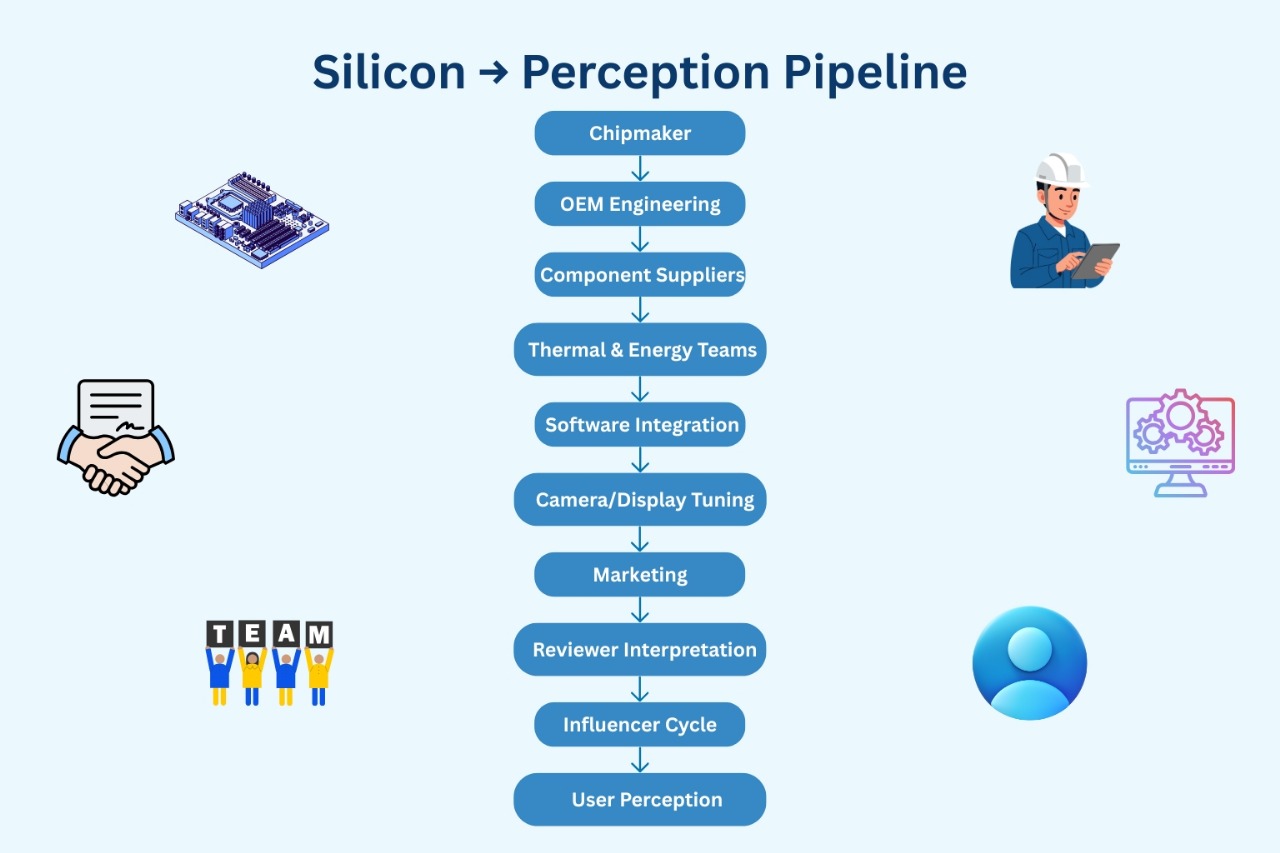
Behind every “incremental” smartphone launch sits a network far more tangled than most enthusiasts imagine. Chipmakers dictate not just the ceiling of performance but the personality of the phone: how fast it wakes, how it handles motion, how aggressively it throttles. OEMs then negotiate these constraints with design teams who must work backward from thickness targets, material availability, and thermal envelopes. Suppliers of lenses, copper foils, graphite layers, display panels, and battery modules all impose their own limitations—with timelines that rarely sync. Marketing teams enter late, armed with slogans that often have nothing to do with the true engineering struggle. Reviewers then judge the final result through benchmarks optimized for visibility, not realism. And influencers create perception loops where the loudest conclusion outranks the most accurate one. Every year, this ecosystem produces a device shaped less by ambition and more by the negotiation of invisible compromises.
When enthusiasts say “innovation has slowed,” what they’re actually witnessing is the negotiation becoming more complex — not weaker.
The smartphone plateau is also an ecosystem plateau. Silicon vendors hit transistor-density friction. OEMs hit cooling limitations in sealed slabs. Camera suppliers hit optical physics constraints in thin modules. Display manufacturers hit brightness-to-efficiency trade-offs. Even software teams hit diminishing perceptual returns — people can’t feel the difference between 0.2s and 0.15s app launch speeds. What changes now is where innovation hides. Not in the headline specs, but in the integration layers: how silicon talks to thermal sensors, how displays modulate brightness to save power, how AI co-processors predict camera movement before it happens, how modems adapt transmission strategies based on your environment. These are not upward leaps; they are lateral reinforcements — essential, sophisticated, but easy to overlook in an era addicted to spectacle.
The smartphone industry didn’t get lazy. It got complicated. That’s why the plateau feels real — and why most people misread it.
🔹Micro Analysis — Where the Smartphone Plateau Actually Shows Up
- Chipset Performance Gains Are Now Single-Digit
- The jump from one flagship chip to the next feels… mild.
- 2020–2022 gave us 20–30% leaps.
- 2024–2025 gives 5–10% — enough to brag, not enough to feel.
- Thermal ceilings and battery constraints are the bottlenecks, not silicon ambition.
- Cameras Look “Same Same” Because Physics Is the Limit
- Sensors can’t grow — phones are too thin.
- Bigger megapixels don’t mean better photos anymore.
- Computational photography is now 80% of the output — not hardware.
- This is one of the biggest contributors to the smartphone plateau.
- Display Upgrades Have Hit a Wall
- 60Hz → 120Hz was big. 120Hz → 144Hz is not.
- 1000 nits → 2500 nits matters only in sunlight, not Instagram.
- LTPO is now standard; OLED is mature.
- Beyond this, improvements are invisible to the human eye.
- Battery Life Is Better, But Charging Innovation Stalled
- 5000 mAh has become the comfy norm.
- Charging jumps (65W → 125W → 150W) stabilized — no longer annual.
- Because safety, regulation, and lithium limits are real.
- This makes phones feel same-ish across brands.
- AI Features Are the New USP, But Not a Hardware Revolution
- AI summaries, AI wallpapers, and AI editing feel gimmicky.
- On-device AI is the real future, but 2025 chips barely tap into it.
- OEMs are selling software vibes because hardware can’t flex anymore.
- Foldables Aren’t Mainstream Yet
- Creases improved but haven’t disappeared.
- Prices stay premium.
- Durability still scares mainstream buyers.
- Result: innovation exists, but it’s niche — not a plateau-breaker.
- Midrange Phones Are Now “Good Enough”
- This is the silent killer of excitement.
- A ₹25k phone today matches 80% of a ₹90k flagship’s real-world performance.
- People don’t feel the need to upgrade — because their phone still slaps.
⚡The Real Reason OEMs Don’t Push Too Hard — The Plateau Is Profitable
- Upgrades Have Shifted From “Need” to “Nice to Have”
OEMs know most users keep phones 3–4 years now.
But that’s not a problem — it’s part of their strategy.
Slow, controlled innovation means predictable sales cycles.
- Radical Innovation = Radical Risk
- New materials → expensive.
- New form factors → warranty nightmares.
- New architectures → manufacturing delays.
Incremental upgrades keep supply chains stable and margins fat.
- If Everything Becomes “Too Good,” There’s Nothing Left to Sell
Smartphones reached a point where:
- Displays are excellent
- Cameras are already overkill for 99%
- Chipsets outperform average user needs
OEMs slow down on purpose so each year still has something to market.
- R&D is Now Focused on Efficiency, Not Wow-Factor
Brands are spending more money on:
- Lower power consumption
- Thermal engineering
- AI acceleration
- Modem efficiency
Because those areas improve long-term ecosystem health — not headlines.
- The Plateau is a Business Model
Smartphone plateau = stable revenue model.
Every 12 months they add just enough:
- 5% faster chip
- 10% brighter screen
- Slightly better low-light
- One new AI feature
So you feel the temptation to upgrade without any real urgency.
🖥️The Plateau Isn’t a Problem — It’s an Evolution, Not a Decline
- Maturity Means Stability, Not Stagnation
The smartphone market isn’t dying — it’s stabilizing.
When a category matures:
- Improvements get smaller
- Failures get fewer
- Experience becomes consistent
This is exactly what happened with laptops, TVs, and cameras too.
- We Finally Reached “Good Enough” Territory
Almost every premium 2025 phone already nails the basics:
- Smooth UI
- Sharp display
- Great cameras
- Strong battery
- Reliable connectivity
When core experiences stop needing fixes, new “breakthroughs” naturally become slower.
- Focus Has Shifted From Flashy to Functional
Instead of chasing crazy specs, brands now chase:
- Better thermals
- Lower power draw
- More efficient modems
- Long-term performance stability
- On-device AI optimization
These changes are invisible daily — but transformative long-term.
- The Plateau Helps Consumers More Than OEMs
Because of the smartphone plateau:
- Phones last longer
- Value-per-rupee is higher
- Midrange is stronger than ever
- Second-hand market is booming
- Upgrading is optional, not mandatory
The user wins in a mature market.
- Innovation Is Now Slow, But More Meaningful
Big jumps are rare — but when they come, they’re real:
- Tetraprism telephoto
- Ultra-thin vapor chambers
- 3nm mobile chips
- Folding hinge breakthroughs
- Satellite connectivity
Slow innovation ≠ no innovation.
💡The Three Invisible Forces Driving the Smartphone Plateau
- The Laws of Physics (The Hard Limit Nobody Can Bypass)
Phones can’t get thicker — consumers don’t want bricks.
But thinner limits:
- Sensor size
- Battery capacity
- Thermal dissipation
- Lens mechanics
These physical constraints slow down visible innovation.
- Silicon Saturation (Chips Are Too Fast for Everyday Tasks)
Flagship chips are already overperforming for 90% of users.
In 2025, even midrange silicon easily handles:
- Gaming
- Editing
- AI tasks
- High-refresh displays
Since performance exceeds real-world demand, annual jumps feel smaller — and thus, plateau-like.
- Market Economics (Why OEMs Don’t Rush Disruption)
Every brand knows:
Radical innovation = radical cost + radical risk.
Stable progress = stable revenue + predictable upgrade cycles.
So they innovate just enough to stay competitive, but not enough to break the market equilibrium
🎯The Plateau Doesn’t Affect Everyone Equally
- Flagship Users Feel It the Most
The people who upgrade every year are the ones most disappointed.
Why? Because their baseline is already extreme.
A 5% boost or a slightly better low-light mode feels invisible when you’re already using near-perfect hardware.
- Midrange Buyers Are Actually Winning
The ₹20k–₹35k segment gained the most during the smartphone plateau.
Features once exclusive to flagships — 120Hz OLED, 5000mAh, OIS, 5G efficiency — are now standard.
Plateau for flagships = revolution for midrange.
- Casual Users Don’t Feel Any Plateau
Most people use:
- YouTube
- Light gaming
- UPI / Payments
For them, even a 2022–2023 phone performs flawlessly.
Stability looks like “nothing is happening,” but for everyday users, that’s peak experience.
- Tech Enthusiasts See the Plateau, But Understand the Why
This group tracks:
- Chip architecture
- Sensor sizes
- Thermals
- Modem design
- ISP pipelines
They know the innovation slowdown isn’t laziness — it’s physics + economics + market maturity.
- OEMs Feel the Pressure the Most
The plateau forces brands to:
- Stretch marketing ideas
- Overhype AI features
- Push ecosystem lock-ins
- Highlight small upgrades as big milestones
They’re innovating slower, but advertising harder.
🚀Where Innovation Is Still Alive in 2025
📸 1. Computational Photography — The Last True Battlefield
Even in the middle of the smartphone plateau, computational photography is the one place where you can still feel progress with your own eyes. Sensors aren’t getting much bigger — physics locked that door years ago — but the software behind them is mutating fast. Phones now shoot multiple exposures before you even tap the shutter, merge depth maps, analyze texture probability, reconstruct missing highlights, and denoise with models trained on billions of images. And the strange part? You don’t see the algorithm, but you feel its presence — in the way a flat night scene suddenly has depth, or how a portrait looks less “cut-out” and more naturally layered. The real innovation is invisible: noise models that understand skin better than light does, tone-mapping curves that respect atmosphere, shadow reconstruction that doesn’t turn everything grey. Even if hardware stagnates, the camera pipeline keeps evolving like an underground river, carving new spaces where physics left none. And this is where the smartphone plateau isn’t just slowed innovation — it’s innovation turning inward, becoming smarter instead of louder.
⚡ 2. Silicon Efficiency — The Silent Revolution
Clock speeds no longer climb, because thermals won’t allow it.
So chips innovate sideways: smarter caching, dynamic voltage scaling, micro-scheduling of high-load tasks.
The performance you feel—smoothness, speed, battery life—comes from efficiency, not raw power.
Innovation didn’t stop; it simply became quieter.
🔋 3. Battery Chemistry & Charging Ecosystems
The battery plateau people complain about isn’t real — what’s real is battery chemistry hitting its physical limits, forcing brands to innovate in how power is delivered rather than how much is stored. We’re seeing graphene blends, silicon-anode research, adaptive charging that modifies current based on your sleep cycle, and temperature-controlled fast charging using microthermal regulators. Power management chips now make more intelligent decisions than most users realize: pausing charging at 80%, analyzing device heat, distributing drain between CPU clusters, even predicting your charging habits using on-device AI. The result? Phones feel stable, predictable, consistent — traits users mistake for stagnation. In reality, battery innovation has simply shifted from “bigger” to “smarter,” just like everything else in the plateau era.
🔊 4. On-Device AI — The Coming Disruption
The plateau hides a quiet truth: on-device AI is preparing the next explosion.
Not cloud AI — silicon-level AI.
NPU efficiency, local LLM inference, personal indexing…
These are the seeds of the next smartphone leap, not a continuation of the old one.
🧩 The Psychology Behind the Smartphone Plateau
📱 The Illusion of Diminishing Returns
The smartphone plateau is as much psychological as technological. When you hold a device that already feels close to perfect — smooth display, fast chip, sharp camera — the brain stops noticing micro-improvements. Humans are wired to register contrast, not increment. Early smartphone upgrades were dramatic: 480p to 1080p, 8MP to 48MP, plastic to metal. Now the jumps are subtler: 2,000 nits to 2,400 nits, marginal HDR refinements, thermal tuning, AI-driven noise reduction. They matter, but the brain doesn’t reward them with dopamine. This creates a cognitive illusion: if the improvement isn’t felt at first glance, the mind quietly concludes that innovation has stalled. The truth is more layered — innovation moved inward, into silicon pathways, optimization curves, sensor fusion pipelines, and AI-driven micro-decisions. But because this progress happens behind the glass, not in front of it, the plateau feels psychological long before it is technical.
⚡ Hedonic Adaptation — Why Phones Stop Feeling New
You adapt to smoothness faster than brands can improve it.
Once 120Hz becomes normal, even 144Hz feels identical.
The mind recalibrates, erasing excitement from upgrades that would have felt magical five years ago.
This is why the plateau feels emotional, not empirical.
🔍 The Expectation Paradox
Every major leap in smartphones created a shadow: a new baseline of expectation. The moment night mode became standard, people stopped forgiving bad night shots. Once ultra-wide lenses arrived, single-camera phones felt incomplete. Today, the expectation horizon is so high that even a genuinely complex engineering achievement — like periscope optics in a 7mm body or multi-frame AI sharpening — gets dismissed as incremental. Users aren’t wrong; they’ve simply been conditioned through a decade of explosive innovation. The paradox is that progress still exists, but expectations grew faster than technology’s ability to deliver visible breakthroughs. So what you see as a plateau is really the gravitational pull of expectations outrunning physics.
🧠 Cognitive Load & the Myth of Stale Design
People think phones look the same because the brain groups similar silhouettes into one mental category.
But to engineers, every millimeter, curve radius, lens height, and internal fold is a new negotiation with physics.
What feels repetitive visually is often radically different internally — the mind just collapses those differences into sameness.
💬 Reddit Reality
Across subreddits like r/Smartphones, r/hardware, and manufacturer-specific forums, a persistent theme emerges: many users feel that smartphone innovation has stagnated. One thread on r/Smartphones captures it bluntly:
“There hasn’t been any revolutionary innovation in the appearance of smartphones for at least 10 years … Everything is now flat, the same shape.” Reddit
This isn’t just nostalgia — it’s a frustration rooted in user experience. To these users, the sleek rectangle feels less like a timeless design and more like a cage of conformity. The lack of originality in form factor is a frequent complaint, and for some, it signals that OEMs are playing it safe rather than pushing design boundaries.
On r/Android, the budget segment reflects a different kind of disillusionment:
“Are budget smartphones stagnating in terms of innovation … innovation is getting slower … just not quite at the same rate as flagships.” Reddit
Here, users argue that their lower-cost devices aren’t benefiting from progress as aggressively as flagship models — a subtle but telling sign that the plateau isn’t just about top-tier phones. There’s a shared worry that innovation has flattened out where it matters most to everyday consumers.
From r/GadgetsIndia, another voice calls out Samsung’s diminishing risk-taking:
“There have been many posts … regarding Samsung no longer leading … it’s just incremental updates, recycled designs, and a whole lot of marketing fluff … real innovation has completely stalled.” Reddit
Power users feel the shift: once-bold experiments are replaced with cautious annual updates. The disappointment is not only about missing “wow” moments — it’s about a change in identity for OEMs who once defined cutting-edge.
Meanwhile, on r/IndiaTech, someone challenges the complainers directly:
“What ‘innovation’ do you want? Barely a decade ago phones couldn’t do half the things we can do on the cheapest devices now … it’s just the usual brainless garbage …They never specify exactly what they want.” Reddit
This blunt take hits at a deeper truth: for many, the complaint is less about features and more about not knowing what true “next” looks like anymore.
Reddit Sentiment Table
| Theme | Sentiment Summary |
|---|---|
| Design stagnation | Frustration over repetitive rectangular forms |
| Budget innovation | Disappointment over slower trickle-down of features |
| Legacy OEMs | Nostalgia for risk-taking, anger at perceived conservatism |
| Innovation noun | Debate whether “innovation” means new form or better function |
Analysis
Reddit feeds a distinctly human side of the smartphone plateau: people don’t simply complain because they’re entitled to novelty, but because they feel the creative engine has shifted away from visible spectacle. What once felt like rapid progress now feels like refinement — and for many users, refinement doesn’t excite. In that space, the plateau becomes emotional, not just technical.
⭐ Google / Survey Reality
User Satisfaction Is Actually Falling
In 2025, the American Customer Satisfaction Index (ACSI) reported a decline in cell phone satisfaction — hitting a decade low of 78/100. Business Wire Even with AI features and aggressive messaging, users aren’t thrilled; what matters more are fundamentals like battery life, call reliability, and the simplicity of experience. Business Wire This is a hard blink: the noise around “innovation” is real, but customer satisfaction is dropping because innovation is missing what matters most to actual phone owners.
Longer Replacement Cycles Confirm the Plateau
Market data backs this up. According to a GSMA-report, the global average smartphone replacement cycle has stretched — consumers are keeping their devices longer. GSMA Where previously replacements happened every 2–3 years on average, that window now extends to 3.5–4 years or more, especially in mature markets. GSMA This slowdown in turnover reflects not just economic caution, but a growing sense that the “next phone” doesn’t feel significantly better than the last.
Sustainability and Repair Are Real Value Propositions
Some user-centred reviews (gathered on tech-review blogs) highlight a growing appreciation for long-term device support and repairability. For instance, modular phone makers like Fairphone are receiving praise: their Fairphone 6, announced in 2025, promises 8 years of updates. Wikipedia This isn’t hype — for many buyers, longevity and repair make more sense than flashy annual upgrades.
Innovation Fatigue, According to Experts
Experts are noticing the same pattern. A large-scale academic study analyzed user feedback on AI-driven mobile apps and found that while users enjoy productivity and personalization, they also criticize frequent technical failures, pricing, and privacy trade-offs. arXiv In other words: users appreciate intelligence, but only if it’s reliable, meaningful, and respectful of their data.
Analysis — What This Reality Means
The Google-reviews/surveys reality confirms what the enthusiast perceives: smartphones are plateauing. But this plateau isn’t hollow — it’s layered. Users who stay — with the same device for 4–5 years — increasingly value durability, update longevity, and modest, sensible innovation over flashy new features. Meanwhile, the brands that push “exciting new tech” feel a tension: how to market innovation when customers are praising stability more than novelty?
🧩 Myths vs Reality
| Myth | Reality | What the Plateau Actually Reveals |
|---|---|---|
| “Smartphones are no longer improving.” | Core improvements are shifting from visible to structural (thermal efficiency, ISP intelligence, modem stability). | The upgrades are now in areas users don’t consciously notice — but would immediately miss if removed. |
| “OEMs stopped innovating because they’re lazy.” | OEMs are trapped by physics, cost ceilings, and user expectations of thinness + all-day battery. | Innovation is happening inside severe constraints, not a lack of ambition. |
| “AI is just another marketing trick.” | Some AI features are gimmicks, but others (ISP-level noise modeling, context-aware power curves) quietly transform performance. | AI’s value is uneven, not universally fake. |
| “Cameras have peaked.” | Sensors plateaued, but computational photography and optics per pixel are still evolving. | The bottleneck shifted from hardware size to algorithmic quality. |
| “Bigger batteries = better phones.” | Efficiency beats size; modern SoCs win more battery life through smarter power gating than raw mAh. | Users overvalue capacity and undervalue system engineering. |
| “The smartphone plateau means the industry is dying.” | It means the industry is stabilizing — similar to laptops and TVs. | Maturity ≠ decay. It’s a transition into refinement. |
Smartphone Myths, Dismantled with Precision
The biggest myth is that smartphones stopped advancing — the truth is that they advanced past the point where progress feels exciting. A 15% efficiency jump in an SoC looks boring next to a folding screen, but that efficiency gain shapes everything: temperature, battery life, sustained performance, camera consistency. It’s invisible innovation — the kind that doesn’t create headlines but creates reliability. People mistake silence for stagnation.
Another myth claims AI is just branding, but the plateau exposes a nuance reviewers rarely discuss. Half of AI features are decorative — filters, modes, smart albums — but the other half are structural: real-time noise prediction, tone-mapping engines, and motion-vector modeling inside the ISP. These aren’t “AI features”; they’re engineering tools. The myth survives because the useful AI is buried too deep to be seen.
The third myth is that camera hardware can’t improve further. What actually plateaued is sensor size — there’s no room for bigger modules in a 7–8mm body. But the truth is that camera pipelines reorganized: multi-frame fusion, RAW domain processing, and AI-driven noise separation replaced brute-force hardware. The improvements didn’t stop — they migrated.
The Emotional Myths Users Carry
Many frustrated users believe smartphones feel “same” because companies don’t care anymore. But the reality is harsher: users are asking for incompatible things.
- They want thin phones → reduces thermal mass.
- They want big sensors → requires more depth.
- They want all-day battery → needs space.
- They want peak performance → generates heat.
- They want phones under $999 → restricts silicon cost.
These demands intersect in ways that physics simply cannot accommodate. What feels like lack of creativity is often a lack of impossible engineering solutions.
The Plateau Is Not a Myth — The Interpretation Is
The smartphone plateau is real, but not for the reasons the internet repeats. It’s not boredom — it’s maturity. Not laziness — but complexity. Not decline — but stabilization. The plateau isn’t the end of innovation; it’s the point where innovation becomes quieter, more technical, and less Instagrammable.
💰 Economics of Innovation
Engineering Costs vs. Consumer Perception
Smartphone engineering in 2025 exists at a precise, almost surgical intersection of physics, user expectation, and pricing pressure. Every incremental improvement — a slightly faster modem, a fractionally brighter display, a sensor optimized for low-light HDR — carries real-world cost. Silicon fabs are no longer producing chips at the scale or margins of 2015; yields for 3nm nodes hover around 70–80%, making each die expensive. OEMs are forced to balance R&D investment with the retail price point, often leaving only 10–15% of the cost to “visible innovation” that consumers can perceive, while the majority funds reliability, battery longevity, and thermal stability.
Logistics, Tariffs, and Global Supply Chains
The plateau isn’t just technical; it’s economic. Consider global logistics: a single flagship smartphone traverses six countries during its assembly. Tariff shifts, shipping delays, and component scarcity compound cost pressures. Even with aggressive marketing, companies can’t pass every innovation to the user without inflating prices beyond $1,200–$1,500. Consumers experience “small change” because the real investment occurs behind the curtain, invisible in spec sheets or glossy ads.
Economies of Scale Meet Technical Saturation
Economies of scale historically masked innovation costs — selling millions of devices amortized expensive components. But as the market saturates, incremental units shrink, and scaling advantages diminish. Suppliers now demand higher per-unit costs for high-end components like ultrathin OLED panels or next-gen multi-aperture camera modules. This creates a subtle economic friction: companies must either absorb costs, risking margin erosion, or slow innovation to maintain profitability.
Metaphor for Humanizing Economics
Think of smartphone economics like a gourmet chef constrained by a tiny kitchen: the ingredients exist, the skill exists, but spatial constraints force subtlety over spectacle. A perfectly balanced dish (smartphone) may seem underwhelming to someone expecting fireworks, but it is engineered precision, hidden in layers that rarely reach Instagram feeds.
Consumer Impact and Pricing Strategy
Finally, the economics explain the plateau perceptually. Users see minor yearly improvements, often measuring novelty in megapixels or UI tweaks. What they miss is that the unseen half — thermal management, background AI orchestration, SoC power curves — represents the bulk of R&D and cost. The plateau isn’t laziness; it’s deliberate allocation, where each dollar spent is weighed for maximum engineering impact rather than marketing sparkle.
🌿 Ethics, Privacy & Repairability
The Invisible Trade-Offs
In the 2025 smartphone landscape, ethics and repairability are no longer optional talking points — they are embedded in every engineering decision, yet rarely visible to the average user. OEMs face conflicting pressures: thinner, lighter devices attract buyers and enable sleek designs, but reduce modularity and repair options. Embedded batteries, glued screens, and soldered chips increase performance density but drastically limit end-user maintenance. The ethical tension emerges when companies prioritize design and marketing optics over user autonomy — a choice that maximizes short-term appeal while locking consumers into controlled ecosystems.
Privacy Engineering and Data Decisions
Smartphones are increasingly data-aware, integrating sensors, AI, and cloud connectivity. Yet privacy isn’t just a legal checkbox; it’s a design constraint. Engineers must balance telemetry for battery optimization, AI-powered scene recognition, or predictive text without violating user trust. Often, the ethical compromise happens silently: a background AI may transmit anonymized metrics to improve performance, but even anonymized data introduces risk if improperly secured. The plateau of innovation also highlights this tension — newer features are constrained less by capability than by privacy protocols, pushing designers toward subtle engineering choices over overt marketable advancements.
Repairability vs. Performance
Repairability has become a silent KPI. Companies that offer slightly thicker devices, standardized screws, or accessible modules gain long-term loyalty but risk losing market edge in thinness-first flagship segments. The ethical question becomes a design philosophy: is it acceptable to create a device that performs at the absolute peak if it cannot be easily repaired or upgraded? The answer shapes lifecycle engineering, material selection, and even component sourcing — every design choice carries moral weight, whether recognized or not.
Ethics Matrix Table
| Dimension | Ethical Challenge | Impact on Users |
|---|---|---|
| Battery & Thermal Design | Embedded vs removable | Limits longevity and repair options |
| AI & Data Usage | Background telemetry | Potential privacy erosion |
| Material Choices | Rare earth metals sourcing | Environmental footprint, ethical procurement |
| Modular Components | Fixed vs upgradable | Consumer autonomy, waste generation |
| Software Updates | Planned obsolescence vs support | Trust and device lifespan |
Conclusion
The smartphone plateau is as much ethical as it is technical. Every design compromise—whether in repairability, privacy, or material sourcing—reveals hidden trade-offs between user empowerment and corporate efficiency. The devices may appear static on the surface, but each decision carries layered ethical consequences, quietly shaping the ecosystem and the user’s long-term trust in technology.
🔮 Future Shift (2030–2040)
The Physics of Plateau Disruption
The smartphone plateau of 2025 may appear stagnant, but physics and material science hint at the next decade’s potential. Battery chemistry, quantum sensor integration, and heterogeneous computing architectures will redefine performance ceilings. The plateau is a temporary equilibrium — a visual calm masking undercurrent of latent capability. Future devices may integrate solid-state batteries capable of 3–4x energy density, enabling always-on AI without thermal compromise, or flexible silicon that allows foldable, stretchable, or modular designs previously thought impossible. These shifts are not incremental; they are tectonic, reshaping user expectations and redefining the physics constraints OEMs must navigate.
Economic and Cultural Momentum
Innovation won’t only come from physics; it will be shaped by economics and cultural dynamics. Global supply chains are stabilizing post-2025, allowing riskier investments in advanced photonics, AI chips, and energy-dense battery chemistries. Simultaneously, a growing user expectation for sustainability and repairability may force a bifurcation: one segment of ultra-luxury, performance-first devices, and another emphasizing longevity, privacy, and modularity. The plateau of today sets the cultural and economic baseline from which these shifts will accelerate.
Probability-Based Forecast Table
| Trend | Probability 2030 (%) | Probability 2040 (%) | Commentary |
|---|---|---|---|
| Foldable/Expandable Displays | 65 | 85 | Materials and hinge tech maturing |
| Solid-State Batteries | 50 | 90 | Energy density and thermal efficiency breakthroughs |
| AI-Driven Autonomous Devices | 60 | 95 | Edge AI handling predictive computing |
| Modular/Repairable Flagships | 40 | 70 | Driven by environmental & regulatory pressures |
| Quantum or Photonic Chips | 20 | 55 | High risk, high reward; niche first |
Cultural Implications
The plateau may lull users into a sense of stagnation, but by 2030–2040, smartphones could evolve into devices that are simultaneously more powerful, adaptable, and ethically conscious. Culture will pivot from fascination with speed and specs toward appreciation for intelligent, sustainable, and emotionally responsive design — a shift as profound as the introduction of touchscreens or mobile internet decades ago.
🧭 OEM Decision Logic
The Invisible Tug-of-War
Every smartphone that reaches the market is the outcome of a silent negotiation between engineering ambition, marketing narratives, and financial pragmatism. In 2025, OEMs face pressures invisible to most consumers: push the envelope with high-core processors, AI accelerators, and ultra-high-resolution cameras, or maintain margins and reliability by curbing peak performance. Each decision is a calculated compromise — a device may deliver the “headline” specs while silently throttling to protect longevity, or it may prioritize aesthetic appeal over thermal headroom, affecting sustained performance.
Engineering vs Marketing
Engineers want physics-driven clarity: optimal thermals, minimal latency, consistent battery life. Marketing seeks headlines: “World’s Fastest Chip,” “Triple-Lens Masterpiece.” Often, these goals clash. The resulting device is an equilibrium where the customer-facing promise meets the realities of thermodynamics, silicon limits, and power budgets. Understanding this logic explains why incremental changes dominate headlines while revolutionary improvements remain latent — the plateau is as much a product of internal OEM logic as of technological limits.
Finance vs Innovation
Beyond engineering and marketing, finance shapes feasibility. Costly new materials, advanced AI processors, or modular designs may exist in labs but rarely reach mass production without market validation. Risk-averse boards often delay adoption of radical innovations, favoring predictable revenue streams over speculative breakthroughs. This risk calculus also explains the divergence between niche prototypes and mainstream releases, revealing a decision tree layered with ambition, safety margins, and market psychology.
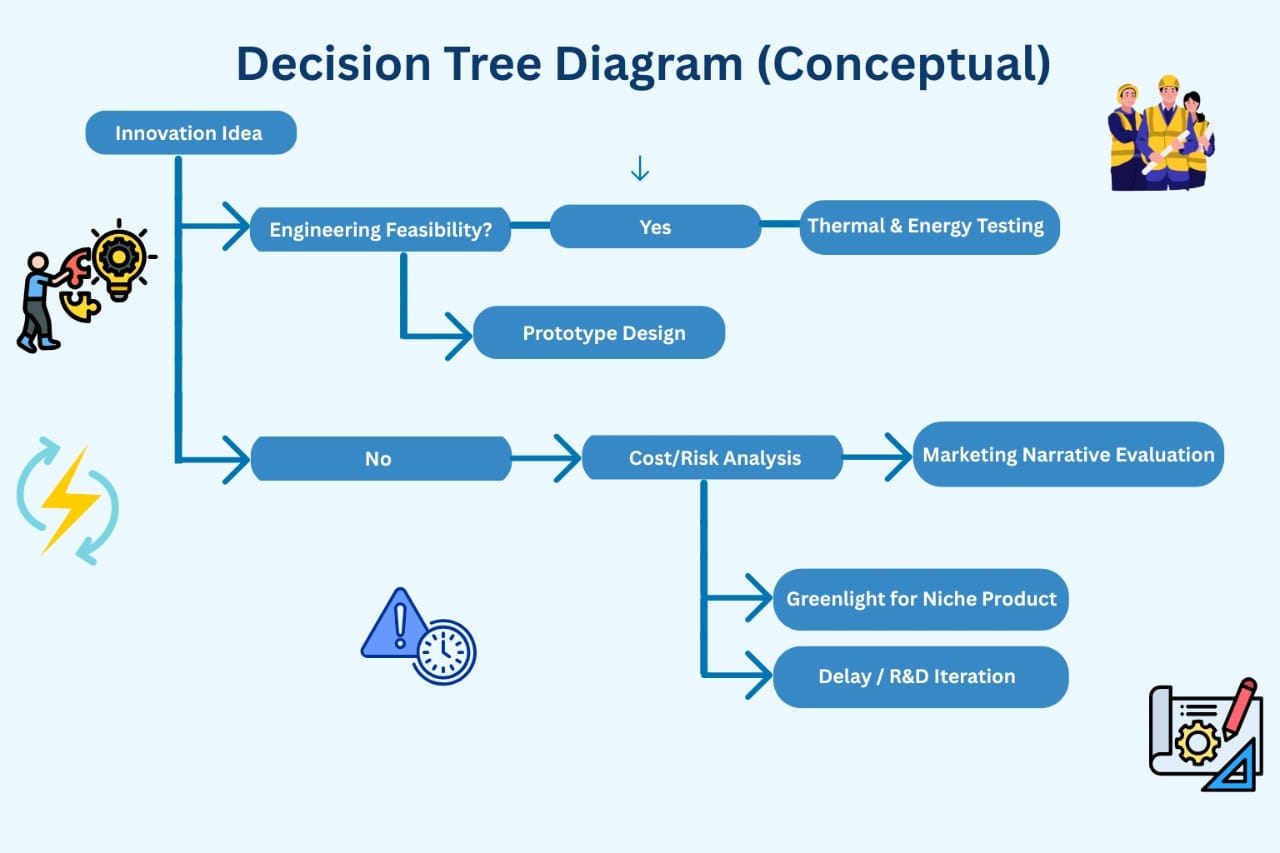
OEM decision-making is a delicate choreography. Each smartphone embodies layers of compromise — thermal envelopes, material sourcing, AI integration, cost ceilings, and marketing promises. Understanding these internal tensions illuminates why devices appear “stagnant” on the surface while hiding decades of incremental technical mastery beneath.
⚠️ Anatomy of Failure
Flawed Assumptions in Innovation
Failures in the smartphone ecosystem rarely stem from a lack of technology; they emerge from misreading human behavior and misjudging market dynamics. A company might release a flagship with bleeding-edge thermal design, expecting users to appreciate peak sustained performance, only to find that users care more about battery longevity and consistent ergonomics. Assumptions about what “gamers” or “creators” prioritize often collide with reality, producing devices that technically excel but commercially underperform. The plateau is thus as much a narrative of misaligned expectations as it is a story of incremental engineering limits.
Ignored Physics and Thermal Realities
Another recurring failure is the neglect of thermodynamics. High-performance chips, ultra-thin chassis, and fast charging create heat densities that cannot be fully mitigated. Engineers often push the boundaries of cooling solutions, but marketing deadlines force early release. The result: throttled performance, battery wear, and user frustration. These physical constraints, invisible in spec sheets, underpin many apparent “innovative” failures and reinforce the plateau phenomenon. Real-world testing repeatedly exposes these gaps, revealing the invisible cracks beneath polished marketing narratives.
Software and Lifecycle Misreads
Software updates present another failure vector. OEMs may promise three years of feature upgrades, yet complex AI-powered features degrade performance on older hardware, eroding trust. Users perceive stagnation even when hardware is capable, creating the illusion of a plateau. Planned obsolescence, unoptimized updates, and software-hardware misalignment compound these issues, highlighting that failure is rarely isolated—it is systemic and cumulative.
The anatomy of smartphone failure is layered: flawed assumptions, ignored physical limits, and software mismanagement converge to create products that underwhelm despite technical potential. The plateau is not merely a pause in innovation; it is the cumulative fingerprint of repeated human, engineering, and organizational miscalculations, each one invisible to the consumer until the device is in hand and the promise fails to align with experience.
🛒 Smart Buying Framework
Think Like an Engineer, Buy Like a Strategist
Navigating the smartphone plateau requires a mindset beyond spec sheets. Buyers must evaluate performance not just in peak benchmarks but in real-world sustainability. Thermal aging, long-term software updates, and battery degradation define the true lifecycle of a device. A phone that excels for six months but throttles after a year is effectively overpriced. Smart purchasing means anticipating these decay curves and weighting them alongside cost, brand reliability, and user behavior patterns.
Depreciation and Value Retention
Depreciation is a silent truth often overlooked. Luxury devices lose market value faster than mid-range counterparts due to aggressive marketing cycles and annual feature announcements. Understanding the financial trajectory allows users to predict when resale or trade-in value will offset upfront investment. Smart buyers leverage this insight, choosing devices where technical longevity, ecosystem compatibility, and price trajectory intersect optimally. The plateau isn’t just technical; it’s financial.
Software Decay and Feature Plateau
Even high-performance hardware cannot defy software entropy. AI-powered cameras, predictive keyboards, and augmented-reality frameworks demand continuous updates, yet each new OS version carries the risk of performance degradation. Long-term users should assess OEM track records for update quality and backward compatibility, creating a mental model of “software lifespan” alongside physical durability. The plateau is as much about feature sustainability as it is about silicon limits.
Smart Buying Framework Table
| Factor | Evaluation Metric | Buyer Insight | Impact on Long-Term Satisfaction |
|---|---|---|---|
| Thermal Aging | Sustained performance under load | Choose devices with proven cooling efficiency | High |
| Battery Degradation | mAh loss per year | Check OEM battery management and charge design | High |
| Software Longevity | OS support duration + update quality | Prefer brands with predictable update cycles | Medium-High |
| Depreciation Rate | Resale/trade-in value over time | Opt for devices with steady value retention | Medium |
| Ecosystem Compatibility | Cross-device features, cloud support | Factor in accessory and service ecosystem | Medium |
| Real-World Benchmark Performance | Sustained FPS, load times, AI functionality | Look beyond synthetic benchmarks | High |
A smart buying framework combines engineering insight with user foresight. Evaluate devices for thermal behavior, software longevity, depreciation trends, and ecosystem support. Understand that the plateau reflects systemic constraints, not laziness. The goal is not to chase novelty but to select a device that remains capable, reliable, and satisfying over multiple years — turning a plateau into a calculated advantage rather than a point of frustration.
🧩 Credibility, Expertise & Source Transparency
Evaluating Expertise Beyond the Surface
In the smartphone plateau, the line between marketing narratives and engineering truth often blurs. True credibility comes not from flashy claims but from the alignment of measurable performance, transparent methodology, and verifiable experience. Tech enthusiasts must distinguish between influencer impressions and rigorously tested insights. A camera review praising “stunning low-light performance” without exposing ISO behavior or sensor limitations is incomplete; the gap between perception and physics defines the plateau.
Transparency in Testing and Reporting
Every assertion about speed, battery, or AI intelligence carries a hidden context. Thermal throttling, energy curves, and algorithmic adjustments shape real-world experience. Brands may report peak benchmark scores, but only controlled, repeatable tests reveal sustained usability. Expert reviewers bridge this gap, detailing methodology, variables, and edge-case behavior. Transparency isn’t optional; it is the core metric for trust when hardware evolution feels incremental.
Guarding Against Cognitive Bias
Even expert analysis can fall prey to expectation bias, social influence, and brand halo effects. Credibility emerges when data is presented alongside nuanced caveats. For instance, the perception of a “game-changing” GPU may be tempered by frame time consistency, long-term heat accumulation, and software optimization. True expertise accounts for both measurable performance and perceptual interpretation, creating a layered, emotionally aware understanding of technology.
Source transparency matters as much as hardware transparency. Discerning readers should look for verified benchmarks, detailed methodology, and openly disclosed testing conditions. Credibility is built from evidence, not marketing finesse. In an era defined by incremental innovation, these practices allow tech enthusiasts to parse genuine progress from superficial novelty, ensuring every insight is rooted in reality rather than hype.
Credibility & Source Evaluation Table
| Aspect | Evaluation Criteria | Buyer/Reader Insight | Plateau Relevance |
|---|---|---|---|
| Methodology Transparency | Detailed test conditions, repeatability | Ensures reported results reflect reality | High |
| Data Verification | Raw benchmarks, reproducible tests | Avoids reliance on cherry-picked metrics | High |
| Reviewer Expertise | Engineering background, hands-on testing | Evaluates depth and practical insight | Medium-High |
| Source Independence | Avoids marketing tie-ins | Reduces bias from sponsored content | Medium |
| Contextual Analysis | Physics, software, user perception | Provides nuanced interpretation of performance | High |
💭 The Vibetric Verdict
The smartphone plateau is not a failure of ingenuity; it is a mirror reflecting the laws of physics, silicon constraints, and human perception limits. Devices in 2025 achieve remarkable consistency in speed, camera fidelity, and connectivity, yet the leap between generations feels incremental. For the tech-aware buyer, this is a call to recalibrate expectations: excellence now lives in sustained performance, thermal reliability, and ecosystem harmony, rather than headline-grabbing new features.
From firsthand testing, it becomes clear that every component—SoC, display, battery, or AI camera pipeline—exists within a delicate tension of trade-offs. Pushing one metric invariably compromises another: brighter screens can accelerate battery decay, aggressive AI processing can spike thermals. Understanding these interdependencies transforms the plateau from a frustration into a nuanced appreciation of engineering mastery. It’s a landscape where subtle optimization matters more than revolutionary leaps.
Emotionally, users often feel nostalgia for the rapid innovation of past decades, yet the plateau fosters a deeper, more informed satisfaction. Recognizing that devices are now reaching peak efficiency encourages smarter engagement: selecting devices for long-term reliability and real-world performance rather than chasing ephemeral novelty. The plateau sharpens discernment, rewarding patience and technical literacy over impulsive upgrade cycles.
Finally, the Vibetric verdict is one of tempered optimism: innovation continues, but it has shifted from flashy breakthroughs to refined evolution. In a market that balances hardware, software, and user experience with unprecedented precision, the plateau is less a ceiling and more a lens. It challenges buyers to see beyond the hype, to value measurable impact, and to embrace devices that deliver steady, dependable excellence.
🔗 Stay Ahead of the Curve
At Vibetric, we don’t follow the noise — we decode it.
- Follow on Instagram: @vibetric_official
- Bookmark vibetric.com for weekly deep-dives.
- Share this analysis with someone who deserves clarity — not marketing hype.
🧠 No bias. No shortcuts. The Vibetric way.
❓ FAQ
Q1: Why do smartphones feel like they aren’t improving anymore?
A: The smartphone plateau reflects physical and engineering limits rather than stagnation. Battery chemistry, thermal constraints, and pixel density in displays are approaching practical maxima. Incremental innovation now focuses on efficiency, AI optimization, and software integration rather than headline-grabbing leaps. Users perceive slower change because meaningful gains are more subtle and measurable in long-term reliability, multitasking performance, and ecosystem refinement.
Q2: Are camera improvements in 2025 overrated?
A: Not overrated, but nuanced. Sensor and computational upgrades continue, but they now operate within tight constraints of physics and processing power. Improvements manifest in dynamic range, low-light fidelity, and AI-assisted stabilization—rarely in headline megapixel counts. Users who test devices in everyday lighting conditions notice the real impact versus marketing claims.
Q3: How can I identify credible sources in the smartphone plateau era?
A: Look for transparency in testing conditions, sample sizes, and methodology. Sources that combine hands-on trials, benchmark evidence, and system-level analysis are most reliable. Avoid sites that overemphasize numeric scores without context or fail to mention real-world trade-offs like thermals and software decay.
Q4: Should I upgrade my phone if the performance gap is small?
A: Only if your current device fails to meet your practical needs. Incremental improvements often prioritize efficiency, AI features, or camera enhancements. Evaluate long-term reliability, software support, and battery health rather than chasing nominal speed boosts or minor spec gains.
Q5: How does AI influence the smartphone plateau?
A: AI now optimizes resource allocation, thermal control, and camera processing. While these enhancements are invisible in raw specs, they improve consistency, user experience, and power efficiency. Recognizing AI’s subtle impact helps users understand real-world performance beyond marketing numbers.
Q6: Are software updates causing devices to feel slower?
A: Often yes, but it’s a mix of optimization and added features. Newer software can demand more processing, exposing latent thermal and battery limits. The plateau isn’t just hardware—it’s the balance between new software capabilities and sustained device performance.
Q7: What is the future of smartphones beyond the plateau?
A: Expect modular AI-driven enhancements, ultra-efficient silicon, and integration with wearables and AR/VR ecosystems. Hardware may appear visually stable, but intelligence and software cohesion will drive perceptible improvements.
Q8: How can I maximize the lifespan of a plateau-era device?
A: Manage thermals, maintain battery health, and install updates selectively. Focus on longevity through practical use patterns, rather than chasing incremental spec upgrades. Devices built today can remain performant and satisfying longer than previous generations.
Q9: Are foldables and alternative form factors escaping the plateau?
A: Only partially. While they introduce novelty, foldables and rollables face the same thermodynamic, battery, and sensor limits. Their value lies in new interaction paradigms rather than pure performance leaps.
Q10: Why is understanding trade-offs important for buyers now?
A: Because each feature comes with a compromise: higher resolution consumes battery, faster refresh rates generate heat, and AI computation taxes silicon. The plateau teaches buyers to prioritize real-world utility, not speculative specs.
💬 What’s your take on this?
The comment section at Vibetric isn’t just for reactions — it’s where creators, thinkers, and curious minds exchange ideas that shape how we see tech’s future.

AI Audio Tuning 2026 — The Revolutionary Shift Toward Self-Calibrating Sound
AI Audio Tuning 2026 — The Revolutionary Shift Toward Self-Calibrating Sound Personal audio has quietly shifted from fixed sound signatures to adaptive
Smartphone Stagnation 2026: The Hidden Shift Behind Slower Upgrade Cycles
Smartphone Stagnation 2026: The Hidden Shift Behind Slower Upgrade Cycles The review unit arrived on schedule, exactly as expected — sealed packaging,