
Smartphone Innovation Slowdown: Why Progress Feels Worse but Works Better
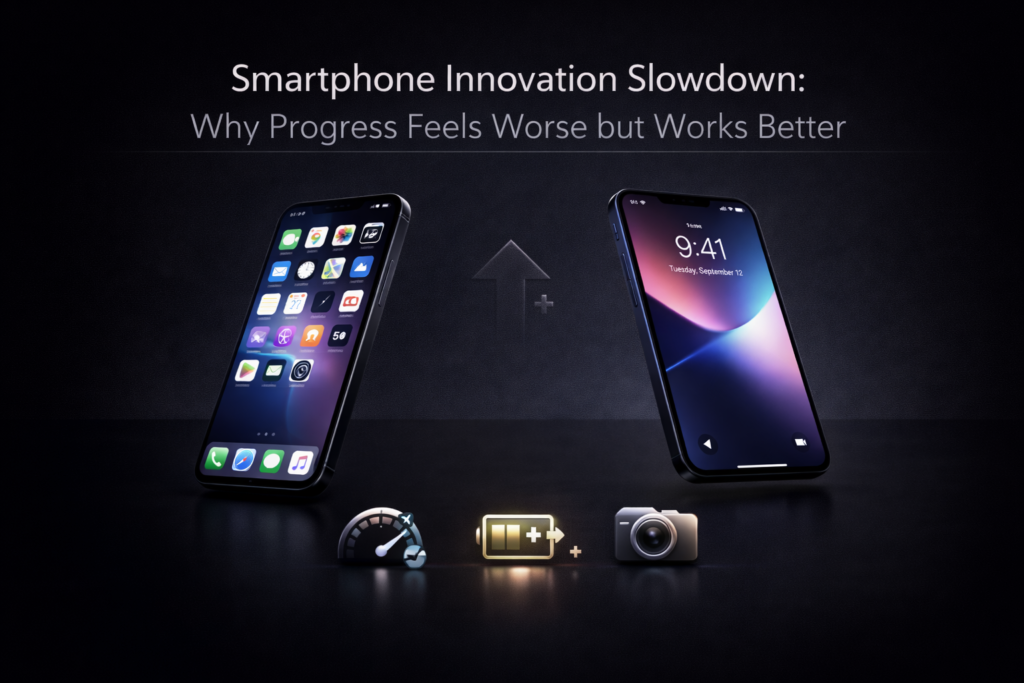
There was a time when a new smartphone launch felt disruptive. Designs shifted visibly. Capabilities expanded overnight. Even casual users could sense progress the moment they picked up a new device. That feeling has faded. Today, new smartphones are met with polite interest rather than excitement. This isn’t because technology stalled—it’s because smartphone innovation slowdown changed the nature of advancement itself.
What once felt like leaps now arrives as refinements, and refinement is harder to feel than novelty.
Familiarity Replaced Discovery
Modern smartphones are victims of their own success. The slab form factor stabilized. Touch interaction matured. Core tasks—messaging, photography, navigation, media—reached a level of reliability where improvements stopped surprising users.
When interaction patterns no longer evolve, the brain stops flagging change as “new.” Even meaningful gains blend into the background. Faster processors don’t alter habits. Sharper displays don’t change behavior. The experience feels familiar because, functionally, it is. This cognitive saturation explains why progress is often interpreted as stagnation, even as engineering advances quietly beneath the surface.
Performance Crossed the Threshold of Sufficiency
Raw performance once defined generational shifts. Early smartphones struggled visibly, making every speed gain obvious. That era ended years ago. Today’s devices operate comfortably beyond daily requirements for most users.
Once performance exceeds necessity, additional power stops translating into felt improvement. Apps already load instantly. Interfaces already feel fluid. What remains are edge cases—gaming peaks, AI workloads, computational photography—that don’t define everyday satisfaction. Progress continues, but it registers as slower visible progress rather than transformation, reinforcing perceptions of smartphone innovation slowdown.
The Industry Optimized for Stability, Not Shock
From a manufacturer’s perspective, radical change became risky. Mature supply chains, global scale, and thin margins reward predictability over experimentation. Refining cameras, improving efficiency, and extending battery health deliver dependable returns. Disruptive redesigns introduce uncertainty.
This led to an industry-wide pivot: fewer visible revolutions, more invisible optimization. Software updates extended device life. Hardware improvements focused on consistency, thermals, and endurance. These choices improved long-term satisfaction—but reduced the “wow” factor that once defined launches. The sense of smartphone innovation slowdown is shaped as much by strategic caution as by technological limits.
A Snapshot of How Innovation Shifted
| Then | Now |
|---|---|
| Visible design changes | Incremental refinement |
| Obvious speed gains | Efficiency and stability |
| New usage behaviors | Polished existing habits |
| Excitement-driven upgrades | Utility-driven upgrades |
The table shows why innovation feels quieter rather than absent.
The Contrarian Reality: “New” Was Never Sustainable—and It Reshaped Upgrades
There’s an uncomfortable truth beneath the nostalgia. The era when smartphones felt radically new was always temporary. Early-stage technologies move quickly because they start from constraint. As categories mature, visible change slows while underlying reliability improves.
This maturity altered upgrade psychology. Users stopped chasing novelty and started waiting for friction—battery degradation, storage pressure, broken screens, or ecosystem shifts. Replacement became reactive instead of aspirational. Longer upgrade cycles reduced pressure for dramatic annual change, further amplifying the narrative of smartphone innovation slowdown. What looks like stagnation is often the feedback loop of a stabilized category.
Closing Insight
Smartphones no longer feel “new” because they no longer need to prove themselves. They’ve crossed from innovation objects into infrastructure. Progress still happens, but it unfolds through reliability, efficiency, and integration rather than spectacle. The slowdown people sense isn’t the absence of innovation—it’s the absence of disruption. And that may be the clearest sign that the category has finally grown up.
For readers tracking how tech maturity reshapes expectations
- Follow our Instagram @vibetric_official for context beyond launch cycles.
- Bookmark vibetric.com to track how mature technologies really evolve.
- Return for analysis that explains why progress sometimes feels invisible
What’s your take on this?
At Vibetric, the comments go way beyond quick reactions — they’re where creators, innovators, and curious minds spark conversations that push tech’s future forward.
AI Smartphones in 2026: The Powerful Infrastructure Shift You Can’t Ignore
AI Smartphones in 2026: The Powerful Infrastructure Shift You Can’t Ignore The most important transformation in mobile technology isn’t visible on the
AI Intelligence Race in 2026: The Real Battle Beyond Speed
AI Intelligence Race in 2026: The Real Battle Beyond Speed For years, consumer technology sold us speed. Every keynote celebrated higher clock