
Are Smart Speakers Replacing Traditional Home Audio?
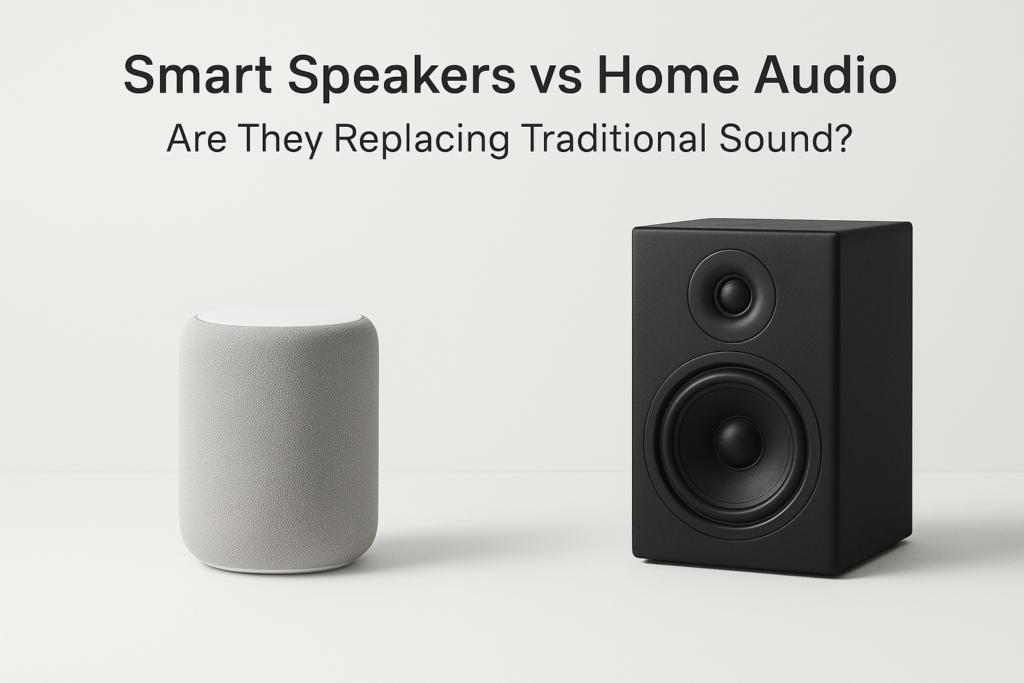
The conversation around smart speakers vs home audio reflects something deeper than sound quality. It reveals how people now value convenience as much as fidelity. A decade ago, home audio was defined by bulky setups, multi-speaker arrangements, and precise placement rituals. Today, a single cylinder on a kitchen counter can play music, answer questions, control lights, set reminders, and integrate into a broader digital life. That shift didn’t just happen because smart speakers got better — it happened because daily habits changed.
How Modern Listening Habits Redefined Expectations
Music used to be an activity; now it’s a backdrop. That subtle cultural change is one of the biggest reasons smart speakers gained ground. Most listening today happens during chores, cooking, remote work, or short breaks, where convenience matters far more than perfect fidelity. Smart speakers provide frictionless playback, hands-free commands, and tight integration with streaming ecosystems.
Traditional audio still wins in acoustic performance, but people no longer begin their audio journey with it. The debate around smart speakers vs home audio is less about frequency response and more about lifestyle fit.
Industry Moves That Pushed Smart Speakers Forward
Tech companies invested heavily in beamforming microphones, room-aware DSP, and compact acoustic engineering. These advances helped small speakers overcome physical limitations and deliver surprisingly full sound for their size. Meanwhile, traditional home audio manufacturers began adding Wi-Fi streaming, room tuning, and voice support to keep up with a changing market.
The result is a convergence: convenience-first tech borrowing from audio engineering, and audio-first brands adopting smart features. The lines continue to blur, but motivations remain distinct.
Mini Comparison: Smart Speakers vs Home Audio (2025)
| Category | Smart Speakers | Home Audio |
|---|---|---|
| Priority | Convenience | Fidelity |
| Strengths | Voice control, ecosystem integration, compact size | Dynamics, clarity, immersion |
| Ideal Use | Daily routines, casual listening | Movies, focused listening sessions |
| Limitations | Limited output, computational tuning dependence | Requires space, setup complexity |
Where Traditional Home Audio Still Dominates
Physics keeps home audio firmly ahead in raw performance. Larger drivers create deeper bass. Bigger enclosures shape sound more accurately. Amplifiers deliver cleaner headroom. No amount of DSP can fully replicate what a well-designed physical system achieves in imaging, dynamic range, or room presence.
For listeners who want immersion, a dedicated setup still feels more effortless and natural. This layer of realism is where smart speakers vs home audio stops being a debate and becomes a question of priorities.
The Overlooked Flaw in Smart Speakers
Smart speakers tune themselves for mainstream preferences — prominent vocals, soft bass roll-off, safe highs. They optimize for background listening, not critical sessions. At louder volumes, many models lean on artificial spaciousness or digital correction, which can collapse under pressure.
The irony is that the smarter the speaker becomes, the more it compensates for limitations rather than surpassing them. It’s convenience engineered to feel like quality, and for most homes, that’s enough. For enthusiasts, it still falls short.
Will Smart Speakers Replace Home Audio?
A true replacement is unlikely. Instead, households are entering a dual-audio era: smart speakers for routines and instant playback, home audio for depth and intention. People aren’t abandoning quality — they’re choosing when quality matters. As living spaces shrink and ecosystems strengthen, smart speakers will continue rising, but traditional setups will remain the benchmark for emotional listening.
Closing Insight
Smart speakers changed listening by making audio effortless, adaptable, and ever-present. They fit the rhythm of a connected lifestyle, turning music into something that blends with the day rather than interrupts it. Traditional home audio, meanwhile, preserves the richness and scale that define real immersion. Both categories thrive because they serve different moments, not because one must replace the other. The future of listening isn’t a battle — it’s a balance shaped by the way people experience sound in their homes.
Stay Sharp with Vibetric
- Follow our Instagram @vibetric_official for refined tech breakdowns and evolving audio trends.
- Bookmark vibetric.com to keep up with new explainers, comparisons, and sound analyses.
- Check back often for deeper insights into devices shaping tomorrow’s listening experience.
What’s your take on this?
At Vibetric, the comments go way beyond quick reactions — they’re where creators, innovators, and curious minds spark conversations that push tech’s future forward.
AI Intelligence Race in 2026: The Real Battle Beyond Speed
AI Intelligence Race in 2026: The Real Battle Beyond Speed For years, consumer technology sold us speed. Every keynote celebrated higher clock
Fanless Laptops 2026 — The Powerful Rise of Silent Performance
Fanless Laptops 2026 — The Powerful Rise of Silent Performance For decades, laptop performance and cooling were inseparable. Faster processors generated more