
Smart Device Hidden Costs: The True Energy, Data, and Consumer Impact
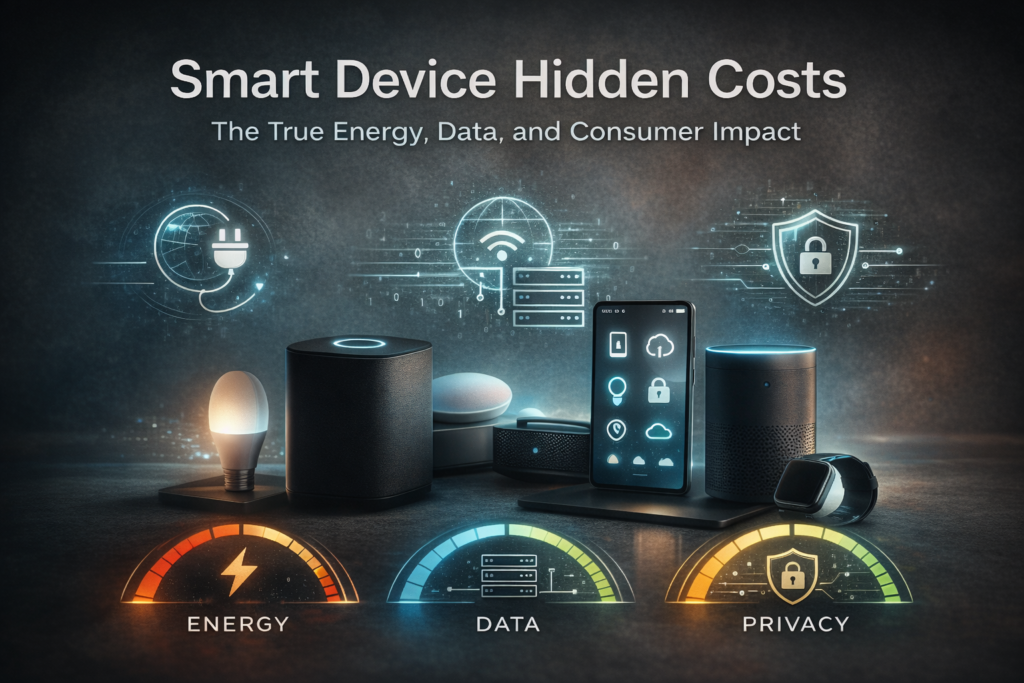
Smart technology didn’t arrive as a disruption. It crept in quietly. One connected bulb, one voice assistant, one app-controlled appliance at a time. Today, “smart” is no longer a feature—it’s an assumption. Yet behind that convenience lies a set of smart device hidden costs most consumers never consciously account for. Not because they’re invisible, but because they’re distributed across energy grids, data pipelines, and long-term behavioral shifts.
The price of intelligence isn’t paid all at once. It accumulates.
Convenience First, Consequences Later
Smart devices succeed by removing friction. They automate decisions, reduce manual effort, and promise efficiency. But automation also reduces awareness. When actions disappear into background processes, so do their costs.
A smart thermostat adjusting itself feels negligible. Multiply that behavior across millions of homes, constant cloud polling, and always-on connectivity, and the impact scales quickly. The issue isn’t that smart devices use energy—it’s that they normalize continuous consumption as a baseline state.
Smart device hidden costs begin here: when convenience becomes perpetual activity rather than intentional use.
Energy Isn’t the Bottleneck People Think It Is
Most consumers focus on the power draw of the device itself. That’s only a fraction of the equation. The larger energy footprint lives elsewhere—in data centers, network infrastructure, and redundancy systems designed to ensure “instant” responsiveness.
Every voice query, sync request, or status check triggers backend processes that operate far beyond the home. Individually trivial, collectively massive. The smarter ecosystems become, the more they depend on persistent connectivity rather than intermittent interaction.
Efficiency gains at the device level often mask inefficiencies at the system level. This is where smart device hidden costs escape traditional energy narratives.
A System-Level Snapshot
| Smart Layer | User Sees | System Bears |
|---|---|---|
| Smart home control | Automation, ease | 24/7 cloud uptime |
| Wearable syncing | Health insights | Constant data processing |
| AI assistants | Instant responses | High compute demand |
| Smart appliances | Optimization claims | Network + server load |
this snapshot reframes cost away from the object and toward the infrastructure enabling it. The device is only the visible tip.
Data as the Silent Currency
Energy is measurable. Data cost is not—at least not in ways consumers can easily track. Smart devices generate continuous behavioral data: routines, preferences, movement patterns, consumption habits.
This data fuels personalization, but it also sustains business models built on aggregation rather than ownership. Consumers rarely “pay” with money after purchase; they pay with predictability. Over time, devices don’t just respond to behavior—they shape it.
Smart device hidden costs surface when autonomy erodes subtly. Defaults become recommendations. Recommendations become habits. Habits become dependencies.
The Psychological Shift No One Markets
Smart ecosystems reduce decision fatigue, which feels beneficial. But they also reduce friction that once encouraged reflection. When lighting, temperature, media, and shopping decisions happen automatically, users disengage from cause and effect.
This detachment has consequences. People consume more because consumption feels abstracted. Energy usage, subscription stacking, and device upgrades blend into background noise.
Ironically, the smarter the environment becomes, the less conscious the user often is. That cognitive outsourcing is rarely discussed—but it’s one of the most profound smart device hidden costs.
Industry Incentives Favor Expansion, Not Efficiency
Smart platforms thrive on ecosystem lock-in. The goal isn’t to sell one device—it’s to anchor a user into a network of interoperable products. This drives innovation, but it also encourages redundancy.
Multiple hubs, overlapping sensors, parallel apps, and always-on services coexist not because they’re optimal, but because they increase retention. Efficiency becomes secondary to engagement metrics.
From an industry perspective, energy and data overhead are acceptable trade-offs for scale. From a societal perspective, they compound quietly until they’re difficult to unwind.
The Contrarian View: Smart Isn’t the Problem—Opacity Is
The issue isn’t intelligence. It’s invisibility. Smart systems fail users not by consuming resources, but by hiding that consumption behind abstraction layers.
When users can’t see energy use, data flow, or dependency depth, they can’t make informed choices. Transparency—not restraint—is the missing design principle.
Smart device hidden costs would feel less threatening if systems exposed them clearly: real-time energy dashboards, data usage boundaries, and meaningful offline functionality. Intelligence doesn’t need to be opaque to be powerful.
Rethinking What “Smarter” Should Mean
The next phase of smart technology won’t be defined by more sensors or faster responses. It will be defined by selective intelligence—systems that know when not to act.
Smarter doesn’t have to mean always-on. It can mean context-aware, user-controlled, and energy-conscious by design. The real innovation ahead is restraint embedded into automation.
Consumers don’t need fewer smart devices. They need devices that respect attention, resources, and autonomy equally.
The true cost of “smart everything” isn’t catastrophic—but it is cumulative. And cumulative costs only become visible once they’re hard to reverse.
Stay Connected with Vibetric
- Follow our Instagram @vibetric_official for deeper analysis on tech systems and human impact.
- Bookmark vibetric.com to track long-term shifts in smart technology design.
- Stay updated as intelligence moves from novelty to responsibility.
What’s your take on this?
At Vibetric, the comments go way beyond quick reactions — they’re where creators, innovators, and curious minds spark conversations that push tech’s future forward.

Technologies That Matter in 2026: The Critical Truth Behind the Global Hype
Technologies That Matter in 2026: The Critical Truth Behind the Global Hype Every technology cycle produces noise before it produces value. By
Smart Device Hidden Costs: The True Energy, Data, and Consumer Impact
Smart Device Hidden Costs: The True Energy, Data, and Consumer Impact Smart technology didn’t arrive as a disruption. It crept in quietly.