
The Shifting Balance of Power in Tech — Why 2025 Is a Turning Point Worldwide
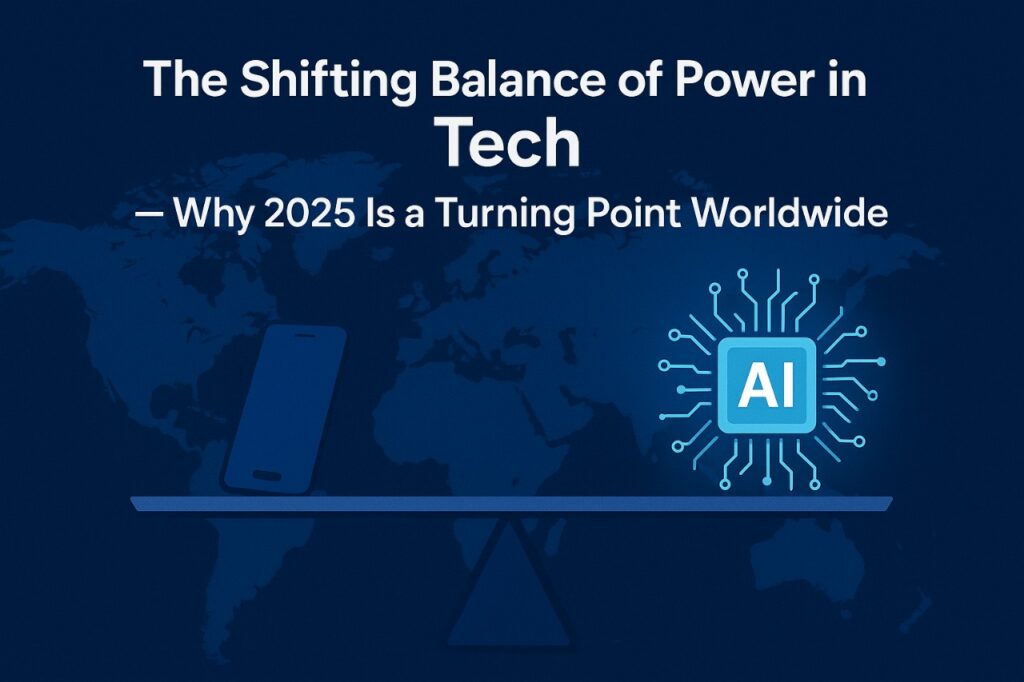
The shifting balance of power in tech isn’t loud. It didn’t start with a launch event, a keynote, or a viral leak. It began with a quiet realization: the companies shaping 2025 aren’t the ones releasing the flashiest hardware they’re the ones reshaping the rules of the digital world.Across continents, industries, and daily life, the equilibrium is changing.
Big names are losing ground. New players are gaining speed. And the most influential technologies of 2025 aren’t just innovations they’re recalibrations of global power.
⚙️ Core Insight (Depth + Clarity)
For nearly a decade, big tech operated like an orbit:
predictable dominance, predictable innovation, predictable competition.
But 2025 breaks the cycle.
Why?
Because the world no longer moves on devices —
it moves on ecosystems, AI architectures, standards, and data flows.
And the companies defining these are not the same ones that won the last decade.
Three shifts define the new era:
- AI models, not smartphones, are the new battleground.
- Countries are building their own tech stacks — from chips to cloud.
- Consumers are moving away from brands and toward capability-based ecosystems.
This is the first year where the global tech landscape feels less like Silicon Valley
and more like a multi-center innovation grid.
📊Bite-Sized Data Table
| Region | Key Power Shift | What It Means |
|---|---|---|
| US | AI platform dominance reshaping big tech hierarchy | Models > hardware |
| Europe | Strongest global push for privacy-first ecosystems | Regulation as competitive advantage |
| China | Self-contained tech stack from chips to cloud | Reduced global dependency |
| India | Surge in AI tools, fintech, and affordable devices | Scale-driven innovation |
| Middle East | Rising investment in AI R&D and cloud infrastructure | New innovation hubs |
| New innovation hubs | Growth in creator tools + digital commerce | Region becoming a testing ground |
🔍 Micro Analysis
A: The Real-World Impact
The shifting balance of power in tech has started reshaping how people live:
- AI assistants are becoming the central interface of everyday tasks.
- Software ecosystems determine productivity more than hardware specs.
- Countries invest in domestic chip manufacturing to reduce reliance.
- Cloud providers are becoming geopolitical players.
- Streaming, payments, and gaming increasingly depend on regional infrastructure.
- Digital identity systems are transforming access, finance, and mobility.
The global map of innovation is no longer top-heavy —
it’s distributed, fluid, and constantly redefined.
B: The Hidden Truth
The biggest shift is invisible:
The world is moving from platform competition to ecosystem sovereignty.
Tech giants, governments, cloud providers, chipmakers —
everyone wants control over:
- data pipelines
- AI training compute
- hardware supply chains
- software standards
- digital identity
- payments and authentication
- cloud hosting zones
This isn’t just about who builds the next big thing. It’s about who owns the infrastructure of digital life.
2025 is the pivot year because:
- AI workloads exploded
- supply chains fractured
- user behavior shifted to automation
- nations realized they needed their own tech resilience
Power is no longer centralized.
It’s redistributed — and still redistributing.
🌍 Culture Angle
People everywhere are feeling a cultural shift: Convenience matters more than brand loyalty.
Privacy matters more than features. Integration matters more than design.
This is why the world’s most influential companies today aren’t the ones with the prettiest devices —
they’re the ones with the smoothest systems. 2025 marks the moment where global tech ecosystems adapt to people, not the other way around.
We’re choosing technologies that reduce friction, save time, predict needs, and create a calm digital environment. And the companies offering this calm now hold the cultural power.
🧠 Quick Vibetric Takeaway
- The shifting balance of power in tech moves away from hardware dominance.
- AI architecture is the single biggest driver of influence.
- Countries want independent ecosystems, not borrowed ones.
- Cloud and data control are geopolitical weapons.
- Consumer behavior now rewards ecosystems, not individual devices.
- Smaller regions are becoming innovation accelerators.
- Power is decentralized — and 2025 is the first visible proof.
💬 Vibetric Verdict
Vibetric Verdict: This is the turning point. 2025 doesn’t just change who leads the tech world it changes how leadership works. Influence is no longer measured in product launches.
It’s measured in infrastructure, ecosystems, intelligence, and resilience.
The world’s new tech leaders aren’t necessarily the biggest companies they’re the ones building the deepest foundations. And that’s why 2025 will be remembered
as the year the balance of power finally shifted.
🔗 Stay in the Loop
We don’t sell hype — we explain it.
- Follow @vibetric_official for grounded gaming insights, hardware testing, and trend analysis.
- Bookmark vibetric.com to stay ahead of the tech curve.
- No hype. No bias. Just facts — the Vibetric way.
💬 What’s your take on this?
The comment section at Vibetric isn’t just for reactions — it’s where creators, thinkers, and curious minds exchange ideas that shape how we see tech’s future.

Why Battery Life Varies So Much Across Regions
Why Battery Life Varies So Much Across Regions Laptop users often assume battery life is a fixed, objective figure determined by watt-hour

Are Premium Ultrabooks Worth Their Price Tag?
Are Premium Ultrabooks Worth Their Price Tag? In 2025, the laptop market is crowded with capable machines at every price point, yet