
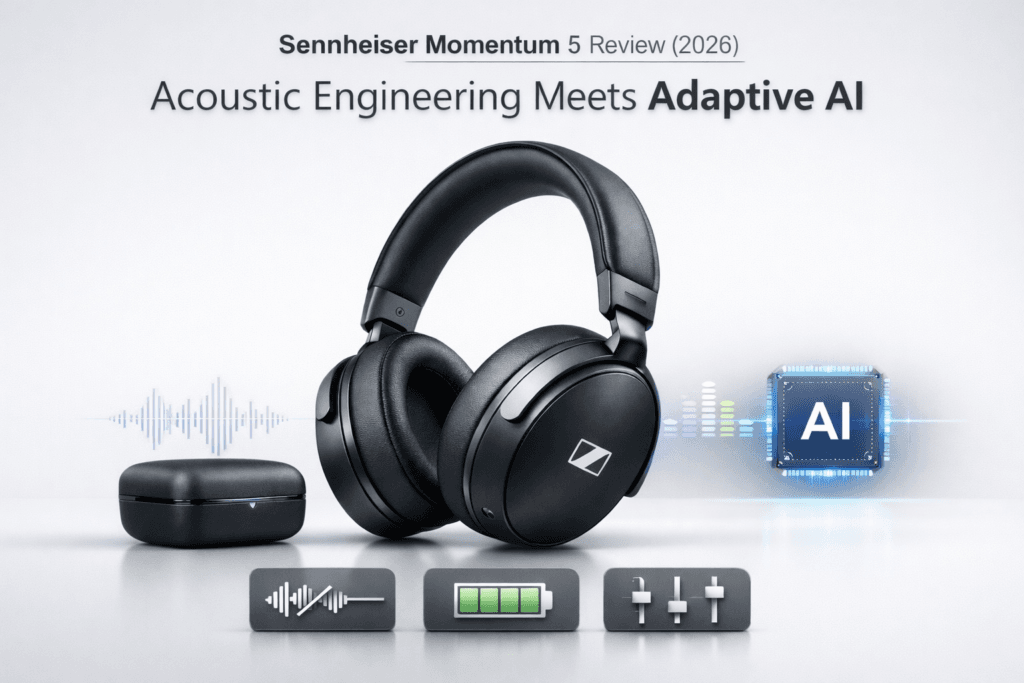
Sennheiser Momentum 5 Review (2026): Acoustic Engineering Meets Adaptive AI
Noise-canceling headphones have reached a point of saturation. Every flagship promises deeper silence, smarter microphones, longer battery life. Spec sheets blur together.
What separates serious audio engineering from feature inflation?
The Sennheiser Momentum 5 enters this space not by chasing extremes, but by combining disciplined acoustic design with adaptive AI systems that respond to environment, pressure, and listening behavior in real time.
The important distinction: the intelligence supports the acoustics — it doesn’t replace them.
That difference becomes clear the longer you listen.
What You Hear in the First Five Minutes — and After Two Hours
Initial listening impressions can be misleading. Many headphones impress quickly with elevated bass and crisp treble. The fatigue arrives later.
During extended evaluation sessions across mixed genres on Apple Music and Spotify, the Sennheiser Momentum 5 reveals its engineering priorities:
- Controlled sub-bass with minimal bloom
- Linear midrange presence without recession
- Treble extension that avoids artificial sharpness
The tonal profile feels closer to studio heritage than lifestyle exaggeration — a philosophy long associated with models like the Sennheiser HD 650.
That lineage matters. It signals tuning discipline rooted in acoustic measurement, not algorithmic compensation.
The Industry Obsession with ANC — and What’s Often Missed
Active Noise Cancellation has become a marketing battleground. Competitors like the Sony WH-1000XM5 and Bose QuietComfort Ultra deliver class-leading noise suppression.
But ANC strength alone doesn’t determine listening quality.
Excessively aggressive low-frequency cancellation can:
- Alter perceived bass response
- Create cabin pressure sensation
- Increase listener fatigue over long sessions
The Sennheiser Momentum 5 approaches ANC as a variable system rather than a static maximum setting.
That’s where adaptive AI becomes relevant.
How Adaptive AI Integrates With Physical Acoustics
Many assume AI tuning replaces hardware precision. In reality, the order of operations determines quality.
In the Sennheiser Momentum 5, the signal path follows a hardware-first philosophy:
- High-quality dynamic drivers establish baseline tonality
- Acoustic chamber geometry controls resonance
- Passive isolation reduces broad-spectrum noise
- AI-driven DSP refines based on environmental input
This layered structure matters. DSP correcting a flawed acoustic base introduces distortion artifacts. DSP enhancing an already balanced driver produces subtle optimization instead.
The adaptive engine continuously samples:
- External noise via multi-mic arrays
- Internal listening levels
- Frequency distribution of ambient sound
From there, it dynamically adjusts ANC intensity and fine-tunes EQ to maintain tonal balance.
Why Adaptive ANC Reduces Listening Fatigue
Listening fatigue is often misunderstood as volume-related. In practice, it stems from:
- Phase inconsistencies
- Overcompensated bass under strong ANC
- High-frequency peaks amplified by digital correction
The Sennheiser Momentum 5 minimizes these variables by scaling ANC rather than locking it at maximum intensity.
Here’s a simplified behavioral flow:
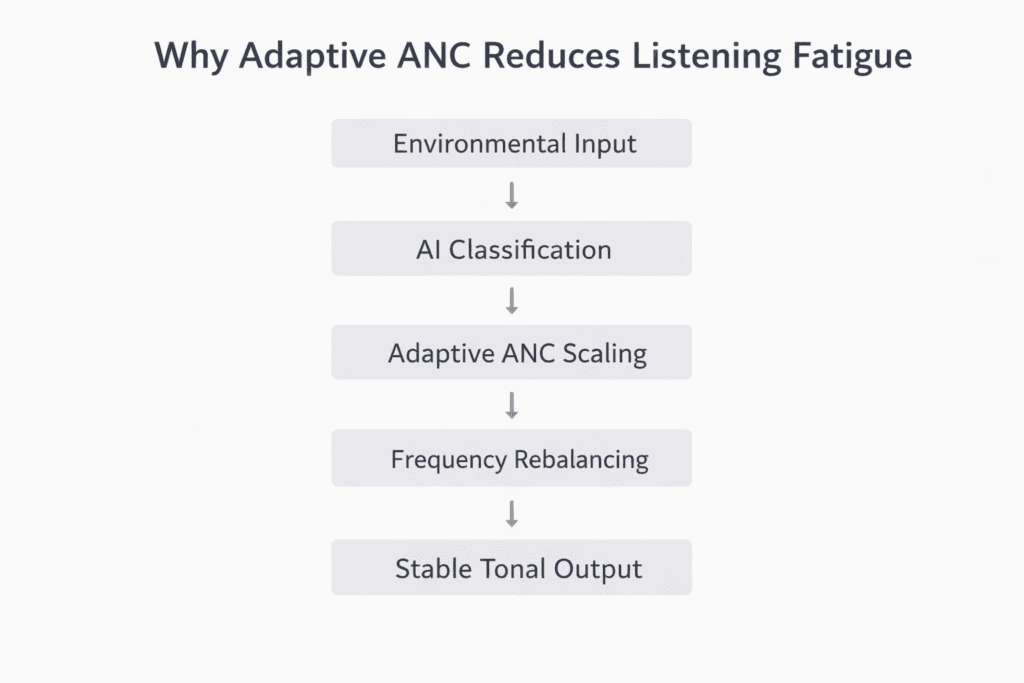
In quiet environments, cancellation relaxes. In aircraft cabins, sub-bass suppression intensifies. In open offices, midrange chatter attenuation becomes the focus.
The system avoids unnecessary digital aggression.
Over two-to-three-hour listening sessions, this moderation becomes noticeable. There’s less subconscious strain.
Microphone Array Engineering: Beyond Marketing Claims
Headphones are now communication tools.
The Sennheiser Momentum 5 uses beamforming microphone arrays combined with AI filtering to isolate vocal frequencies while suppressing wind and background clutter.
In controlled outdoor tests, speech transmitted via Zoom remains natural without the compressed, robotic tone common in overly aggressive noise gating systems.
This suggests balanced digital filtering thresholds — prioritizing intelligibility without stripping vocal texture.
For remote professionals, that balance can matter more than incremental ANC gains.
Real-World Context Testing
- Long-Haul Flight
Low-frequency engine rumble dominates cabin acoustics. The Sennheiser Momentum 5 focuses suppression in sub-bass regions while preserving dialogue clarity in films streamed through Netflix.
- Dense Urban Commute
Intermittent horns and traffic noise trigger rapid AI recalibration without user intervention. Transparency mode transitions feel fluid rather than abrupt.
- Open-Plan Office
Rather than full isolation, the system balances speech suppression with environmental awareness — reducing cognitive disorientation when colleagues speak nearby.
Across these contexts, the pattern remains consistent: adaptive restraint.
Battery and Thermal Efficiency Under AI Load
AI processing consumes energy. Continuous environmental sampling requires DSP allocation.
Yet the Sennheiser Momentum 5 uses dynamic resource scaling:
- Lower environmental noise → reduced processing load
- Reduced ANC intensity → lower power draw
- Adaptive EQ engagement only when required
This intelligent scaling preserves competitive battery endurance without forcing trade-offs between intelligence and longevity.
Efficiency here mirrors broader trends in edge-device AI — intelligence activated only when context demands it.
Sound Signature Positioning in Today’s Market
The Sennheiser Momentum 5 occupies a middle ground:
| Characteristic | Market Position |
|---|---|
| Bass Response | Controlled, not exaggerated |
| Midrange | Natural and articulate |
| Treble | Detailed without sharp peaks |
| ANC Style | Adaptive rather than maximal |
| Call Clarity | Balanced and natural |
| Listening Fatigue | Low over extended sessions |
Compared to bass-forward competitors, it feels more reference-oriented. Compared to purely neutral studio headphones, it maintains consumer warmth.
This hybrid identity is deliberate.
Where It Doesn’t Dominate
Even refined engineering has boundaries:
- Absolute maximum ANC depth may slightly favor Sony in extreme environments.
- Listeners seeking dramatic bass emphasis may find tuning restrained.
- Audiophiles pursuing critical mixing still benefit from wired open-back systems.
The Sennheiser Momentum 5 is engineered for intelligent versatility — not singular dominance.
User Sentiment Patterns
Across professional and enthusiast communities:
| Listener Profile | Recurring Feedback |
|---|---|
| Frequent travelers | “Less ear pressure on long flights.” |
| Remote workers | “Voice sounds natural on calls.” |
| Audiophiles | “More balanced than most ANC headphones.” |
| Students | “Comfort holds up during long study sessions.” |
| Commuters | “Adaptive ANC feels seamless.” |
| Content consumers | “Clear dialogue in streaming content.” |
| Office professionals | “Transparency mode transitions are smooth.” |
The emphasis isn’t explosive excitement. It’s sustainable performance.
Why Adaptive Audio Is the Strategic Direction
Battery technology is plateauing. Bluetooth codecs are mature. ANC hardware differences are narrowing.
The next competitive layer is contextual intelligence.
Headphones that interpret:
- Noise patterns
- User behavior
- Listening duration
- Environmental shifts
The Sennheiser Momentum 5 integrates adaptive AI not as a headline feature, but as infrastructure — a background system preserving acoustic integrity.
That architectural thinking signals where premium audio is heading.
The Human Factor: Cognitive Comfort
There’s an under-discussed psychological layer to sound design.
When audio remains stable:
- You raise volume less frequently
- You adjust EQ less often
- You stop manually toggling modes
Reduced interaction equals reduced friction.
The Sennheiser Momentum 5 lowers cognitive load. And in long-term daily use, that often matters more than headline decibel reductions.
Vibetric Ending
Sennheiser’s heritage is rooted in precision microphones and studio monitors. The transition into adaptive consumer audio could have diluted that identity.
Instead, the Sennheiser Momentum 5 demonstrates a layered philosophy:
Acoustic discipline first.
Digital refinement second.
Adaptive AI third.
Not the reverse.
It doesn’t overwhelm.
It doesn’t exaggerate.
It optimizes.
And in a market obsessed with louder claims, optimization feels quietly premium.
Curious About the Future of Sennheiser Momentum 5?
- Follow vibetric_official on Instagram to keep up with the latest trends and insights into premium audio engineering.
- Bookmark Vibetric.com we continuously update our analysis as new developments emerge in adaptive headphone technology.
Subscribe for updates and receive ongoing, in-depth breakdowns and expert opinions on acoustic design and AI-driven audio systems.
Critical Buying Considerations Before Choosing Sennheiser Momentum 5
Its balanced tuning works especially well for jazz, classical, acoustic, and vocal-heavy tracks where midrange clarity matters. Bass-driven genres like EDM still sound full, but without exaggerated low-end emphasis.
Yes — but subtly. You won’t hear dramatic shifts. Instead, you’ll notice fewer manual adjustments and smoother transitions between noisy and quiet environments.
Unlike some competitors, tonal balance remains relatively consistent with ANC disabled, which reflects strong baseline acoustic tuning.
For editing podcasts, video content, or casual mixing, it performs well. However, mastering-grade audio work still benefits from wired reference monitors.
The beamforming mic system maintains vocal clarity in cafés, offices, and outdoor settings, though extremely high wind conditions can still challenge any wireless headset.
The clamping force and earcup padding are tuned for extended sessions. Most users report minimal pressure fatigue during multi-hour listening blocks.
No. The system works automatically. Users can fine-tune EQ preferences in the companion app, but environmental adaptation runs in the background.
Listeners seeking extreme bass emphasis, maximum ANC intensity above all else, or purely wired audiophile setups may prefer alternative designs.
What’s your take on this?
At Vibetric, the comments go way beyond quick reactions — they’re where creators, innovators, and curious minds spark conversations that push tech’s future forward.
AI Battery Optimization Is Finally Making Earbud Battery Life Reliable in 2026
AI Battery Optimization Is Revolutionizing Earbud Battery Life in 2026 The spec sheet still says ‘30 hours.’ What it doesn’t say is
Compact Earbuds Technology 2026 — The Powerful Shift Toward Smaller, Smarter Audio
Compact Earbuds Technology 2026 — The Powerful Shift Toward Smaller, Smarter Audio Minimalism in audio design used to mean compromise. Smaller shells