
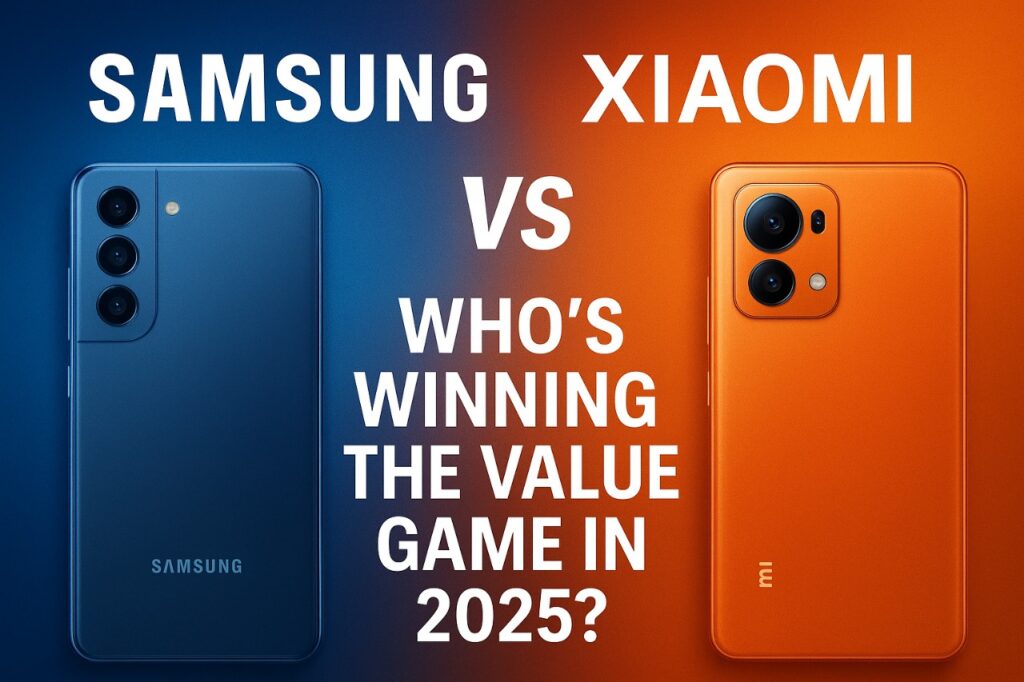
Samsung vs Xiaomi — Who’s Winning the Value Game in 2025?
Value has quietly become the real battlefield of modern smartphones. Not the megapixel wars, not the chipset hype, not even the AI buzzwords — value. The ability of a phone to deliver performance, longevity, features, and trust at a price that feels justified.
In 2025, this battle has never been more intense. Samsung continues to dominate the global stage with its premium ecosystem and long-term support, while Xiaomi disrupts the market with aggressive pricing and hardware-first engineering. One sells assurance. The other sells ambition.
Consumers today aren’t just buying phones — they’re buying stability, convenience, and identity. And in a world where upgrades feel incremental, the question becomes sharper than ever:
Is Samsung still the safer long-term value?
Or has Xiaomi finally mastered premium performance at half the price?
This blog cuts through assumptions, hype cycles, and spec sheet illusions — giving you a grounded, expert-backed breakdown of Samsung vs Xiaomi in 2025, and who truly wins the value game.
⚡Quick Summary Table
| Category | Samsung (2025) | Xiaomi (2025) |
|---|---|---|
| Pricing Strategy | Premium + Upper Midrange | Aggressive + Hardware Value |
| Software Support | 7 Years OS / 7 Years Security | 4 Years OS / 5 Years Security |
| Build Quality | Aluminum/Armor Glass | Aluminum/Glass/Polycarbonate |
| Camera Performance | Consistent + Proven Processing | High-end hardware |
| Battery + Charging | Moderate battery + slower charging | Bigger batteries + faster charging |
| Ecosystem | Mature, stable, seamless | Expanding but inconsistent |
| Value-for-Money | Strong long-term value | Strong upfront value |
🧭What This Blog Covers
This analysis includes:
✅ What’s Included
- Direct comparison of Samsung vs Xiaomi in design, performance, cameras, software, and long-term value
- Real-world user behavior and Reddit patterns
- Feature trade-offs, strengths, and weaknesses
- Value breakdown for 2025 market conditions
❌ What’s NOT Included
- Old 2023–2024 devices
- Regional availability differences
- Rumor-based comparisons
- Benchmark-only conclusions
📌 How the Evaluation Is Structured
The blog follows a real-world first, expert-backed approach rather than spec-sheet theory. Pricing, software support, camera behavior, ecosystem reliability, and durability matter more than synthetic numbers.
🏗️Design & Build Analysis
Samsung and Xiaomi have matured drastically in build quality, but their philosophies differ.
🧱 Materials & Construction
- Samsung: Armor Aluminum frames, Gorilla Armor/Glass Victus 3, durable mass-tested construction.
- Xiaomi: Premium materials in high-end models, but polycarbonate still common in midrange.
✋ Ergonomics
- Samsung prioritizes rounded edges, weight balance, and slimness.
- Xiaomi favors chunkier designs due to larger batteries and cooling systems.
🔧 Durability Expectations
Samsung is still ahead — its IP ratings and build consistency hold up long-term. Xiaomi’s durability varies heavily between models.
📊 Mini Comparison Table
| Aspect | Samsung | Xiaomi |
|---|---|---|
| Frame | Armor Aluminum | Aluminum / Plastic mix |
| Glass Quality | Gorilla Armor / Victus | Gorilla Glass Victus / 5 |
| Weight Balance | Excellent | Moderate |
| IP Rating | Better | Varies by model |
🎨Display / Audio / Camera
🌈 Display
Both brands use exceptional OLEDs, but Samsung’s tuning remains industry-leading:
- Higher color accuracy
- Better outdoor visibility
- More consistent brightness integrity
Xiaomi does offer brighter peak numbers, but real-world tuning still favors Samsung.
🎧 Audio
- Samsung: Balanced, fuller mids, cleaner stereo separation
- Xiaomi: Louder output but harsher highs
📸 Camera Performance
This is where philosophies split:
- Samsung: Mature processing → better skin tones, HDR, low light
- Xiaomi: Strong hardware → inconsistent but impressive in ideal conditions
📊 Micro Camera Table
| Feature | Samsung | Xiaomi |
|---|---|---|
| HDR Consistency | ⭐⭐⭐⭐⭐ | ⭐⭐⭐ |
| Low Light | ⭐⭐⭐⭐ | ⭐⭐⭐⭐ |
| Color Accuracy | ⭐⭐⭐⭐⭐ | ⭐⭐⭐ |
| Detail Capture | ⭐⭐⭐⭐ | ⭐⭐⭐⭐⭐ |
🚀Performance Breakdown
2025 flagship and midrange phones from both brands are extremely capable.
⚙️ Samsung (Snapdragon 8 Gen 3 / Gen 4)
- Stable thermals
- Predictable performance
- Lower peaks but fewer drops
- Great for long gaming sessions
⚡ Xiaomi (Snapdragon 8 Gen 3 / Dimensity 9400 / 8300)
- Higher peak power
- Faster sustained performance… until thermal constraints hit
- Cooling varies significantly by model
⭐ Real-World Takeaway
Samsung ≈ smoother long-term performance
Xiaomi ≈ faster short-term performance
🔋Battery Life & Efficiency
🔋 Samsung
- Focus on efficiency rather than size
- More conservative thermal control → better battery stability
- Charging speeds remain slower (25–45W)
⚡ Xiaomi
- Big batteries (5000–5500 mAh common)
- Extreme charging speeds (90W–120W)
- Slightly faster battery degradation over time
Real-World Use
- Samsung lasts longer on lighter workloads
- Xiaomi lasts longer on heavy tasks due to bigger cells
🧩Software & Experience Layer
Software is where Samsung vs Xiaomi diverge the most.
📱 Samsung One UI 7
- Clean animations
- Mature interface
- No aggressive background killing
- 7 years of guaranteed support
🔧 Xiaomi HyperOS
- Faster animations
- More customizable
- Occasional ads (depending on region)
- Less stable background management
- 4+5 year support structure
🧠 Software Decides Long-Term Value
This is why Samsung remains the long-term winner — updates directly affect security, battery life, and optimization.
👥Real-World User Insights
| User Insight Type | Summary |
|---|---|
| Praise | Xiaomi’s unbeatable hardware value at every price |
| Praise | Samsung’s unmatched software polish |
| Complaint | Xiaomi UI ads + inconsistent updates |
| Complaint | Samsung’s slow charging speeds |
| Long-Term Review | Samsung phones age better after 2–3 years |
| Long-Term Review | Xiaomi hardware stays good but software slows |
| Buyer Pattern | Xiaomi wins budget, Samsung wins premium |
| Misconception | “More megapixels = better photos” — still false |
🥊Competitor Comparison Table
Alternatives (2025)
- Google Pixel 9 Pro → Best computational photography
- iPhone 16 Pro → Best ecosystem + long-term support
- Nothing Phone 3 → Best design + clean UI
📊 Comparison Table
| Brand | Strength | Weakness | Best for |
|---|---|---|---|
| Samsung | Software + Longevity | Slower charging | Long-term users |
| Xiaomi | Performance + Value | Update inconsistency | Performance buyers |
| Pixel | Camera + Clean UI | Average hardware | Photography users |
| Apple | Ecosystem + Stability | High price | Premium buyers |
📌Pros & Cons
✅ Samsung — Pros
- Best software support in Android
- Durable builds
- Balanced cameras
- Strong resale value
- Consistent long-term performance
❌ Samsung — Cons
- High pricing
- Slow charging
- Conservative hardware tuning
✅ Xiaomi — Pros
- Best hardware value
- Fastest charging
- Big batteries
- High performance-per-rupee
❌ Xiaomi — Cons
- Ads in UI (region-specific)
- Software updates less reliable
- Inconsistent camera processing
- Thermal throttling on some models
🛒Buyer Guide (Who Should Buy What?)
- If you want long-term value → Samsung wins
- If you want raw performance per rupee → Xiaomi wins
- If you want best camera reliability → Samsung
- If you want fast charging + huge battery → Xiaomi
- If you upgrade every 1–2 years → Xiaomi
- If you keep your phone 4–5+ years → Samsung
⚠️Known Issues & Limitations
Samsung Issues
- Slow charging
- Occasional shutter lag
- Exynos variants still less efficient
Xiaomi Issues
- Ads (MIUI regions)
- Faster battery degradation
- Update delays
- Over-aggressive background app killing
🔮Future-Proofing Score
📅 Samsung
7 years of updates make it the most future-proof Android brand.
⚡ Xiaomi
Hardware remains impressive, but software future-proofing lags behind.
Winner: Samsung — by longevity, ecosystem stability, and resale value.
💬 Vibetric Verdict
Samsung vs Xiaomi in 2025 isn’t a fight of specs — it’s a fight of identity.
Samsung wins the long-term value war, while Xiaomi dominates the immediate-spec-value war. Both brands deliver, but in different ways.
Your choice depends on whether you value years of stability or months of thrill.
🔗 Stay in the Loop
We help you choose smarter, not louder.
- Follow @vibetric_official on Instagram for weekly flagship breakdowns, AI deep-dives, and long-term real-world reviews.
- Bookmark Vibetric.com for for expert reviews, trend analysis, and buyer guides.
No fluff. No bias. Just honest performance — the Vibetric way.
❓ FAQs
- Which brand offers better long-term value, Samsung or Xiaomi?
Samsung offers better long-term value due to longer software support, better durability, and higher resale value.
- Which is better for cameras: Samsung or Xiaomi?
Samsung performs more consistently in all lighting conditions, while Xiaomi delivers higher detail but inconsistent processing.
- Which phone lasts longer over the years?
Samsung devices age better thanks to thermal stability and long-term optimization.
- Why is Xiaomi cheaper despite similar hardware?
Xiaomi uses aggressive pricing, slimmer profit margins, and regional ads to reduce costs.
- Does Xiaomi still show ads in 2025?
Yes — depending on the region and model, HyperOS still includes optional ads.
- Which is better for gaming: Samsung or Xiaomi?
Xiaomi has higher peak performance; Samsung offers better thermal consistency.
- Which has better battery life?
Xiaomi devices generally last longer due to bigger batteries, but Samsung maintains better long-term battery health.
- Which brand offers better UI experience?
Samsung’s One UI is smoother and more stable; Xiaomi HyperOS is more customizable but less predictable.
- Which brand is better for budget buyers?
Xiaomi — it dominates the budget and upper-budget segments.
- Which brand is best for premium users in 2025?
Samsung — for reliability, cameras, ecosystem, and support.
💬 What’s your take on this?
The comment section at Vibetric isn’t just for reactions — it’s where creators, thinkers, and curious minds exchange ideas that shape how we see tech’s future.

AI Infrastructure in 2026: The Critical Shift Reshaping Modern Technology
AI Infrastructure in 2026: The Critical Shift Reshaping Modern Technology For years, artificial intelligence was presented as decoration. Product launches highlighted AI-enhanced
AI Battery Optimization Is Finally Making Earbud Battery Life Reliable in 2026
AI Battery Optimization Is Revolutionizing Earbud Battery Life in 2026 The spec sheet still says ‘30 hours.’ What it doesn’t say is