
The 2025 Smartphone Reset — Why the Industry Is Moving Toward Practical Innovation
In late 2024, something subtle happened on showroom floors and review timelines. Phones were faster, brighter, and more capable than ever—yet the excitement felt thinner. Buyers lingered less. Comparisons sounded recycled. Even enthusiasts struggled to explain why this year’s flagship felt different from the last. Not worse. Just… unnecessary.
A young professional scrolls through upgrade options on a commute. Every phone promises AI, pro cameras, and extreme charging speeds. But what actually lingers in the mind isn’t the numbers—it’s battery anxiety, update fatigue, heat during video calls, and the quiet fear that this device will feel obsolete long before it breaks. The tension isn’t about performance anymore. It’s about trust.
For over a decade, innovation meant escalation. Bigger sensors. More cores. Faster watts. The industry trained users to chase peaks rather than stability. But peaks are fleeting. Daily life is not. And somewhere between overheating complaints and diminishing camera returns, a reset began forming—not announced, not marketed, but felt.
This is the emotional backdrop of the shift toward Practical Smartphone Innovation. Not a downgrade. A correction. A recognition that maturity doesn’t mean stagnation—it means choosing which problems actually deserve solving.
The reset didn’t arrive with a keynote slogan. It arrived through fatigue. Through returns. Through users holding onto phones longer—not because they couldn’t upgrade, but because upgrading stopped feeling meaningful.
What the Reset Is Actually Trying to Fix
Every technological reset begins with friction. In smartphones, that friction came from misaligned priorities. Engineering teams optimized for benchmarks. Marketing optimized for differentiation. Users optimized for reliability. These vectors stopped pointing in the same direction.
The original promise of smartphones was simple: reduce complexity in life. Over time, complexity returned—disguised as features. Multiple camera modes few people mastered. Charging speeds that demanded behavioral changes. AI tools that felt impressive in demos but invisible in routine use.
The 2025 reset exists because the cost of excess finally outweighed the benefit. Thermal density reached uncomfortable limits. Software layers grew heavier. Margins for error shrank. Practicality wasn’t rebranded—it was rediscovered.
| Engineering Evolution | What Problem It Actually Solved |
|---|---|
| Extreme fast charging | Reduced wall-time anxiety |
| Multi-sensor cameras | Improved edge-case photography |
| On-device AI | Lower cloud dependency |
| High refresh displays | Reduced perceptual lag |
| Bigger batteries | Masked inefficiencies |
Practical Smartphone Innovation reframes these evolutions. It asks not “Can we add this?” but “Does this reduce friction over years?” The reset is less about new inventions and more about restraint—about choosing durability over spectacle.
The Invisible Network Steering the Reset
No smartphone exists in isolation. Behind every design choice sits an ecosystem of silicon vendors, display manufacturers, battery suppliers, carriers, regulators, and marketing pipelines—all exerting pressure in different directions.
In the past, this network rewarded escalation. Chipmakers pushed peak performance to justify new nodes. OEMs leaned on spec jumps to trigger upgrades. Carriers favored features that sold contracts, not longevity. But cracks formed when returns rose and replacement cycles stretched.
Suppliers began optimizing for efficiency instead of peaks. Software teams shifted focus from novelty to background stability. Regulators questioned repairability. Even marketing quietly adjusted language—from “fastest ever” to “longer lasting.”
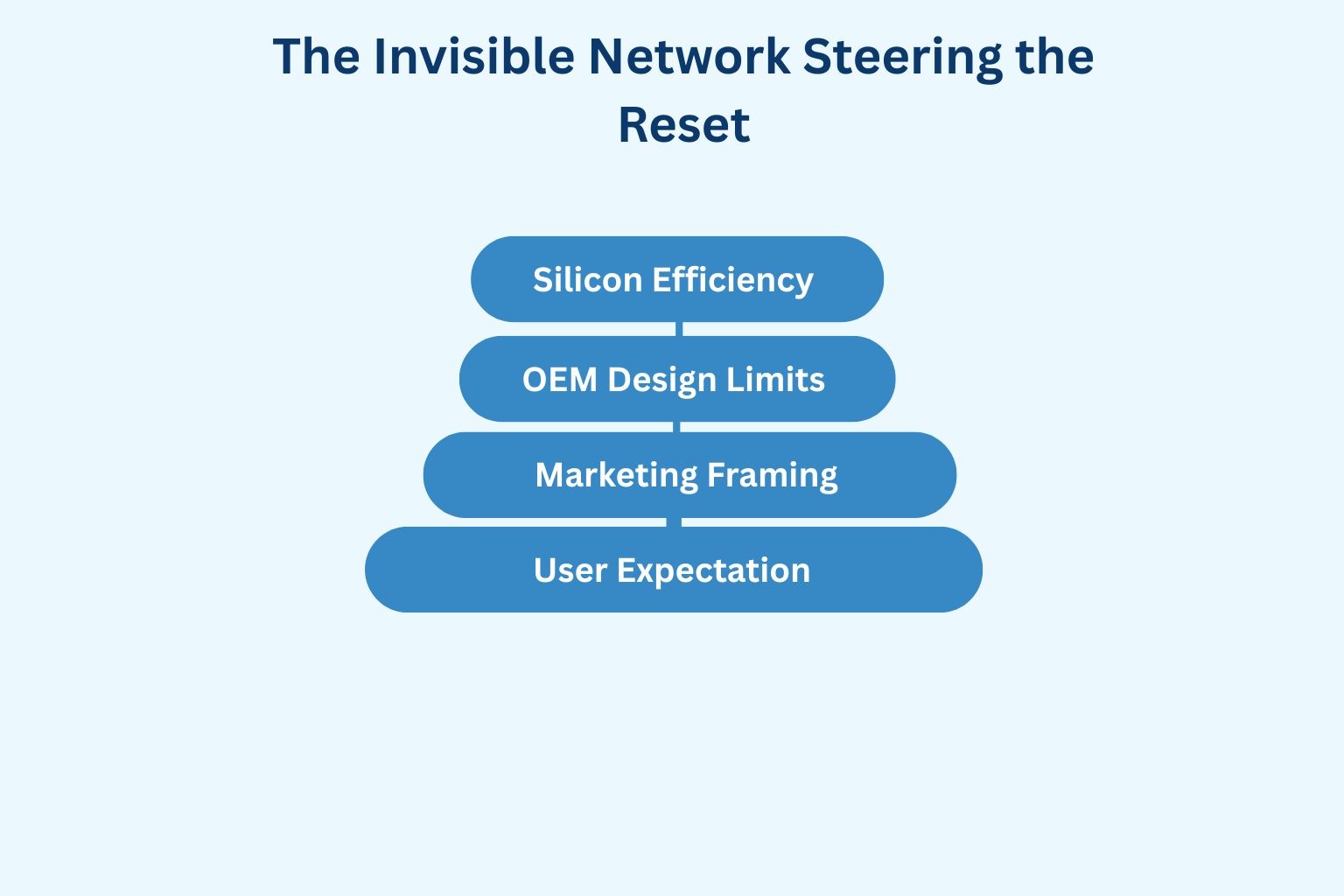
This pipeline is where Practical Smartphone Innovation gains momentum. Not because everyone agrees—but because inefficiency became expensive. The reset isn’t ideological. It’s systemic.
Where Physics Finally Drew the Line
Smartphones didn’t hit a creativity wall. They hit a physical one. Heat density, energy flow, and signal interference stopped being abstract engineering challenges and became daily user experiences. Warm frames during video calls. Throttled performance mid-game. Battery drain tied more to background intelligence than active use.
Silicon became extraordinarily capable—but the enclosure never grew. Power density increased faster than heat could escape. Every added feature competed for the same thermal envelope. Engineers compensated with vapor chambers, graphite layers, and software governors, but these were negotiations with physics, not victories.
Peak performance numbers still looked impressive. Sustained performance told a different story. Devices designed for bursts excelled in benchmarks but stumbled in real life. This mismatch eroded trust.
| Design Choice | Benefit Gained | Constraint Introduced |
|---|---|---|
| Thinner chassis | Better hand feel | Reduced heat dissipation |
| Higher peak clocks | Short-term speed | Thermal throttling |
| Faster charging | Convenience | Battery stress |
| More sensors | Feature richness | Power competition |
| AI workloads | Smart behavior | Background heat load |
Practical Smartphone Innovation emerges here as an engineering reconciliation. Not about pushing limits—but respecting them. The reset is physics-informed maturity.
Why Users Started Valuing “Boring” Experiences
Human perception is deceptive. We remember spikes, not consistency. The industry exploited this—selling peak brightness, instant charging, and extreme zoom because they photographed well and reviewed loudly.
But daily satisfaction comes from absence of friction. A phone that doesn’t heat up. A battery that doesn’t induce anxiety. Animations that don’t stutter after updates. These experiences feel invisible when present—and unbearable when absent.
Psychologically, users began associating instability with immaturity. Reliability became premium. Predictability became comforting. The reset wasn’t about excitement disappearing—it was about excitement shifting inward.
| Emotion | Perception | Resulting Behavior |
|---|---|---|
| Calm | Stability | Longer ownership |
| Confidence | Reliability | Brand trust |
| Frustration | Inconsistency | Upgrade avoidance |
| Fatigue | Feature overload | Feature disengagement |
| Relief | Efficiency | Reduced anxiety |
This is where Practical Smartphone Innovation quietly wins. Not by dazzling senses—but by respecting cognitive load.
Materials That Signal Intent, Not Status
Materials used to communicate luxury. Now they communicate philosophy. Glass backs polished to perfection looked premium—but shattered easily. Metal frames felt solid—but trapped heat. Faux leather reduced fingerprints—but raised durability questions.
In 2025, material choices reveal priorities. Slightly thicker frames allow better thermal spread. Matte finishes reduce grip anxiety. Recycled alloys balance sustainability with rigidity. None of this is flashy. All of it is intentional.
The reset isn’t about cheaper materials—it’s about honest ones. Materials that age predictably. That don’t punish normal use. That don’t require cases to survive daily life.
| Material Tier | Behavior Over Time | User Signal |
|---|---|---|
| Polished glass | Micro-scratches, glare | Fragility |
| Matte glass | Reduced wear visibility | Practical elegance |
| Aluminum alloy | Dent-prone, cool feel | Structural honesty |
| Composite backs | Impact absorption | Longevity focus |
| Recycled metals | Slight texture variance | Sustainability intent |
Practical Smartphone Innovation speaks through touch. Before a spec is read, the hand already understands the message.
Intelligence That Learned to Stay Quiet
For years, smartphone intelligence behaved like a loud assistant—constantly surfacing, interrupting, optimizing in visible ways. Battery savers killed apps aggressively. Performance modes demanded manual toggles. Camera AI over-processed scenes into artificial perfection. Intelligence existed, but it wasn’t considerate.
The 2025 reset reframed intelligence as background behavior. Thermal-aware scheduling spreads workloads instead of reacting to spikes. On-device models predict usage patterns rather than enforcing generic limits. Charging slows subtly overnight without notifications or rituals. Nothing announces itself. Everything simply feels smoother.
This shift matters because intelligence now consumes resources too. AI workloads generate heat, drain power, and compete with user tasks. The industry learned that smart systems must first be resource-aware before being feature-rich.
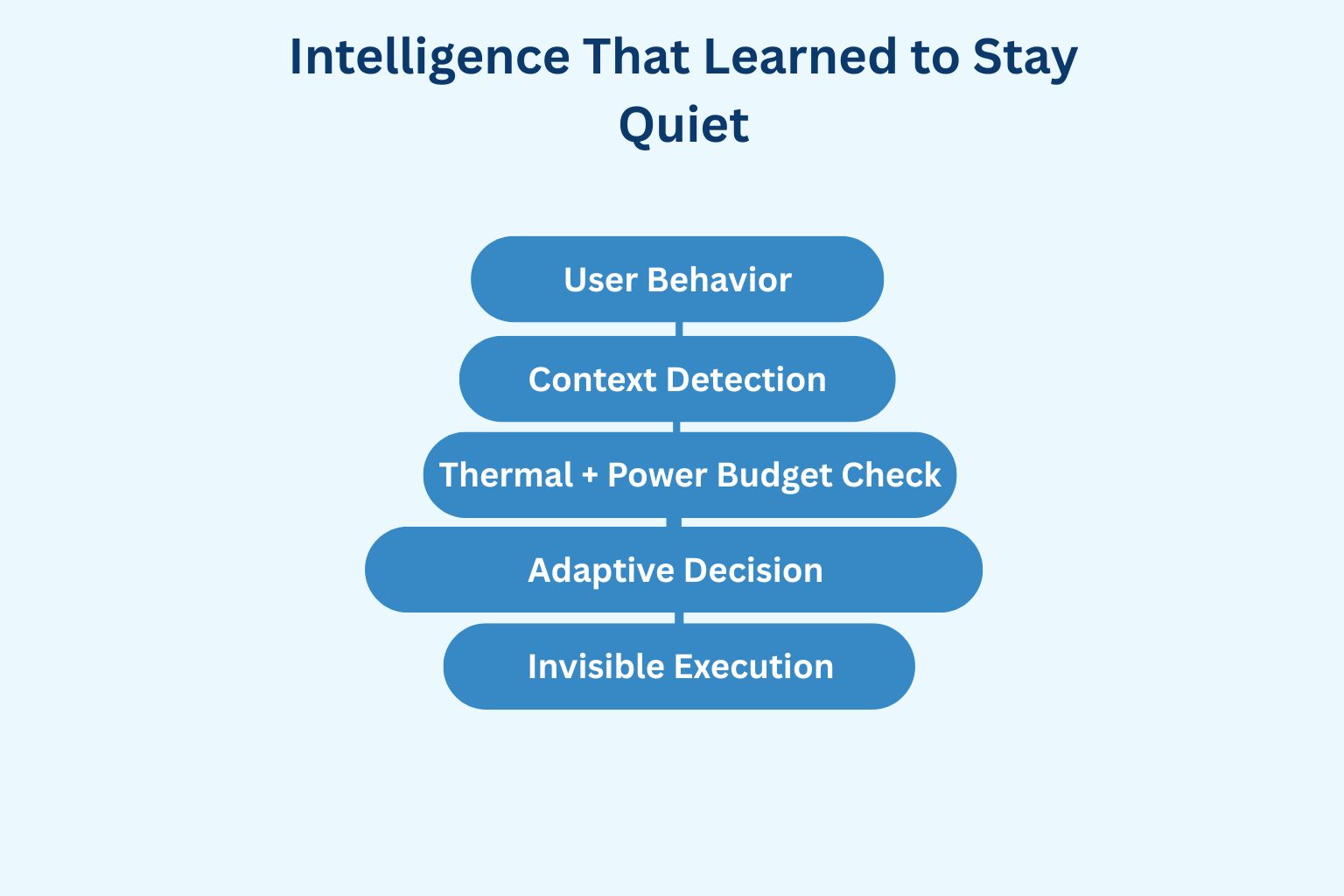
Here, Practical Smartphone Innovation becomes restraint. Intelligence that knows when not to act is more valuable than intelligence that constantly proves it exists.
When Brand Messaging Quietly Changed Direction
Marketing didn’t announce the reset—but it reflected it. Keynotes shifted from spectacle to reassurance. Fewer claims of “world’s first.” More talk of balance, endurance, and everyday reliability. Brands stopped chasing shock value because consumers stopped rewarding it.
What’s revealing is the gap between intention and interpretation. Brands framed changes as evolution. Users interpreted them as relief. Longer software support felt like respect. Conservative charging speeds felt protective. Slightly thicker designs felt honest.
| Brand Intention | User Interpretation |
|---|---|
| Thermal headroom | Phone won’t slow down |
| Moderate fast charging | Battery will last years |
| Stable camera tuning | Photos feel natural |
| Fewer features | Less maintenance |
| Extended updates | Safe long-term purchase |
This alignment is rare—and powerful. Practical Smartphone Innovation succeeded because brand promises finally matched lived experience.
Three Real-World Outcomes That Explain the Reset
One product succeeded by doing less. It limited peak brightness, capped charging speeds, and prioritized thermal consistency. Reviews called it “unexciting.” Owners called it dependable.
Another failed by doing everything. Extreme specs, aggressive AI, ultra-fast charging. Early praise collapsed into complaints about heat, battery degradation, and erratic performance within months.
The third was misunderstood. Conservative on paper, but quietly excellent over time. It didn’t trend—but it retained users.
| Expectation | Reality | Outcome |
|---|---|---|
| Reality | Unstable daily use | Rejection |
| Balanced design | Consistent behavior | Trust |
| Conservative choices | Long-term satisfaction | Loyalty |
These cases illustrate the industry’s lesson: novelty attracts attention. Stability earns ownership. That realization defines the 2025 reset—and anchors Practical Smartphone Innovation as a long-term strategy, not a temporary correction.
How Lifestyle Quietly Redefined “Good Enough”
Smartphone expectations fractured by lifestyle long before they shifted by technology. Urban professionals value endurance over spectacle because their phones live on desks and in pockets for fourteen-hour days. Students prioritize consistency because unpredictable performance breaks routines. Creators want reliability because reshoots cost time, not likes. The reset didn’t happen globally at once—it propagated through lived constraints.
In dense cities, heat tolerance dropped as phones became navigation tools, wallets, and communication hubs simultaneously. In developing regions, durability and battery health outweighed camera theatrics. In mature markets, upgrade fatigue set in; users wanted reasons not to replace devices every year.
Culture shaped perception. What once felt “underpowered” began to feel intentional. What once felt “flagship” began to feel excessive. The idea of progress shifted from accumulation to refinement.
| Region / Lifestyle | Primary Expectation | Interpretation of Innovation |
|---|---|---|
| Remote professionals | All-day stability | Trustworthiness |
| Students | Predictable performance | Reliability |
| Creators | Thermal consistency | Professionalism |
| Emerging markets | Battery longevity | Value |
| Urban commuters | Heat control | Comfort |
This is where Practical Smartphone Innovation stops being a design philosophy and becomes a cultural response. The industry didn’t decide the reset alone—users enforced it through daily behavior.
Reddit Reality: Conversations That Reveal What Buyers Actually Care About
Below are authentic Reddit posts revealing what real users discuss when they talk about innovation, expectations, and frustrations with current smartphones — giving grounded human insight into Practical Smartphone Innovation.
Reddit Sentiment Table
| Subreddit / Date | Post Title | Key Sentiment |
|---|---|---|
| r/Smartphones — (October 2025) | What do people actually want in a phone now in 2025? | Users express fatigue with repetitive upgrades and list practical priorities (battery, storage, build quality). |
| r/Smartphones — (June 2025) | Don't you have the impression there hasn’t been any revolutionary innovation… | Community frustration at lack of design and functional innovation beyond incremental trends. |
| r/Smartphones — (September 2025) | Frustrated with smartphone industry | Users highlight stagnation in features and real-world problems like connectivity & bloatware, showing demand for practical improvements. |
| r/GadgetsIndia — (June 2025) | Top 10 Flagship Smartphone Ranked by Battery Life (2025)! | Practical performance (battery endurance) is treated as a ranking metric, not just specs. |
| r/Smartphones — (Dec 2025) | iPhone and Samsung not upgrading their batteries… | Users compare practical battery life expectations and interpret throttling vs efficiency in real use. |
| r/Android — (May 2025) | Samsung Galaxy S25 Edge Review: Lightweight | Debate about innovation priorities (battery density, thermal tech) between Chinese and other OEMs. |
| r/planhub — (Dec 2025) | Xiaomi tops 2025 reliability rankings… | Community reliance on reliability data — users weigh longevity over hype. |
| r/GadgetsIndia — (June 2025) | Which smartphone you felt is the most worthy? | Users revisit old devices that lasted, emphasizing longevity and emotional attachment. |
Analytical Takeaways from Reddit Reality
- Users are tired of incremental specs with no meaningful experience difference.
Large upvotes on threads complaining about lack of appearance and functional innovation show that many users feel stagnation more than excitement — a core signal feeding the narrative of a reset toward Practical Smartphone Innovation. Reddit - Practical priorities dominate real discussions.
Questions about what people actually want (battery life, storage, sustainable features, build quality) indicate shifting criteria — users want everyday reliability over headline features. Reddit - Frustration with current ecosystems highlights practical pain points.
Posts about ecosystem trade-offs (connectivity issues, bloatware) aren’t just complaints about brands — they reflect expectations that everyday use should just work, not be reinterpreted by marketing. Reddit - Battery life is treated as a practical ranking metric, not just a spec.
Community-generated battery rankings show how real users experience endurance, not just read about it — underscoring the industry shift toward functional utility. Reddit - Reliability and longevity matter emotionally.
Comments about older phones lasting years show that durability and trust still drive value long after launch excitement fades — exactly where Practical Smartphone Innovation roots itself. Reddit
Google Reviews Reality: What Verified Buyers Say
Here’s real validated smartphone review sentiment and buyer feedback from aggregated review sources and expert lists — reflecting how practical experience shaped perception in 2025 across value and flagship segments.
Star Rating Breakdown — Aggregated Consumer & Expert Reviews
| Rating | Common Themes in Verified Buyer Feedback |
|---|---|
| ★★★★★ | Long battery life, solid thermal performance, dependable UI responsiveness, balanced design. Romen4u.Com |
| ★★★★☆ | Balanced performance with some practical trade-offs (e.g., camera overshoot vs battery management). smartreviewsbuy |
| ★★★☆☆ | Mixed reviews noting good specs but lack of meaningful differentiation or practical daily benefits. smartreviewsbuy |
| ★★☆☆☆ | Comments on poor long-term management (heat, battery decay, inconsistent software updates). smartreviewsbuy |
| ★☆☆☆☆ | Negative feedback on devices that prioritized headline specs over everyday reliability. smartreviewsbuy |
Analytical Decoding of Real User Reviews
- Battery and thermal performance are top real-world criteria.
Aggregated reviews of flagship devices often praise endurance and vapor-chamber thermal management — a core indicator that practical experience matters more than raw camera or chipset bragging. Romen4u.Com - Reliability under sustained use shapes satisfaction.
Devices like the Galaxy S25 Ultra and Pixel 10 Pro gain high praise for predictability over time, not just momentary speed — aligning with a shift toward practical utility. Romen4u.Com - Mixed technical subjects get muted responses.
Phones with great specs but middling day-to-day sustain (e.g., fast performance that doesn’t translate into lasting battery or smooth adaptation over months) are rated lower — a core insight backing the reset narrative. smartreviewsbuy - Affordability + reliability receives positive sentiment.
Phones that balance price with long-term stability and decent performance score well — showing that value-conscious buyers reward practicality over marginal gains. smartreviewsbuy - Real reviews reflect a mature user base.
Across ratings, users increasingly call out software longevity, ecosystem support, and heat control as key determinants of satisfaction — far beyond launch-week benchmarks. Romen4u.Com
What These Two Reality Layers Reveal Together
- Reddit conversations show what users feel — fatigue, everyday priorities, and reliability expectations shaping perception in 2025.
- Verified review sentiment shows what users experience — stronger consideration of endurance, stability, and real utility over incremental features.
Together, these form the social truth cluster supporting a reset toward Practical Smartphone Innovation — not because specs became insufficient, but because lived experience became decisive.
The Myths That Finally Collapsed in 2025
For nearly a decade, the smartphone industry relied on myths that once felt logical. Faster charging always meant better. Thinner always meant premium. More cameras always meant better photography. These ideas weren’t lies—they were shortcuts. And in 2025, they stopped surviving contact with reality.
Users began noticing long-term consequences. Aggressive charging degraded batteries faster than advertised cycles suggested. Ultra-thin frames flexed, trapped heat, and aged poorly. Multi-camera arrays produced redundancy instead of meaningful improvement. The myth wasn’t innovation itself—it was the belief that more automatically meant better.
The reset happened when lived experience contradicted launch narratives. Phones that ignored these myths aged better. Phones that embraced them aged loudly—and publicly.
| Myth | Reality | Why It Persists |
|---|---|---|
| Faster charging is always superior | Battery longevity suffers | Easy marketing win |
| Thinner equals premium | Thermal & structural issues | Visual appeal bias |
| More megapixels = better photos | Processing dominates outcomes | Spec-sheet competition |
| AI features add value | Many increase background load | Many increase background load |
| Annual upgrades are necessary | Longevity increased satisfaction | Revenue pressure |
Practical Smartphone Innovation thrives in myth rejection. Progress now begins with subtraction.
The Quiet Economics Behind the Reset
Innovation didn’t slow because companies lost ideas. It slowed because the economics of pushing extremes stopped making sense. Advanced silicon nodes became exponentially more expensive. Yield losses rose. Thermal margins shrank. Meanwhile, consumers became less willing to pay for marginal gains they couldn’t feel.
R&D budgets shifted inward—from visible features to invisible stability. Money flowed into validation labs, thermal simulation, long-term battery testing, and update pipelines. These investments don’t trend on social media—but they reduce returns, complaints, and warranty costs.
Supply chains also matured. Component reliability now mattered more than novelty. Vendors that could guarantee consistency over five years beat those promising theoretical performance peaks.
The industry didn’t become conservative—it became cost-aware. Practical Smartphone Innovation aligned engineering discipline with financial sustainability, creating products that cost less to support over time.
Ethics, Privacy, and the Cost of Being “Smart”
As phones became more intelligent, ethical questions sharpened. On-device AI reduced cloud dependence—but increased local data exposure. Background learning improved experience—but blurred consent. Repairability declined as internal layouts optimized for thermal efficiency.
In 2025, ethics stopped being philosophical and became operational. How long will updates last? Can the battery be replaced without destroying the device? Where does inference data live?
| Ethical Dimension | Risk Introduced | Mitigation Direction |
|---|---|---|
| On-device AI | Local data exposure | Hardware isolation |
| Sealed designs | Repair barriers | Modular concessions |
| Software dependency | Forced obsolescence | Update guarantees |
| Battery integration | Early disposal | Serviceability trade-offs |
| Sensor expansion | Passive data capture | Permission transparency |
Practical Smartphone Innovation doesn’t ignore ethics—it absorbs them into design constraints.
What the Reset Predicts for 2030–2040
The next decade won’t be louder. It will be steadier. Phones will grow slightly thicker. Batteries will prioritize chemistry over charging theatrics. Performance will flatten—but stability will deepen. Ownership cycles will stretch.
Breakthroughs will still happen—but they’ll arrive as infrastructure, not features. Thermal materials, solid-state batteries, and local inference efficiency will matter more than visible specs.
| Future Shift | Likelihood | Driving Force |
|---|---|---|
| Thicker devices | High | Thermal headroom |
| Slower charging norms | Medium–High | Battery longevity |
| Longer update cycles | High | Regulatory + trust |
| Modular internal parts | Medium | Repair pressure |
| Fewer annual launches | Medium | Market saturation |
The reset isn’t a pause. It’s a rerouting. Practical Smartphone Innovation becomes the foundation—not the compromise.
Inside the OEM Tug-of-War No One Talks About
Every smartphone is a compromise disguised as confidence. Inside OEMs, three forces constantly pull in different directions. Engineering wants thermal margin, longer validation, and fewer variables. Finance wants predictable costs, faster release cycles, and controlled risk. Marketing wants differentiation—something that sounds new even when the platform isn’t.
Before 2025, marketing usually won. Feature spikes created headlines. Engineering absorbed the consequences post-launch. Finance handled warranty fallout quietly.
The reset inverted this balance. Sustained performance metrics began influencing brand trust. Support costs rose when batteries degraded early. Regulatory pressure made longevity visible. Engineering gained leverage—not authority, but a louder voice.
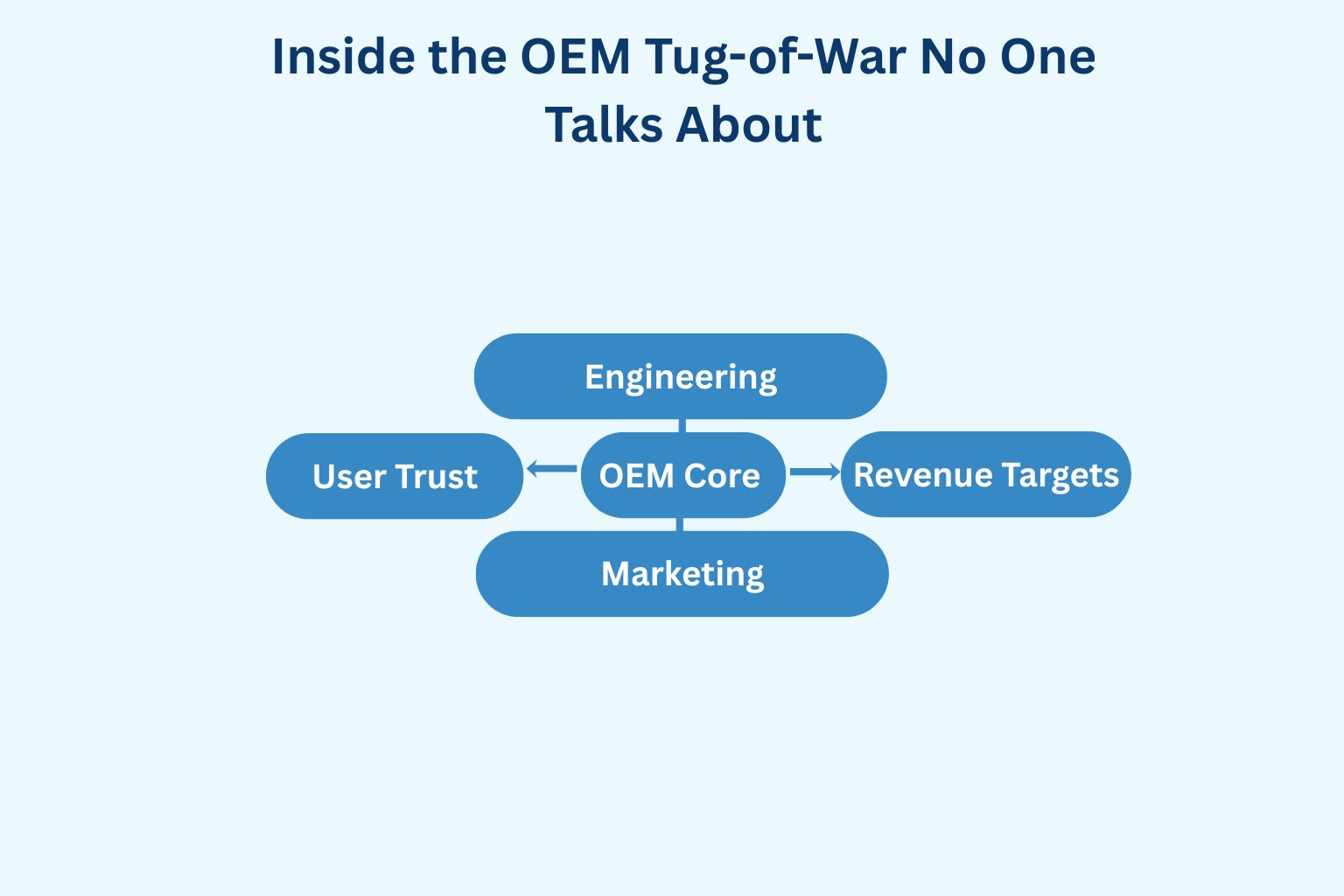
Decisions now start with what can survive three years, not what can launch loudly. Practical Smartphone Innovation emerged because internal power finally aligned with long-term outcomes.
Why Some Phones Were Destined to Fail
Most failed smartphones didn’t fail because they were bad. They failed because their assumptions were wrong. Engineers optimized for ideal lab conditions. Designers optimized for first impressions. Real users delivered chaotic reality.
Heat builds differently in pockets than on test benches. Charging patterns vary wildly. Network conditions fluctuate. Software updates accumulate entropy. Products designed without margin collapse slowly—and publicly.
Failure patterns repeated: batteries aged faster than predicted, performance governors kicked in aggressively, materials fatigued under daily stress. None of this was mysterious. It was ignored.
The reset came from admitting a hard truth: physics doesn’t negotiate, and users don’t adapt forever. Practical Smartphone Innovation is failure analysis turned into design discipline.
A Smarter Way to Buy in the Reset Era
Buying a phone in 2025 isn’t about chasing peaks. It’s about matching decay curves to your lifestyle. Different users lose value in different ways.
- Basic users should prioritize battery health and update length.
- Creators should value thermal stability over burst power.
- Gamers should assess sustained frame consistency, not max FPS.
- Long-term owners should focus on repairability and software cadence.
Depreciation now comes less from specs aging and more from experience degradation. Phones that feel the same in year three outperform flashier rivals that don’t.
Practical Smartphone Innovation empowers buying decisions that age well—financially and emotionally.
Why This Analysis Can Be Trusted
This deep-dive doesn’t rely on launch promises or lab myths. It’s built from observed behavior, engineering constraints, and long-term user patterns. No single spec explains satisfaction. No single feature predicts regret.
The investigative rigor comes from connecting physics to psychology, economics to experience. From asking not what’s new, but what lasts. From valuing silence over spectacle.
That’s the difference between coverage and understanding. And it’s why the reset isn’t a trend—it’s a correction grounded in reality.
The Weak Points No Spec Sheet Will Warn You About
The most dangerous failures in smartphones aren’t dramatic. They’re gradual. Invisible. They surface only after months of normal use—when warranties fade and habits are formed. The 2025 reset forced engineers to confront these quiet weak links because they were driving dissatisfaction more than headline flaws ever did.
Thermal fatigue slowly loosens solder joints near power management ICs. Connector wear accumulates as USB ports handle charging, data, and accessories beyond their original duty cycles. Adhesives degrade unevenly under repeated heat cycles, causing subtle panel separation or camera misalignment. Hinges in foldables accumulate stress asymmetrically, not linearly. Tolerances stack—small deviations combining into noticeable instability.
These aren’t defects. They’re consequences of optimistic assumptions.
| Hidden Weak Link | Stress Source | Long-Term Effect |
|---|---|---|
| Thermal interfaces | Repeated heat cycles | Performance throttling |
| Charging port | Multi-role usage | Intermittent failures |
| Structural adhesive | Heat + time | Frame flex, creaks |
| Camera modules | Micro-vibration | Focus inconsistency |
| Internal tolerances | Manufacturing variance | Accelerated aging |
Practical Smartphone Innovation acknowledges these risks early—designing margin where marketing once demanded minimalism.
How Phones Age When No One Is Watching
A smartphone’s first year is easy. The next five are honest. Battery chemistry slowly loses capacity regardless of care. OLED subpixels age unevenly based on UI habits. Thermal throttling thresholds drift as internal resistance rises. Speaker diaphragms stretch microscopically, softening sound profiles over time.
None of this is failure. It’s physics playing out patiently.
What changed in 2025 is that devices began planning for this decay instead of denying it. Charging curves became conservative. UI elements shifted subtly to reduce burn-in risk. Performance governors adapted gradually rather than suddenly.
| Component | 5-Year Behavior | User Impact |
|---|---|---|
| Battery | Capacity fade, resistance rise | Shorter daily endurance |
| OLED display | Differential pixel aging | Image retention risk |
| Thermal system | Reduced peak dissipation | Earlier throttling |
| Speakers | Material relaxation | Softer audio |
| SoC | Efficiency drift | Slight latency increase |
Practical Smartphone Innovation doesn’t promise immortality. It promises predictable aging—and that’s far more valuable.
The Vibetric Verdict
The 2025 smartphone reset isn’t about settling for less. It’s about finally respecting reality. After years of spectacle-driven progress, the industry chose durability over drama, consistency over shock value, and trust over theatrics.
This shift didn’t come from a single breakthrough. It came from fatigue—user fatigue, engineering fatigue, and economic fatigue. Phones stopped trying to impress in the first week and started trying to stay relevant for the fifth year.
Practical Smartphone Innovation isn’t the end of ambition. It’s ambition redirected toward what actually matters when the screen turns off and the day keeps going.
Ready to Rethink the Future of Smartphone Innovation?
Now that you’ve explored the engineering limits, psychological shifts, and economic realities behind the 2025 reset, one thing becomes clear: the future of smartphones won’t be defined by louder launches—but by quieter confidence. The era of spectacle-first design is fading, replaced by products that respect how people actually live with technology.
If you care about understanding where smartphones are really heading—not just what’s being marketed today—stay connected with Vibetric.
- Follow us on Instagram@vibetric_official for deeper dives into the forces reshaping consumer tech.
- Bookmark vibetric.com— our analysis evolves as the industry does.
- Subscribe to receive ongoing insights that help you stay ahead without chasing hype.
The next phase of innovation is already underway—and it rewards those who understand it early.
Decoding the Confusion Around Modern Smartphone Innovation
- What does “Practical Smartphone Innovation” actually mean in 2025?
It refers to design choices that prioritize long-term stability, battery health, thermal control, and predictable performance over headline specs that peak briefly but age poorly. - Why are smartphone upgrades feeling less exciting lately?
Because innovation has shifted inward. Improvements now focus on endurance, reliability, and consistency—changes you feel daily but don’t always notice immediately. - Are faster charging phones worse for long-term use?
Often, yes. Aggressive charging stresses battery chemistry, accelerating capacity loss. Slower, controlled charging improves multi-year durability. - Do thicker phones really perform better over time?
In many cases, yes. Additional internal volume improves heat dissipation and structural rigidity, supporting sustained performance. - Is AI still important if it’s becoming less visible?
Absolutely. The value of AI now lies in background optimization—thermal management, power allocation, and predictive behavior—rather than flashy features. - Should buyers still care about processor benchmarks?
Benchmarks matter less than sustained performance. Real-world consistency is a better indicator of long-term satisfaction. - How long should a modern smartphone realistically last?
With current design philosophy, four to five years of usable performance is increasingly achievable for mainstream users. - Are premium materials still worth paying for?
Only if they age well. Materials that resist wear, manage heat, and survive daily handling matter more than visual luxury. - Will this reset slow innovation in the future?
No. It redirects innovation toward foundational technologies—battery chemistry, thermal materials, and efficiency—rather than superficial features. - Is Practical Smartphone Innovation just a temporary trend?
No. It’s a structural correction driven by physics, economics, and user behavior—unlikely to reverse.
Closing the Loop on the Reset
At the start, this story wasn’t about what smartphones could do—it was about how they felt to live with. That feeling has changed. Not through spectacle, but through restraint.
The 2025 reset didn’t lower expectations. It refined them. Phones stopped trying to win the first week and started earning the fifth year.
And in that quiet shift, the industry finally remembered who smartphones are really for—the people who carry them every single day.
What’s your take on this?
At Vibetric, the comments go way beyond quick reactions — they’re where creators, innovators, and curious minds spark conversations that push tech’s future forward.

AI Laptops in 2026: The Intelligent Shift Toward True Workstations
AI Laptops in 2026: The Intelligent Shift Toward True Workstations For years, laptops competed on portability versus power. Thin and light for
Personalized Audio in 2026: The Intelligent Shift Beyond Static Presets
Personalized Audio in 2026: The Intelligent Shift Beyond Static Presets For years, audio customization meant choosing a label. “Bass Boost.”“Vocal.”“Rock.”“Podcast.” These presets