
Phones Camera Replacing Cameras: The Hidden Shift Happening Faster Than Expected
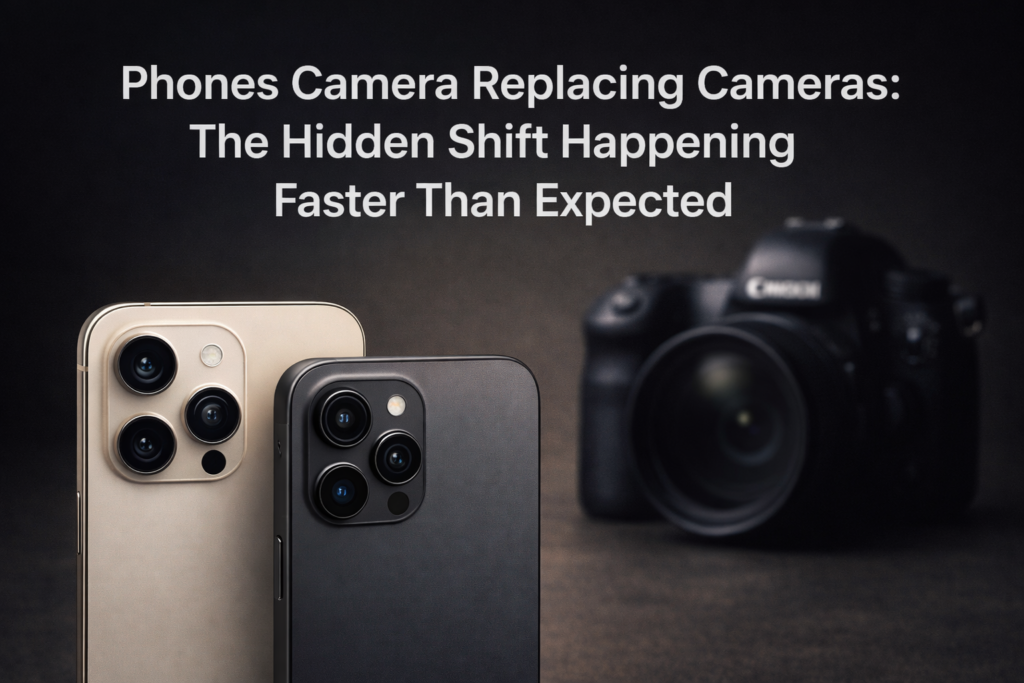
The question isn’t whether smartphones are improving as cameras—it’s whether dedicated cameras are losing relevance faster than the industry anticipated. For years, the assumption was coexistence: phones for convenience, cameras for “serious” work. That line is blurring rapidly. The reality of phones camera replacing cameras is less about image quality alone and more about how photography is now practiced, shared, and valued.
The Behavioral Shift That Changed Everything
Most photos today are taken with intent beyond storage. They’re edited, shared, analyzed by algorithms, and consumed on screens within minutes. Smartphones were built around this loop from day one. Dedicated cameras were not.
This behavioral mismatch matters more than sensor size. Phones prioritize immediacy, computational enhancement, and frictionless output. As users adapt to this workflow, the definition of a “good camera” shifts away from optical purity toward practical results. Phones camera replacing cameras isn’t driven by specs—it’s driven by habit.
Why Computational Photography Closed the Gap So Quickly
Traditional cameras rely on physics: lenses, sensors, light. Smartphones rely on computation layered on top of constrained hardware. Early on, this felt like a compromise. Now it’s an advantage.
Multi-frame stacking, AI-based noise reduction, HDR fusion, and semantic scene recognition allow phones to outperform larger sensors in common conditions—especially low light and high contrast. These aren’t edge cases; they’re everyday scenarios. The camera that adapts automatically wins most of the time.
This is why replacement is happening faster than expected. Phones didn’t wait to match cameras optically—they leapfrogged them perceptually.
The Quiet Decline of the “Casual Camera” Segment
Interchangeable-lens systems remain strong among professionals and enthusiasts. The real collapse is in compact and entry-level cameras. These once existed to offer “better than phone” quality without complexity. That value proposition no longer holds.
Placed here to anchor the market shift, this comparison clarifies where replacement pressure is strongest:
| Segment | Replacement Pressure |
|---|---|
| Compact point-and-shoot | Extremely high |
| Entry-level mirrorless | Moderate |
| Professional systems | Low (for now) |
| Action / niche cameras | Context-dependent |
Phones camera replacing cameras is not uniform—it’s targeted. The middle ground is disappearing.
Why Sharing Speed Now Competes with Image Quality
A technically superior image that takes effort to offload, edit, and publish often loses to a slightly inferior one that’s instantly usable. Phones optimize for the entire pipeline: capture to consumption.
Dedicated cameras still excel at controlled environments, but friction penalizes them in everyday use. This is especially true for younger users, for whom photography is inseparable from communication. If a camera slows the conversation, it loses relevance.
The Industry’s Misread: Assuming Enthusiast Logic Scales
Camera brands often argue from enthusiast priorities—dynamic range charts, lens sharpness, manual control. These matter deeply to a shrinking audience. Most users care about consistency, automation, and results under pressure.
Smartphones are engineered for average conditions and average users. That’s precisely why phones camera replacing cameras feels sudden. The industry optimized for excellence while phones optimized for sufficiency plus convenience—and sufficiency crossed the threshold.
A Contrarian Reality: Dedicated Cameras Aren’t Dying, They’re Narrowing
This isn’t a total replacement story. It’s a specialization story. Dedicated cameras are becoming more extreme: either deeply professional or highly niche. The broad consumer middle is gone.
In that sense, smartphones didn’t kill cameras—they forced them to pick a side. Casual photography migrated to phones. Serious photography doubled down on tools phones can’t replicate yet.
Why This Transition Feels Faster Than Past Disruptions
Previous tech shifts were gradual because infrastructure lagged. Here, distribution, social platforms, and cloud tools already exist. Smartphones simply plugged into an ecosystem ready to amplify them.
Once quality crossed “good enough,” acceleration became inevitable. That tipping point arrived quietly—and phones camera replacing cameras stopped being a forecast and became observable behavior.
What This Means for Buyers Today
If photography is part of daily communication, smartphones already dominate. If photography is a craft, dedicated cameras remain irreplaceable—but increasingly isolated.
The smarter question isn’t which is better. It’s which workflow matches how you actually shoot, share, and revisit images. Tools that align with behavior survive. Those that don’t become specialized artifacts.
Cameras didn’t lose the race on image quality. They lost it on relevance.
Track Where Imaging Is Really Heading
- Follow our Instagram @vibetric_official for perspective beyond megapixels.
- Bookmark vibetric.com to keep up with shifting creative tools.
- Stay connected as photography continues to redefine itselfTop of FormBottom of Form.
What’s your take on this?
At Vibetric, the comments go way beyond quick reactions — they’re where creators, innovators, and curious minds spark conversations that push tech’s future forward.
Next-Gen Smartphones Feel Dramatically Better in 2026 — Even If They Look the Same
Next-Gen Smartphones Feel Dramatically Better in 2026 — Even If They Look the Same The industrial design hasn’t changed much. The camera
OnePlus 15 Review 2026: Intelligent Performance in the AI Era
OnePlus 15 Review 2026: Intelligent Performance in the AI Era Performance used to be theatrical. Manufacturers showcased peak clock speeds, explosive benchmark