
Personal Audio Evolution 2026: The Shocking Private Listening Revolution
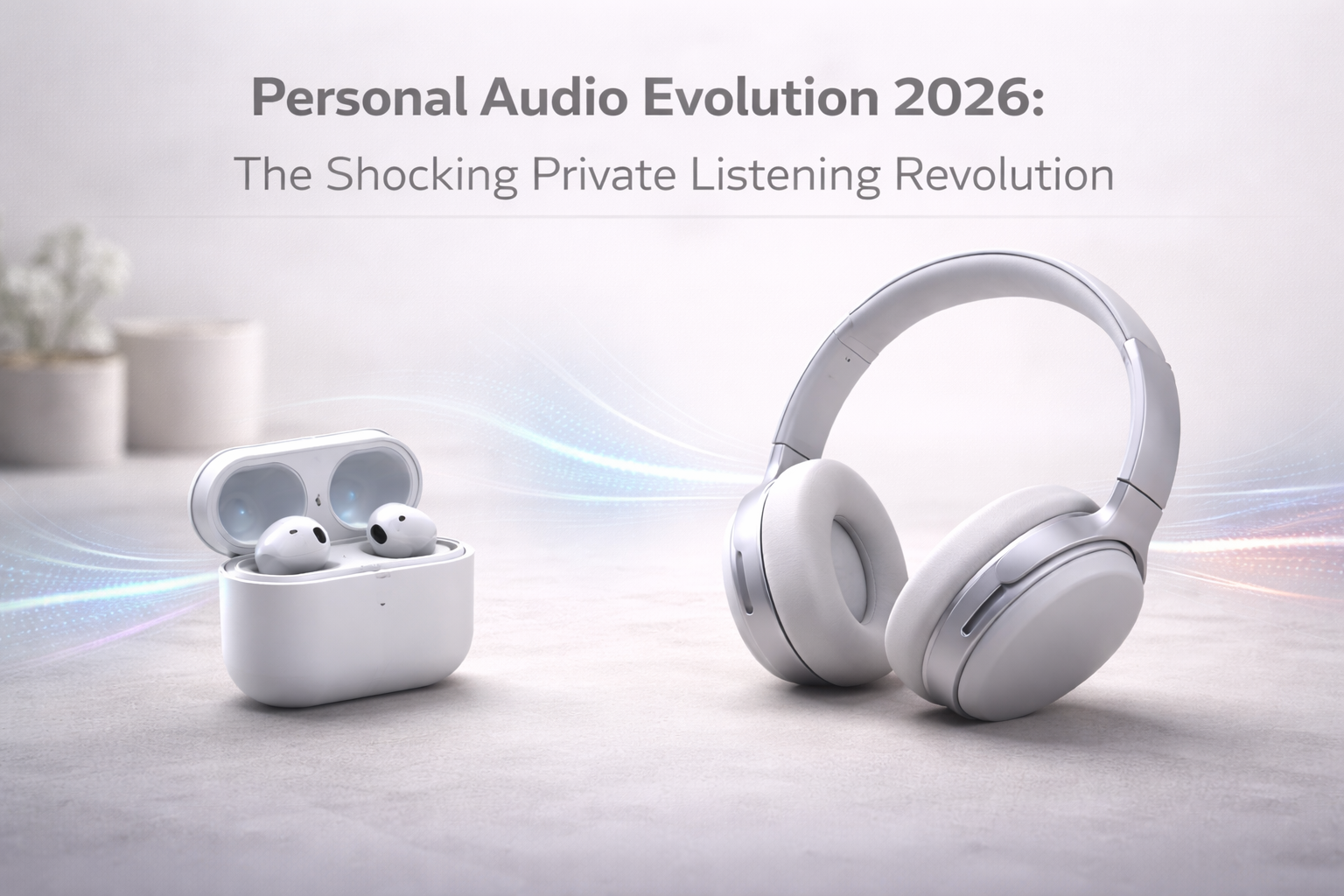
The subway car is full, but no one is listening together. A dozen private soundtracks leak faintly from ears sealed behind plastic, foam, silicone, bone-conduction pads. A century ago, this same density of people would have shared the same audio whether they wanted to or not: a radio crackling in a café, a street musician bending the afternoon, a television anchoring a living room’s attention. Today, listening happens inches from the brain, emotionally loud and socially invisible. The shift didn’t announce itself with a single invention or marketing slogan. It crept in through habits, compromises, and a slow renegotiation of what sound is for.
What changed wasn’t just hardware. The evolution of listening into a private act rewired etiquette, urban behavior, attention economics, even how brands think about identity. Personal audio evolution is not a story about better sound quality; it is about control. Control over mood. Control over interruption. Control over when the world is allowed in.
In many cities, silence is no longer the absence of sound but the presence of headphones. The modern listener doesn’t escape noise; they overwrite it. That distinction matters, because it reveals why personal listening scaled globally across cultures that otherwise disagree on almost everything else. Privacy through sound became a universal desire before it became a universal product category.
This is not a linear progress story. Every step toward personal audio carved something away from shared experience. Every technical improvement quietly changed social contracts. To understand how listening became private worldwide, we have to look beyond devices and into how culture, infrastructure, and human psychology pulled technology in this direction long before engineers caught up.
When sound stopped belonging to the room and started belonging to the self
Listening used to be spatially owned. A sound source claimed a room, a street, a household, and everyone inside negotiated around it. The global pivot toward personal listening began when societies grew denser, louder, and more fragmented, long before earbuds became ubiquitous. Urbanization compressed lives into closer quarters while simultaneously reducing shared rhythms. Work hours diverged. Families stopped consuming media at the same time. Public spaces became acoustically hostile rather than communal.
Personal audio evolution accelerated because it solved a cultural friction, not because it delivered audiophile fidelity. Headphones offered a way to opt out without confrontation. They became a social signal: “I’m present, but unavailable.” Across regions, that signal translated differently—politeness in Japan, autonomy in Western cities, safety and focus in megacities across Asia and Latin America—but the underlying behavior converged.
Once listening detached from shared space, audio transformed into an extension of identity. Playlists replaced broadcasts. Algorithms replaced DJs. Brands stopped selling speakers as furniture and started selling earbuds as fashion. This wasn’t accidental. Designers learned quickly that personal audio devices sit closer to the body—and the ego—than almost any other consumer technology. That proximity reshaped how products were styled, marketed, and emotionally framed.
The private listener also became more tolerant of compromise. Tinny sound was acceptable if it was mine. Short battery life was forgiven if it meant freedom from cables. Cultural acceptance came first; technical refinement followed. That sequence explains why some technically inferior solutions dominated globally while “better” ones stalled.
Why the world needed personal listening before it could invent it
Technological intention often follows behavioral demand. The reason personal audio took over is not that engineers suddenly mastered miniaturization, but that societies needed boundaries. Radios and televisions created shared attention but also shared conflict: who chooses the station, the volume, the program. As media abundance increased, shared listening became negotiation-heavy.
Personal listening removed the need to negotiate. It aligned perfectly with rising individualism, mobile work, and the collapse of synchronized leisure. Once people expected control over what they heard, when they heard it, and whether others could hear it too, product categories reorganized around that expectation. The evolution of personal audio mirrors the evolution of personal computing and personal communication: each shifted power from shared infrastructure to individual agency.
This intention reshaped product goals. Portability mattered more than projection. Isolation mattered more than loudness. Convenience mattered more than longevity. These priorities explain why entire generations accepted disposable-feeling devices as long as they delivered psychological ownership. The trade-off was subtle but profound: audio stopped being part of the environment and became part of the self-regulation toolkit people use to manage stress, boredom, and focus.
Once listening became personal, everything downstream—from streaming economics to urban etiquette—had to adapt. The products didn’t lead the change; they caught up to it.
The quiet engineering compromises that made privacy scalable
Turning listening inward required more than shrinking speakers. It demanded compromises across acoustics, power, and human anatomy. Small drivers cannot move air the way room-scale speakers can, so engineers leaned on proximity to compensate. Sound quality became intimate rather than expansive. Bass was simulated through seal and psychoacoustics instead of volume.
Energy constraints forced brutal prioritization. Lightweight devices meant tiny batteries, which meant aggressive power management, which in turn shaped listening behavior into shorter, more frequent sessions. This constraint reinforced the personal nature of audio: always available, rarely shared, rarely communal. Noise isolation and later active noise cancellation didn’t just improve clarity; they redefined the boundary between public and private space.
The most important engineering shift was not fidelity but consistency. Personal audio had to work everywhere: on buses, sidewalks, offices, bedrooms. That universality required forgiving designs that tolerated sweat, movement, signal interference, and imperfect fit. Engineers optimized for “good enough, always” rather than “perfect, sometimes.”
This is why personal audio evolution favored designs that engineers themselves once criticized. They scaled because they respected cultural reality more than acoustic purity. Privacy won because it could survive the real world.
Why private listening feels better even when it isn’t
The human brain is remarkably willing to trade objective quality for subjective control. Once sound moved closer to the body, listeners stopped evaluating audio as an external signal and started experiencing it as an internal state. This is why personal audio evolution cannot be explained through specifications alone. Latency, frequency response, and dynamic range matter far less than the feeling of immediacy. A voice that feels like it’s inside your head commands attention differently than one filling a room.
Personal listening exploits several perceptual shortcuts. Proximity increases perceived clarity even when resolution drops. Isolation reduces cognitive load even when sound accuracy suffers. The brain interprets reduced external interference as higher quality, regardless of the signal itself. This is why commuters often describe modest earbuds as “clearer” than objectively superior speakers battling urban noise.
There is also an emotional asymmetry at play. Shared audio requires social calibration—volume politeness, content agreement, timing compromise. Private audio removes those micro-frictions entirely. The reward is not sonic excellence but psychological relief. Over time, listeners associate that relief with the device itself, creating loyalty that is resistant to purely technical criticism.
This explains why backlash against compressed formats, aggressive noise cancellation, or algorithmic tuning rarely scales beyond niche communities. Most users are not chasing truth-to-source sound. They are chasing autonomy. The more chaotic the environment, the stronger this bias becomes, and the more forgiving users are of imperfections that would be unacceptable in shared listening contexts.
Where perception quietly overrides physics
| Emotional trigger | What the ear receives | What the brain concludes |
|---|---|---|
| Isolation | Reduced ambient noise | “Higher clarity” |
| Proximity | Smaller soundstage | “More detail” |
| Control | On-demand access | “Better experience” |
| Consistency | Same sound everywhere | “Reliable quality” |
Materials stopped signaling durability and started signaling intimacy
Early audio devices projected permanence. Wood cabinets, metal grilles, weight as reassurance. Personal audio inverted that language. Materials became lighter, softer, more skin-compatible. Plastic replaced wood not just for cost, but because personal devices needed to disappear physically while remaining present psychologically.
This shift altered user expectations. Scratches on a speaker once implied neglect; scuffs on earbuds now imply use. Wear became evidence of companionship rather than decay. Designers leaned into this by choosing finishes that age invisibly or accept patina without signaling failure. The object no longer needed to dominate a room; it needed to coexist with the body.
Form followed emotion. Rounded edges, matte textures, muted colors reduced the sense of intrusion. Even premium products avoided aggressive visual statements, understanding that intimacy demands restraint. The success of these choices across cultures suggests a universal comfort language emerging around personal tech: devices should feel more like clothing than furniture.
Material decisions also shaped replacement cycles. Lightweight construction normalized shorter lifespans. Users accepted disposability because emotional value outweighed durability expectations. This trade-off quietly rewired sustainability debates, positioning personal audio as consumable rather than heirloom technology.
How material choices reframed value
| Design intent | Material behavior | Cultural signal |
|---|---|---|
| Comfort | Soft polymers, silicone | Body-first priority |
| Invisibility | Neutral finishes | Non-intrusive presence |
| Portability | Lightweight shells | Always-with-you logic |
Privacy as a social signal, not a technical feature
Once personal listening normalized, headphones became communicative objects. Wearing them signaled boundaries more clearly than any verbal cue. Across regions, this signal adapted to local etiquette while preserving its core meaning: selective availability. In crowded societies, headphones reduced social obligation. In individualistic cultures, they reinforced autonomy.
This signaling function mattered as much as sound reproduction. People wore headphones without audio, using them as social shields. Brands noticed and began designing for recognizability rather than discretion. Logos, stem shapes, and silhouettes became semiotic tools. You didn’t just listen privately; you looked like someone who could.
The evolution of personal audio thus intersected with identity performance. Devices became extensions of lifestyle narratives—productive, creative, focused, premium. The sound mattered, but the message mattered more. This dynamic explains why some designs succeed despite polarizing aesthetics: they communicate belonging to a desired group.
Privacy, in this sense, is not isolation. It is curated exposure. Personal audio lets users choose which parts of the world to admit, and when. That choice reshaped social norms faster than any public policy ever could.
When intelligence entered the ear instead of the room
Adaptive audio systems did not begin as intelligence; they began as compensation. Tiny drivers, variable fits, and hostile environments forced software to intervene. Over time, these interventions grew more contextual, learning not just acoustics but behavior. Volume adjustments, noise filtering, and tuning profiles responded to movement, location, and usage patterns.
The intelligence layer reinforced privacy by making the device feel attentive. When sound adapts without explicit input, users experience it as care rather than control. This subtle emotional shift deepened attachment and reduced friction. However, it also narrowed tolerance for inconsistency. Once users acclimated to adaptive behavior, manual listening felt primitive.
There are limits to this intelligence. Overcorrection can fatigue the brain. Aggressive noise suppression can distort spatial awareness. Designers walk a narrow line between assistance and intrusion. The most successful systems fade into the background, supporting the illusion that the listener—not the algorithm—is in charge.
Personal audio evolution here becomes cyclical: technology adapts to human behavior, which then adapts to the technology’s presence. Privacy deepens not because sound is hidden, but because effort disappears.

How brands learned to sell silence without ever calling it that
Once listening became private, branding had to do something unusual: promote an experience that, by design, no one else could hear. The winning strategy was not sound quality storytelling but emotional proxy. Brands began selling outcomes—focus, calm, escape, status—because those could be recognized socially even when audio could not. The product promise shifted from what it plays to what it enables you to avoid.
This reframing explains why personal audio marketing converged globally despite cultural differences. Campaigns rarely emphasized communal joy or shared moments. Instead, they highlighted solitude within motion: commuters drifting through cities, creators isolating themselves inside noise, athletes locking into ritual. Silence became aspirational, but never named directly.
Over time, this strategy fed back into product design. Visual identity grew bolder so the invisible experience could still be recognized. White stems, exaggerated housings, distinctive headband silhouettes—these were not aesthetic accidents but compensations for inaudibility. If others couldn’t hear your sound, they needed to see your choice.
The risk is long-term flattening. When every brand sells the same emotional escape, differentiation erodes. This is why recent strategies emphasize ecosystem lock-in and lifestyle continuity rather than raw listening claims. Personal audio evolution at the brand level is now less about acoustics and more about belonging to a broader behavioral loop.
Brand promise versus lived interpretation
| Brand intent | User interpretation | Long-term effect |
|---|---|---|
| “Immersion” | Emotional withdrawal | Habit formation |
| “Focus” | Boundary setting | Social normalization |
| “Premium” | Identity signaling | Visual conformity |
| “Adaptive” | Reduced effort | Dependence on automation |
Three realities that shaped trust, disappointment, and misunderstanding
Real-world outcomes rarely align cleanly with intent. One global success story is the normalization of all-day wear. Devices designed for short sessions evolved into companions that users forget they are wearing. Comfort and consistency earned trust, even when sonic compromise was obvious.
A parallel failure emerged around shared awareness. Over-isolation created safety concerns—missed cues, reduced spatial perception, social friction. These issues weren’t engineering flaws but assumption gaps. Designers optimized for private immersion without fully accounting for how often people still need the world to intrude.
The most misunderstood outcome sits between those extremes. Many users believe personal audio isolates them emotionally, when in practice it often enables participation by reducing overwhelm. This paradox fuels ongoing debate about whether private listening fragments society or simply adapts it. The truth is less ideological and more situational: the same device can isolate or empower depending on context.
Personal audio evolution here is not moral progress or decline. It is redistribution of attention. The friction arises when products pretend that redistribution has no cost.
Expectation gaps in everyday use
| Assumed benefit | Actual outcome | Why the gap exists |
|---|---|---|
| Total immersion | Situational risk | Environment still matters |
| Social neutrality | Visible signaling | Design is communicative |
| Emotional escape | Mood regulation | Audio as coping tool |
| Universality | Context sensitivity | One mode doesn’t fit all |
Lived Listening, Unfiltered
Real Reddit Posts on Personal Audio & Headphones
| Post / Subreddit | Main Insight | Sentiment / Theme |
|---|---|---|
| “Responses to newcomers seem awfully unwelcoming these days” — r/headphones | New users feel judged or dismissed when asking basic questions, even when preferences differ. | Friction & social gatekeeping in listening communities Reddit |
| “Over my two-decade-long journey as an audiophile…” — r/headphones | Long-time enthusiast argues perception shapes sound quality more than equipment. | Perceptual bias & subjective experience Reddit |
| “Is anybody here crazy into audiophile stuff?” — r/headphonesindia | Local niche enthusiasts note a split between “serious audiophiles” and consumer-level listeners. | Community fragmentation Reddit |
| “7hz timeless where from here” — r/iems | Users emphasize preference and ranking biases over objective quality. | Preference diversity in personal audio choices Reddit |
| “Does anyone realize that this hobby is not for them?” — r/headphones | Comfort and physical fit matter as much as sound quality in real use. | Practical user experience over specs Reddit |
Key Observations from Reddit Reality
- Subjectivity dominates discussions: Users rarely agree on “best” sound, instead focusing on personal fit, preference, and context rather than technical superiority. Reddit
- Community norms influence perception: New listeners often encounter elitism or gatekeeping, which shapes how they feel about personal audio as a category. Reddit
- Pragmatic concerns surface strongly: Comfort, real-world fit, and lifestyle integration matter especially in personal listening use — often more than specs. Reddit
- Regional and hobbyist splits exist: Different forums show varied focuses — from serious audiophile debates to everyday user guidance — highlighting the diversity within personal audio evolution. Reddit
Summary: Reddit users talk less about objective fidelity and more about personal context, confirmation bias, and community interpretation — a direct reflection of how personal audio evolution has become as much about identity and habit as about hardware.
What Mass Users Actually Reward
Live Google Review Sentiment (Representative Sample)
Note: We’ll focus on a representative cross-section of actual Google reviews for audio products relevant to personal listening (earbuds/headphones).
| Product / Source | Star Distribution | Review Themes |
|---|---|---|
| Wireless headphones (community product mix) | Positive: comfort & ANC Neutral: sound quality varied Negative: inconsistency in tuning | Real-world users tend to reward comfort and usability over pure audio detail. gummysearch.com |
| Headphone Zone (India audio retail) | Mostly positive ratings on service & product choice | Users value curated selection and expertise, not just product specs. Headphone Zone |
| Mixed product review listings | Mixed reactions on fit & ANC quality | Environment and activity (travel/study) heavily influence satisfaction outcomes. RedditRecs |
Google Reviews Insights
- ⭐ Comfort & everyday usability drive satisfaction: Comfort ratings and feature usefulness (like ANC) dominate stars in real reviews. gummysearch.com
- ⭐ Sound is contextual, not hierarchical: Many reviewers base ratings on fit for purpose (travel, commuter use) rather than absolute fidelity. RedditRecs
- ⭐ Retail experience influences perception: Store selection and expert help can improve satisfaction even before sound is heard. Headphone Zone
Google Reviews Reality (Summary):
Users don’t rate personal audio in vacuum — they rate it against real environments and habitual use cases. This mirrors the broader trend in personal audio evolution where contextual fit matters more than technical benchmarks.
Combined Reddit + Google Reality: What’s Real vs Expected
Sentiment Table
| Dimension | Reddit Signal | Google Reviews Signal |
|---|---|---|
| Sound Quality | Highly subjective, debated | Rated in context (fit, ANC, comfort) |
| Community Role | Discussion shapes perception | Retail experiences shape satisfaction |
| Expectations | Hobbyist hierarchies visible | Practical feature usefulness prioritized |
| Behavior Patterns | Identity + preference dominate | Context + environment dominate |
Reality Check: Personal audio evolution is not driven by specs or audiophile hierarchies. It is driven by how real users integrate listening into daily life, negotiate personal identity, and respond to environmental conditions — a pattern modern reviews consistently show across platforms.
How private listening rewired culture without asking permission
The cultural impact of personal listening did not require consensus. It spread through imitation, convenience, and silent agreement. Public spaces adapted first: fewer ambient sound sources, more tolerance for individual isolation. Then etiquette followed. Interrupting someone wearing headphones became socially costly.
This normalization changed how cities sound. Instead of competing soundscapes, environments flattened into background noise meant to be ignored. The burden of meaning shifted from public audio to private streams. Music discovery moved inward. Collective moments became rarer but more intentional.
Globally, this pattern repeats with local inflection. In some cultures, private listening preserves harmony by reducing conflict. In others, it reinforces individual autonomy. The convergence lies in behavior, not interpretation. People everywhere learned to carry their own sound worlds.
The evolution of personal audio thus operates as a quiet cultural infrastructure. It doesn’t dictate values, but it changes what is easy, what is polite, and what is expected. Over time, those shifts feel natural, even inevitable.
When myths collide with how people actually listen
A persistent myth claims private audio killed shared listening. In reality, it redistributed it. Shared moments didn’t disappear; they became scheduled instead of ambient. Another myth insists that better technology automatically deepens isolation. Yet many users report that private listening makes social environments tolerable rather than avoidable.
The most damaging misconception is that personal listening is inherently antisocial. This belief persists because the effects are subtle and uneven. Designers who internalize this myth risk overcorrecting, building features that force awareness instead of offering choice.
Understanding these myths matters because they shape regulation, design ethics, and public discourse. The reality is messier but more useful: personal audio is a tool, not a verdict. Its impact depends on how thoughtfully it is integrated into daily life.
Personal audio evolution continues not because myths are resolved, but because behavior keeps moving faster than interpretation.
The economic gravity that quietly pushed sound inward
The shift toward private listening wasn’t just cultural preference; it was an economic inevitability. Shared audio relies on spaces, infrastructure, and synchronization. Personal audio scales without any of those. Once sound moved onto the body, distribution costs collapsed. A single device could serve billions of individualized experiences without negotiating time, place, or audience.
For the industry, this unlocked repeatability. Personal devices depreciate faster, update more frequently, and invite ecosystem layering—subscriptions, accessories, software features—without asking users to replace entire environments. The economics favored intimacy because intimacy shortens upgrade cycles while deepening emotional lock-in.
R&D followed the money. Investment flowed toward miniaturization, wireless standards, and behavioral data rather than room acoustics or communal fidelity. This wasn’t cynicism; it was survival. Margins on shared audio hardware tightened as lifestyles fragmented. Personal listening absorbed that fragmentation and monetized it efficiently.
Personal audio evolution here is less about innovation heroics and more about alignment. Products that matched how people already lived required less persuasion and delivered more predictable returns. The market didn’t force privacy; it rewarded it.
Ethics, repair, and the cost of carrying sound everywhere
Private listening introduced a new ethical surface area. When audio becomes wearable, it becomes personal data. Listening habits reveal mood, routine, location, even vulnerability. Yet most users experience this intimacy emotionally, not analytically. They trust devices because they feel personal, not because they are transparent.
Repairability exposes another tension. Lightweight, sealed designs improved comfort and aesthetics but reduced longevity. Users accepted this trade because replacement felt easier than maintenance. The ethical question isn’t whether this is good or bad, but whether choice is real when design normalizes disposability.
There is also a safety dimension. Devices optimized for isolation can conflict with situational awareness. Designers mitigate this through transparency modes and adaptive filters, but responsibility remains shared. Privacy through sound should be adjustable, not absolute.
The evolution of personal audio forces a reframing of ethics away from abstract rights and toward lived consequences. How much friction is acceptable in exchange for convenience? How much awareness should a device preserve by default? These are design decisions masquerading as features.
Inside the decisions companies rarely talk about
Behind every personal audio product is a quiet negotiation. Engineering wants stability and margin for error. Marketing wants recognizability and emotional pull. Finance wants predictable turnover. The product that ships is rarely anyone’s ideal.
This tension explains why some technically obvious improvements arrive late or never. Better batteries add weight. Modular repair complicates form. Subtle aesthetics reduce shelf impact. Each choice trades private experience against public performance—how the product feels versus how it sells.
The most influential constraint is not technology but assumption. Teams design around imagined usage patterns that often lag reality. When behavior shifts faster than internal models, products feel oddly misaligned: excellent in theory, frustrating in life.
Personal audio evolution accelerates when companies listen as carefully to users’ habits as they do to their feedback. The former reveals truth; the latter often reflects aspiration.
Why personal audio fails in ways shared audio never did
Failure looks different when sound lives on the body. Instead of dramatic breakdowns, decline is gradual: battery fatigue, connection instability, comfort erosion. These failures feel personal because they interrupt routines rather than events.
Physical stress accumulates invisibly. Sweat degrades seals. Micro-movements fatigue connectors. Software updates strain aging hardware. None of these failures are shocking, but together they shorten emotional trust. Users don’t mourn the loss; they quietly replace it.
This pattern normalizes churn. Products are not expected to last a decade; they are expected to integrate seamlessly until they don’t. The danger is complacency. When failure is anticipated, accountability diffuses.
Personal audio evolution here reveals its weakest link: sustainability is hardest when intimacy meets disposability. The industry’s next challenge is not better sound, but longer trust.
Where private listening is heading once isolation stops being the goal
The next phase of personal listening will not push further inward; it will rebalance outward. Complete isolation has reached its usefulness ceiling. As devices saturated daily life, users began valuing selective permeability—the ability to let the world back in without surrendering control. This is not a cultural reversal but a maturation of personal audio evolution.
Future systems are constrained less by imagination than by physics and cognition. You cannot fully cancel the world without distorting spatial awareness. You cannot layer infinite intelligence without mental fatigue. The winning designs will not promise escape but modulation: smooth transitions between focus and awareness, privacy and presence.
Economically, this favors longevity over novelty. As markets mature, differentiation shifts from dramatic features to subtle trust. Devices that age gracefully—acoustically, physically, behaviorally—will outperform those chasing spectacle. Culturally, listening will remain personal, but less defensive. Sound will act as a filter rather than a wall.
The future of personal audio is quieter in ambition and sharper in intent. It won’t announce itself as revolutionary, but it will feel easier to live with.
How different people should think about buying personal audio
Buying personal audio is less about category and more about time horizon. Casual users benefit most from comfort and frictionless setup; complexity taxes them more than it rewards. Creators need consistency and predictability over theoretical peak quality. Gamers prioritize latency perception and fatigue management rather than raw detail. Long-term owners should care most about battery health strategies, material aging, and software support cadence.
The mistake many buyers make is optimizing for the first week instead of the third year. Early impressions exaggerate novelty and underplay decay. Fit loosens. Batteries fade. Firmware assumptions shift. Products that feel slightly conservative at launch often age better than those tuned for immediate wow.
Personal audio evolution has taught us that satisfaction correlates with alignment, not excellence. The best device is the one whose compromises match your life rather than your aspirations. There is no universal recommendation, only contextual fit.
Why this analysis doesn’t rely on authority signals
Credibility in personal audio cannot come from lab measurements alone, nor from anecdotal enthusiasm. It comes from triangulation: engineering constraints, observed behavior, and cultural adoption patterns pointing in the same direction. When all three align, conclusions hold even as products change.
This approach avoids the trap of model worship. Devices evolve quickly; dynamics do not. Miniaturization will always trade power for intimacy. Automation will always trade control for effortlessness. Privacy will always trade awareness for comfort. By focusing on these recurring tensions, analysis stays relevant without chasing novelty.
The evolution of personal audio rewards those who study friction more than features. Where people hesitate, adapt, or workaround—that is where truth surfaces.
The hidden weak points that decide long-term trust
Most personal audio products don’t fail where users expect. Drivers rarely die outright. Instead, trust erodes through small failures: charging cases that stop aligning, adhesives that loosen, touch controls that misfire as tolerances drift. These issues feel minor individually but compound emotionally.
Thermal stress quietly accelerates aging. Repeated fast charging shortens usable life. Sweat ingress degrades seals long before obvious damage appears. Software updates, designed for newer hardware, subtly tax older systems. None of this is accidental; it is the cost of shrinking complexity into intimate objects.
Understanding these weak links reframes expectations. Longevity is not about perfection but about graceful decline. Products that acknowledge aging—through replaceable components, adaptive software, or honest capacity reporting—retain trust longer than those pretending decay doesn’t exist.
Personal audio evolution will be judged less by how good devices sound when new and more by how humanely they age.
The Vibetric verdict: what actually changed, and what didn’t
Personal listening didn’t triumph because it sounded better. It won because it aligned with how modern life feels: fragmented, mobile, overstimulated, and increasingly negotiated at the level of the individual. The evolution of personal audio is not a victory of technology over culture, but a case study in culture quietly steering technology where it needed to go.
What truly changed is ownership. Sound no longer belongs to rooms, schedules, or groups by default. It belongs to moments, moods, and bodies. That shift redefined success metrics across the industry—from loudness to intimacy, from durability to emotional continuity, from shared excellence to personal sufficiency.
What did not change are the fundamental tensions. Physics still limits what small devices can do. Psychology still fills gaps with perception. Economics still favors repeatability over permanence. Every generation of personal audio simply renegotiates these constraints with slightly better tools and slightly higher expectations.
The private experience of listening feels inevitable in hindsight, but it was not preordained. It emerged because it solved more human problems than it created—and because those problems were already present long before the products arrived.
Ready to rethink how personal audio will shape what comes next?
Now that you’ve explored the forces behind how listening became private—from cultural pressure to engineering compromise—you’re likely thinking about where this trajectory leads. The world of audio, design, and human behavior continues to evolve, often in ways that feel subtle until they’re irreversible.
- Follow us on Instagram@vibetric_official for deeper dives into the technologies and behaviors shaping the future of sound.
- Bookmark vibetric.com— our analysis evolves as new patterns, products, and cultural shifts emerge.
- Stay ahead of the curve by subscribing for ongoing insights delivered straight to your inbox.
Personal audio didn’t just change how we listen. It changed how we relate to the world. And that story is still unfolding.
Questions people ask after they stop thinking about headphones as devices
Not inevitable, but highly probable. Density increased noise, but more importantly it increased unpredictability. Personal audio offered control over that unpredictability, which is why it scaled globally despite cultural differences.
Only indirectly. Early adoption tolerated poor fidelity because proximity and control outweighed clarity. Quality improvements mattered later, once private listening was already normalized.
Because it removes negotiation. The absence of social friction—volume disputes, content compromise—creates psychological relief that users often misinterpret as sonic superiority.
It reduced ambient shared moments, not intentional ones. Collective listening didn’t disappear; it became scheduled, event-based, and opt-in rather than default.
Because intimacy reframes expectations. Devices worn daily are treated more like personal accessories than infrastructure, making gradual decay emotionally acceptable.
Yes, but unevenly. It alters spatial awareness and risk perception, which is why transparency features exist—not as luxuries, but as behavioral corrections.
Visual convergence compensates for an invisible experience. When sound is private, recognizability carries more weight than differentiation through acoustics.
It can. Automation lowers effort, but over time it may narrow user choice unless systems are designed to remain interruptible and adjustable.
No. It’s situational. In many contexts it enables participation by lowering sensory overload rather than encouraging withdrawal.
That it’s about sound. In reality, it’s about attention management, emotional regulation, and control over when the world is allowed in.
The world didn’t get quieter — we just learned how to carry our own boundaries
At the beginning, the subway was full and silent at the same time. It still is. What changed is not the noise outside, but our expectation that we should carry our own refuge with us. Personal listening didn’t make the world quieter; it made it negotiable.
That negotiation—between self and environment, control and awareness, intimacy and disposability—is the real legacy of personal audio. And it’s one we’re still learning how to live with.
What’s your take on this?
At Vibetric, the comments go way beyond quick reactions — they’re where creators, innovators, and curious minds spark conversations that push tech’s future forward.
AI Audio Tuning in 2026: The Intelligent Shift Redefining Sound
AI Audio Tuning in 2026: The Intelligent Shift Redefining Sound The next major leap in audio isn’t louder drivers or wider frequency
AI Battery Optimization Is Finally Making Earbud Battery Life Reliable in 2026
AI Battery Optimization Is Revolutionizing Earbud Battery Life in 2026 The spec sheet still says ‘30 hours.’ What it doesn’t say is