
Performance Per Watt in 2026: The Critical Benchmark Redefining Computing
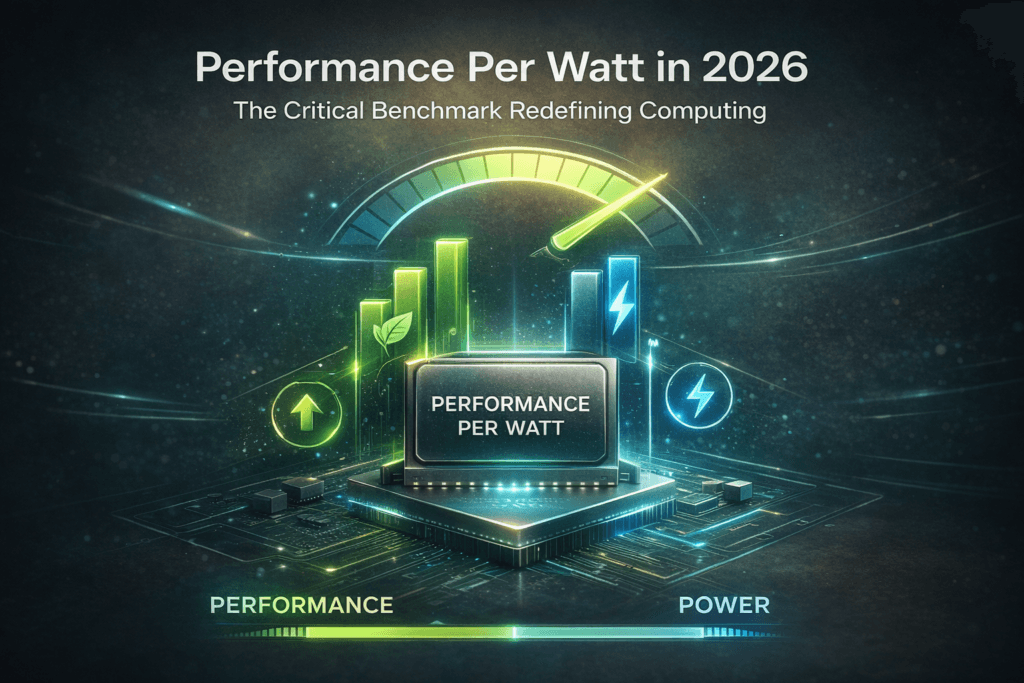
For years, performance was measured in absolutes. Faster processors won. Higher benchmark scores dominated headlines. Bigger numbers implied progress.
That era is losing relevance.
In modern computing, performance per watt is becoming the metric that actually matters. Not how fast a chip can run at its peak — but how efficiently it sustains meaningful workloads without draining battery, overheating, or throttling.
Efficiency is no longer a secondary consideration. It is the benchmark.
Why Raw Speed Stopped Being Enough
Most flagship devices today — whether powered by silicon from Apple, AMD, Intel, or Qualcomm — already exceed everyday computing demands.
Documents render instantly. 4K video playback is seamless. Multitasking rarely pushes hardware to its limits.
The bottleneck shifted.
Instead of asking how high performance can spike, engineers now focus on how long performance can be sustained within realistic power envelopes. Thin laptops, fanless tablets, and compact smartphones cannot afford uncontrolled thermal spikes.
Peak power is easy.
Controlled power is engineering.
The Architecture Behind Efficiency
Modern chip design reflects this shift in priorities.
Rather than relying solely on high-frequency cores, manufacturers are deploying heterogeneous architectures — combining high-performance cores with efficiency cores optimized for lighter tasks. Dynamic workload scheduling distributes processes intelligently, reducing unnecessary energy consumption.
A simplified comparison illustrates the transition:
| Traditional Metric Focus | Efficiency-Driven Focus |
|---|---|
| Peak clock speed | Sustained output at lower wattage |
| Short benchmark bursts | Long-duration workload stability |
| Raw multi-core scaling | Intelligent core allocation |
| Maximum GPU throughput | Balanced CPU-GPU-NPU efficiency |
Performance per watt measures how much useful work a system delivers relative to energy consumed. It rewards intelligent design rather than brute force.
And in mobile-first computing, energy is the constraint.
AI Workloads Accelerated the Shift
The rise of AI processing intensified the relevance of performance per watt.
On-device inference — whether for real-time transcription, image enhancement, or contextual prediction — runs continuously in the background. These tasks cannot afford excessive thermal output or rapid battery drain.
Dedicated neural processing units (NPUs) emerged not just to increase capability, but to improve efficiency. Offloading AI tasks from general-purpose cores dramatically increases performance per watt under machine learning workloads.
In this context, efficiency is not about conserving energy for its own sake. It enables intelligence to function persistently without degrading user experience.
The smarter devices become, the more efficient they must be.
Thermal Reality: Physics Still Governs
Silicon innovation is impressive, but it does not escape physics.
Higher wattage produces heat. Heat requires dissipation. Dissipation requires space, airflow, or advanced materials. Thin and portable designs restrict those options.
Performance per watt acknowledges that physical constraints are not optional. It optimizes within them.
A chip that achieves marginally higher peak speed but overheats quickly may score well in synthetic tests, yet underperform in sustained creative tasks like video rendering or software compilation.
Efficiency translates into consistency.
Consistency translates into trust.
The Enterprise and Data Center Parallel
This efficiency pivot is not limited to consumer devices.
Data centers now prioritize performance per watt because energy costs scale exponentially at enterprise levels. AI model training clusters, cloud services, and edge computing nodes all demand optimized energy usage.
Companies such as NVIDIA are increasingly highlighting efficiency metrics alongside raw compute power. The same logic shaping laptops and smartphones applies at server scale.
Energy efficiency has become both an economic and environmental consideration.
The metric is universal.
A Subtle Consumer Impact
Most buyers won’t analyze wattage curves.
They’ll notice practical outcomes:
- Laptops that maintain high performance without loud fans
- Smartphones that process AI tasks without overheating
- Tablets that sustain gaming or editing sessions longer
- Devices that feel stable instead of erratic
Performance per watt quietly defines how “premium” a device feels over time.
A machine that stays cool and consistent often feels faster than one that spikes and throttles.
The Marketing Narrative Is Changing
Benchmark culture once dominated product launches. Charts, bars, and percentage increases framed progress.
Now the narrative is shifting toward sustained performance, battery longevity under load, and efficiency under AI acceleration.
This is a healthier competitive landscape.
Instead of chasing unsustainable power increases, manufacturers are incentivized to refine architectures, optimize fabrication processes, and improve workload scheduling.
Performance per watt rewards balance.
Where the Metric Leads Next
As computing becomes increasingly mobile and AI-driven, energy efficiency will only grow in importance. Wearables, mixed reality devices, and compact AI laptops cannot function without disciplined power management.
In this environment, raw speed is insufficient without efficiency to support it.
Performance per watt reframes the question of innovation. It asks not just how powerful a system can be, but how intelligently it uses that power.
And that is a far more demanding benchmark.
The future of computing will not belong to the fastest chip.
It will belong to the most efficient one.
Keep Tracking the Shift with Vibetric
- Follow our Instagram @vibetric_official for precision-driven analysis on performance per watt trends.
- Bookmark vibetric.com to stay aligned with next-generation efficiency benchmarks.
- Return for insight into how intelligent design is redefining computing.
What’s your take on this?
At Vibetric, the comments go way beyond quick reactions — they’re where creators, innovators, and curious minds spark conversations that push tech’s future forward.
Snapdragon X Elite Gen 2 Laptops: Powerful Shift for Windows on ARM
Snapdragon X Elite Gen 2 Laptops: Powerful Shift for Windows on ARM For years, Windows laptops have chased performance in familiar ways:
Windows AI PCs 2026 — The Powerful Shift Toward Intelligent Computing
Windows AI PCs 2026 — The Powerful Shift Toward Intelligent Computing For years, PC upgrades were measured through familiar metrics—faster processors, better