
OnePlus 15 Review 2026: Intelligent Performance in the AI Era
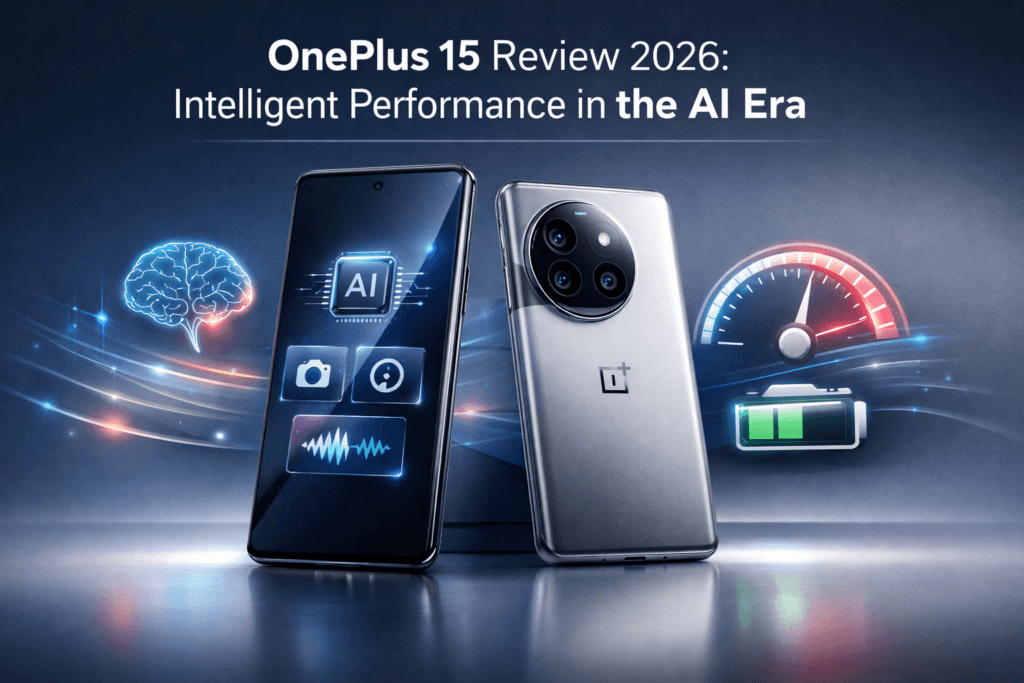
Performance used to be theatrical.
Manufacturers showcased peak clock speeds, explosive benchmark charts, and gaming demos engineered to impress in 30 seconds. But in 2026, that metric feels incomplete. Modern smartphones don’t just open apps — they translate speech in real time, enhance photos semantically, predict usage patterns, and balance dozens of invisible background processes.
The OnePlus 15 enters this environment with a different ambition. It doesn’t just aim to be fast. It aims to be intelligently fast — sustained, predictive, thermally disciplined.
And that shift reflects something much bigger than a yearly upgrade cycle.
When Benchmarks Plateau, Architecture Becomes the Differentiator
Spend an hour with the OnePlus 15 and the difference isn’t loud — it’s layered.
Apps don’t stutter under multitasking pressure. Gaming sessions don’t collapse into sudden throttling after ten minutes. Camera processing feels stable rather than variable. Battery drain doesn’t behave randomly — it adapts.
That consistency signals architectural intent.
The OnePlus 15 is built on Qualcomm’s latest flagship silicon, the Snapdragon 8 Elite. Unlike prior performance races focused on CPU dominance, this generation shifts investment toward neural acceleration, heterogeneous compute balance, and sustained energy efficiency.
From an engineering standpoint, that matters more than incremental GHz gains.
AI Workloads Don’t Spike — They Persist
Traditional performance testing centers on peak bursts — opening heavy apps, rendering a scene, running a benchmark.
AI workloads don’t behave that way.
They are:
- Continuous but low-latency
- Multimodal (camera, audio, sensor, contextual data)
- Distributed across CPU, GPU, and NPU simultaneously
On the OnePlus 15, AI tasks include:
- Semantic scene detection in photography
- Live transcription and translation
- Adaptive refresh rate modulation
- Predictive memory allocation
- Intelligent power scaling
These aren’t isolated features. They operate in parallel.
That means performance is no longer about peak speed. It’s about orchestration across compute domains.
In 2026, this shift toward persistent on-device AI is no longer experimental — it’s foundational to flagship design.
The Compute Stack Is No Longer CPU-Centric
Where previous flagship eras prioritized CPU escalation, the OnePlus 15 reflects a rebalanced hierarchy.
| Compute Domain | Historical Flagship Priority | OnePlus 15 Performance Strategy |
|---|---|---|
| CPU | Max clock speed | Efficiency under sustained load |
| GPU | Short gaming bursts | Scene-aware adaptive scaling |
| NPU | Voice assistant support | Generative & semantic AI engine |
| ISP | HDR enhancement | Real-time AI scene modeling |
| Power Controller | Reactive voltage shifts | Predictive energy distribution |
Instead of maximizing one component, the OnePlus 15 distributes intelligence across the stack.
From a semiconductor trend perspective, this mirrors global silicon investment patterns — neural acceleration is scaling faster than general-purpose CPU cores because modern workloads demand contextual computation.
Heat Is the Real Performance Governor
Performance ceilings are rarely defined by silicon alone. They’re defined by heat.
AI-driven systems generate persistent micro-loads rather than dramatic spikes. Over time, those micro-loads create thermal accumulation patterns that traditional cooling systems weren’t optimized to handle.
The OnePlus 15 integrates:
- An expanded vapor chamber
- Layered graphite heat dispersion
- Smarter workload scheduling to reduce thermal clustering
In sustained gaming plus background AI indexing scenarios, the device maintains frame stability rather than collapsing into throttled cycles.
From an engineering standpoint, this suggests foresight. It’s easier to cool peaks. It’s harder to manage persistence.
How OnePlus 15 Navigates an AI-Heavy Flagship Field
The broader flagship field includes devices like the Galaxy S25 and the iPhone 17 — both heavily positioned around AI integration.
Yet their philosophies differ.
| Comparative Axis | OnePlus 15 | Galaxy S25 | iPhone 17 |
|---|---|---|---|
| AI Deployment Style | On-device optimization | Ecosystem-driven AI services | Tight hardware-software integration |
| Performance Strategy | Fluid sustained scaling | Multi-device synergy | Vertical efficiency control |
| Thermal Philosophy | Stability under mixed AI load | Balanced | Conservative efficiency bias |
| Customization Depth | High | Moderate | Limited |
| Gaming Stability | Consistent over time | Strong | Controlled but capped |
the OnePlus 15 stands out not because it dominates every category, but because it emphasizes consistency under heterogeneous load — a characteristic power users tend to value long term.
What Intelligent Performance Actually Feels Like
Architecture matters only if it translates into lived improvement.
With the OnePlus 15:
- App switching feels anticipatory rather than reactive.
- Camera processing time is stable across lighting scenarios.
- Background indexing doesn’t interrupt foreground smoothness.
- Battery degradation risk is mitigated through balanced thermals.
You don’t notice the device “trying.” That’s the goal.
Intelligent performance disappears into the experience.
Four Stress Tests That Reveal the Real Design Philosophy
- The Remote Professional
Video conferencing, cloud uploads, and navigation running simultaneously no longer destabilize foreground apps.
- The Creator on the Move
AI-assisted noise reduction and image processing feel immediate, reducing export unpredictability.
- The Competitive Gamer
Frame pacing remains steady beyond the 20-minute mark — a real stress threshold many devices fail to sustain.
- The Long-Term Owner
Heat stability reduces component stress, improving longevity over multi-year ownership.
The OnePlus 15 performs best when it’s pushed consistently, not occasionally.
What Early Power Users Are Actually Noticing
Initial user discourse trends cluster around long-session behavior rather than headline specs.
| Community Feedback Pattern | Observed Sentiment |
|---|---|
| Sustained gaming performance | Stable with minimal throttling |
| Thermal comfort | Improved surface temperatures |
| AI feature maturity | Functional, evolving with updates |
| Battery adaptation | Smarter drain curves |
| Software smoothness | Clean and responsive |
| Multitasking reliability | Strong under heavy load |
| Longevity expectations | Optimistic |
The recurring pattern isn’t spectacle. It’s endurance.
When This Much Architecture Might Be Unnecessary
Not every user needs neural acceleration at scale.
If daily usage involves:
- Social media scrolling
- Messaging
- Light browsing
The architectural sophistication of the OnePlus 15 may feel underutilized.
Additionally, users deeply embedded in proprietary ecosystems may value cross-device AI continuity over performance fluidity alone.
Architecture shines brightest under stress.
The Industry Is Quietly Redefining “Fast”
Smartphones are shifting toward:
- On-device generative compute
- Reduced cloud dependency
- Energy-aware background intelligence
- Predictive UI adaptation
CPU gains are flattening. GPU improvements are incremental. Neural engines are scaling aggressively.
The OnePlus 15 aligns with that trajectory rather than resisting it.
From a long-term perspective, devices optimized around AI acceleration are better positioned for evolving software demands — particularly as mobile operating systems integrate deeper contextual modeling.
Matching the OnePlus 15 to the Right Type of Buyer
| User Type | Why OnePlus 15 Fits | Key Consideration |
|---|---|---|
| Everyday User | Fluid, adaptive feel | AI headroom may exceed needs |
| Creator | AI-assisted workflow stability | Tool ecosystem matters |
| Gamer | Sustained frame pacing | Not gaming-branded |
| Multi-Year Buyer | Future-ready neural scaling | Premium investment tier |
The OnePlus 15 makes the most sense for users who plan to hold their device beyond a single upgrade cycle.
AI acceleration compounds in value over time.
Vibetric Ending
The smartphone performance narrative is evolving.
The OnePlus 15 doesn’t chase record-breaking single-core bursts. It distributes intelligence across CPU, GPU, NPU, ISP, and power management layers.
That balanced topology delivers:
- Stability
- Predictability
- Longevity
- Adaptive efficiency
In the AI era, equilibrium outperforms excess.
And equilibrium scales further than spikes.
Curious About the Future of OnePlus 15?
- Follow vibetric_official on Instagram to stay ahead of flagship performance shifts and AI-driven silicon evolution.
- Bookmark Vibetric.com we continuously refine our analysis as firmware updates and architectural insights emerge.
Subscribe for ongoing deep dives into mobile compute trends and long-term device viability.
OnePlus 15: Questions Beyond the Spec Sheet
It meaningfully affects performance. Memory allocation, refresh rate tuning, and camera processing are AI-assisted at the system level.
Benchmarks measure short bursts. Sustained performance evaluates stability over extended mixed workloads — where this device excels.
Its neural acceleration and thermal balance position it well for evolving software demands, especially as AI integration deepens.
Not inherently. Balanced thermal control and predictive scaling can reduce stress compared to unmanaged peak loads.
For light use, yes — much of its architectural depth may go untapped.
It emphasizes performance fluidity and sustained compute rather than ecosystem dominance.
Yes. Firmware refinements can optimize model efficiency and scheduling logic over time.
Absolutely. Lower sustained temperatures reduce long-term component stress.
In some cases, yes. Aggressive AI-driven power balancing may cap peak bursts to preserve thermals and battery health. For users chasing maximum benchmark numbers, this balance-first strategy may appear conservative — but it prioritizes real-world endurance over short-lived spikes.
What’s your take on this?
At Vibetric, the comments go way beyond quick reactions — they’re where creators, innovators, and curious minds spark conversations that push tech’s future forward.
Software-Driven Smartphone Updates 2026 — The Powerful Shift Changing Hardware
Software-Driven Smartphone Updates 2026 — The Powerful Shift Changing Hardware Five years ago, buying a smartphone meant weighing camera megapixels, chip benchmarks,
OnePlus 15 Review 2026: Intelligent Performance in the AI Era
OnePlus 15 Review 2026: Intelligent Performance in the AI Era Performance used to be theatrical. Manufacturers showcased peak clock speeds, explosive benchmark