
NVIDIA RTX 5090 (2026): The Powerful AI GPU Redefining Modern Rendering
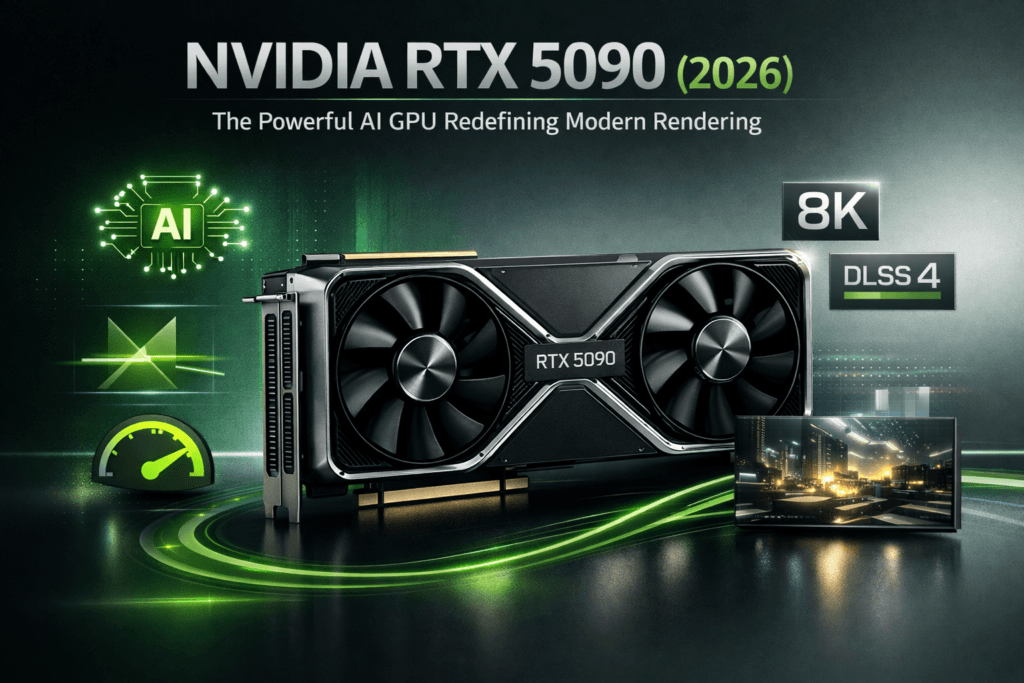
Gaming used to be about frames per second. Now it’s about neural networks per frame.
If you’ve followed the trajectory of high-end GPUs over the last decade, you already know the shift: rasterization gave way to ray tracing, and ray tracing quietly gave way to AI-driven rendering. The NVIDIA RTX 5090 isn’t just the next number in a lineup—it represents a structural pivot in how graphics are computed, enhanced, and even imagined before they’re rendered.
And most people are still evaluating it like a traditional GPU.
When Raw Power Stops Being the Whole Story
Unboxing a flagship GPU used to feel like buying horsepower. Bigger die, wider memory bus, more cores. The mental model was linear.
With the NVIDIA RTX 5090, that model breaks.
Yes, it delivers enormous raster and ray-tracing gains over the previous generation. But the defining change isn’t just brute-force performance. It’s how aggressively AI now sits inside the rendering pipeline.
This card doesn’t just render pixels. It predicts them.
Why This Generation Is Architecturally Different
The NVIDIA RTX 5090 is built on the new Blackwell architecture—successor to Ada Lovelace—which doubles down on three pillars:
- AI tensor acceleration
- Ray-tracing throughput efficiency
- Memory bandwidth scaling for AI workloads
What matters isn’t the raw specification sheet—it’s the balance.
The Three Engines Inside the RTX 5090
| Component Focus | Why It Matters |
|---|---|
| 5th-Gen Tensor Cores | Power next-gen DLSS and generative AI inference |
| 4th-Gen RT Cores | Faster BVH traversal and ray-triangle intersection |
| Massive VRAM Bandwidth | Essential for 4K/8K textures and AI upscaling buffers |
| AI Frame Generation | Synthesizes frames, reducing CPU bottlenecks |
| Advanced Encoding Engines | High-efficiency AV1 and creator workflows |
| Content consumers | “Clear dialogue in streaming content.” |
| Office professionals | “Transparency mode transitions are smooth.” |
The shift is subtle but profound: performance scaling is now hybrid. Half silicon, half neural inference.
The Feedback Loop Most Gamers Don’t See
AI rendering introduces a performance feedback system that traditional GPUs never had.
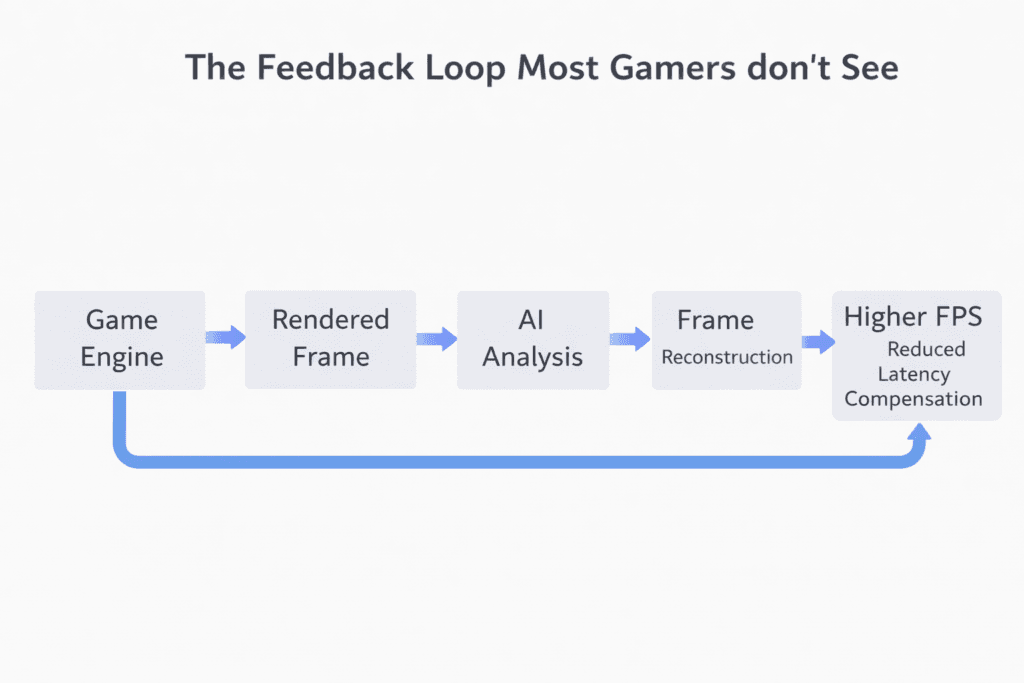
The NVIDIA RTX 5090 doesn’t simply render faster—it renders smarter. DLSS 4 and advanced frame generation predict motion vectors, interpolate detail, and refine textures using trained models.
The result? Frame rates that feel disproportionately higher than the raw raster gains alone would suggest.
That’s not marketing. That’s pipeline restructuring.
Real-World Scenarios: Where It Actually Changes Things
- 4K Ultra with Path Tracing
Previous generations could technically run full path tracing. The RTX 5090 runs it with AI assistance that makes it playable. Heavy ray-traced titles now depend on neural reconstruction to sustain smooth performance.
- CPU-Limited Competitive Gaming
In esports titles where CPUs once bottlenecked high-end GPUs, AI frame generation compensates. The card synthesizes additional frames, reducing dependency on the processor.
- Creator + AI Workloads
For video editors and AI developers, the NVIDIA RTX 5090 is less about gaming and more about inference acceleration. Tensor core improvements significantly reduce generation times in:
- Local LLM testing
- Stable diffusion workflows
- AI video enhancement
- 3D rendering with neural denoisers
- Multi-Display / 8K Enthusiasts
Memory bandwidth and VRAM headroom matter here. High-resolution workflows, especially with HDR pipelines, no longer feel constrained.
The Spec Sheet vs The Experience Gap
There’s a common misconception: “If raster gains are incremental, the upgrade isn’t worth it.”
That thinking belongs to 2016.
With the NVIDIA RTX 5090, performance scaling is multi-dimensional:
- Traditional rasterization uplift
- Ray-tracing efficiency gains
- AI-driven frame synthesis
- Latency mitigation through Reflex
- Encoding acceleration for streamers
This is why benchmark-only evaluations can understate the real-world leap.
It’s not just frames. It’s workflow fluidity.
Market Behavior: Why AI GPUs Are the New Standard
The industry isn’t just chasing prettier games. It’s chasing computational sustainability.
Pure raster scaling is power-hungry and inefficient. AI reconstruction allows:
- Lower render resolution internally
- Smarter upscaling externally
- Reduced energy per perceived frame
The NVIDIA RTX 5090 represents NVIDIA’s acknowledgment that Moore’s Law isn’t enough anymore. Neural enhancement is the multiplier.
Developers are adapting accordingly. Modern engines are being built with DLSS pipelines assumed—not optional.
That changes the long-term ecosystem.
Community Reality Check
Across enthusiast forums and technical subreddits, sentiment clusters around distinct patterns:
| User Type | Common Observation |
|---|---|
| Competitive gamers | AI frame gen improves smoothness but latency tuning matters |
| 4K enthusiasts | Path tracing finally feels viable |
| Creators | Massive gains in render + export acceleration |
| Upgraders from RTX 40-series | Incremental raster gain, major AI gain |
| Power users | PSU and case airflow planning essential |
| Skeptics | Concern about over-reliance on AI interpolation6 |
The conversation isn’t polarized. It’s nuanced.
The NVIDIA RTX 5090 doesn’t replace raw performance—it augments it.
Where It Changes Human Experience
Performance is measurable. Experience is perceptual.
Higher frame consistency reduces cognitive strain. Lower latency improves competitive reaction time. AI denoising reduces creative iteration cycles.
These are not marketing abstractions. They directly influence:
- Editing turnaround speed
- Streaming stability
- Competitive edge
- Thermal noise perception
- System longevity under sustained load
The psychological effect of smoothness is underestimated. Consistent frametimes feel more “real” than peak FPS spikes.
That’s where the RTX 5090 quietly wins.
Buyer Framework: Who Should Actually Consider It?
Everyday Users
Not necessary. The NVIDIA RTX 5090 is overkill for casual 1080p usage.
Competitive Gamers
Valuable if targeting ultra-high refresh 1440p or 4K with AI frame gen optimization.
Creators & AI Developers
One of the strongest justifications. Tensor improvements meaningfully impact productivity.
Enthusiasts / Future-Proof Buyers
If aiming for 4K path tracing or long upgrade cycles, it offers extended headroom.
Where the RTX 5090 Dominates — and Where It Demands Compromise
| Pros | Constraints |
|---|---|
| Exceptional AI acceleration | Premium-tier power demands |
| Industry-leading ray tracing | Requires strong cooling setup |
| Future-focused architecture | Not fully utilized in older games |
| Advanced AV1 encoding | Expensive tier positioning |
| Strong VRAM headroom | Physical size considerations |
The Counterpoint: When It Might Not Be Worth It
If you’re upgrading from a late Ada card and play mostly rasterized esports titles, the uplift may feel modest relative to cost.
Similarly, if your display caps at 1440p 144Hz and you don’t use AI workloads, the NVIDIA RTX 5090 may sit underutilized.
This GPU shines most when pushed into AI-enhanced scenarios.
The Bigger Industry Shift
The deeper implication isn’t about this specific GPU. It’s about trajectory.
Future GPUs won’t scale purely by adding cores. They’ll scale by:
- Smarter prediction
- Frame synthesis
- Real-time neural reconstruction
- AI-assisted rendering logic
The NVIDIA RTX 5090 is a transitional landmark—a GPU where AI stops being an assist feature and becomes the backbone.
That matters.
Vibetric Ending
Remember when upgrading GPUs meant simply “more power”?
Now it means choosing between traditional rendering and hybrid neural pipelines.
The NVIDIA RTX 5090 signals that the AI-accelerated GPU era isn’t approaching—it’s here. And future generations won’t reverse this direction. They’ll intensify it.
The question isn’t whether AI belongs in rendering.
It’s whether you’re ready to depend on it.
Curious About the Future of NVIDIA RTX 5090?
- Follow vibetric_official on Instagram to keep up with the latest trends and insights into high-performance GPUs and AI-accelerated computing.
- Bookmark Vibetric.com we continuously update our analysis as new developments emerge in GPU architecture and rendering technology.
Subscribe for ongoing, in-depth breakdowns and expert evaluations of next-generation graphics hardware.
Critical Questions Before You Upgrade
No. While it excels at gaming, its AI tensor improvements make it equally compelling for creators and AI developers.
AI frame generation enhances performance but does not replace native rendering. Raster and ray-tracing performance remain strong independently.
For 4K path tracing and AI-heavy workflows, it offers significant longevity.
Critical. High-end GPUs require robust PSUs and thermal management for stable performance.
For standard 1440p 144Hz gaming, yes. For high-refresh competitive setups with AI enhancements, not necessarily.
Yes. Advanced encoding engines improve stream quality while preserving performance.
It depends on use case. The AI and ray-tracing improvements are meaningful, but raster gains may feel incremental.
Industry trends strongly suggest that neural-assisted rendering will define future GPU development cycles.
What’s your take on this?
At Vibetric, the comments go way beyond quick reactions — they’re where creators, innovators, and curious minds spark conversations that push tech’s future forward.
Ray Tracing in 2026: The Powerful Shift From Experimental to Standard Graphics
Ray Tracing in 2026: The Powerful Shift From Experimental to Standard Graphics The technology spent years as a benchmark showcase. Now it’s
PS5 Pro vs PS5: Powerful Upgrade or Overpriced Refresh?
PS5 Pro vs PS5: Powerful Upgrade or Overpriced Refresh? The dilemma isn’t whether the new console is better. It is whether it