
The Powerful Shift to NPU Computing in (2026): Why CPUs Are No Longer Enough
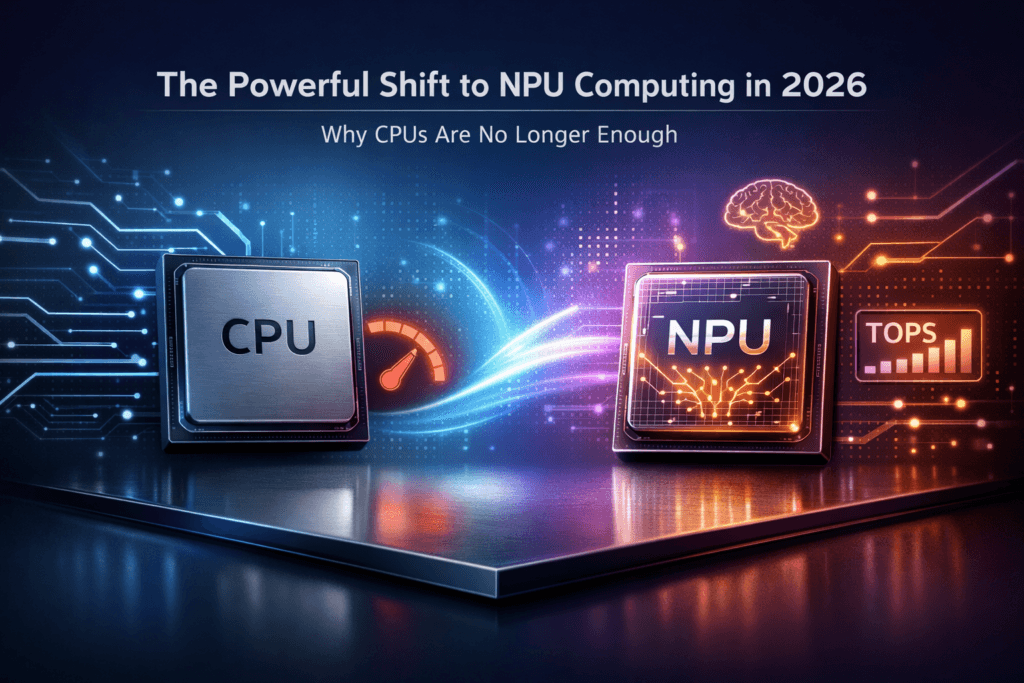
For four decades, the CPU was the definitive measure of a computer’s capability. That framing is being systematically retired — not by marketing, but by where the meaningful workloads have migrated.
Why the CPU Was Never Designed for This
The central processing unit was architected around a specific computational model: sequential instruction execution with low latency on highly variable workloads. That design produces a general-purpose processor of extraordinary flexibility — one that can context-switch between a spreadsheet calculation, a network request, and a file system operation within microseconds. General-purpose flexibility is the CPU’s core competency, and it remains unmatched for the tasks that require it.
Neural network inference is not one of those tasks. The computational pattern underlying NPU computing — large matrix multiplications, activation functions applied in parallel across millions of weights, repeated tensor operations on fixed-precision data — is structurally mismatched to the CPU’s architecture. A CPU executes these operations correctly but inefficiently, burning clock cycles and power on fetch-decode-execute overhead that adds no value to the mathematical operation being performed.
The NPU eliminates that overhead by hardcoding the operation. A neural processing unit is, at its core, a matrix multiplication engine with fixed data paths, no branch prediction, no out-of-order execution, and no cache hierarchy optimized for random access. It does far fewer things than a CPU — and the things it does, it executes at an efficiency ratio that general-purpose hardware cannot approach.
How Every Major Silicon Vendor Moved at Once
The convergence on NPU computing across the semiconductor industry between 2020 and 2026 has no clean parallel in recent history. Apple, Qualcomm, MediaTek, AMD, Intel, and Google all committed to dedicated neural processing silicon within the same narrow window — not through coordination but through simultaneous recognition that on-device AI inference was about to become a primary workload category.
The catalyst was not a single product or model. It was the aggregate weight of use cases — computational photography, real-time translation, voice recognition without cloud round-trips, generative text on device — crossing a threshold where GPU offloading was no longer an adequate answer. GPUs are power-hungry, thermally demanding, and architecturally over-specified for inference-only workloads. The industry needed something smaller, cooler, and permanently active.
What emerged is a new competitive axis. NPU TOPS — tera-operations per second — is now a first-order specification on flagship mobile and PC silicon, cited alongside CPU core counts and GPU shader counts in launch materials. The metric that didn’t exist in consumer chip marketing five years ago is now a primary benchmark category.
TOPS figures without context are nearly meaningless. A 40 TOPS NPU running 8-bit integer inference on a well-optimized model outperforms a 60 TOPS competitor running poorly quantized weights on a mismatched operator set. Efficiency per operation, not peak throughput, is the number that matters for real-world NPU computing performance.
What NPU Computing Feels Like from the Outside
The perceptual signature of NPU computing is, by design, invisibility. When inference runs on a dedicated neural engine rather than borrowing CPU or GPU cycles, the rest of the system continues operating without interruption. A photo enhancement that would previously cause a momentary UI stall now completes in the background without any observable effect on foreground responsiveness. A live caption that previously introduced occasional dropout now runs continuously without affecting video playback smoothness.
This invisibility is the success condition, not a limitation. Users do not experience NPU computing as a feature — they experience the absence of friction that its predecessors created. The behavioral signal that something has changed is the disappearance of the micro-pauses, frame drops, and thermal warnings that accompanied AI workloads on devices that lacked dedicated inference hardware.
The implication for product evaluation is significant. NPU computing improvements do not present well in side-by-side demos. They accumulate across a day of use, in the aggregate smoothness of a device that is running more concurrent intelligent processes than any prior generation — quietly, without asking permission or consuming the headroom that makes everything else feel fast.
The Workload That NPUs Cannot Own
The shift toward NPU-centric computing is real and directionally correct, but the CPU-is-obsolete conclusion that sometimes follows from it is not. The NPU’s architectural efficiency comes entirely from workload specialization — and that specialization is a hard constraint, not a temporary limitation. Tasks requiring low-latency response to unpredictable input, complex branching logic, irregular memory access patterns, or instruction sets that vary at runtime remain firmly in CPU territory.
More practically: the operators supported by current NPU hardware are a subset of all neural network operations. Models with non-standard architectures, custom attention mechanisms, or novel layer types frequently fall back to CPU or GPU execution mid-inference because the NPU’s fixed data paths cannot accommodate them. The gap between ‘NPU-optimized’ models and the broader research frontier is not trivial, and it means that cutting-edge model architectures are often CPU or GPU workloads by necessity rather than choice.
NPU computing is the right tool for a large and growing category of tasks. It is not a general-purpose replacement for the CPU, and the framing of this transition as a power struggle between competing processors misreads what is actually a workload partitioning story.
| Workload type Optimal processor Why not CPU Why not GPU | Optimal processor | Why not CPU | Why not GPU |
|---|---|---|---|
| Fixed-model inference | NPU | High overhead per op | Thermal cost disproportionate |
| Real-time image processing | NPU + ISP | Latency under sustained load | Power budget too high always-on |
| Generative text (small models) | NPU | Throughput ceiling on large batches | Inefficient at int8 precision |
| 3D rendering | GPU | Parallelism insufficient | — native workload |
| OS, app logic, branching tasks | CPU | — native workload | Architectural mismatch |
| Large model inference | GPU / CPU fallback | Memory bandwidth ceiling | Closest fit currently available |
A Transition Measured in Workloads, Not Clock Speeds
The shift from CPU-centric to NPU computing is not the death of general-purpose processing — it is the maturation of a computing ecosystem sophisticated enough to route different workloads to architectures genuinely suited for them. The CPU remains essential. What it is no longer is the sole measure of a platform’s intelligence.
The devices and platforms that execute this transition well will be the ones where the workload routing is accurate and the integration between processor types is tight enough that the user never has to think about which unit is running their inference. The NPU’s job is to disappear into the experience. The platforms where it succeeds at that will define what capable computing feels like for the next decade.
Go Deeper with Vibetric
- Bookmark Vibetric — this piece before your next device purchase — the workload table holds up as a buying framework.
- Follow Vibetric_Offical on Instagram — NPU computing will be one of the defining hardware stories of the next three years.
- Share with anyone still evaluating chips by GHz alone — the metric that matters has changed.
What’s your take on this?
At Vibetric, the comments go way beyond quick reactions — they’re where creators, innovators, and curious minds spark conversations that push tech’s future forward.
Performance Per Watt in 2026: The Critical Benchmark Redefining Computing
Performance Per Watt in 2026: The Critical Benchmark Redefining Computing For years, performance was measured in absolutes. Faster processors won. Higher benchmark
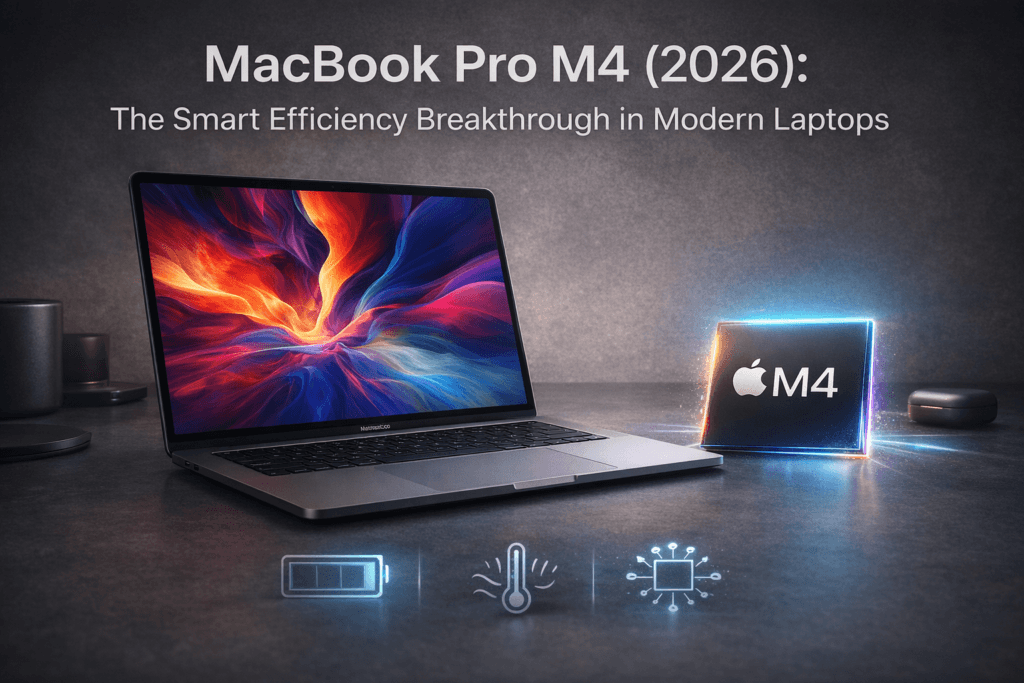
MacBook Pro M4 (2026): The Smart Efficiency Breakthrough in Modern Laptops
MacBook Pro M4 (2026): The Smart Efficiency Breakthrough in Modern Laptops There’s a moment every serious laptop user recognizes. The export bar