
Next Gen Audio Chips 2026 Reveal Why Smarter Processing Sounds Better Than Specs
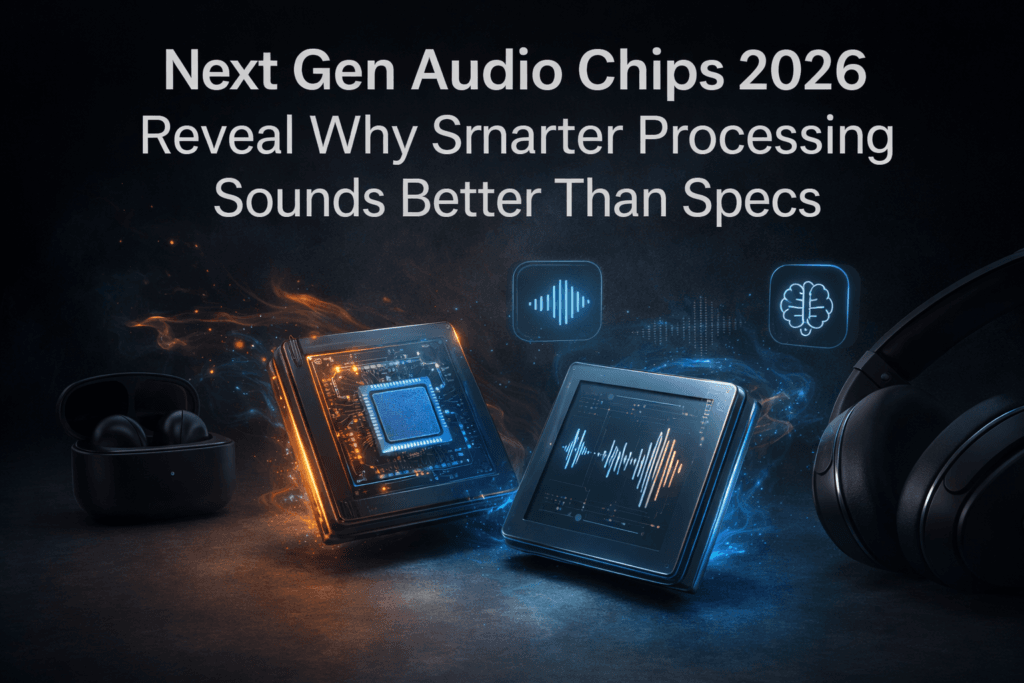
Audio quality used to be defined primarily by drivers, enclosures, and acoustic tuning. In 2026, a growing share of perceived sound performance is determined somewhere less visible: the signal processor. The latest wave of next gen audio chips 2026 is shifting attention from raw hardware capability to computational refinement—how sound is interpreted, optimized, and delivered before it ever reaches the speaker or headphone driver.
The result isn’t louder or more dramatic audio. It’s cleaner separation, steadier dynamics, and more consistent performance across environments that once disrupted listening quality.
Why Processing Power Now Matters More Than Driver Size
Advances in audio chip design have introduced real-time processing pipelines capable of analyzing incoming signals, environmental noise, and playback characteristics simultaneously. Instead of applying static tuning profiles, these chips dynamically adjust equalization curves, spatial rendering, and dynamic range behavior depending on listening conditions.
This is particularly important in wireless audio systems, where compression artifacts, latency, and interference historically degraded quality. Next gen audio chips 2026 prioritize adaptive correction, ensuring that playback remains stable whether streaming high-resolution audio, gaming, or taking calls in noisy surroundings.
The difference is subtle but cumulative: sound remains balanced rather than fluctuating with changing conditions.
Latency and Synchronization Finally Reach Maturity
Another major contribution of modern audio chipsets is improved synchronization across devices. Multi-speaker setups, true wireless earbuds, and gaming headsets rely heavily on timing precision. Even small inconsistencies between channels can disrupt spatial perception and clarity.
Recent audio chips integrate tighter clock management and predictive buffering systems, reducing phase inconsistencies and keeping channels aligned even in challenging wireless environments. In practical terms, this leads to more accurate positional audio, cleaner stereo imaging, and fewer perceptible dropouts—improvements that matter more than incremental loudness gains.
These refinements define how next gen audio chips 2026 enhance real listening experiences rather than headline specifications.
The Human Perception Layer: Why Listeners Notice the Difference
Human hearing is highly sensitive to timing errors, distortion spikes, and tonal imbalance, especially over long listening sessions. Earlier audio hardware often performed well under ideal conditions but degraded quickly in motion-heavy or noisy environments.
Modern processing pipelines focus on perceptual consistency—maintaining tonal balance and spatial accuracy even as surroundings change. Adaptive noise management systems distinguish between environmental noise that should be reduced and audio cues that should remain intact, preventing the “hollow” or overprocessed sound that once accompanied aggressive noise cancellation.
This perceptual stability is why next gen audio chips 2026 feel like qualitative upgrades rather than measurable ones. The listening experience remains trustworthy across contexts.
Industry Strategy: Chips as Ecosystem Anchors
Audio processing chips are increasingly designed not as standalone components but as ecosystem anchors connecting phones, earbuds, speakers, and vehicles into unified sound environments. Shared processing standards allow smoother handoffs between devices, consistent tonal signatures, and synchronized playback across rooms or platforms.
Manufacturers recognize that users rarely listen on a single device anymore. By embedding advanced processing logic at the chipset level, they ensure that sound character and performance remain coherent across the ecosystem, reinforcing brand identity while improving user experience.
This ecosystem thinking is a major driver behind investment in next gen audio chips 2026.
A Contrarian Insight: Better Processing Often Means Less “Exciting” Sound
Interestingly, improved processing does not always produce the exaggerated bass or boosted treble that casual listeners might initially perceive as “better.” Instead, many next-generation chips aim for balanced neutrality, preserving recording intent rather than reshaping it dramatically.
The contrarian truth is that better audio processing can feel less flashy at first, but far less fatiguing over time. Listeners notice reduced harshness, clearer vocals, and more stable sound staging during long sessions—benefits that become obvious only after extended use.
A Snapshot of What Actually Improved
| Audio Dimension | Earlier Focus | 2026 Processing Advantage |
|---|---|---|
| Tuning | Static EQ profiles | Real-time adaptive tuning |
| Wireless playback | Latency trade-offs | Predictive buffering & sync control |
| Noise handling | Aggressive filtering | Context-aware noise shaping |
| Multi-device audio | Manual coordination | Ecosystem-level consistency |
These changes illustrate how processing power is redefining sound quality beyond traditional hardware limits.
Where Audio Innovation Is Headed Next
As processing capabilities continue to grow, the next frontier will likely involve personalized audio rendering—chips that adapt sound profiles to individual hearing characteristics without requiring complex manual calibration. This evolution moves audio technology closer to perceptual optimization rather than one-size-fits-all tuning.
The most important takeaway is simple: in 2026, sound quality is increasingly determined by what happens before the signal reaches the speaker. The sophistication of the processing pipeline now shapes clarity, immersion, and reliability more than raw acoustic components alone.
Signals Worth Tracking
- Follow our Instagram @vibetric_official for deep analysis of next gen audio chips 2026 and emerging audio technologies.
- Bookmark vibetric.com to monitor how audio processing continues reshaping listening experiences.
- Stay updated as computational audio becomes the defining factor in modern sound quality.
What’s your take on this?
At Vibetric, the comments go way beyond quick reactions — they’re where creators, innovators, and curious minds spark conversations that push tech’s future forward.
Adaptive Transparency Mode in 2026: The Intelligent Evolution Beyond Basic Passthrough
Adaptive Transparency Mode in 2026: The Intelligent Evolution Beyond Basic Passthrough Noise cancellation used to be the headline feature. Transparency was the
Spatial Audio Default in 2026: The Quiet Shift Redefining Immersive Sound
Spatial Audio Default in 2026: The Quiet Shift Redefining Immersive Sound There was a time when surround sound required a living room