
How Monitor Response Time Impacts Everyday Gaming
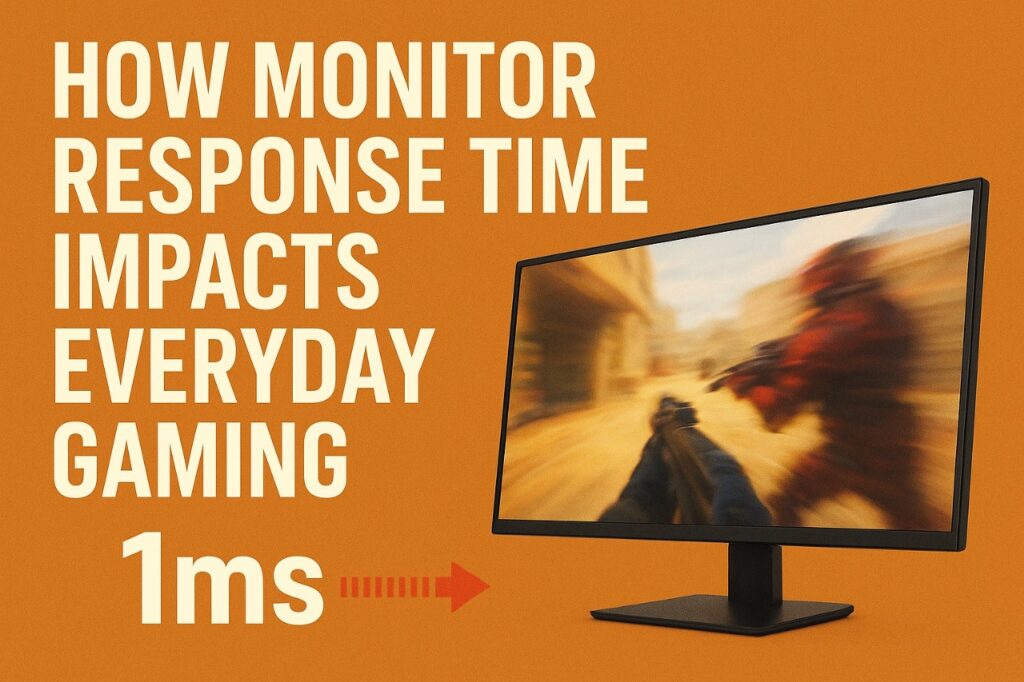
For most gamers, the conversation around display specs stops at refresh rate — 120Hz, 144Hz, maybe 240Hz if you’re serious. But there’s another number quietly defining how your games actually feel: monitor response time.
It’s one of those specs that hides in plain sight — mentioned on every box, rarely understood, and often confused with input lag. Yet it shapes everything from how crisp your motion looks to how connected you feel during gameplay.
This blog breaks down what monitor response time really means, how it affects real-world gaming, and why shaving off milliseconds doesn’t always make you a better player — but it does make you a smoother one.
⚙️ Core Insight (Depth + Clarity)
The monitor response time determines how quickly a pixel changes from one color to another — usually measured in milliseconds (ms). It affects how motion appears on-screen: whether it looks sharp and fluid, or smeared and ghosted.
In simple terms:
- Low response time = crisp, blur-free motion.
- High response time = trails, ghosting, and visual lag.
But here’s the catch — lower isn’t always better by itself.
That’s because response time interacts with refresh rate, input lag, and frame pacing. You can have a blazing 1ms display, but if your GPU can’t feed frames fast enough, or your game engine has uneven timing, the experience won’t feel fluid.
The industry’s obsession with numbers — “1ms! 0.5ms!” — has turned response time into marketing shorthand for speed. But real-world gameplay depends more on consistency than on raw milliseconds.
Most modern panels (IPS, OLED, VA) already deliver fast-enough response times for smooth visuals. What matters now is stability across transitions — how evenly the screen handles fast color changes during real motion.
In 2025, the smartest displays don’t just chase speed — they manage it intelligently.
📊Bite-Sized Data Table
| Display Type | Typical Response Time | Real-World Experience | Gaming Impact |
|---|---|---|---|
| IPS LCD | 4–5ms | Balanced visuals, minimal blur | Great for most games |
| VA Panel | 6–8ms | Deeper contrast, but some ghosting | Good for slower genres |
| TN Panel | 1–2ms | Sharp and fast, weaker colors | Ideal for esports |
| OLED | <1ms | Perfect blacks, instant transitions | Excellent for all gaming |
Note: Manufacturers measure “grey-to-grey” (GtG) response — real-world transitions are usually slower than advertised.
🔍 Micro Analysis
1. The Real-World Effect
In everyday gaming, monitor response time decides how alive motion feels.
When pixels can’t switch fast enough, moving objects leave faint trails — especially noticeable in darker scenes. Fast shooters, racers, and action games rely on quick transitions to maintain clarity during motion.
For example:
- A 1ms panel keeps moving enemies razor-sharp during camera pans.
- A slower 8ms panel blurs fine edges — your aim feels softer, your reaction slower.
But here’s where it gets real: past a certain threshold (around 3–5ms), most players can’t consciously detect the difference. What they do notice is motion consistency — no flicker, no smearing, no random drops.
That’s why a stable 5ms display with great overdrive can feel smoother than a “1ms” panel that overshoots and causes ghosting.
The true goal isn’t the lowest number — it’s balanced transitions across all tones and refresh cycles.
2. The Hidden Truth
Brands know that gamers love numbers — so they optimize response time for lab tests, not for real gameplay.
That 1ms figure? It’s often achieved through aggressive overdrive — a technique that forces pixels to change faster, sometimes overshooting the target color. The result:
- Artifacts (inverse ghosting or halos).
- Color inaccuracies under fast motion.
- Flicker on certain brightness levels.
So, while a monitor advertises ultra-low response time, the real performance depends on tuning and panel behaviour.
The hidden truth: the best displays aren’t the fastest — they’re the most consistent.
Even esports professionals often Favor tuned 240Hz panels with balanced 3–4ms real response time rather than unstable 1ms models. It’s about predictable timing, not just theoretical speed.
🌍 Culture Angle
The gaming community has evolved.
A decade ago, performance meant brute force — “the most frames, the fastest display.”
Now, modern players value comfort, clarity, and endurance. Streamers, creators, and casual gamers spend hours in front of screens, so eye comfort, adaptive sync, and color accuracy often matter more than chasing sub-millisecond bragging rights.
This cultural shift reflects maturity: gaming setups are no longer about showing off FPS counters — they’re about maintaining performance balance.
The best monitors in 2025 aren’t just tools for competition — they’re calibrated experiences for stability and immersion.
🧠 Quick Vibetric Takeaways
- Monitor response time defines pixel transition speed — not overall system latency.
- Numbers under 5ms are practically indistinguishable for most players.
- Overdrive helps, but too much causes ghosting and color distortion.
- Response time only matters alongside refresh rate and frame pacing.
- OLED and tuned IPS panels deliver the best balance of speed + color.
- Real smoothness = consistent performance, not extreme specs.
- Stability and calibration define great monitors — not just “1ms” labels.
💬 Vibetric Verdict
Vibetric Verdict: Gamers often chase specs that look faster on paper — but the best gameplay feels come from harmony, not haste.
A great display doesn’t just react quickly; it responds intelligently.
Because gaming is more than frame counts — it’s about rhythm, flow, and timing.
As monitor tech matures, the question won’t be “how fast is it?” but “how consistent does it feel?”
And that’s where the future of gaming displays truly begins — not in speed, but in balance.
🔗 Stay in the Loop
We don’t sell hype — we explain it.
- Follow @vibetric_official for grounded insights on gaming hardware, performance psychology, and real-world tech behavior.
- Bookmark vibetric.com to stay ahead of the tech curve.
- No hype. No bias. Just facts — the Vibetric way.
💬 What’s your take on this?
The comment section at Vibetric isn’t just for reactions — it’s where creators, thinkers, and curious minds exchange ideas that shape how we see tech’s future.
AI Hardware Investment 2027: The Critical Shift Driving the Next Semiconductor Boom
AI Hardware Investment 2027: The Critical Shift Driving the Next Semiconductor Boom In 2023 and 2024, the AI conversation centered on models.
AI Smartphones in 2026: The Powerful Infrastructure Shift You Can’t Ignore
AI Smartphones in 2026: The Powerful Infrastructure Shift You Can’t Ignore The most important transformation in mobile technology isn’t visible on the