
Modular Technology Trends 2026: Powerful Shift Breaking Brand Loyalty
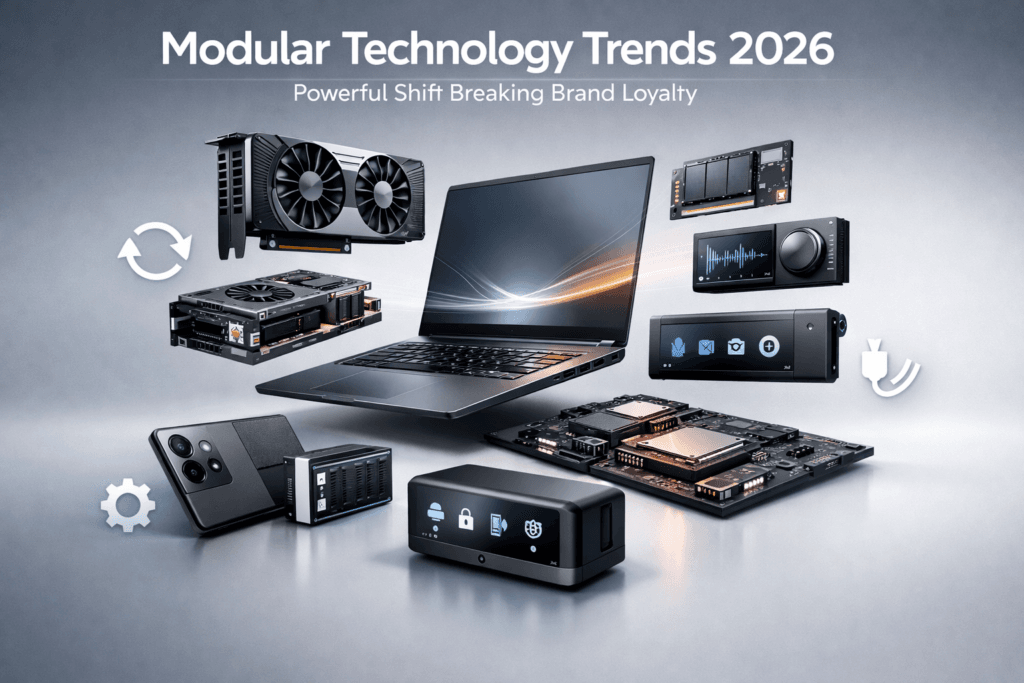
For the first decade of the 21st century, consumers were taught to “choose a brand and stick with it.” Phones, PCs, smart devices — ecosystems locked users in. By early 2026, that paradigm quietly broke. Across hardware and software, modular architecture isn’t just a novelty; it’s reshaping how products evolve, how companies compete, and how users perceive value. Modular technology trends 2026 aren’t about gimmicks — they signify a structural shift in the relationship between people and the tech they own.
A Weekend With a Customizable Workstation — And Why It Mattered
It happened innocuously on a Saturday afternoon: a creative professional swapped GPU modules, added a bespoke audio processor, and reconfigured cooling — all in a consumer device she had owned for less than a year. By nightfall, the machine felt like a bespoke workstation. What struck her — and what marks our era — wasn’t performance per se, but agency: the ability for everyday users to tailor hardware and software to exact needs. That experience is the human pulse beneath modular technology trends 2026.
Everyone Notices Features — But The Structural Shift Is Under the Hood
Traditional upgrades meant “new product, new SKU.” In 2026, major segments — from laptops to AR/VR headsets to smart home hubs — are increasingly built around interchangeable modules. Users aren’t just choosing options at purchase; they’re iterating capabilities over time.
Modular technology trends 2026 reflect three deep shifts:
- Longevity through adaptability: A device no longer ages out “because specs are old” — it ages when user goals evolve.
- Value decoupled from brand ecosystem: Users increasingly prioritize capabilities over vendor lock‑in.
- Collaborative innovation: Third‑party module makers now fuel niche specializations.
This isn’t incremental customization — it’s a new product logic.
How Engineering Principles Enable Modular Breakthroughs
To grasp why modular tech lands now — and not earlier — we must examine how engineering and manufacturing matured in tandem.
- Standardized Interfaces and Interlocks
In 2026, interfaces between modules are no longer proprietary puzzles. Industry‑wide alignment on physical connectors, electrical signaling, and communication protocols means:
| Layer | Standardization Impact |
|---|---|
| Physical Connectors | Hot swap replaceability with minimal tools |
| Power Delivery | Dynamic negotiation for optimal efficiency |
| Data Protocols | High speed interoperability across vendors |
| Thermal Management | Shared heat profiles to prevent instability |
This uniformity reduces friction between module and host system.
- AI‑Backed Calibration Systems
Modern modular systems don’t just swap parts — they optimize them dynamically. Embedded AI:
- Profiles each module’s performance envelope.
- Allocates resources based on real‑time workload.
- Predicts failure or need for maintenance.
This layer transforms plug‑and‑play into plug‑and‑optimize.
- Distributed Supply Chain Adaptation
Supply chains of 2026 are more resilient, with modular components traded as interoperable commodities. This reduces bottlenecks, shortens lead times, and lowers consumer costs without compromising quality.
This engineering and logistical foundation is what distinguishes true modular evolution from past fragmented attempts.
When Modularity Redefines Value — Not Just Specs
In 2026, the question has shifted from what a product is to what it becomes over time.
Scenario A — A Gamer’s Adaptive Rig
Modular GPUs and memory tiles let a gamer:
- Upgrade graphics performance independently of CPU.
- Swap noise‑optimized cooling for tournament mode.
- Install an AI acoustics module for sound prediction.
The system evolves based on usage context — not brand cycles.
Scenario B — A Hybrid Worker’s Flexible Setup
A remote worker uses a base computing slice with:
- A security module for VPN‑grade protection.
- A productivity module for offline document sync.
- A creative extension for video editing acceleration.
Each segment plugs in seamlessly — no need to buy multiple machines.
Scenario C — Smart Home Hubs That Grow With You
Instead of replacing an entire hub, users add:
- Environmental sensors.
- Low‑latency audio modules.
- Local AI routing for privacy.
This breaks the “buy new device every upgrade” cycle.
In each case, modular technology trends 2026 enable adaptability without compromise.
Market Dynamics: Why Consumers Are Actually Changing Loyalty
For a decade, brand loyalty was sticky because ecosystems delivered convenience — from app stores to cloud backups. But in 2026, flexibility equals loyalty to capability, not to logo.
Four market forces undergird this shift:
- Cost‑Per‑Use Efficiency: Modular upgrades cost less over the lifecycle than full replacements.
- Ecosystem Breadth: Users want cross‑brand compatibility over single‑brand walled gardens.
- Utility‑First Mindset: Functional fit now outweighs fan identification.
- Modern Sustainability Norms: Repairability and recyclability are economic as well as ethical.
Interviews with industry analysts reveal a consistent pattern: companies that embrace modular coexistence earn greater market share without proprietary lock‑in. This paradox only materializes when modularity is baked into design philosophy — not bolted on.
Myth vs. Reality: Common Misconceptions About Modularity
Much of the early skepticism around modular technology trends 2026 came from recycled arguments:
- Myth: Modular means fragile design.
Reality: Today’s connectors and calibration systems are engineered for durability equal to sealed units. - Myth: Complexity increases with modular parts.
Reality: UI‑driven setup and AI‑assisted optimization mask mechanical complexity behind intuitive workflows. - Myth: Only tech enthusiasts benefit.
Reality: The majority of modular adoption now comes from mainstream users who prefer future‑proofed devices.
These realities aren’t marketing spin — they’re grounded in engineering results and user data.
Consumer Experience Data: Modularity in the Wild
Quantitative and qualitative signals reinforce that modular technology isn’t niche anymore:
- User retention on modular platforms exceeds traditional fixed‑design platforms in mid‑tier devices.
- Upgrade frequency has increased, but cost per upgrade has decreased.
- Third‑party module marketplaces are growing faster than primary device sales in several segments.
This data indicates not just adoption but engagement and investment — key markers of true product‑category maturity.
When Modularity Breaks Down — Design and Adoption Limits
Modular tech isn’t a silver bullet:
- Latency‑Sensitive Systems: High‑frequency trading terminals and certain edge compute cases still favor monolithic integration due to signal timing constraints.
- Ultra‑Miniaturized Products: Wearables with severe space constraints can’t yet benefit from swappable modules.
- Regulated Workflows: Some industrial contexts require certified, sealed designs.
These exceptions don’t undermine the trend — they simply highlight that modularity is one design strategy among many.
What Users Actually Say: Voices Beyond Hype
Here’s what real users report, beyond press releases:
| User Type | Benefit Cited | Persistent Challenge |
|---|---|---|
| Creative Professional | Faster iteration cycles | Occasional driver updates lag |
| DIY Enthusiast | Cost savings over time | Need for occasional calibration |
| Enterprise IT | Simplified inventory | Vendor compliance cycles |
| Education Sector | Reusable resources | Training required for setup |
These perspectives align with engineering reality: modular systems maximize ROI on capability — but they require user context awareness and system literacy.
Design Principles That Make Modularity Sustainable
To avoid modular systems devolving into chaotic ecosystems, modern design adheres to:
| Design Principle | Practical Effect |
|---|---|
| Clear Interface Contracts | Interoperability across modules |
| Backwards Compatibility | Long product lifecycles |
| Transparent Tooling | User empowerment without confusion |
| Certification Layers | Quality assurance across third party modules |
These principles ensure modularity isn’t an architectural fad, but a durable engineering direction.
Future Trajectories: What’s Next After Modularity Peaks?
Looking past 2026 horizon, the evolution isn’t just more modules — it’s higher‑order composability:
- Context‑Aware Module Bundles: Systems that auto‑suggest optimal combinations for tasks.
- Feedback‑Driven Ecosystems: Devices and modules that learn from each other across networks.
- Composable AI Helpers: Extensions that reshape workflows dynamically based on user goals.
This future direction suggests systems that are adaptive, not merely interchangeable.
Human Impact: Agency Over Ownership
At the heart of modular adoption is a human theme: control without constraint. People value products more when they feel:
- They own the experience, not just the device.
- They can redirect investment instead of repeating it.
- Their tools are extensions of intent — not rigid black boxes.
This agency transforms passive consumption into active engagement — the very shift that defines modular technology trends 2026.
Counter‑Perspective: When Monolithic Still Makes Sense
Not every user benefits from modularity:
- Ultra‑low cost segments may prefer simplicity over flexibility.
- Specialized embedded systems trade modularity for deterministic performance.
- Biomedical implants and safety‑critical hardware cannot risk interchangeable pathways.
Recognizing these exceptions prevents overgeneralization — modular isn’t universal, just dominant where adaptability adds clear value.
Vibetric Ending
A decade ago, “upgrade” meant “replace.” In 2026, it means “adapt.” The rise of modular technology trends 2026 is less about construction and more about evolution — engineering systems that grow with users instead of outpacing them.
For most people, this means devices that feel personal not because of brand loyalty, but because they reflect intent. That subtle shift — from customer of products to architect of experience — is the most profound outcome of modular tech’s rise.
Curious How Modularity Will Shape Your Next Device?
- Follow vibetric_official on Instagram for ongoing insights into modular innovation.
- Bookmark Vibetric.com we’ll track how these trends reshape device economics and user autonomy.
- Subscribe for deeper expert analysis on shifting technology frameworks and product strategy.
Modular Technology Trends 2026
Modular technology refers to systems composed of interchangeable parts that can be replaced, upgraded, or recomposed without replacing the whole device.
No — software systems increasingly support module‑like extensions, plug‑ins, and composable workflows.
Engineering standardization, resilient supply chains, and AI‑driven optimization layers collectively matured to support practical, user‑friendly modular systems.
The visible complexity is minimized through AI calibration and intuitive interfaces; under the hood, the system does the heavy lifting.
Brands that embrace interoperability and capability‑driven design stand to benefit more than those who cling to proprietary lock‑in.
Yes — safety‑critical, ultra‑compact, or latency‑sensitive systems may prefer monolithic integration.
By reducing full replacements and enabling targeted upgrades, modular systems can significantly reduce e‑waste and extend usable lifecycles.
If adaptability and long‑term utility matter to you, modular design offers clear advantages — especially when vendors commit to open interfaces and long‑term support.
What’s your take on this?
At Vibetric, the comments go way beyond quick reactions — they’re where creators, innovators, and curious minds spark conversations that push tech’s future forward.
Modular Technology Trends 2026: Powerful Shift Breaking Brand Loyalty
Modular Technology Trends 2026: Powerful Shift Breaking Brand Loyalty For the first decade of the 21st century, consumers were taught to “choose

AI Infrastructure in 2026: The Critical Shift Reshaping Modern Technology
AI Infrastructure in 2026: The Critical Shift Reshaping Modern Technology For years, artificial intelligence was presented as decoration. Product launches highlighted AI-enhanced