
Minimalist Tech Design Trends 2026 — Why Clean, Powerful Devices Are Winning
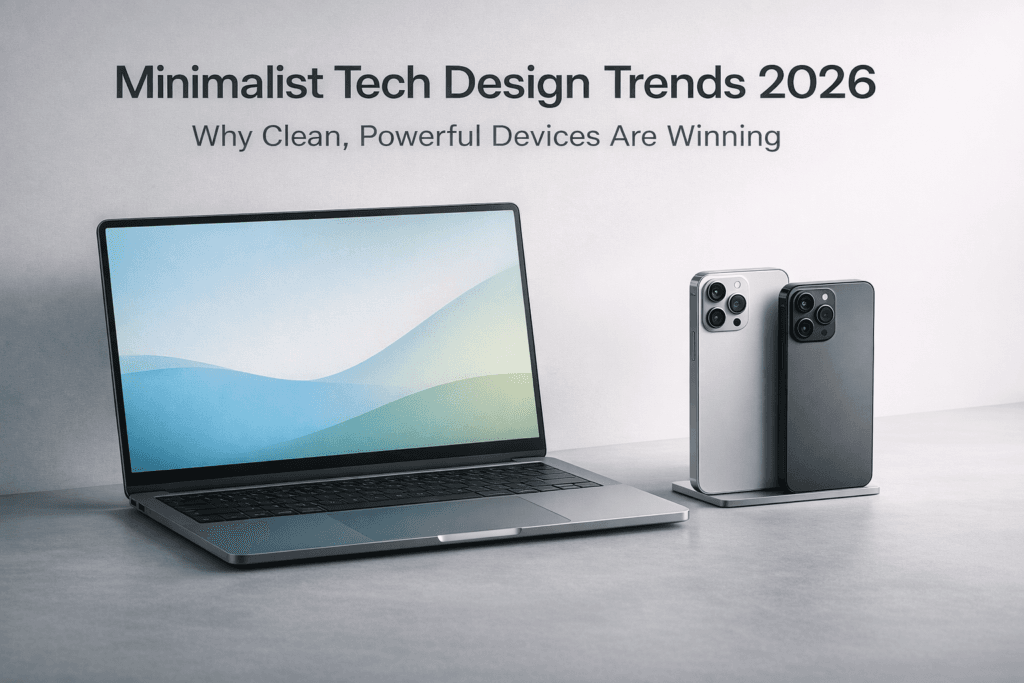
For years, consumer technology competed on excess — more cameras, more ports, more lighting, more visible power. In 2026, restraint is outperforming spectacle. The devices gaining traction aren’t louder or flashier; they are quieter, cleaner, and more intentional. Minimalist tech design trends 2026 reflect a broader recalibration in how users evaluate value.
Minimalism today is not aesthetic emptiness. It is engineered reduction — removing friction, visual noise, and unnecessary hardware complexity. The race is no longer about who can add the most features. It’s about who can integrate them without clutter.
When Simplicity Becomes a Performance Strategy
Minimalist design once centered on visual appeal. Now it influences engineering efficiency. Fewer external seams improve structural rigidity. Reduced button counts lower mechanical failure points. Unified materials enhance thermal behavior.
In laptops, tablets, and wearables, internal component stacking has become more vertical and consolidated. Ports are fewer but more versatile. Physical interfaces give way to adaptive software layers. These decisions reduce manufacturing complexity while improving reliability.
That’s why minimalist tech design trends 2026 are not merely stylistic. They represent a systemic simplification that affects durability, heat management, and long-term usability.
User Behavior Has Shifted Toward Cognitive Ease
Consumers in 2026 are navigating dense digital ecosystems. Notifications, dashboards, and layered app environments already demand constant attention. Hardware that visually competes for attention feels counterproductive.
Minimalist products provide cognitive relief. Clean surfaces and simplified interfaces reduce decision fatigue. Fewer visible elements create faster comprehension.
This behavioral reality explains why minimalist tech design trends 2026 resonate strongly with productivity-focused users. Devices that fade into workflow outperform devices that demand admiration.
Where the Engineering Gains Are Coming From
| Design Shift | Structural Benefit | User Impact |
|---|---|---|
| Reduced external ports | Improved chassis integrity | Cleaner form, fewer failure points |
| Unified material bodies | Better heat distribution | Stable long-term performance |
| Hidden antenna lines | Seamless connectivity integration | Visual continuity |
| Software-first controls | Lower mechanical complexity | Longer lifespan |
| Compact internal layouts | Efficient space utilization | Thinner, lighter devices |
The pattern is consistent. Minimalism reduces redundancy. It consolidates systems. It eliminates parts that once existed to signal capability rather than deliver it. Minimalist tech design trends 2026 are driven by integration maturity.
The Industry Incentive: Efficiency at Scale
From a manufacturing standpoint, simplified designs streamline production lines. Fewer components mean fewer supply dependencies. Cleaner assembly reduces error rates. Material uniformity improves recycling processes.
As sustainability scrutiny increases, minimalism aligns naturally with environmental positioning. Fewer parts, tighter builds, and modular internal design contribute to longer product lifecycles.
The economic logic reinforces the aesthetic one. Minimalist tech design trends 2026 make financial and operational sense for manufacturers aiming at durability and sustainability metrics.
The Contrarian View: Is Less Always Better?
Minimalism can risk oversimplification. Eliminating too many physical controls may frustrate power users. Removing expandability can limit flexibility. Excessive software abstraction may reduce tactile satisfaction.
The most successful minimalist products in 2026 avoid this trap by balancing reduction with capability. They remove redundancy, not functionality. Intentional minimalism is disciplined — not extreme.
This distinction matters. Minimalist tech design trends 2026 succeed when they prioritize clarity, not restriction.
Cultural Signals Behind the Shift
Design language often mirrors cultural mood. After years of aggressive innovation cycles and rapid feature stacking, consumer appetite has shifted toward calm reliability. Users increasingly value devices that feel stable and enduring rather than experimental.
Minimalist hardware communicates longevity. Clean lines age better visually. Neutral finishes resist trend fatigue. Simplified designs reduce perceived obsolescence.
In this way, minimalist tech design trends 2026 reflect a maturity phase in consumer electronics — refinement replacing novelty.
Why This Momentum Is Accelerating
AI integration plays a subtle role. As software becomes more capable, hardware no longer needs to expose every function physically. Adaptive interfaces replace dedicated buttons. Intelligent automation reduces manual toggles.
When software handles complexity invisibly, hardware can simplify externally. The cleaner the surface, the more advanced the internal system often becomes.
This convergence of intelligent software and restrained hardware is pushing minimalist tech design trends 2026 forward rapidly across categories — from smartphones to smart home devices.
Clarity as Competitive Advantage
Minimalism in 2026 is not an aesthetic trend cycle. It is a strategic response to complexity saturation. Devices are winning not by displaying power, but by containing it elegantly.
Minimalist tech design trends 2026 reveal that engineering maturity allows subtraction without sacrifice. The strongest products are those confident enough to remove what no longer adds value.
As technology becomes more intelligent internally, it increasingly chooses to appear simple externally. In a market once defined by visible innovation, quiet clarity has become the differentiator.
Stay Connected with Vibetric
- Follow our Instagram @vibetric_official for sharp analysis of evolving tech design philosophy.
- Bookmark vibetric.com for ongoing insights into intelligent hardware trends.
- Stay updated as refinement reshapes the future of consumer devices.
What’s your take on this?
At Vibetric, the comments go way beyond quick reactions — they’re where creators, innovators, and curious minds spark conversations that push tech’s future forward.
Best Tech Gadgets 2026 — The Smart Devices That Truly Deliver
Best Tech Gadgets 2026 — The Smart Devices That Truly Deliver Every year begins with spectacle. Product teasers promise transformation. Launch events

Global Chip Shortage Impact on Consumers — The Surprising Shift in 2026
Global Chip Shortage Impact on Consumers — The Surprising Shift in 2026 For nearly half a decade, semiconductor constraints shaped everything from