
Loudness vs Sound Quality: Why Clean Audio Wins Every Time
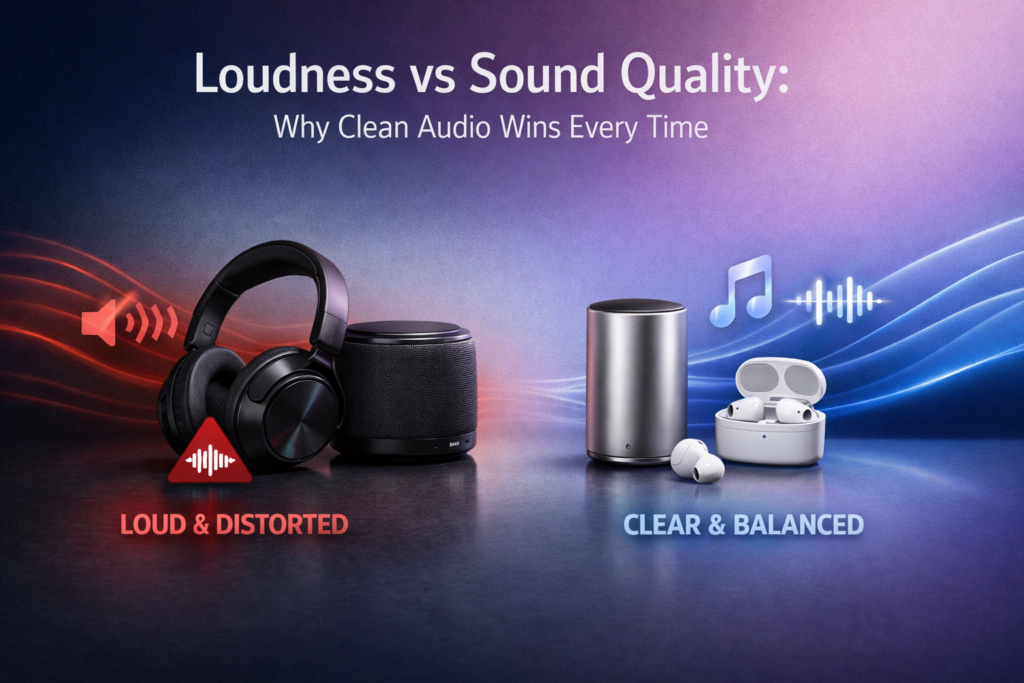
Loud audio is easy to notice. Clean audio is harder to define—but instantly recognizable once you hear it. In a market flooded with louder speakers, boosted bass modes, and aggressive volume tuning, the distinction between loudness vs sound quality has become blurred for most listeners. Many assume more volume equals better sound, when in reality, loudness often masks deeper problems in audio reproduction. Understanding the difference isn’t about becoming an audiophile; it’s about recognizing why some systems feel effortless and immersive while others fatigue you within minutes.
Why Our Ears Confuse Volume With Quality
Human hearing is inherently biased. Louder sounds trigger stronger neurological responses, which the brain often interprets as “better.” This psychoacoustic effect is well-documented in audio engineering and is frequently exploited in demos, retail environments, and even smartphone sound tuning. When two speakers are compared side by side, the louder one almost always wins initial preference—even if it’s objectively less accurate.
This is where loudness vs sound quality becomes a perception problem. Loud systems compress dynamic range to keep everything forward and present. That compression reduces contrast between soft and loud passages, creating the illusion of power. Clean systems, by contrast, preserve micro-dynamics—small shifts in volume and texture that make music feel alive. They may seem quieter at first, but they reveal more over time.
How Loudness Is Manufactured, Not Measured
Loudness is not just about turning up the volume knob. In most consumer audio products, achieving higher loudness involves a combination of gain amplification, dynamic range compression, and frequency boosting—especially in the bass and upper treble. These adjustments increase perceived energy without necessarily increasing fidelity.
The trade-off is distortion. As drivers are pushed closer to their physical limits, harmonic distortion rises. Bass notes lose definition, vocals smear, and transients—like drum hits or plucked strings—become blunt. Many modern speakers and earbuds are tuned to sound impressive in short bursts, prioritizing loudness over long-term listenability. This approach wins spec sheets and quick demos, but it rarely delivers satisfying sound quality.
Clean Audio: Precision, Not Restraint
Clean audio is often misunderstood as “flat” or “boring.” In reality, it’s about control. A clean system maintains low distortion across its volume range, keeps frequencies balanced, and preserves timing accuracy. Nothing jumps out unnaturally, and nothing feels suppressed.
From an engineering perspective, clean sound quality depends on several factors working together: well-designed drivers, stable amplification, effective damping, and thoughtful digital signal processing. Instead of compressing everything to sound big, clean tuning allows recordings to breathe. Quiet details remain audible without forcing loud passages to become harsh. This is why clean systems often scale better—turn them up, and they stay composed rather than collapsing into noise.
The Loudness vs Sound Quality Trade-Off in Everyday Devices
In smartphones, laptops, and portable speakers, space and power constraints make this trade-off unavoidable. Smaller drivers can only move so much air. To sound louder, manufacturers rely heavily on DSP tricks: bass enhancement, midrange push, and aggressive limiting. The result is sound that cuts through ambient noise but sacrifices realism.
Clean audio tuning in compact devices focuses on intelligibility and tonal balance rather than sheer output. Vocals remain natural, cymbals don’t splash, and bass stays textured instead of boomy. These devices may not dominate a noisy room, but they reward attentive listening. Over time, users often describe them as “less tiring” or “more natural,” even if they can’t articulate why.
A Simple Framework to Tell Them Apart
You don’t need measurement tools to hear the difference between loud and clean audio. A few listening cues can reveal what you’re dealing with:
| Listening Cue | Loud Audio Bias | Clean Audio Bias |
|---|---|---|
| High volume | Gets harsh quickly | Stays controlled |
| Bass | Big but blurry | Tight and layered |
| Vocals | Forward, sometimes shouty | Natural and stable |
| Long sessions | Fatiguing | Comfortable |
This framework highlights the core of loudness vs sound quality: one prioritizes immediate impact, the other prioritizes sustained clarity.
The Consumer Behavior Behind the Tuning Choices
Manufacturers don’t choose loud tuning by accident. Most buyers listen in short bursts—scrolling videos, quick songs, crowded spaces. In these scenarios, loud audio performs better. It grabs attention and feels powerful, even if accuracy suffers. Clean audio reveals its advantages over longer sessions, which are harder to demonstrate in marketing or retail settings.
This behavior loop reinforces itself. Consumers expect louder products, brands deliver them, and clean tuning becomes a niche differentiator rather than a baseline expectation. The irony is that many users who complain about listening fatigue or “tinny” sound are reacting to loudness-first tuning without realizing it.
Why Clean Audio Matters More Than Ever
As content quality improves—higher-bitrate streaming, better recordings, spatial audio mixes—the limitations of loud tuning become more obvious. Clean sound quality allows these improvements to come through. It respects the recording instead of reshaping it to fit a volume target.
In the long run, loud audio impresses. Clean audio endures. One is designed to win your attention; the other is designed to keep it. The real difference isn’t about preference—it’s about intent.
Keep Your Listening Standards Sharp
- Follow our Instagram @vibetric_official for clear-eyed audio and tech insights.
- Bookmark vibetric.com for weekly deep dives that cut through spec noise.
- Keep up with evolving sound trends without the hype.
What’s your take on this?
At Vibetric, the comments go way beyond quick reactions — they’re where creators, innovators, and curious minds spark conversations that push tech’s future forward.
Sony WH-1000XM6 ANC Headphones: Powerful Silence or Overhyped Upgrade in 2026?
Sony WH-1000XM6 ANC Headphones: Powerful Silence or Overhyped Upgrade in 2026? For years, noise-canceling headphones have chased the same promise: silence on
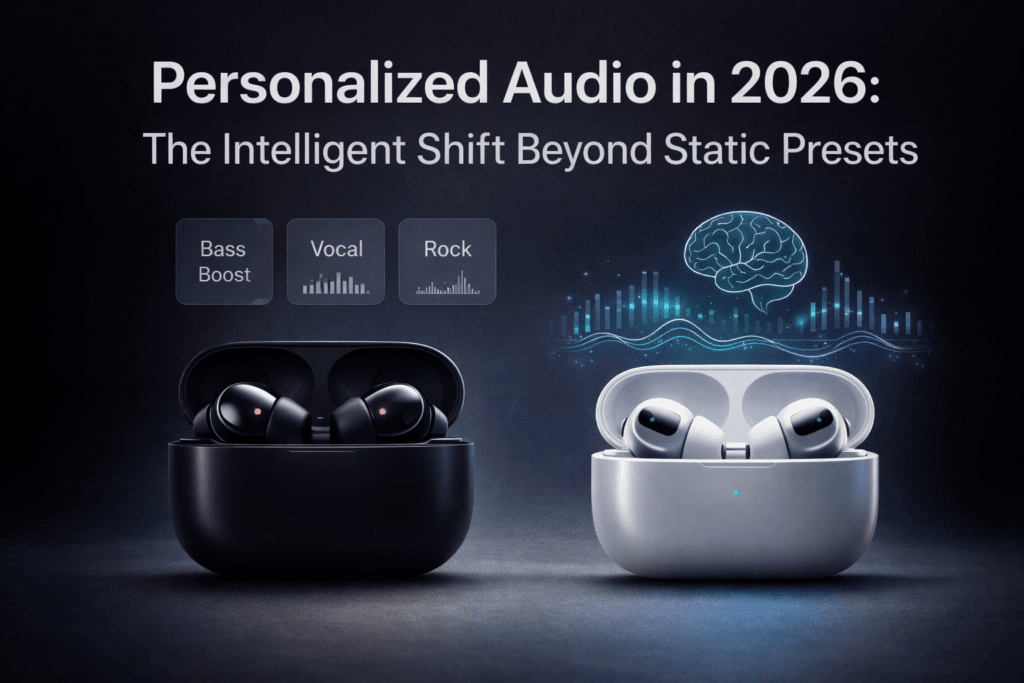
Personalized Audio in 2026: The Intelligent Shift Beyond Static Presets
Personalized Audio in 2026: The Intelligent Shift Beyond Static Presets For years, audio customization meant choosing a label. “Bass Boost.”“Vocal.”“Rock.”“Podcast.” These presets