
Do Lightweight Mice Really Make You Play Better?
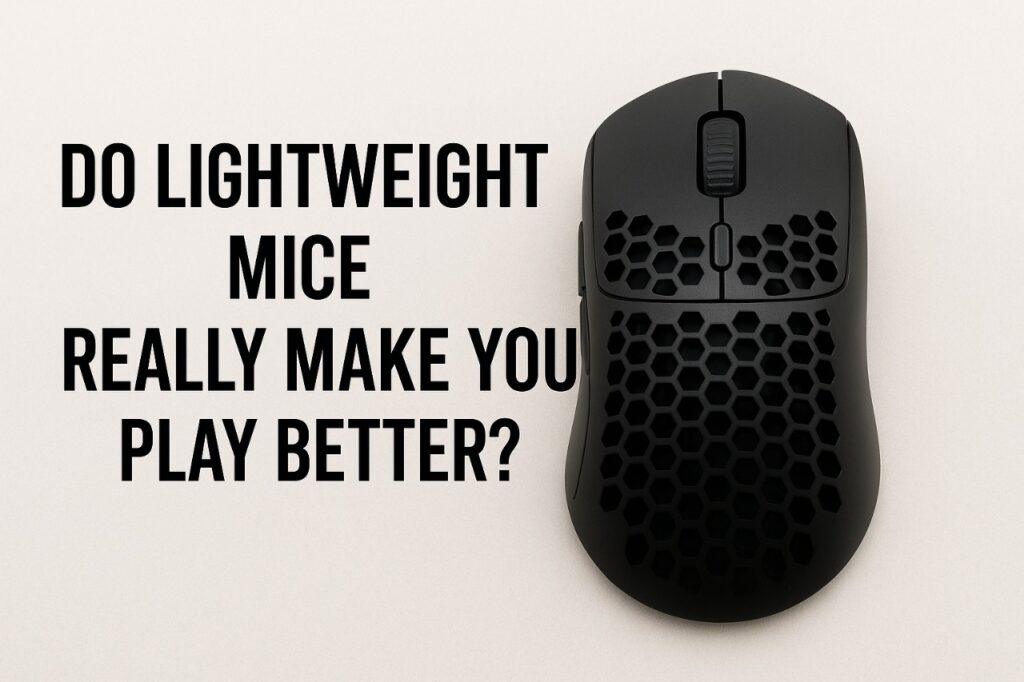
In competitive gaming, every millisecond counts, and peripheral choices can subtly influence performance. Lightweight gaming mice have emerged as a major trend, promising faster flicks, smoother swipes, and reduced fatigue. Marketing often positions them as a “must-have” for serious gamers, but it’s worth asking whether shaving grams from your mouse genuinely translates to better gameplay—or if the improvement is largely psychological.
Engineering a Lighter Mouse
Lightweight gaming mice are typically under 70 grams, achieved through honeycomb shells, hollowed interiors, or lighter materials like magnesium alloys and high-grade polymers. The goal is simple: reduce inertia so smaller muscle movements create faster cursor motion.
However, engineering challenges are complex:
- Structural rigidity must be maintained to prevent flex during intense maneuvers.
- Cable design, even in wireless models, must avoid drag or interference.
- Weight distribution and center of gravity are critical for precise control.
A poorly engineered lightweight mouse can feel unstable or inconsistent, negating any potential advantage of reduced mass.
Fatigue and Long-Term Comfort
One of the clearest advantages of lightweight mice is reduced hand fatigue. Extended sessions in FPS, MOBA, or RTS games can strain forearm and wrist muscles. Lighter mice reduce repetitive stress and make long gaming sessions more comfortable.
Yet, comfort is highly subjective. Some players favor the tactile reassurance of heavier mice, feeling more in control during micro-adjustments. Grip style—fingertip, claw, or palm—also affects whether weight reduction enhances comfort or feels unnatural.
Performance Metrics: Myth vs Reality
Studies and player testing suggest that lightweight mice provide marginal gains in reaction speed, particularly for rapid flick shots or tiny corrective movements. Professional esports players may benefit from even a few grams saved.
For casual or mid-level gamers, the difference is far less noticeable. Sensor quality, tracking precision, and click latency remain far more influential for overall performance. Weight is a factor, but it does not replace proper technique or consistent practice.
Balance and Build Quality Matter More Than Weight Alone
Reducing weight without proper balance can compromise accuracy. A lightweight gaming mouse must distribute mass strategically to prevent drift during fast movements. Premium models often combine honeycomb shells with internal reinforcement to maintain rigidity, while budget models may sacrifice stability for ultra-light weight.
Other considerations include surface finish, button response, and scroll-wheel accuracy. A mouse that is light but poorly designed in these areas will hinder performance more than a slightly heavier, well-engineered model.
The Role of Personal Playstyle
Not every player benefit from a lightweight mouse. Low-sensitivity users, who rely on large sweeping movements, often prefer heavier mice that provide momentum and control. High-sensitivity players, aiming for micro-adjustments, may gain more from featherweight designs. Ultimately, grip technique, gaming genre, and personal preference determine whether a lightweight gaming mouse truly improves performance.
A Contrarian Angle: Psychology and Confidence
The psychological effect of a lightweight mouse should not be underestimated. Feeling faster, more agile, and less fatigued can improve confidence and hand-eye coordination during play. This advantage, while intangible, often contributes as much to performance as the physical properties of the mouse itself.
Closing Reflection
Lightweight gaming mice represent thoughtful engineering aimed at reducing fatigue and enhancing micro-movement response. They offer potential advantages in speed, comfort, and agility, particularly for competitive players. Yet weight alone does not define skill, precision, or consistency. Selecting a mouse requires understanding ergonomics, balance, playstyle, and personal preference. Featherweight design can improve your game, but only when it complements your technique and overall setup.
Keep Gaming Smart with Vibetric
- Follow @vibetric_official on Instagram for in-depth gaming peripheral insights and performance analysis.
- Bookmark vibetric.com to compare ergonomic, technical, and real-world advantages of mice.
- Stay updated on reviews that assess both measurable metrics and practical gameplay impact.
What’s your take on this?
At Vibetric, the comments go way beyond quick reactions — they’re where creators, innovators, and curious minds spark conversations that push tech’s future forward.
Performance Per Watt in 2026: The Critical Benchmark Redefining Computing
Performance Per Watt in 2026: The Critical Benchmark Redefining Computing For years, performance was measured in absolutes. Faster processors won. Higher benchmark

Global Chip Shortage Impact on Consumers — The Surprising Shift in 2026
Global Chip Shortage Impact on Consumers — The Surprising Shift in 2026 For nearly half a decade, semiconductor constraints shaped everything from