
Laptop Performance Perception — The Hidden Reason Modern Laptops Feel Faster
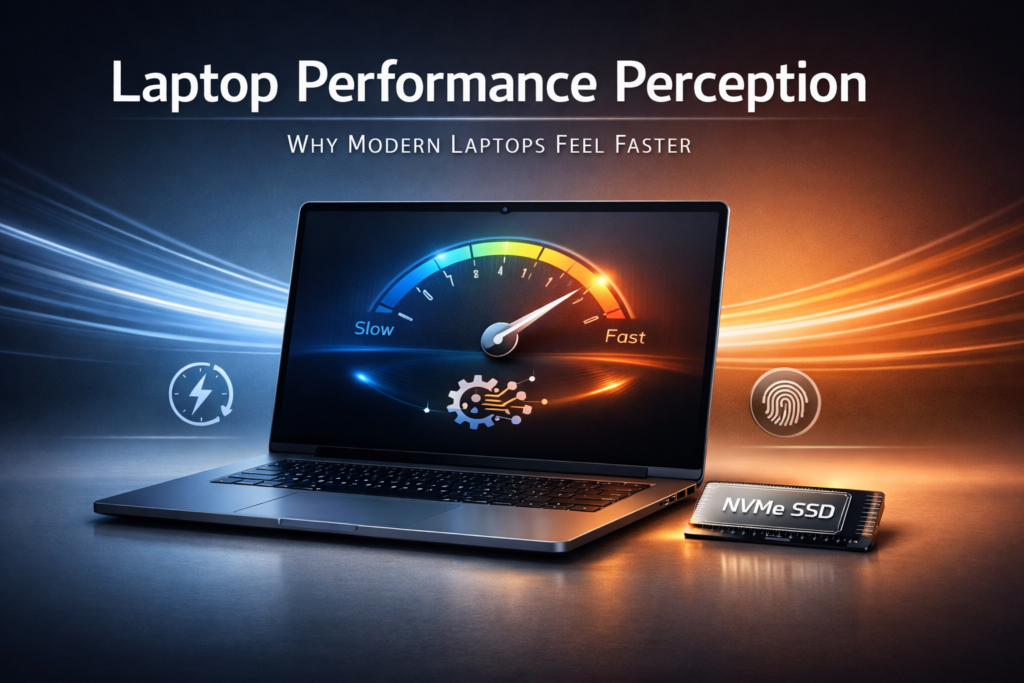
On paper, many modern laptops don’t look dramatically more powerful than models from a few years ago. Clock speeds haven’t exploded, RAM numbers feel familiar, and storage specs look incremental. Yet when you actually use a 2025 laptop, it feels faster—apps open instantly, multitasking is smoother, and everyday tasks feel frictionless. This disconnect highlights an important shift: laptop performance perception is no longer driven by raw specs alone.
The Shift From Peak Power to Perceived Speed
For years, performance marketing focused on bigger numbers: higher GHz, more cores, larger memory pools. But users don’t experience benchmarks—they experience responsiveness. Modern laptops are optimized around how quickly the system reacts to intent: opening an app, switching windows, waking from sleep, or handling background tasks without slowing down.
This shift has redefined laptop performance perception. A device doesn’t need extreme hardware if it minimizes delays. Faster wake times, instant authentication, and smoother animations create a sense of speed that raw specifications fail to capture.
Software Optimization Is Doing the Heavy Lifting
Operating systems in 2025 are far more intelligent than before. Task scheduling, background process management, and predictive resource allocation play a major role in how fast a laptop feels.
Instead of allowing every app to compete equally for resources, modern OS design prioritizes foreground tasks. This means:
- Active apps receive CPU and memory priority
- Background processes are paused or throttled
- Idle resources are reclaimed instantly
The result is a laptop that feels consistently fast, even if the underlying hardware hasn’t changed much. Laptop performance perception improves because the system behaves predictably, not because it’s brute-forcing tasks.
Storage and Memory Latency Matter More Than Size
One of the most underrated contributors to perceived speed is latency. Modern NVMe SSDs and faster memory architectures dramatically reduce access times. Even if total storage capacity or RAM size hasn’t increased, data moves faster.
This impacts laptop performance perception in subtle but powerful ways:
- Apps launch quicker
- File searches feel instant
- System indexing happens invisibly
- Multitasking no longer stalls the UI
Users rarely notice why things feel faster—they just know the laptop doesn’t get in their way.
Efficiency-Focused Processors Changed Everything
Modern CPUs emphasize performance per watt rather than peak output. This approach delivers consistent speed without heat spikes or throttling. Instead of short bursts followed by slowdown, laptops maintain steady performance across long sessions.
This consistency matters more than peak numbers. A laptop that delivers 90% performance all the time feels faster than one that hits 120% briefly and then drops. Laptop performance perception improves when speed is reliable, silent, and thermally stable.
The Role of Instant-On and Authentication
Speed isn’t just about computation—it’s about access. Features like instant wake, facial recognition, fingerprint sensors, and always-on connectivity remove friction before work even begins.
From the user’s perspective:
- The laptop feels ready the moment it opens
- Logging in is invisible
- Switching contexts is seamless
These moments shape laptop performance perception more strongly than synthetic benchmarks. A device that saves seconds repeatedly feels dramatically faster over time.
UI Fluidity and Animation Design
Modern interfaces are deliberately engineered to feel smooth. High refresh rate displays, optimized animations, and reduced frame drops all contribute to the illusion of speed.
Even when tasks take the same amount of time to complete, smoother visual feedback makes them feel quicker. This psychological layer is intentional. Laptop performance perception is influenced as much by visual continuity as by actual processing speed.
Background Intelligence You Never See
In 2025, laptops constantly manage themselves:
- Predictive caching preloads frequently used apps
- AI-based power management anticipates workload changes
- Adaptive performance profiles adjust in real time
These processes operate silently, but they shape how responsive a system feels. The laptop seems to “understand” what you want next, reinforcing the perception of intelligence and speed.
A Contrarian View: Specs Still Matter—Just Differently
This doesn’t mean specifications are irrelevant. They still define performance ceilings. But the gap between “enough” and “excess” has narrowed. Once a laptop crosses a baseline of competence, optimization determines experience.
In other words, laptop performance perception today is less about how powerful a machine can be and more about how efficiently it delivers that power when needed.
Why This Matters for Buyers
Many users overspend chasing specs they won’t feel. A well-optimized mid-tier laptop often feels faster in daily use than a poorly tuned high-end machine. Understanding laptop performance perception helps buyers focus on:
- Responsiveness over raw numbers
- Thermal stability over peak benchmarks
- Software experience over spec sheets
The smartest purchase isn’t always the most powerful—it’s the most balanced.
Closing Insight
Modern laptops feel faster because they’re designed around human experience, not benchmark bragging rights. Through efficiency, optimization, and intelligent resource management, they eliminate friction rather than chasing raw power. Laptop performance perception has evolved—and in 2025, speed is something you feel, not something you measure.
Understand Performance Beyond Specs
- Follow our Instagram @vibetric_official for real-world performance insights without spec-sheet hype.
- Bookmark vibetric.com for practical laptop analysis focused on experience, not marketing.
- Explore deeper guides that help you choose devices based on how they actually feel to use.
What’s your take on this?
At Vibetric, the comments go way beyond quick reactions — they’re where creators, innovators, and curious minds spark conversations that push tech’s future forward.
Snapdragon X Elite Gen 2 Laptops: Powerful Shift for Windows on ARM
Snapdragon X Elite Gen 2 Laptops: Powerful Shift for Windows on ARM For years, Windows laptops have chased performance in familiar ways:
AI Laptops in 2026: The Intelligent Shift Toward True Workstations
AI Laptops in 2026: The Intelligent Shift Toward True Workstations For years, laptops competed on portability versus power. Thin and light for