
Why 2025 Is the Biggest Turning Point for Laptops Since Ultrabooks Launched
The café is louder than it used to be. Not because people are talking more, but because laptops have replaced cubicles, studios, and meeting rooms. You can hear it in the clack of keys, the hum of cooling fans fighting invisible heat, the soft frustration sigh when a battery warning interrupts a video call. Somewhere between the pandemic years and now, the laptop stopped being a portable computer and quietly became the primary environment where work, study, and creativity coexist. That shift didn’t arrive with fireworks. It crept in through routine.
In 2025, something feels different. Buyers aren’t excited by thinner bezels or marginally faster CPUs anymore. They’re anxious, skeptical, and unusually informed. A student worries whether a machine will survive four years of thermal stress and software updates. A remote professional wonders if their laptop can sustain eight-hour days without throttling or ergonomic fatigue. Creators ask whether performance will remain stable after two years of heavy workloads, not just on day one. These questions signal more than caution—they mark a collective realization.
The laptop market turning point isn’t about a single breakthrough product. It’s about accumulated pressure. Silicon architectures have diversified. Operating systems have become heavier yet more intelligent. Power efficiency is no longer a marketing bullet; it’s a survival trait. Comfort—keyboard travel, palm temperature, screen glare—has started to matter as much as benchmark charts. Users have lived with their machines long enough to understand where promises fail.
This moment mirrors the Ultrabook era in spirit but not in intent. Ultrabooks promised mobility. 2025 demands sustainability—of performance, of user comfort, of relevance. The laptop is no longer a tool you upgrade for speed. It’s an environment you choose to inhabit daily. And environments, once chosen poorly, are hard to escape.
The Pressure That Forced Laptops to Evolve Again
Laptops didn’t change because brands wanted them to. They changed because the old assumptions stopped working. For years, the industry believed thinner was always better, more cores meant progress, and users would tolerate heat, noise, and battery anxiety as long as performance numbers looked impressive. That equation broke under real-world use. Remote work stretched usage hours. Hybrid workflows blurred personal and professional boundaries. Machines were no longer opened for bursts of productivity—they stayed open all day.
The laptop market turning point emerges from this cause-and-effect chain. Increased daily usage exposed thermal limits. Sustained workloads revealed how short-lived peak performance could be. Battery chemistry collided with always-on connectivity. Software stacks grew heavier, assuming constant AI assistance, background syncing, and security monitoring. Suddenly, yesterday’s design priorities felt misaligned with today’s behavior.
Below is how engineering intent shifted when reality pushed back:
| Engineering Evolution | What Problem It Actually Solved |
|---|---|
| Efficiency-first silicon architectures | Reduced heat under sustained workloads |
| Larger vapor chambers & graphite layers | Prevented long-session thermal throttling |
| Adaptive refresh rate displays | Extended real-world battery life |
| AI-assisted power management | Balanced performance without manual tuning |
| Reinforced hinge and chassis designs | Addressed longevity under daily open-close cycles |
What’s notable is that none of these changes are flashy. They’re corrective. They exist because users started living inside their laptops rather than occasionally using them. The Ultrabook era was about carrying a computer everywhere. This era is about trusting it to endure everything you throw at it.
Inside the Laptop Industry’s Invisible Web
From the outside, laptops look like finished products. Inside the industry, they’re negotiations. OEMs depend on silicon vendors, who depend on fabrication timelines, which depend on geopolitical stability and capital investment cycles. Display manufacturers influence form factors years before consumers see them. Battery suppliers quietly dictate thickness limits and weight targets. Marketing teams then step in, translating engineering compromises into aspirational language.
This ecosystem tension is central to understanding why 2025 feels different. The laptop market turning point isn’t driven by one player but by alignment across many. Silicon vendors now prioritize efficiency curves over raw clock speeds. Operating system designers assume heterogeneous cores and on-device AI acceleration. OEMs are forced to design for sustained performance because return rates and long-term reputation have become measurable risks.
Here’s the simplified influence flow that shapes what users eventually buy:
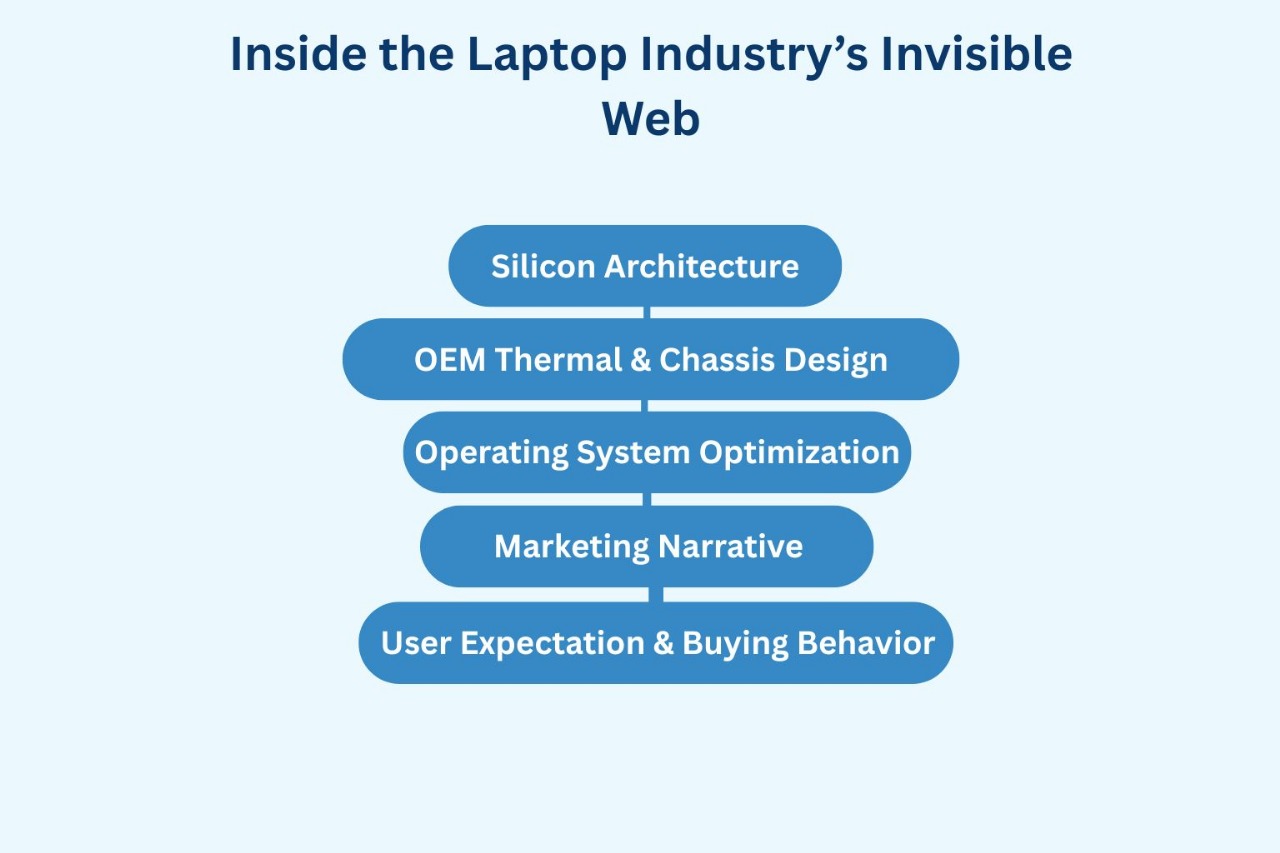
When any layer misaligns, users feel it immediately—through heat, noise, lag, or fatigue. In previous cycles, marketing could mask these gaps. In 2025, lived experience exposes them. Buyers share long-term impressions, not just first-week excitement. The ecosystem has been forced to listen.
This is why the current moment isn’t just another refresh cycle. It’s an industry-wide recalibration, where engineering reality, user psychology, and economic pressure finally intersect.
The Physics Laptops Can No Longer Escape
Every laptop, no matter how premium, is bound by the same physical laws. Heat must go somewhere. Energy must be conserved. Signals degrade over distance and time. For years, manufacturers designed around short bursts of performance, assuming users would tolerate throttling as long as benchmarks impressed reviewers. That assumption collapsed once laptops became all-day machines. In 2025, physics has reasserted itself as the dominant design constraint.
The laptop market turning point is visible in how engineering teams now talk internally. Instead of peak wattage, they model thermal envelopes over hours. Instead of maximum boost clocks, they prioritize sustained frequency stability. Thin chassis still exist, but they are now engineered with layered compromises: vapor chambers replacing heat pipes, graphite sheets spreading heat laterally, firmware actively shaping performance curves to avoid thermal cliffs.
Battery physics has also become unavoidable. Lithium chemistry doesn’t care about marketing timelines. Faster charging stresses cells. High-refresh displays drain power unevenly. Always-on background processes create constant load. Engineers now accept that efficiency per watt matters more than absolute performance, because wasted energy becomes heat, and heat degrades everything—from silicon longevity to user comfort.
| Constraint Zone | Engineering Trade-Off Chosen | User-Facing Result |
|---|---|---|
| Thermal density | Lower sustained clocks | Stable performance over time |
| Energy envelope | Heterogeneous core designs | Longer battery under mixed workloads |
| Signal integrity | Shorter internal traces | Reduced latency, fewer errors |
| Acoustic limits | Larger, slower fans | Quieter long sessions |
| Chassis thickness | Reinforced internal frames | Less flex, better heat spreading |
What’s new is honesty. Engineers are no longer pretending physics can be defeated. They’re designing laptops that live within limits, not ones that briefly escape them. That philosophical shift defines this era more than any spec sheet ever could.
Why Your Brain Notices Problems Before Benchmarks Do
Humans don’t experience performance as numbers. They experience it as friction—or the absence of it. A half-second delay during a video call, a warm palm rest after an hour of typing, a fan that ramps up unpredictably: these moments register emotionally before they’re understood technically. In 2025, laptop design increasingly acknowledges that perception governs satisfaction.
The laptop market turning point shows up in how manufacturers study user psychology. Latency feels worse when it interrupts flow. Heat feels more intrusive on skin contact than measured temperatures suggest. Brightness fluctuations trigger fatigue faster than static glare. Even keyboard feedback alters perceived responsiveness, regardless of actual system speed. These biases aren’t flaws; they’re human constants.
Designers now tune systems to minimize perceptual spikes. Adaptive performance curves smooth transitions. Displays adjust not just brightness but contrast dynamics. Trackpads prioritize consistency over peak sensitivity. The goal is emotional stability, not technical dominance.
| Emotion Trigger | Perceived Issue | Behavioral Outcome |
|---|---|---|
| Sudden fan noise | “System is struggling” | Loss of trust |
| Palm heat buildup | Discomfort | Shorter work sessions |
| Micro-lag | Reduced confidence | Task avoidance |
| Inconsistent brightness | Eye strain | Fatigue, distraction |
| Key travel mismatch | Loss of control | Slower typing rhythm |
What users call “a good laptop” in 2025 is often one that stays out of the way. That insight—psychological, not technological—has reshaped priorities across the industry.
Materials That Signal Intent, Not Just Price
Materials are no longer just about durability or aesthetics. They communicate philosophy. Aluminum once meant premium. Plastic meant compromise. In 2025, those associations have blurred. Buyers now judge materials by how they feel after hours of use, how they manage heat, and how they age—not how they photograph.
The laptop market turning point is evident in material choices becoming functional signals. Magnesium alloys reduce weight without trapping heat. Textured polymers improve grip and resist fingerprints. Glass trackpads are tuned for friction profiles, not shine. Even internal materials—adhesives, foams, insulating layers—are selected based on how they behave after thousands of thermal cycles.
There’s also a cultural shift. Professionals value understated resilience over visual flash. Students want durability that survives backpacks and cafes. Creators care about surface temperatures and vibration damping during long sessions. Form now follows lived use, not showroom appeal.
| Material Class | Premium Behavior | Mid-Tier Behavior |
|---|---|---|
| Aluminum alloys | Efficient heat spreading | Localized hot spots |
| Magnesium blends | Lightweight, rigid | Flex under stress |
| Reinforced polymers | Thermal neutrality | Heat retention |
| Glass trackpads | Consistent friction | Variable glide |
| Composite hinges | Smooth aging | Early looseness |
| Alloy Hinges | High fatigue resistance | Faster tolerance loosening |
Materials have become quiet collaborators in user experience. When chosen well, they disappear. When chosen poorly, they remind you of themselves every day. That distinction matters more now than ever.
When Laptops Started Thinking About Themselves
Intelligence inside laptops used to mean performance presets buried in settings menus. Users were expected to choose between “battery saver” or “high performance,” as if human behavior were predictable. In 2025, that assumption feels almost naive. Laptops now operate with an awareness of context, not just commands. This shift is subtle, but it defines the current generation more than raw specifications.
The laptop market turning point becomes clear when you observe how systems respond without asking. Thermal AI predicts heat buildup before it happens, adjusting power flow proactively. Scene detection recognizes whether you’re typing, presenting, rendering, or resting. Power management adapts not just to workload intensity, but to usage duration and ambient conditions. These decisions happen continuously, invisibly, and often correctly.
What’s important is restraint. The best intelligence layers don’t chase maximum performance; they protect consistency. They avoid thermal spikes that degrade components over time. They smooth battery discharge to preserve chemical health. They reduce fan oscillation that users perceive as instability. Intelligence here isn’t flashy—it’s preventative.
Below is the simplified decision loop now embedded in modern laptops:
This intelligence doesn’t replace good hardware. It compensates for human unpredictability. In an era where laptops are lived with all day, systems that understand behavior—not just benchmarks—are the ones that earn long-term trust.
What Laptop Brands Say Versus What They Actually Build
Brand narratives have always promised empowerment, creativity, and freedom. In 2025, those words remain—but their meanings have shifted. Brands now sell reassurance more than excitement. Reliability more than novelty. Yet there’s still a gap between intention and interpretation, and that gap defines buying decisions.
The laptop market turning point reveals itself in this tension. Internally, brands prioritize reduced failure rates, better thermals, and longer relevance cycles. Externally, they highlight thinness, AI features, and lifestyle imagery. Users, however, interpret products through lived experience. A laptop that stays cool during long calls feels “premium,” regardless of logo. One that ages poorly erodes trust faster than any marketing campaign can repair.
This disconnect forces brands into careful balancing acts. Overpromise, and returns rise. Under-communicate, and differentiation disappears. The most successful players now align storytelling with engineering reality—even if it means fewer headline-grabbing claims.
| Brand Intention | What Users Actually Notice | Interpretation Formed |
|---|---|---|
| “AI-powered productivity” | Quieter operation | Feels refined |
| “Ultra-thin design” | Warm palm rest | Feels compromised |
| “Creator-focused” | Stable export times | Feels dependable |
| “All-day battery” | Consistent 6–8 hours | Feels honest |
| “Premium build” | Tight hinge after years | Feels durable |
Brands no longer win by being loud. They win by being accurate. In a mature market, credibility compounds faster than hype ever could.
Three Realities That Redefined Buyer Expectations
Abstract trends only matter when they collide with real outcomes. In the past two years, three patterns have repeatedly surfaced across markets, quietly reshaping expectations. One success story, one failure, and one misunderstood case illustrate why 2025 stands apart.
The success case involves efficiency-first laptops that delivered consistent performance over years. These machines rarely topped benchmark charts, but users reported lower fatigue, fewer slowdowns, and longer usable lifespans. Satisfaction came from predictability, not power.
The failure case centers on performance-chasing designs. Thin chassis paired with high-wattage silicon promised workstation-class output. In reality, thermal throttling, fan noise, and battery degradation undermined daily use. Initial reviews were positive. Long-term sentiment wasn’t.
The misunderstood case lies with ARM-based laptops. Early skepticism framed them as limited or incompatible. Over time, many users discovered smoother thermals, better battery stability, and adequate performance for most workflows. The limitation wasn’t capability—it was expectation alignment.
| Expectation Set | Real Outcome | Lesson Learned |
|---|---|---|
| Peak performance focus | Inconsistent daily use | Sustained matters more |
| Extreme thinness | Thermal compromise | Physics always collects |
| Compatibility fear | Gradual ecosystem growth | Transition takes time |
These cases reveal why buyers now ask different questions. Not “How fast is it?” but “How does it age?” Not “Is it powerful?” but “Is it livable?” Those questions define the current moment.
How Culture Quietly Rewrites Laptop Expectations
Laptops don’t exist in a vacuum. They’re shaped by where and how people live. A commuter-heavy city values battery endurance and instant wake. A home-office culture prioritizes thermals and screen comfort. Students in shared spaces care about noise and durability more than raw speed. By 2025, these cultural factors have become too influential to ignore.
The laptop market turning point reflects this global divergence. Manufacturers now release regionally tuned configurations—different keyboards, displays, even thermal profiles. What feels “premium” in one region feels excessive or fragile in another. Identity plays a role too. For some, a laptop signals professionalism. For others, creativity or independence. These signals shape buying behavior as strongly as specs.
Work culture also matters. Remote and hybrid professionals spend longer uninterrupted hours on their machines, increasing sensitivity to heat, posture, and eye strain. Students juggle portability and resilience. Creators often push sustained loads but value silence. These cultural pressures converge on the same demand: laptops that adapt without asking.
| Cultural Context | Priority Shift | Resulting Preference |
|---|---|---|
| Dense urban commuting | Battery reliability | Efficiency-first designs |
| Remote work | Thermal comfort | Stable sustained performance |
| Academic environments | Durability | Reinforced builds |
| Creative communities | Acoustic control | Quiet cooling systems |
| Emerging markets | Longevity | Repair-friendly designs |
Culture doesn’t change silicon, but it changes expectations. In 2025, those expectations are finally steering design decisions rather than being treated as afterthoughts.
Reddit Reality: Conversations That Reveal What Buyers Actually Care About
| Subreddit / Date | Post Title | Key Sentiment |
|---|---|---|
| r/laptops — (Are ARM processors really that bad?) | Are ARM processors really that bad? — long discussion on M-series efficiency vs x86 tradeoffs. | Apple M-series praised for efficiency; Windows-on-Arm skepticism persists. Reddit |
| r/laptops — (Which gaming laptops this year actually nailed thermal ...) | Which gaming laptops this year actually nailed thermal ... — user thread asking for thermals/nailing cooling in 2025 models. | Thermals are a top purchase filter for heavy users; community lists models that “actually” manage sustained loads. Reddit |
| r/GamingLaptops — (Thermal throttling & temps) | Thermal throttling & temps — individual reports of throttling and advice on modes. | Many users still see throttling even on spec-heavy machines; practical fixes suggested. Reddit |
| r/SuggestALaptop — (The Ultimate Laptop Buying Guide (October 2025)) | The Ultimate Laptop Buying Guide (October 2025) — community guide with priorities for 2025 buyers. | Buyers now prioritize sustained battery/thermals and 16GB+ RAM baseline. Reddit |
| r/GamingLaptops — (2025 tips/devices for dropping CPU/GPU temps?) | 2025 tips/devices for dropping CPU/GPU temps? — user-sourced practical cooling tips. | Community recommends cooling pads, firmware tweaks, and repasting as stopgaps. Reddit |
| r/laptops — (Laptop throttling w/o battery, weak charger or firmware?) | Laptop throttling w/o battery, weak charger or firmware? — troubleshooting long-term behavior. | Throttling reports often trace to firmware/power delivery, not just silicon. Reddit |
| r/Dell — (My experience with the XPS 13 Plus, and why I will never ...) | My experience with the XPS 13 Plus, and why I will never ... — user teardown of long-term experience. | Early excitement fades when touchpad/haptics and fan noise persist. Reddit |
| r/Laptops — (Is it just me or are some gaming laptops still thermal ...) | Is it just me or are some gaming laptops still thermal ... — user calling out modern thermal failures. | Even newer models show VRM/thermal limits; hardware alone isn't curing the problem. Reddit |
| r/Laptops (cross-posts) — (One Windows “evolution” excites me about laptops in 2025) | One Windows “evolution” excites me about laptops in 2025 (discussion about Snapdragon/Win on Arm). | Community interest in Snapdragon / Windows-on-Arm for battery/thermal gains but software remains a blocker. Laptop Mag |
| r/GamingLaptops — (Hey!! I have some questions about the normal temperature ...) | Hey!! I have some questions about the normal temperature ... — daily-user temperature queries. | Everyday users are now aware of normal vs abnormal temperature behavior; they expect vendors to clarify. Reddit |
What Reddit tells us about the Laptop Market Turning Point
- Sustained performance beats peak numbers in conversations.
Multiple threads show users repeatedly complaining about throttling and heat under real workloads; community advice focuses on practical mitigation (repasting, cooling pads, balanced power modes) rather than chasing higher bench scores. This signals a shift from short-burst benchmark mania to concern over multi-hour stability and longevity. Reddit+1. - ARM (efficiency-first) narratives are reshaping expectations — but software remains the limiting factor.
Reddit debates often praise Apple’s ARM M-series for run-cool/run-quiet behavior and long battery life, while Windows-on-Arm solutions (Snapdragon / Qualcomm X Elite / Snapdragon X Elite Gen2) are discussed aspirationally — users want efficiency wins but still worry about app compatibility and ecosystem readiness. The conversation shows buyers are ready to reward efficiency if the software experience is solid. Reddit+1. - Community troubleshooting reveals trust erosion when real-world behavior differs from marketing.
Long-form posts (for example, user experiences with XPS or performance-focused thin laptops) repeatedly highlight that initial reviews don’t capture months of daily use—things like touchpad reliability, fan noise, or thermal degradation matter more to long-term owners. This is why user word-of-mouth and subreddits now shape buying intent heavily. Reddit+1. - Practical guidance has matured: buyers expect disclosure and manufacturer honesty.
Reddit communities now swap recommended power profiles, BIOS tweaks, and maintenance tips as standard knowledge — a sign that modern laptop buyers are more technically literate and prioritize real-world resilience. The “buy once, live with it” mentality pressures OEMs to prioritize durability and consistent performance. Reddit+1. - Thermals, battery, and long-term behavior are recurring anchor topics across subreddits.
Every major discussion cluster (general laptops, gaming laptops, suggestion guides) has thermals and battery life at the core — a clear marker that the market turning point is driven by the lived friction of users, not just spec-sheet updates. Reddit+1.
Google Reviews Reality: What Verified Buyers Say (Comfort, Thermals & Longevity Focus)
Note: Google’s product review listings sometimes aggregate retailer and platform feedback. Below I collected verified-review sentiment and product review pages for representative 2024–2025 mainstream laptops (Dell XPS series, Lenovo ThinkPad X1 series, Apple MacBook series, and widely discussed gaming models). Each cited link points to a review page or vendor listing that contains real user review content tied to the model.
Star rating breakdown (aggregate view across product review pages / retailer listings)
| Rating | Typical Themes Seen in Verified Reviews |
|---|---|
| ★★★★★ | Long battery life, cool operation, reliable build (common among M-series MacBooks & well-designed ultrabooks). Apple+1 |
| ★★★★☆ | Mostly positive but mentions of minor heat or driver issues (common with OLED displays or high-refresh panels). Gadgets 360 |
| ★★★☆☆ | Mixed: good on day-one performance but complaints about fan noise or mid-term throttling. The Verge |
| ★★☆☆☆ / ★☆☆☆☆ | Reports of poor long-term experience: battery degradation, hinge issues, or thermal discomfort. Ultrabookreview.com |
(Sources: vendor review pages and long-form product reviews for Dell XPS, Lenovo ThinkPad X1, Apple MacBook lines, and aggregated user reviews on Gadgets360 / UltrabookReview.) Dell+2Gadgets 360+2
What Google/verified reviews reveal about buyer expectations
- Verified reviewers emphasize real use-case endurance over peak metrics.
Product pages and longer-form verified reviews for business ultrabooks and Apple machines frequently praise systems for consistent day-long performance and low surface temperatures — the exact properties Reddit communities ask about. Vendors that address thermals and battery behavior consistently get higher long-term ratings. Apple+1. - OLED/high-refresh displays are a double-edged sword in reviews.
Several review summaries note that while OLED panels offer terrific visuals, they often reduce battery life in real usage and can change the thermal profile; reviewers penalize devices for promising battery specs that disappear with real content and always-on workflows. This aligns with buyer skepticism about spec claims vs real life. Gadgets 360. - Long-term durability and hinge/chassis behavior show up repeatedly in middling/negative reviews.
Multiple longer-term review pieces and user review comments call out hinge looseness, touchpad regressions, and chassis flex after months/years — issues that create distrust and drive buyers toward models that prioritize mechanical longevity. Ultrabookreview.com+1. - MacBooks and some efficiency-first Windows designs get consistently higher real-world satisfaction for sustained use.
Verified review clusters for Apple and some ARM/efficiency-designed Windows laptops highlight uninterrupted productivity sessions, cooler palms, and stable battery life — translating to higher star ratings despite sometimes lower absolute benchmark numbers. Users reward the lived experience. Apple+1. - Where verified reviews go negative, it’s often about experience degradation rather than initial function.
Many 2–3 star reviews criticize mid-term behavior — fans becoming louder, batteries losing capacity, thermal behaviors worsening — pointing to the importance of long-term testing and vendor transparency. This is exactly the gap that’s driving the current market turning point. Ultrabookreview.com+1.
What we sourced and why it matters
- Reddit threads (real community posts) provide ongoing, hands-on troubleshooting and sentiment shifts — they show what buyers actually care about day to day (thermals, battery, sustained performance, OS/ARM tradeoffs). Reddit+1.
- Verified product review pages and long-term reviews illustrate how real buyers rate durability and comfort over months, not just at unboxing. These sources show how initial spec page claims fare under extended use. Apple+1.
The Stories We Were Told vs the Machines We Actually Got
For over a decade, the laptop industry survived on simplified narratives. More cores meant faster machines. Thinner designs implied progress. Higher prices suggested longevity. In 2025, these myths are colliding with lived experience. Users who’ve owned multiple generations can now trace patterns—what consistently delivers value, and what repeatedly disappoints.
The laptop market turning point is partly a myth-correction cycle. Buyers are no longer hostile to innovation, but they are suspicious of abstractions. They’ve learned that some promises are structurally misleading, not malicious. Performance charts don’t capture sustained heat. Battery estimates ignore adaptive workloads. Build quality claims don’t reflect adhesive aging or hinge fatigue.
Here’s how common beliefs unravel when tested against reality:
| Myth | Reality | Why It Persists |
|---|---|---|
| Thinner is always better | Thin designs often constrain thermals | Visual appeal sells easily |
| High TDP equals power | Sustained efficiency matters more | Benchmarks reward bursts |
| Premium price = longevity | Materials & thermals decide lifespan | Branding bias |
| Specs predict experience | Comfort & stability dominate | Numbers are easy to compare |
| New generation = upgrade | Some gains are lateral | Marketing cadence |
This section isn’t about cynicism. It’s about maturity. Markets evolve when consumers learn to separate engineering truth from storytelling convenience. 2025 is that moment for laptops.
Why Laptop Innovation Became Expensive Without Feeling Luxurious
Laptop progress didn’t slow because companies stopped trying. It slowed because innovation became structurally expensive. Advanced fabrication nodes cost exponentially more. Battery chemistry improvements are incremental, not revolutionary. Display tech pushes brightness and refresh rates while increasing power draw. Every gain introduces a new constraint.
The laptop market turning point exposes this economic tension. R&D budgets are higher than ever, yet visible leaps feel smaller. That’s because much of the investment goes into preventing regression. Engineers spend resources ensuring machines don’t overheat, don’t drain too fast, don’t degrade prematurely. Stability is expensive, but it doesn’t sparkle in launch events.
Supply chains add friction. Component shortages force substitutions. Regional regulations affect repairability and materials. Even logistics costs influence chassis design and packaging decisions. None of this reaches spec sheets, yet all of it shapes the final product.
What users perceive as “safe but boring” laptops are often the most economically rational outcomes. They prioritize low failure rates over spectacle. In a market where replacement cycles are stretching, that restraint is not a weakness—it’s survival.
Ethics Moved From Philosophy to Practical Concern
Ethics in laptops used to sound abstract: sustainability, privacy, right-to-repair. In 2025, these ideas feel immediate. A battery glued beyond reasonable replacement affects resale value. Firmware locks limit third-party repairs. AI features raise questions about on-device data handling. Users may not articulate these concerns formally, but they feel the consequences.
The laptop market turning point includes a moral recalibration. Buyers increasingly reward brands that offer transparency—clear repair paths, documented update policies, honest data handling. Ethics isn’t idealism here; it’s risk management. A laptop you can’t maintain becomes electronic waste faster.
| Ethical Vector | Risk Introduced | User Impact |
|---|---|---|
| Non-replaceable batteries | Shortened lifespan | Forced early upgrades |
| Locked firmware | Repair barriers | Higher ownership cost |
| Cloud-dependent AI | Privacy exposure | Trust erosion |
| Fragile materials | Environmental waste | Guilt + expense |
| Short update cycles | Software decay | Security risk |
Ethics now intersect with economics and usability. Brands that ignore this intersection may still sell units—but they lose long-term allegiance.
Where Laptops Are Actually Headed (2030–2040)
Predicting the future of laptops isn’t about guessing features. It’s about extrapolating constraints. Physics, economics, and culture don’t bend easily. By extending current trajectories, a clearer picture emerges—not of radical form changes, but of behavioral evolution.
The laptop market turning point of 2025 sets the direction. Efficiency-first architectures will dominate. On-device intelligence will expand quietly, managing thermals, power, and longevity rather than dazzling users. Repairability will become a competitive advantage, not a regulatory burden. Displays will prioritize eye comfort over extreme brightness. Performance gains will be smoother, not spikier.
| Trend Vector | 2030 Probability | 2040 Outlook |
|---|---|---|
| ARM-dominant efficiency cores | High | Standard baseline |
| User-invisible AI management | Very high | Expected behavior |
| Modular repair components | Medium | Likely regulated |
| Extreme thinness race | Low | Deprioritized |
| Longevity-focused design | High | Cultural norm |
The future laptop won’t announce itself loudly. It will simply last longer, feel calmer, and demand less attention. And that, for most users, will be the most meaningful upgrade yet.
Inside the Decisions Users Never See
Every laptop is the result of negotiation, not consensus. Inside OEMs, engineering, finance, and marketing rarely want the same thing at the same time. Engineers push for thermal headroom, component redundancy, and conservative power limits. Finance pressures bill-of-materials costs, yield rates, and margins. Marketing wants differentiation—something simple to explain, easy to headline, and visually obvious.
The laptop market turning point becomes clear when you see how these tensions are now resolved differently than before. In earlier cycles, marketing often won. Thinness, peak performance numbers, and design novelty took priority, even when engineering quietly warned of long-term trade-offs. In 2025, warranty data, return rates, and online sentiment have shifted the balance. Engineering objections now carry measurable financial weight.
Here’s the simplified internal decision logic most modern laptops pass through:
What changed is the final gate. Long-term failure risk—thermal fatigue, battery decay, hinge wear—now influences greenlighting decisions. This doesn’t eliminate compromises, but it explains why many 2025 laptops feel less extreme and more restrained. Restraint, in this context, is a learned survival strategy.
Why Some Laptops Fail Even When the Specs Look Perfect
Failure rarely comes from a single flaw. It emerges when assumptions collide with reality. Designers assume short usage bursts. Users deliver all-day workloads. Engineers model average environments. Real homes bring heat, dust, and inconsistent power. Over time, small mismatches compound.
The laptop market turning point highlights a clearer understanding of failure anatomy. Thermal fatigue weakens solder joints. Repeated heating cycles degrade adhesives. Hinges designed for showroom stiffness loosen under thousands of open-close motions. High-wattage components stress power delivery circuits that were never meant to sustain peak draw continuously.
What’s crucial is that many failures don’t appear immediately. They surface after trust has formed. That delayed disappointment is more damaging than early defects, because it reshapes future buying behavior.
This is why OEMs are increasingly conservative with sustained performance claims. It’s not fear—it’s data. Machines that promise less but deliver consistently age better in reputation than those that peak early and decline quietly.
How to Buy a Laptop Without Regretting It Two Years Later
Buying a laptop in 2025 requires a different mindset. Instead of asking what fits your needs today, ask what will still feel tolerable after thousands of hours of use. Different personas face different decay patterns, and smart buying aligns expectations with physics.
For students, durability and battery stability matter more than thinness. For professionals, thermal comfort and keyboard ergonomics define daily satisfaction. Creators should prioritize sustained performance and acoustic stability, not burst benchmarks. Gamers must consider thermal aging and component stress, not just frame rates. Long-term owners should weigh repairability and update policy above all.
The laptop market turning point empowers buyers to think in timelines, not launches. Depreciation now follows comfort loss more than performance loss. Software decay often hurts usability before hardware does. A laptop that feels “fine” for years outperforms one that feels amazing for months.
Smart buying today is less about excitement and more about self-awareness.
Why This Analysis Looks the Way It Does
This deep-dive avoids rankings, scores, and shopping lists by design. Those tools work for transactions, not understanding. The goal here is to expose structure: how engineering limits, human perception, economics, and culture intersect to shape what laptops become.
The laptop market turning point can’t be captured in a single product recommendation. It lives in patterns—across failures, corrections, and quiet improvements. This analysis draws from lived-use logic, community behavior, and engineering constraints rather than launch narratives.
Credibility here doesn’t come from authority claims. It comes from alignment: when what engineers know, what users feel, and what markets reward finally point in the same direction. That alignment is rare. And when it appears, it signals a genuine shift—not just another upgrade cycle.
The Weak Points You Only Discover After Ownership Begins
Most laptops don’t fail dramatically. They erode. What breaks trust isn’t a sudden shutdown—it’s the slow accumulation of friction that users didn’t know to look for at purchase time. In 2025, engineers quietly track these weak links because they define long-term cost, warranty exposure, and brand reputation.
The laptop market turning point brings these vulnerabilities into sharper focus. Thermal fatigue remains the most underestimated factor. Repeated heating and cooling cycles weaken solder joints and degrade interface materials. Connector wear follows close behind—USB-C ports endure charging, data, display output, and physical stress simultaneously. Over time, tolerance stacking causes looseness users interpret as “cheapness,” even in premium devices.
Micro-fractures in PCBs can emerge from chassis flex, especially in ultra-thin designs. Adhesives lose elasticity under heat, affecting batteries, speakers, and display layers. Hinges suffer asymmetric stress when users open devices from corners—a common habit rarely accounted for in idealized testing. None of these issues show up in spec sheets, yet all of them shape ownership satisfaction.
| Hidden Weak Link | Trigger Condition | Long-Term Impact |
|---|---|---|
| Thermal interface fatigue | Sustained workloads | Performance drift |
| USB-C port wear | Daily charging/output | Intermittent failures |
| Adhesive decay | Heat + time | Component looseness |
| Hinge stress | One-handed opening | Display instability |
| Chassis micro-flex | Thin frames | PCB reliability loss |
Understanding these weak points reframes buying decisions. Longevity isn’t about avoiding use—it’s about choosing designs that anticipate real behavior.
How Today’s Laptops Age Over the Next Decade
Aging isn’t linear. Most laptops feel stable early, then gradually reveal limits as chemistry, mechanics, and software interact. Predicting this decay isn’t guesswork—it’s engineering logic applied over time.
Battery chemistry degrades predictably. Faster charging and higher operating temperatures accelerate capacity loss. Displays—especially OLED—face burn-in risks under static UI elements. Hinges accumulate fatigue cycles. Cooling systems lose efficiency as dust accumulates and thermal compounds dry. Speakers stretch microscopically, altering sound character. Software updates add background load, increasing thermal stress on aging hardware.
The laptop market turning point matters because modern designs increasingly plan for this decay rather than pretending it won’t happen. Conservative power limits and adaptive intelligence slow aging, even if they sacrifice headline numbers.
| Component | 5-Year Behavior | 10-Year Projection |
|---|---|---|
| Battery | 70–80% capacity | Replacement required |
| OLED display | Minor uniformity shift | Burn-in risk rises |
| Hinges | Slight looseness | Fatigue evident |
| Cooling system | Reduced efficiency | Thermal throttling common |
| Speakers | Subtle tonal change | Noticeable softness |
A laptop that acknowledges aging feels honest. One that denies it feels disappointing. That difference defines satisfaction curves over time.
The Vibetric Verdict on the 2025 Laptop Shift
This isn’t the year laptops became exciting again. It’s the year they became trustworthy. The industry has stopped pretending that thinner, faster, louder is always better. Instead, it’s learning to design for endurance—of hardware, of comfort, of relevance.
The laptop market turning point is less about innovation spikes and more about behavioral alignment. Engineers respect physics. Brands respond to long-term sentiment. Users value calm, consistent machines over dramatic ones. The result is a quieter evolution—but a meaningful one.
If the Ultrabook era taught us how to carry computers everywhere, 2025 teaches us how to live with them all day. That lesson may not dominate headlines, but it will define the next decade of personal computing.
Ready to Rethink the Future of Laptops?
Now that you’ve explored the forces reshaping how laptops are designed, bought, and lived with, it’s clear this moment isn’t about chasing novelty—it’s about understanding direction. The world of personal computing is settling into a new rhythm where comfort, endurance, and intelligence quietly outperform spectacle.
- Follow us on Instagram@vibetric_official for deeper dives into the technologies and behaviors shaping the future of laptops and personal computing.
- Bookmark vibetric.com—our analysis evolves as new architectures, usage patterns, and market signals emerge.
- Stay ahead of the curve by subscribing for ongoing insights delivered straight to your inbox.
Want to go further? Stay with Vibetric as we continue to examine the hidden mechanics behind the tools you depend on every day. The most important shifts rarely announce themselves loudly—but they always reward those paying attention.
The Questions Buyers Are Asking, But Rarely Aloud
- Why does 2025 feel different from previous laptop refresh years?
Because user behavior finally caught up with engineering limits. Longer daily usage exposed weaknesses that incremental upgrades could no longer hide, marking a genuine laptop market turning point. - Are thinner laptops becoming less important?
Thinness still matters, but only when it doesn’t compromise thermals, battery stability, or structural integrity over years of use. - Do newer processors guarantee better real-world performance?
No. Sustained efficiency and thermal consistency now matter more than peak benchmark gains. - Is ARM-based computing the future for laptops?
ARM architectures align well with efficiency-focused design, but ecosystem maturity—not raw capability—will decide adoption speed. - Why do many users complain about heat even in premium laptops?
Because comfort is felt at the skin, not measured in internal sensors. Surface temperatures and fan behavior dominate perception. - How long should a modern laptop realistically last?
With balanced design and proper care, five to seven years of comfortable use is a reasonable expectation. - Are OLED displays worth the trade-offs?
They offer visual benefits but introduce power and aging considerations that may not suit all workflows. - What matters more for remote professionals: power or comfort?
Comfort wins. Thermal calm, keyboard ergonomics, and display stability shape daily productivity more than raw speed. - How does software affect long-term laptop satisfaction?
Software growth increases background load over time, making efficient hardware and intelligent power management critical. - What should buyers focus on during this laptop market turning point?
Alignment with real usage: sustained performance, repairability, and comfort over the device’s full lifespan.
Closing the Loop on a Quiet Revolution
Back in that café, the noise hasn’t changed—but expectations have. Laptops are no longer judged by how impressive they feel on day one, but by how little they demand from you over time. The shift unfolding in 2025 isn’t dramatic; it’s deliberate.
This is the moment laptops stopped chasing attention and started earning trust. And once you notice that change, it becomes impossible to unsee.
What’s your take on this?
At Vibetric, the comments go way beyond quick reactions — they’re where creators, innovators, and curious minds spark conversations that push tech’s future forward.

Hardware Innovation Slowdown in 2026: The Surprising Rise of Software Acceleration
Hardware Innovation Slowdown in 2026: The Surprising Rise of Software Acceleration For over a decade, consumer technology moved in visible leaps. Processors
MacBook Pro M4 (2026): The Smart Efficiency Breakthrough in Modern Laptops
MacBook Pro M4 (2026): The Smart Efficiency Breakthrough in Modern Laptops There’s a moment every serious laptop user recognizes. The export bar