
How Laptop Design and Work Culture Evolved: The Subtle Shift Shaping Modern Work
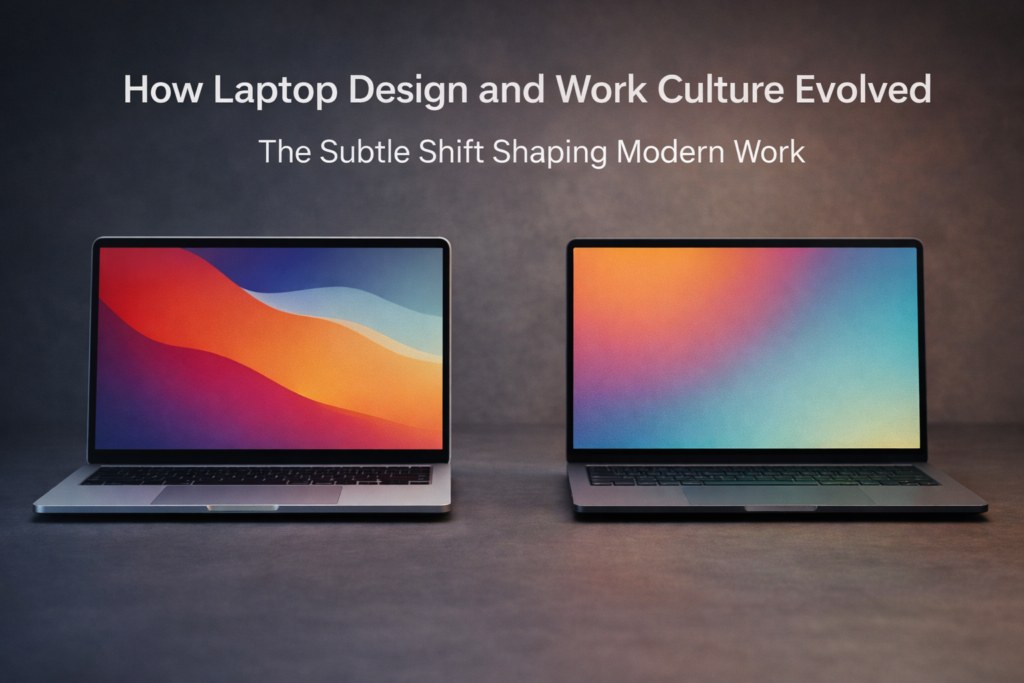
Laptops no longer signal technical ambition—they signal intent. Open one in a café, a coworking space, or a home office, and its design quietly communicates how work is done today. Thin profiles, muted finishes, silent operation, and all-day endurance aren’t aesthetic accidents. They’re cultural artifacts. Laptop design and work culture have converged because work itself has changed shape.
From Desks to Everywhere: Portability as a Cultural Demand
Work used to happen in fixed places with fixed hours. Laptops mirrored that reality: heavier machines, visible vents, aggressive performance posturing. As work dissolved into locations and schedules, portability became a social requirement, not a technical luxury.
Design followed behavior. Slim chassis, lighter materials, and compact chargers aren’t just about convenience—they acknowledge that work now lives in transit. A device that resists movement resists modern workflows. Laptop design and work culture aligned the moment work became nomadic by default.
Quiet Power and the Rise of Focus
Open offices, shared homes, and public spaces changed what “performance” feels like. Loud fans and heat spikes disrupt concentration and social norms. Today’s laptops prioritize calm operation—controlled thermals, efficient silicon, and predictable behavior.
This shift reframes competence. A machine that stays cool and quiet under pressure feels more professional than one that announces its power. Design choices—hidden vents, sealed keyboards, restrained lighting—mirror a culture that values focus over spectacle.
Minimalism as a Signal of Cognitive Load
Modern work is information-dense. Notifications, meetings, and multitasking tax attention. Laptop design responded by reducing visual noise: cleaner lines, fewer ports (sometimes controversially), uniform color palettes.
Minimalism here isn’t fashion; it’s a coping mechanism. When work demands constant context switching, devices aim to recede. Laptop design and work culture intersect where hardware tries not to compete with mental bandwidth.
A Snapshot of Design Choices That Map to Work Norms
Placed here to ground the cultural link, this snapshot shows how specific design decisions echo workplace realities:
| Design Choice | Cultural Reflection |
|---|---|
| Thin, light builds | Work happens everywhere |
| Long battery life | Schedules are fluid |
| Quiet cooling | Shared spaces are normal |
| Neutral aesthetics | Professional identity is portable |
These traits aren’t about specs. They’re about social compatibility.
The Blurring of Personal and Professional Identity
Laptops now straddle roles. The same device handles spreadsheets by day and streaming by night. Design reflects this duality—professional without being corporate, casual without being playful.
Materials and finishes aim for neutrality. Logos shrink. Colors soften. The goal is adaptability. In a culture where work and life overlap, devices must transition without friction. Laptop design and work culture merged as boundaries dissolved.
Why Performance Became Implicit, Not Explicit
Modern software workloads are bursty and cloud-assisted. Users assume responsiveness; they don’t celebrate it. As a result, performance moved from being advertised loudly to being delivered quietly.
Design supports this assumption. Fewer aggressive angles, subtler branding, and emphasis on consistency over peaks suggest confidence. The machine doesn’t need to prove itself—it needs to be dependable. That mirrors workplaces where reliability outperforms heroics.
The Contrarian Angle: Design Is Now a Form of Management
Laptop design increasingly manages user behavior. Limited port selection nudges wireless workflows. Battery-first architectures discourage desk tethering. Instant wake reinforces always-available expectations.
This isn’t neutral. It encodes assumptions about how work should flow. In optimizing for flexibility and speed, design subtly pressures availability. Laptop design and work culture don’t just reflect each other—they co-evolve, sometimes uncomfortably.
Remote Work Normalized the “Camera-First” Device
The pandemic-era shift made webcams, microphones, and speakers central. Laptops adjusted: better camera placement, improved mics, smarter audio tuning. These aren’t accessories anymore; they’re core design pillars.
This emphasis reveals a cultural truth: presence is now mediated. Design prioritizes how you appear and sound, not just what you compute. The laptop became a stage as much as a tool.
Why Homogeneity Isn’t a Failure—It’s a Signal
Critics argue that laptops all look the same. That sameness reflects convergence on shared needs. When work patterns stabilize, design narrows. Variation becomes risk.
Homogeneity signals maturity. It suggests that laptop design and work culture have agreed on fundamentals: portability, endurance, quiet competence. Innovation continues, but within boundaries defined by behavior rather than novelty.
What This Means for the Next Design Phase
Future changes will likely be subtle: better materials, smarter power management, context-aware interfaces. Radical form factors may appear, but mainstream design will remain conservative as long as work demands predictability.
The real evolution will happen where design interprets culture more sensitively—respecting downtime, supporting focus, and acknowledging limits. Devices that understand when not to intrude will feel most modern.
When Tools Mirror Values
Laptops used to chase aspiration. Now they mirror reality. They’re shaped by flexible schedules, shared spaces, and blended identities. In doing so, they document how work feels today.
Laptop design and work culture are no longer separate conversations. One is the physical expression of the other. And as work continues to redefine itself, the machines we carry will quietly record every shift.
Read the Culture Behind the Hardware
- Follow our Instagram @vibetric_official for design insights beyond aesthetics.
- Bookmark vibetric.com to track how tools evolve with work.
- Stay connected as modern culture leaves its imprint on everyday tech.
What’s your take on this?
At Vibetric, the comments go way beyond quick reactions — they’re where creators, innovators, and curious minds spark conversations that push tech’s future forward.
Performance Per Watt in 2026: The Critical Benchmark Redefining Computing
Performance Per Watt in 2026: The Critical Benchmark Redefining Computing For years, performance was measured in absolutes. Faster processors won. Higher benchmark
AI Laptops in 2026: The Intelligent Shift Toward True Workstations
AI Laptops in 2026: The Intelligent Shift Toward True Workstations For years, laptops competed on portability versus power. Thin and light for