
iPhone vs Galaxy Flagship Smartphone: The Real Truth Behind the Divide
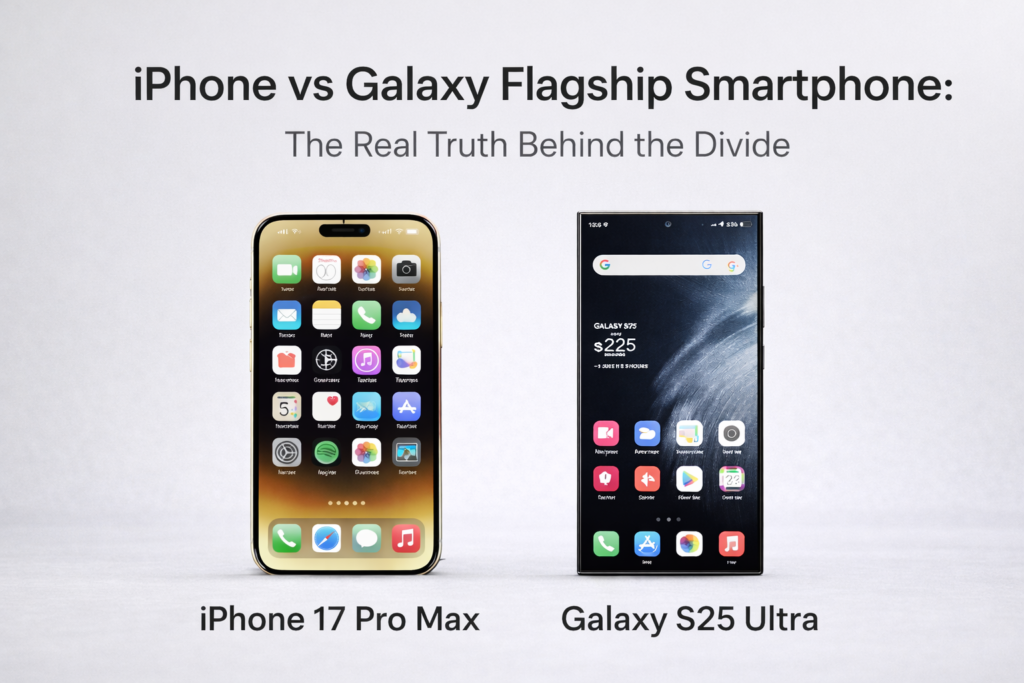
Every year, flagship phones promise progress. And every year, fewer people feel it immediately. Screens are already sharp. Cameras already good enough. Performance already invisible in daily use. Yet the iPhone 17 Pro Max vs Galaxy S25 Ultra debate has resurfaced with unusual intensity—not because one phone is “better,” but because they represent two diverging philosophies about what a flagship smartphone should become next.
At first glance, this is another iPhone vs Galaxy flagship smartphone showdown. Look closer, and it’s a referendum on control versus flexibility, refinement versus experimentation, and how much responsibility users actually want.
A familiar scene with a different kind of tension
Picture someone in a café toggling between phones on a wooden table. One feels monolithic and restrained. The other, aggressively capable—almost daring its owner to use everything it offers. Neither looks revolutionary. Both feel inevitable.
The tension isn’t about specs anymore. It’s about direction.
What everyone compares—and what they usually miss
Most conversations around iPhone 17 Pro Max vs Galaxy S25 Ultra orbit the same talking points: camera megapixels, zoom ranges, AI features, chip benchmarks. Those matter—but they obscure the deeper question.
Apple is optimizing for predictability at scale.
Samsung is optimizing for possibility at the edge.
That difference shapes everything else.
Two design philosophies that quietly dictate behavior
Apple’s incremental pressure toward “invisible tech”
The iPhone 17 Pro Max continues Apple’s long-term pattern: fewer visible changes, more internal consolidation. Refinements to materials, thermals, and camera processing don’t scream for attention—but they reduce friction.
Apple’s design logic assumes:
- Users don’t want to manage complexity
- Software should anticipate intent
- Hardware should disappear into routine
This is a phone designed to feel calm under pressure—especially for people who rely on it professionally but don’t want to think about it.
Samsung’s intentional overload
The Galaxy S25 Ultra, by contrast, leans into abundance. Hardware capabilities are exposed, configurable, and occasionally overwhelming. Advanced camera controls, stylus integration, deep multitasking, and aggressive AI tools invite exploration.
Samsung assumes:
- Power users want options, not guardrails
- Learning curves are acceptable
- Capability is its own value
This phone doesn’t vanish into your day—it demands participation.
A quick technical snapshot (what the spec sheets don’t tell you)
| Area | iPhone 17 Pro Max | Galaxy S25 Ultra |
|---|---|---|
| Performance tuning | Sustained, efficiency-first | Peak-heavy, feature-driven |
| Camera philosophy | Computational realism | Optical dominance + flexibility |
| AI integration | System-level, subtle | User-facing, configurable |
| Input methods | Touch + voice | Touch + voice + S Pen |
| Ecosystem gravity | Tight, closed-loop | Broad, device-agnostic |
This table looks neutral. In practice, it isn’t.
Cameras: realism versus reach
Apple’s pursuit of “natural correctness”
On the iPhone 17 Pro Max, photography is increasingly about trust. Colors aim to resemble memory, not drama. HDR is restrained. Video prioritizes consistency over spectacle.
Apple’s assumption: most users want to capture moments, not interpret them.
Samsung’s obsession with optionality
The Galaxy S25 Ultra continues to dominate on zoom, sensor variety, and manual control. It’s the phone you hand to someone who asks, “What else can it do?”
Samsung’s assumption: users want creative authority—even if they don’t always use it.
Result:
- iPhone photos feel immediately shareable
- Galaxy photos feel editable, malleable, and occasionally spectacular
Neither is objectively superior. They reward different personalities.
Performance isn’t about speed anymore—it’s about restraint
Both devices are absurdly fast. The difference lies in how that power is deployed.
- The iPhone 17 Pro Max prioritizes sustained performance and thermal stability. You rarely notice throttling because Apple avoids hitting extremes.
- The Galaxy S25 Ultra allows higher peaks but trusts software to manage consequences later.
In daily use, this translates to:
- Fewer performance spikes on iPhone
- More visible power on Galaxy during heavy multitasking, gaming, or creative work
This pattern mirrors the broader iPhone vs Galaxy flagship smartphone divide: consistency versus capability.
Where real users feel the difference (not reviewers)
Scenario 1: The always-on professional
Calendar, email, camera, documents—nonstop.
- iPhone feels reliable, predictable, low-maintenance
- Galaxy feels powerful but occasionally distracting
Scenario 2: The creative tinkerer
Photo editing, stylus notes, multitasking.
- Galaxy S25 Ultra feels liberating
- iPhone feels intentionally limited
Scenario 3: The long-term keeper
Three to five years of use.
- iPhone benefits from longer software cohesion
- Galaxy offers faster feature evolution—but faster abandonment of old ideas
What the data trends quietly suggest
Across the audio industry, three patterns are emerging:
- Increased investment in on-device machine learning for audio tasks
- Greater emphasis on personalization over universal tuning
- A shift from maximum cancellation metrics to comfort and clarity scores
None of these trends require radical hardware breakthroughs. They require better software philosophy. That’s why next gen active noise cancellation will feel like a software revolution disguised as an audio upgrade.
The human cost of “choice”
There’s an unspoken psychological layer in the iPhone 17 Pro Max vs Galaxy S25 Ultra debate.
- More features increase cognitive load
- Fewer options reduce anxiety—but also reduce agency
iPhone users often feel relief.
Galaxy users often feel empowerment.
The right choice depends on which emotion you value more.
Who should buy which phone (without marketing nonsense)
Everyday users
iPhone 17 Pro Max
Less configuration. Fewer decisions. More calm.
Creators & professionals
Galaxy S25 Ultra
Tools matter. Control matters. Flexibility matters.
Gamers & enthusiasts
Galaxy S25 Ultra
Peak performance, multitasking, customization.
Future-proof buyers
iPhone 17 Pro Max
Ecosystem stability and long-term software cohesion.
Pros & Cons at a glance
| Phone | Strengths | Trade-offs |
|---|---|---|
| iPhone 17 Pro Max | Reliability, video, ecosystem | Limited customization |
| Galaxy S25 Ultra | Power, flexibility, creativity | Complexity, learning curve |
When this advice breaks down
If you already live inside Apple’s ecosystem, switching rarely makes sense—no matter how impressive Samsung’s hardware becomes. Likewise, if you rely on Android workflows, the iPhone’s elegance may feel restrictive rather than freeing.
This comparison only matters for new or flexible buyers.
What real users already complain about
Scanning community discussions reveals consistent pain points that next-gen systems are clearly targeting:
| Topic | iPhone Bias | Galaxy Bias |
|---|---|---|
| Camera realism | “More natural” | “Too flat” |
| Zoom & versatility | “Overkill” | “Essential” |
| Customization | “Unnecessary” | “Freedom” |
| Ecosystem | “Seamless” | “Restrictive” |
| Longevity | “Ages better” | “Innovates faster” |
| Learning curve | “Just works” | “Worth the effort” |
| Value perception | “Overpriced but stable” | “Expensive but capable” |
The arguments repeat because the priorities don’t change.
Where flagship phones are actually heading
The iPhone vs Galaxy flagship smartphone rivalry is no longer about winning specs. It’s about defining how much control users should have in an AI-assisted future.
- Apple will continue hiding complexity behind polish
- Samsung will continue exposing capability—then refining it
The gap isn’t closing. It’s widening.
Returning to that café table
One phone disappears into routine. The other invites experimentation. Neither is wrong. But they are not interchangeable.
The iPhone 17 Pro Max vs Galaxy S25 Ultra debate isn’t about which phone is better. It’s about which philosophy you want shaping your daily decisions.
Vibetric Ending
Technology doesn’t just solve problems—it shapes behavior. The best flagship isn’t the most powerful one. It’s the one that aligns with how you think, work, and live.
Which One Is Right for You: iPhone 17 Pro Max or Galaxy S25 Ultra?
- Follow vibetric_official on Instagram to keep up with the latest trends and insights into flagship smartphones.
- Bookmark Vibetric.com we continuously update our analysis as new developments emerge in the smartphone industry.
- Subscribe for updates and receive ongoing, in-depth breakdowns and expert opinions on premium mobile technology.
FAQ: iPhone 17 Pro Max vs Galaxy S25 Ultra
It depends. iPhone excels in video and consistency; Galaxy excels in zoom and manual control.
It can be, especially if you don’t plan to use its advanced features.
Historically, iPhones maintain software cohesion longer; Galaxy phones evolve faster but change direction more often.
Only in extreme workloads. Everyday tasks feel identical.
Galaxy S25 Ultra offers more tools; iPhone offers more predictability.
Yes. It often matters more than hardware.
Only if your current phone feels limiting—not just old.
Galaxy for multitasking and stylus work; iPhone for focused, distraction-free use.
For some users, yes. For others, it’s essential.
Philosophy: control versus calm.
What’s your take on this?
At Vibetric, the comments go way beyond quick reactions — they’re where creators, innovators, and curious minds spark conversations that push tech’s future forward.
OnePlus 15 Review 2026: Intelligent Performance in the AI Era
OnePlus 15 Review 2026: Intelligent Performance in the AI Era Performance used to be theatrical. Manufacturers showcased peak clock speeds, explosive benchmark
AI Intelligence Race in 2026: The Real Battle Beyond Speed
AI Intelligence Race in 2026: The Real Battle Beyond Speed For years, consumer technology sold us speed. Every keynote celebrated higher clock