
IoT Adoption in Everyday Life 2026 — The Hidden Problem Finally Solved
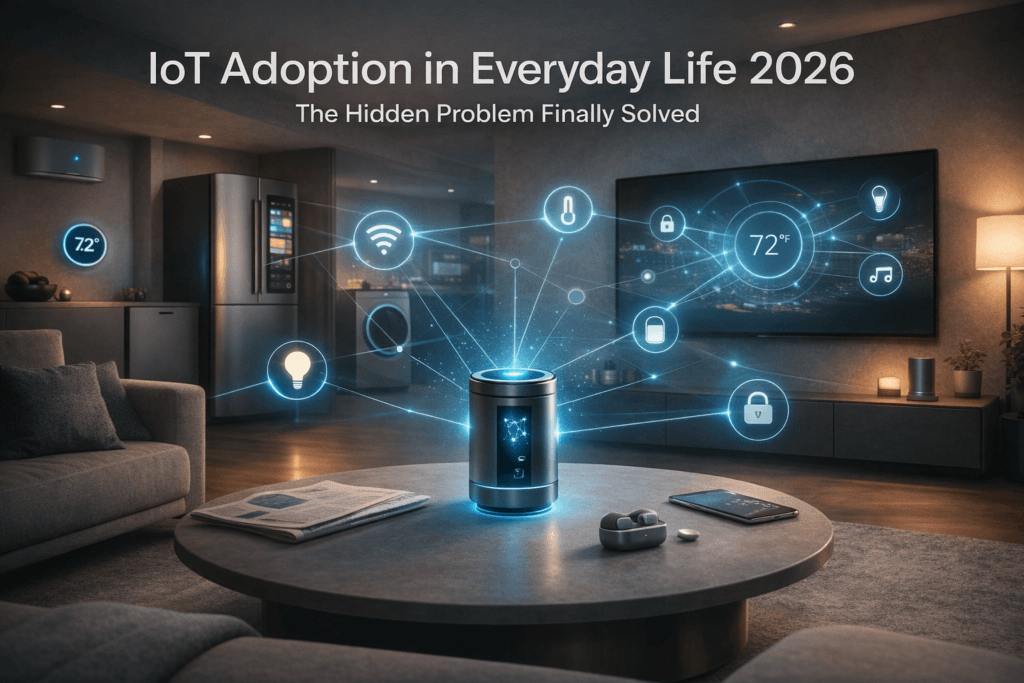
For years, the Internet of Things lived in demos and keynote slides—smart fridges nobody needed, dashboards nobody checked. Homes were “connected,” cities were “instrumented,” and businesses were “data-driven,” yet daily life felt mostly the same. The gap wasn’t imagination. It was friction. In 2026, that friction finally collapses. Not with a single breakthrough, but with a quiet convergence that turns IoT from optional tech into background reality—and once it fades into the background, everything changes.
The Moment You Notice Things Just… Working
It doesn’t arrive with a product launch. It shows up when your building adjusts airflow before a meeting starts, when a delivery reroutes itself because a loading dock is already full, when your energy bill drops without a settings menu ever opening. The shift in IoT adoption in everyday life 2026 isn’t about novelty—it’s about invisibility. Sensors, networks, and automation stop asking for attention and start earning trust.
That trust is the real unlock.
Everyone Talked About Smart Devices—The Real Change Was the Plumbing
For a decade, the conversation focused on endpoints: smart locks, trackers, wearables. The real blockers were underneath.
- Connectivity was fragmented.
- Edge processing was underpowered.
- Security was bolted on, not designed in.
- Integration costs dwarfed hardware costs.
In 2026, those constraints ease simultaneously. Not perfectly—but enough.
Low-power wide-area networks mature. Edge AI becomes efficient rather than flashy. Device identity and zero-trust models stop being enterprise-only concepts. Cloud-to-edge orchestration tools become boring—and boring is good. This is why IoT adoption in everyday life 2026 accelerates without fanfare: the hard parts finally fade from view.
Why “Always-On” Finally Becomes Acceptable
The biggest misconception around IoT was that people resisted it out of fear. In reality, they resisted inconvenience.
Earlier systems demanded configuration, updates, and constant babysitting. Today’s deployments are built around failure tolerance rather than uptime perfection. Devices assume patchy connectivity. Systems degrade gracefully. Data syncs opportunistically. That design philosophy matters more than raw performance.
A quiet rule emerges:
If a system needs a manual override more than once a month, it failed.
This is the standard that pushes IoT adoption in everyday life 2026 past the tipping point.
The Infrastructure Stack That Made 2026 Possible
A quick snapshot of what actually changed:
| Layer | What’s Different Now | Why It Matters |
|---|---|---|
| Sensors | Cheaper, more accurate, longer-lived | Deployment at scale becomes viable |
| Edge Compute | Purpose-built inference, not general CPUs | Faster decisions, lower latency |
| Networks | Hybrid LPWAN + 5G/6G fallback | Coverage without power drain |
| Security | Hardware-rooted identity | Trust without constant authentication |
| Orchestration | Policy-based automation | Fewer dashboards, more outcomes |
None of these alone create a revolution. Together, they make IoT boring enough to be everywhere.
Where It Shows Up First (Even If You Don’t Call It IoT)
Homes That Optimize Without Asking
Thermostats stop reacting and start predicting. Appliances negotiate power usage with the grid in real time. Not “smart home” theatrics—just systems shaving waste automatically. This is IoT adoption in everyday life 2026 at its most subtle.
Workplaces That Remove Micro-Friction
Room booking systems know when meetings end early. Lighting adjusts to occupancy patterns, not schedules. Maintenance happens before failure because vibration data says so, not because a calendar reminder fires.
Cities That Intervene Quietly
Traffic signals adapt to pedestrian density. Water systems detect leaks at the block level. Public infrastructure stops being reactive. Citizens don’t notice the sensors—they notice fewer problems.
The Data Shift: From “More” to “Enough”
Early IoT chased volume. Collect everything, analyze later. That model collapsed under its own cost.
In 2026, the winning systems ask a different question: What’s the minimum data needed to act? Edge inference filters noise. Only decisions—or exceptions—travel upstream. Storage shrinks. Privacy improves. Latency disappears.
This restraint is why IoT adoption in everyday life 2026 doesn’t trigger backlash. People aren’t overwhelmed with dashboards or alerts. Most never see the data at all.
Myth vs Reality: What IoT Actually Looks Like Now
| Myth | Reality |
|---|---|
| IoT means constant surveillance | Most data never leaves the device |
| It’s all about smart homes | The biggest gains are in shared spaces |
| More devices = more complexity | Modern systems reduce human touchpoints |
| Security is the weak link | Identity is now the strongest layer |
The Human Impact Nobody Marketed
The biggest benefit isn’t efficiency—it’s cognitive relief.
When environments adapt automatically, people stop managing them. Fewer settings. Fewer reminders. Fewer “did I remember to…?” moments. That reduction in mental load is why IoT adoption in everyday life 2026 feels different from previous waves of automation.
Creativity benefits. Focus improves. Stress drops—not because life is simpler, but because fewer decisions are forced on us.
A Simple Feedback Loop That Changed Everything
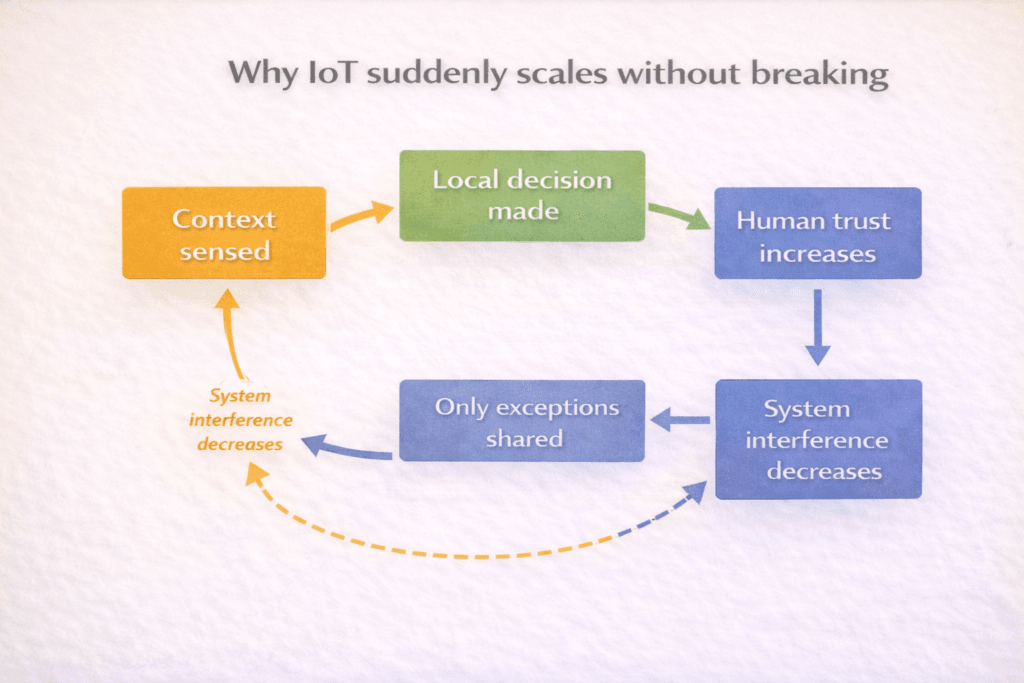
The less a system interrupts, the more it’s allowed to exist. That loop didn’t hold in earlier years. In 2026, it does.
When the Promise Still Falls Apart
This isn’t universal.
- Legacy buildings without retrofit budgets lag behind.
- Highly regulated environments move cautiously.
- One-off consumer gadgets still overpromise and underdeliver.
In these cases, IoT remains visible—and visibility often feels like failure. The lesson is clear: IoT adoption in everyday life 2026 favors systems thinking over product thinking.
What Real Users Are Saying (Unfiltered)
| User Context | Sentiment | Why |
|---|---|---|
| Office managers | Positive | Fewer complaints, fewer tickets |
| Home renters | Neutral | Benefits without ownership complexity |
| IT admins | Cautiously optimistic | Less firefighting, more policy control |
| Privacy advocates | Mixed | Improved design, uneven transparency |
| Small businesses | Positive | Predictable costs, measurable gains |
| Consumers | Indifferent (good sign) | “It just works” |
Indifference is the win. Excitement fades; reliability scales.
The 2027–2029 Trajectory (No Hype)
Looking ahead, the next phase isn’t about more devices—it’s about interoperable intent. Systems negotiating with systems. Buildings coordinating with grids. Logistics adapting to weather, labor, and demand in real time.
The groundwork laid by IoT adoption in everyday life 2026 makes that possible without another reinvention cycle.
The Quiet Ending We Didn’t Expect
Back at the beginning, IoT wanted to be seen. In 2026, it finally disappears. Not because it failed—but because it succeeded. When technology stops asking for attention and starts shaping outcomes, it stops being a buzzword. It becomes part of the environment, like electricity or plumbing. Invisible. Essential. Done right.
Vibetric Ending
The real milestone isn’t adoption curves or device counts. It’s the moment you stop noticing the system at all. That’s when technology graduates from product to infrastructure—and 2026 is when IoT earns that promotion.
What’s Next for Connected Living? Stay Ahead of the Curve
- Follow vibetric_official on Instagram to keep up with the latest trends and insights into connected technology and digital infrastructure.
- Bookmark Vibetric.com we continuously update our analysis as new developments emerge in IoT and automation.
- Subscribe for updates and receive ongoing, in-depth breakdowns and expert opinions on the future of everyday technology.
Questions People Actually Ask Once IoT Becomes Invisible
Because multiple constraints ease at the same time. Connectivity reliability, edge intelligence, security design, and deployment economics all cross minimum viable thresholds together. Previous waves improved one or two layers; 2026 is when the full stack becomes dependable enough for daily reliance.
Institutions lead the adoption curve, especially offices, logistics hubs, and public infrastructure. Consumers experience the benefits indirectly—through smoother services, lower friction, and more responsive environments—often without realizing IoT is involved.
Not in the way early systems did. Modern deployments prioritize local processing, sharing outcomes rather than raw data. This architectural shift reduces data exhaust and makes large-scale surveillance harder, not easier, when implemented correctly.
Homes are fragmented, owner-managed, and budget-constrained. Shared environments—offices, buildings, cities—benefit more from automation because small efficiency gains compound across many users and operate continuously.
Edge inference efficiency and hardware-rooted identity mattered most. They reduced latency, improved resilience, and made security intrinsic instead of optional. Without these, scale would still be impractical.
Some are, particularly where retrofit costs outweigh short-term savings. However, modular sensor systems and battery-efficient networks are narrowing that gap, allowing partial upgrades that still deliver meaningful gains.
Upfront costs remain, but the cost curve has shifted toward predictability. Maintenance, energy optimization, and reduced downtime now provide measurable operational returns that weren’t reliable in earlier generations.
No—and that’s a sign of maturity. The most successful systems remove the need for dashboards, configuration, or ongoing attention. If users forget the technology is there, it’s doing its job.
That success comes from collecting more data. In reality, the best systems collect less, decide faster, and escalate only when something truly deviates from normal behavior.
The next phase is coordination, not connectivity. Systems will increasingly negotiate with each other—buildings with grids, logistics with weather, infrastructure with demand—without human mediation.
What’s your take on this?
At Vibetric, the comments go way beyond quick reactions — they’re where creators, innovators, and curious minds spark conversations that push tech’s future forward.