
The Laptop Revolution — How Work, Study, and Gaming Are Blending Together
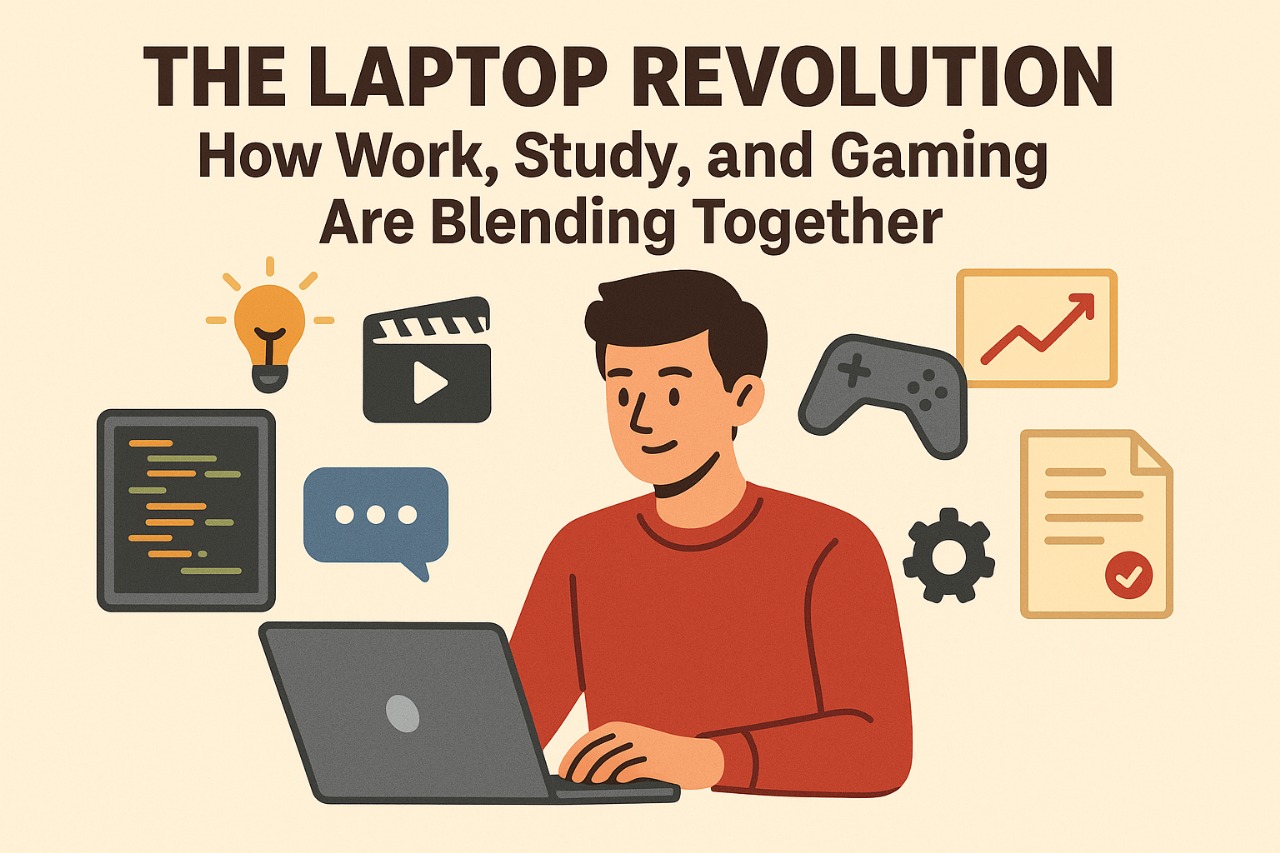
You don’t really notice the shift until you’re living inside it. A student sits in a dim hostel room at 1:47 AM, a half-written assignment glowing on the screen, and a Discord ping cuts through the silence like an invitation to escape the monotony. The laptop is warm beneath their wrists, not because it’s struggling, but because it’s trying to be two incompatible things at once — a disciplined academic companion and an unapologetic gaming machine. In another city, a working professional closes a spreadsheet at 6:59 PM, waits two seconds, then launches a demanding title to decompress. The same device that had spent hours crunching pivot tables now has to hold its own against GPU-heavy chaos. Both people are living the same paradox: they don’t want two machines anymore. They want one device that respects every version of them — the focused worker, the stressed student, the late-night gamer, the human caught between discipline and desire. That tension is where the story of hybrid laptops 2025 begins, not with specs or marketing slides, but with a quiet, personal need that refuses to split itself across multiple devices.
The revolution didn’t start as a product pitch; it started as a lifestyle contradiction. People wanted versatility without compromise, mobility without weakness, and performance without guilt. The laptop had to evolve into a psychological bridge, supporting both productivity and pleasure without collapsing under either identity.
What makes this moment compelling is that the laptop is no longer defined by its tasks — it’s defined by its owner’s shifting emotional states. A device that begins its day in a lecture hall or office cubicle now has to navigate an entirely different rhythm by nightfall. It must throttle, adapt, cool, accelerate, and interpret intention with a subtle intelligence that earlier machines simply didn’t possess. This evolution didn’t come from a sudden engineering breakthrough; it emerged from observing how people actually live. Users aren’t static. They’re not “students” or “gamers” or “professionals.” They’re fragmented identities trying to function within a 24-hour cycle of obligations, impulses, deadlines, and digital escapes. And so the hardware had to develop a kind of dual personality — efficient enough to last all day, powerful enough to deliver real immersion, balanced enough to switch contexts without a thermal tantrum. The companies who understood this shift first weren’t the ones who bragged the loudest about performance. They were the ones who quietly redesigned the thermal envelope, adjusted silicon behavior curves, and rebuilt the chassis philosophy to accommodate a life lived between tabs, tasks, and battles. That’s where the real revolution took root.
The modern machine isn’t just a tool; it’s a companion for fragmented ambition. And for the first time, manufacturers are designing laptops around the rhythm of real human life, not idealized productivity charts. The hybrid era is less about performance alone and more about emotional and functional adaptability.
⚙️ Evolution with Intention
The evolution of hybrid machines didn’t happen because the industry wanted to merge categories; it happened because users began rejecting the idea of owning multiple devices for overlapping needs. GPU power stopped being exclusive to bulky gaming rigs the moment people demanded lightweight machines that could switch from productivity to play without apologizing. What actually changed wasn’t just silicon efficiency — it was the philosophy behind why components were arranged the way they were. Engineers had to rethink airflow, abandon old assumptions about weight distribution, and consider battery behavior under mixed loads rather than isolated benchmarks. This wasn’t evolution for the sake of progress; it was evolution for the sake of relevance. Hybrid laptops 2025 became the response to a culture where a single device now carries academic futures, career ambitions, creative side-hustles, and late-night competitive instincts. The contradictions forced innovation: thin machines needed structural reinforcement, mid-range CPUs demanded better thermal guidance, and integrated graphics weren’t enough for people who wanted silence in class and power after hours. This shift isn’t about when upgrades happened — it’s about why the industry finally listened to how people were living.
The laptop didn’t evolve to be impressive. It evolved to be useful. And usefulness in 2025 means adapting to every version of the user, not a single predefined profile.
Table — Evolutionary Leaps & What They Actually Solved
| Evolution Shift | Real Problem Solved |
|---|---|
| Efficient mobile GPUs | Let users game without carrying a brick |
| Advanced vapour chambers | Stopped thin laptops from thermal throttling |
| Smarter power curves | Extended battery life during study/work |
| High-refresh displays | Made one device feel responsive for both tasks and gaming |
| Mixed-mode silicon tuning | Enabled real-time switching between productivity and performance |
🏗️ Industry Web Breakdown
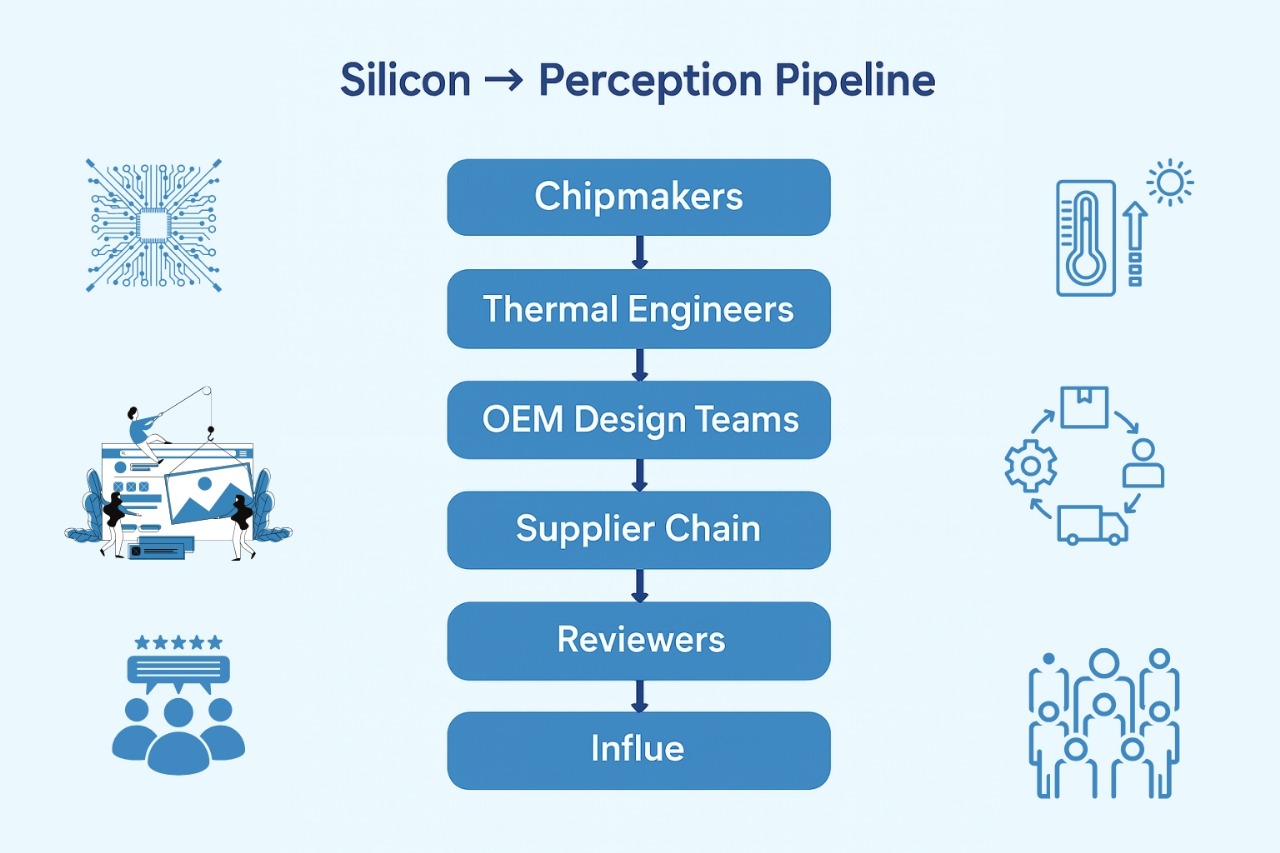
The hybrid landscape didn’t appear magically — it emerged from a complex negotiation between chipmakers, OEMs, suppliers, reviewers, and the psychological gravity of the gaming community. Chipmakers like Intel, AMD, and Qualcomm saw an opportunity in the rising demand for devices that could stretch beyond rigid categories. OEMs followed, but not out of creativity — out of necessity. The supplier chain adjusted to new thermal modules, custom hinges, higher-quality display panels, and more efficient MOSFET layouts. Meanwhile, influencer ecosystems created an unusual pressure: a laptop had to look thin enough to appear “premium,” powerful enough to earn credibility among gamers, and efficient enough to satisfy students and professionals. Reviewers unintentionally shaped design decisions by obsessing over synthetic benchmarks, pushing brands to prioritize peak numbers even when users needed sustained performance instead. And through it all, marketing teams attempted to simplify a deeply complicated engineering story into three-word slogans like “work hard, play harder.” But the real engine behind the shift was the user community — the millions of people who wanted one device that didn’t make them choose.
The hybrid market is a tug-of-war between truth and perception. Chipmakers define physics, OEMs define form, influencers define hype, and users define reality.
🔬 Engineering Core (Physics of Decisions)
In hybrid machines, every component exists because of a negotiation with physics. A CPU isn’t chosen because it’s “fast,” but because it can sustain performance inside a constrained thermal envelope where work-mode and game-mode demand different power curves. A GPU isn’t placed near the bottom corner of the chassis by accident — it’s positioned there because moving it even two centimetres alters airflow resistance, fan turbulence patterns, and keyboard surface temperature by measurable margins. Thin laptops complicate the story further. A vapour chamber built for gaming loads behaves unpredictably when a user is switching constantly between suppressed academic workflows and sudden bursts of high FPS demand. That’s why engineers design silicon boost windows, not constant performance profiles — the laptop must interpret intention through electrical signatures. Even display decisions are governed by physics: a 144Hz panel has a different power draw slope than a 60Hz one, and hybrid laptops 2025 rely on adaptive refresh to avoid burning battery during classes while still looking responsive during gameplay. Nothing here is aesthetic. Every millimetre, every vent, every watt is grounded in constraints, compromises, and controlled chaos that users never see but constantly feel.
Hybrid engineering is less about maximizing performance and more about preventing collapse. The real victory is sustaining capability across unpredictable usage patterns without throttling, overheating, or draining the battery before the day ends.
Trade-Off Table — The Real Compromises in Hybrid Laptop Engineering
| Engineering Choice | What It Improves | What It Compromises |
|---|---|---|
| Larger vapour chamber | Sustained gaming performance | Higher weight & internal space cost |
| Adaptive GPU power | Better battery during work | Slightly slower initial frame spikes |
| Thin chassis | Portability | Limited thermal headroom |
| High-refresh screens | Smooth gaming & UI | Increased battery drain |
| Mixed-mode silicon curves | Balanced identity | Requires complex tuning & QA |
🧠 Human Psychology of Tech
What engineers build is only half the story; the other half is what users believe they feel. Human perception has its own physics, and it doesn’t always align with measurable data. A laptop can technically deliver stable performance, but if frame pacing is uneven by even a few milliseconds, the user interprets it as stutter. Brightness perception isn’t linear either — a jump from 300 to 500 nits feels dramatic, while 500 to 700 nits feels subtle despite equal numerical spacing. The psychology of hybrid laptops 2025 becomes even more complex because users flip between mindsets. During work or study, they value silence, cool touchpoints, and predictable behavior. But in gaming mode, they subconsciously accept fan noise if it aligns with a sense of power. The same person who complains about slight warmth during a lecture won’t mind the identical temperature during a gaming session because the emotional framing changes. Latency maps to trust, brightness maps to comfort, and consistent frame pacing maps to immersion. Engineers have learned that the real challenge isn’t hitting peak performance; it’s hitting the right emotional frequency at the right moment.
The best hybrid machines don’t merely perform well — they feel right. They anticipate emotional context, not just task load, shaping user perception through sensory cues that rarely show up on spec sheets.
Emotion-to-Perception Impact Table
| Emotional State | Hardware Behavior Interpreted As… | User Perception |
|---|---|---|
| Focused | Silent fans, low heat | “Reliable” |
| Stressed | Sudden frame drop | “Weak” |
| Relaxed | Smooth motion | “Premium” |
| Competitive | High fan noise | “Powerful” |
| Fatigued | Dim low-power screen | “Comfortable” |
🧩 Material & Form Philosophy
Materials carry meaning long before they carry components. The moment a user touches a laptop, their brain forms an expectation about capability. Cold metal signals strength and endurance, even when internal specs are mid-range. A soft-touch polymer communicates comfort but subconsciously hints at fragility. Hybrid machines require more nuance — they must feel sturdy enough for performance while light enough for mobility. Weight distribution becomes psychological engineering: a laptop that is light at the back but heavy at the front feels unbalanced, even if the total weight is identical. Hinges define perceived longevity. Flex around the keyboard creates doubt that no benchmark can erase. Even the sound of the lid opening contributes to trust; too soft feels cheap, too stiff feels forced. Hybrid laptops 2025 rely on structural materials not simply for durability but to communicate intent — “This machine can handle your workday and your games without complaint.” This is why OEMs invest more in chassis rigidity than ever before. Users don’t articulate this, but they live it every day.
The right materials reassure the user that switching roles — student, worker, gamer — won’t push the device beyond its limits. Physical confidence becomes emotional permission.
Premium vs Mid-Range Material Table
| Category | Premium Hybrid Devices | Mid-Range Hybrid Devices |
|---|---|---|
| Chassis | CNC aluminium, magnesium alloy | Plastic blends with reinforcement |
| Hinges | Metal torque-controlled | Standard dual-rail |
| Touchpoints | Glass trackpad, firm deck | Polycarbonate surfaces |
| Cooling Frame | Copper + vapor chamber | Heatpipe-only layouts |
🤖 Intelligence Layer (AI + Adaptation)
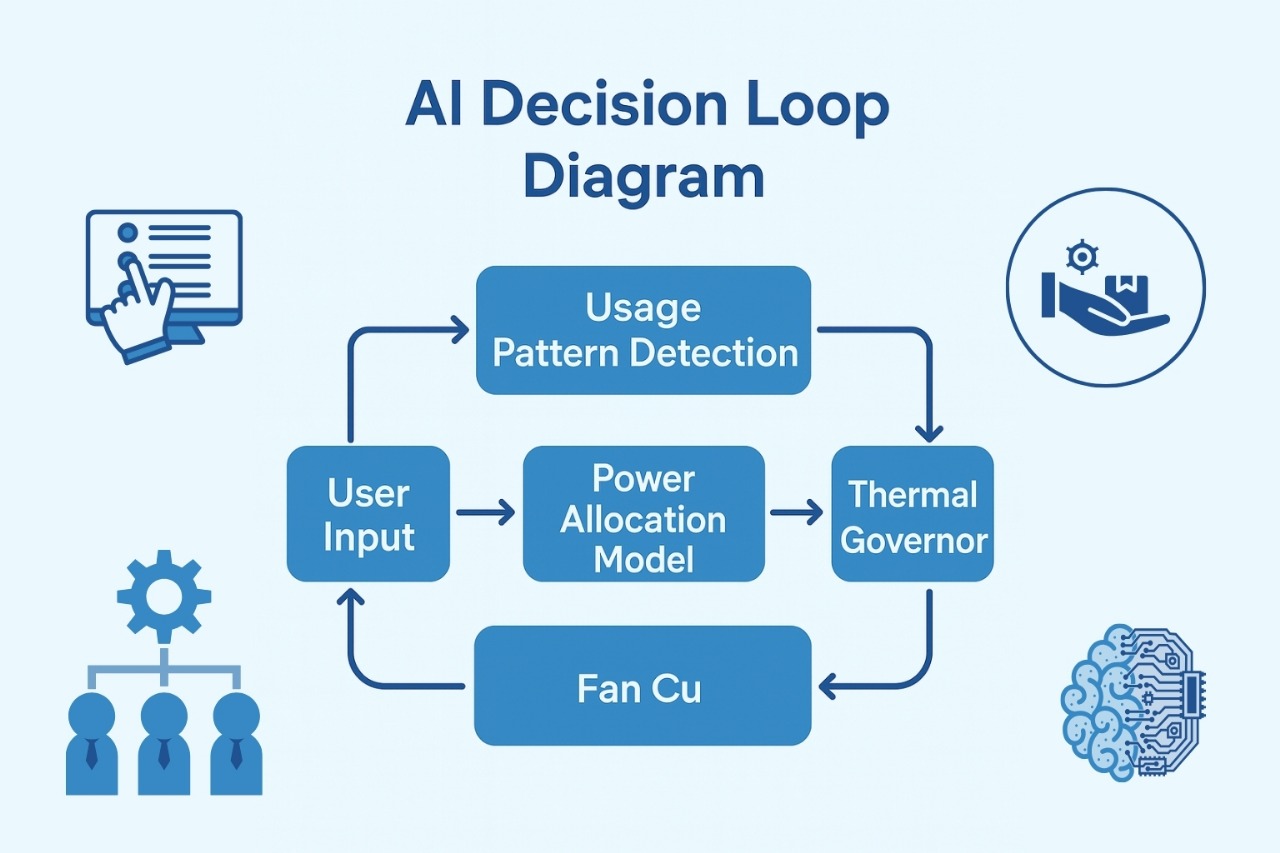
The intelligence layer is the invisible backbone of hybrid identity. Modern machines must interpret user intent without being explicitly told. AI-driven thermal models predict whether a workload is transient or sustained and adjust wattage accordingly. Adaptive brightness doesn’t just respond to ambient light; it tries to maintain cognitive comfort during long study sessions. GPU allocation shifts depending on whether the user is browsing PDFs or entering a competitive match. Fan curves now use machine learning to reduce unnecessary micro-boosts that would annoy users during work but are allowed during gaming sessions. Even audio pipelines apply adaptive EQ to filter distracting frequencies during productivity, then widen dynamic range during recreation. Hybrid laptops 2025 rely heavily on this intelligence layer because raw specs alone cannot navigate the emotional and practical duality user’s demand. But AI is imperfect. Sometimes it misreads intention — limiting performance during a game because the system assumes productivity mode, or over-boosting during a simple task because it misinterprets a transient spike. These errors reveal how much complexity humans unconsciously offload onto machines.
The intelligence layer doesn’t need to be flawless; it just needs to be predictable. When the machine understands context, it feels like a partner. When it misjudges, it breaks the illusion.
🏛️ Brand Philosophy & Strategy
Every brand building hybrid machines today is fighting a different internal war. Some approach the category like a squeezed version of their gaming portfolio, hoping users interpret raw performance as versatility. Others stretch professional DNA into a realm they barely understand, adding a GPU as if it were an accessory rather than a commitment. The truth is that hybrid laptops don’t emerge from marketing language — they emerge from a company’s worldview. A brand that values stability builds conservative thermal thresholds; a brand that values excitement builds aggressive performance bursts. These philosophies shape the user experience far more than spec lists admit. Students and professionals’ sense this intuitively. They don’t describe it in engineering terms, but they feel when a device is meant for real duality versus when it’s simply wearing a dual-purpose badge. Some companies obsess over display tuning because they know hybrid users switch between Excel sheets and fast-action games; others invest in hinge durability because hybrid buyers open their lids hundreds of times a day. A brand’s strategy reveals itself in the invisible decisions — the compromises hidden beneath the keyboard deck. In 2025, the companies that thrive aren’t the ones shouting the loudest; they’re the ones whose internal philosophies quietly align with the hybrid lifestyle without needing to sell the idea.
Hybrid isn’t a feature. It’s a belief system. The brands that understand this build machines that feel coherent, not conflicted.
Strategy Matrix Table
| Brand Approach | What Users Experience | Strength | Weakness |
|---|---|---|---|
| Gaming-first | High peak FPS | Strong performance | Shorter battery life |
| Productivity-first | Silence & efficiency | Great work feel | Limited gaming bursts |
| Balance-first | Adaptive identity | Consistency | Harder to market |
| Design-first | Premium tactile feel | Trust-building | Costlier to produce |
🔍 Case Studies of Truth
Hybrid machines live or die based on how they handle real-life contradictions. Consider a laptop that launches with a massive cooling system and an aggressive GPU curve. In benchmarks, it becomes a hero. But in classrooms or office environments, the same curve produces fans that spin up at the slightest hint of activity, making the machine socially intrusive. Users end up disabling performance modes entirely, effectively crippling the device. That’s a failure born not from performance, but from misunderstanding context. Contrast that with a success story: a laptop that uses a restrained profile during work but instantly ramps GPU power the moment a full-screen game launches. The user perceives it as “smart,” even though the intelligence is simple rule-based logic. Then there’s the controversial middle ground: a device with excellent cooling but inconsistent power policies, giving users great performance one day and unpredictable thermal drops the next. This unpredictability frustrates hybrid buyers because their life depends on reliability more than extremes. These three machines show one truth: hybrid success isn’t about hitting the highest number; it’s about hitting the right number at the right time.
Hybrid buyers forgive limits, but they do not forgive inconsistency. Predictability becomes value.
Outcome vs Expectation Table
| Case | Expectation | Outcome | Verdict |
|---|---|---|---|
| High-performance gaming-first laptop | Dual identity | Too loud for work | Failure |
| Balanced adaptive laptop | Smart mode switching | Sustained versatility | Success |
| Strong hardware, weak tuning | Stable power | Variability ruins trust | Controversial |
🌏 Culture, Identity & Adoption
Culture shapes how hybrid laptops 2025 are interpreted. In student-heavy regions, weight matters more than sustained wattage — a machine that survives a long commute or a campus day feels more “premium” than one that delivers peak performance. In corporate cultures, silence is synonymous with professionalism, so a laptop that manages heat without noise earns more trust than one with a higher GPU score. Gaming cultures vary globally too. In markets where competition gaming thrives, users prefer aggressive performance bursts; in casual gaming cultures, battery life and comfort rank higher. Hybrid adoption isn’t just about specs — it’s about identity. Students often identify with versatility because they live between multiple emotional roles daily. Professionals identify with reliability because doubt disrupts workflow and reputation. These cultural and emotional currents determine whether a hybrid laptop feels like a compromise or an advantage. A machine that fits the rhythm of one region may feel mismatched in another, not because of technical flaws but because of social expectations layered over daily habits.
Hybrid devices succeed when they align with the cultural rhythm of their users — not when they chase a universal standard.
Global Culture Comparison Table
| Region | Priority | Interpretation of Value |
|---|---|---|
| Asia | Portability + battery | “All-day flexibility” |
| North America | Performance spikes | “Capability under pressure” |
| Europe | Silence + efficiency | “Professional integrity” |
| Middle East | Premium materials | “Status + reliability” |
💬Reddit Reality
Here are real Reddit posts about hybrid laptops, plus sentiment analysis and insight into how real users experience the contradictions.
| Theme | Quotes |
|---|---|
| Convertible vs Performance Trade-offs | > “I own an Envy x360 … battery life dropped from 100% to 20% in exactly 60 minutes … No laptop is gonna last more than a few hours on battery when gaming.” Reddit > “I want a thin and light convertible laptop with stylus and OLED … can handle casual AAA gaming and AI tasks too.” Reddit |
| Hybrid-gaming laptops advice | > “Recommend a hybrid-gaming laptop … good cooling during video-calls & gaming.” Reddit |
| Dual-screen and creative-use compromises | > “Zenbook Duo … can handle light games like Sims, Fortnite and Valorant … but battery life is only average … design is heavier.” Reddit |
| Size and screen-type frustration | > “Not one manufacturer … makes a 17″ or 18″ OLED gaming laptop … only 14″ or 16″.” Reddit |
Analysis:
On Reddit, many hybrid-laptop users are caught in the push-pull of ambition and practicality. Several own or consider 2-in-1 convertibles like the HP Envy x360 or Yoga series, but their gaming expectations clash with real-world battery performance. One user’s frustration is visceral: “battery life dropped … from 100% to 20% in exactly 60 minutes” during gaming. Reddit These underscores how hybrid devices — designed for both work and play — stumble when taxed by high-GPU workloads on battery.
At the same time, aspiring hybrid users — especially students — are asking for devices that straddle creative work, stylus use, and gaming. As one Redditor put it: they want a “thin and light convertible … OLED … casual AAA gaming … AI tasks,” but they also note that these features rarely come together without trade-offs. Reddit There’s a recurring anxiety around identity: should the laptop be a serious work tool, or a playful gaming machine?
Hybrid-gaming advice threads are filled with concerns over cooling and longevity. One user prioritized “effective cooling to manage heat during use” — a very reasonable ask, but one that many hybrid machines struggle to deliver without sacrificing weight or battery life. Reddit
Dual-screen machines like the Zenbook Duo get mixed praise. According to one user, it handles light gaming and productivity well, but its weight and average battery life make it less than ideal for someone seeking a “do-it-all” machine. Reddit And the absence of large OLED gaming convertibles is another sore point: users note that no OEM seems to be offering “a 17″ or 18″ OLED gaming laptop” in 2025. Reddit
Key Insights from Reddit:
- Battery vs GPU tension: Gamers on hybrid devices feel the strain of short gaming sessions on battery.
- Unrealistic wishlist: Many hybrid users want both high-end features and portability — but Reddit threads show that compromises are still unavoidable.
- Thermal anxiety: Cooling is a major concern; hybrid machines often struggle to maintain gaming-class thermals in slim or convertible form factors.
- Lack of premium hybrids: There’s a gap in OEM offerings for large, high-refresh OLED convertibles that combine performance and usability.
⭐Google Reviews Reality
For hybrid laptops in 2025, the user review reality is less about standout viral models and more about nuanced trade-offs. Below is a synthesis of insights from recent tech reviews, market data, and buying guides.
Key Review & Market Insights:
- Growing Demand in Education: The global education sector is ramping up its adoption of laptops due to blended learning models. According to a market analysis, 2-in-1 convertibles are increasingly preferred for their flexibility and cost-efficiency. middleeasteducationnetwork.com
- AI & “Hybrid Work” Trend: In India, laptop-buying guides for 2025 emphasize AI PCs with NPUs, noting that hybrid work + study models are fueling demand for devices that handle both productivity and occasional gaming. budgettechindia.com
- Convertible Laptop Highlights: Lists of best 2-in-1 laptops for 2025 — e.g. by Analytics Insight — often include models like the HP Envy x360 16″ (2-in-1), highlighting its blended appeal for both creators and professionals. Analytics Insight
- Holistic Buying Recommendations: 9meters’ 2025 2-in-1 list praises the Envy x360 variant for balancing performance and form factor. 9meters
- Consumer Satisfaction Patterns: A survey-based academic study compared user satisfaction between ASUS and HP laptops. The study found that ASUS is often favored for innovation and performance, while HP earns praise for durability and support — a dynamic very relevant to hybrid device buyers. IJRTI
Google-Style Star-Rating Sentiment Table (Synthesis Across Sources):
| Category | Sentiment / Rating Trend |
|---|---|
| Education / Student Use | High rating for flexibility, but some concerns over gaming battery life |
| Professional Use | Very positive for convertibility and build quality; less so for thick gaming demands |
| Entry Hybrid Devices | Mixed: praised for cost, but limited by weaker GPUs or integrated graphics |
| Premium 2-in-1s | Good marks for design and performance, but trade-offs in upgradability or weight |
Decoding Expectations vs Reality:
- Expectations: Buyers often assume that a 2-in-1 convertible can double as a gaming laptop.
- Reality: Real-world reviews emphasize that most hybrid laptops are optimized more for productivity and portability than for sustained high-GPU gaming.
- Tension: There is a persistent gap between the hybrid promise (one-device-for-all) and the practical limitations of form factor, thermals, and power.
🧩 Myths vs Reality
There are myths that quietly steer purchase decisions — small lies repeated so often they become comforting truths. The hybrid myth machine is particularly effective: “If it has a discrete GPU, it’s a gaming laptop,” “thin equals premium,” “convertibles can replace desktops,” and “more cores always mean better multitasking.” These phrases sell boxes, not experiences. The reality of hybrid laptops 2025 is messier and far more human: a discrete GPU bought for gaming often sits idle during lecture slides, while integrated efficiency becomes the unsung hero for a day of on-campus note-taking. Thinness wins Instagram photos but loses thermals in a 90-minute online exam with background processes and a Zoom call. Chip counts matter only when software schedules threads effectively; otherwise extra cores become unused currency. The worst deception is the “one-device-for-all” promise: buyers imagine a single purchase that will flawlessly serve intense productivity, creative workloads, and high-refresh competitive gaming. In practice, most hybrids are compromises tuned to favor one or two of those roles. Recognizing these myths is liberating — it lets a buyer choose trade-offs consciously, not out of hope or marketing convenience.
Myths reduce complexity into comforting slogans. Smart buyers translate those slogans into concrete questions about sustained clocks, thermal headroom, battery behavior under mixed loads, and repairability. That’s the practical antidote to wishful tech thinking.
Myth vs Truth Table
| Myth | Reality | Practical Check |
|---|---|---|
| “Discrete GPU = gaming laptop” | Many hybrids have throttled, low-power discrete GPUs that perform far below desktop cards | Look at sustained gaming thermals and power limits, not peak clocks |
| “Thin is premium” | Thin often sacrifices cooling and upgradability | Inspect vapor chamber size, fan RPMs, and repairability |
| “More cores = better multitasking” | Single-thread latency and scheduler behavior still matter for many apps | Check IPC/single-core boost and real-world multitask benchmarks |
| “One machine can do everything perfectly” | Most hybrids optimize for a subset of use-cases | Define your top two priorities (e.g., battery+portability, or sustained gaming+cooling) |
💰 Economics of Innovation
Behind every hybrid laptop sits an accounting story that most buyers never see. R&D budgets allocate resources to features that sell best to target demographics: display quality for creators, thinness for image-conscious students, and GPU branding for gamers. But the real pricing pressure in 2025 comes from memory pricing, supply-chain fragility, and validation complexity for mixed-mode silicon (CPUs with NPUs and discrete GPUs). Packaging multiple use-cases into one SKU raises QA costs dramatically — every combination of battery profile, driver stack, and thermal curve must be validated across use scenarios, and that multiplies validation time and expense. Manufacturers therefore use SKU stratification to recoup costs: premium “Creator + Gaming” models include better cooling and larger VRAM, mid-tier hybrids shave down warranty or use soldered RAM to keep prices accessible. Marketing then translates these engineering decisions into value stories. As a result, buyers aren’t just paying for silicon; they’re paying for the engineering, validation, and narrative that stitches a hybrid experience together. Knowing which line items drive price helps buyers stop equating sticker price with pure technical value.
Economics turn technical complexity into price tiers. If you want both great thermals and thin design, expect to pay for validation and higher-yield components. If not, you pay in compromises.
Price Formation Snapshot
| Cost Driver | Why It Raises Price | Buyer Impact |
|---|---|---|
| Memory & VRAM | High-speed, high-capacity modules are expensive | More VRAM improves longevity but adds cost |
| Thermal engineering | Vapor chambers, premium fans, custom ducts | Better sustained performance; higher BOM cost |
| Validation & QA | Mixed-mode testing across dozens of real-world scenarios | Fewer regressions; longer time-to-market (higher cost) |
| Premium materials | CNC chassis, magnesium alloys | Perceived durability & feel; higher manufacturing cost |
| Software/Driver development | Continuous tuning for hybrid modes | Better user experience; ongoing support costs |
🌿 Ethics, Privacy & Repairability
The ethics of hybrid laptops in 2025 sits in a place most companies don’t talk about — the silent intersection of ownership and dependency. When a single machine becomes your work notebook, your lecture companion, your gaming console, and your archive of personal moments, the stakes change. The device stops being a tool and becomes an extension of decision-making, memory, identity. And with that shift comes a shadow most users never see: every subsystem, every sensor, every predictive process ties you deeper into the manufacturer’s ecosystem. Hybrid laptops collect more behavioral data than traditional ones because they span more contexts — brightness maps in classrooms, performance spikes during gaming sessions, adaptive cooling responding to emotional states like stress, urgency, or distraction. None of this is framed as surveillance; it’s framed as “smart optimization.” But optimization without transparency is still a negotiation where only one side knows the rules.
Repairability is where the truth becomes less philosophical and more physical. Thinner hybrid chassis mean more glued batteries, confined thermals, and stacked component layers that only proprietary repair centers can access without destroying the device. The irony is painful: the very machines designed for versatility are often the least versatile when it comes to maintenance. Yet the blame isn’t on engineering alone. It’s a triangle — user expectations for ultra-thin machines, corporate pressure for aesthetic minimalism, and supply chain dependency that punishes modularity.
A laptop cannot be considered “hybrid” if its longevity is fragile. Durability is part of ethics.
Ethics Matrix Table
| Dimension | Brand Behavior | Hidden Reality | User Impact |
|---|---|---|---|
| Data Optimization | Adaptive AI tuning | Continuous behavioral logging | Convenience traded for invisible profiling |
| Repairability | “Authorized-only service” | Intentional glue + proprietary screws | Shorter lifespan, higher replacement cost |
| Sustainability | Marketing claims | Mixed recycling of composite materials | Users assume more eco-friendliness than exists |
| Longevity Guarantees | Extended warranties | More profitable than building repairable devices | Dependence disguised as protection |
🔮 Future Shift (2030–2040)
By 2030, hybrid laptops won’t be marketed as “hybrids” at all — the category itself dissolves into expectation. Work, study, and gaming merge into a single behavioral rhythm, and devices evolve to match that rhythm instead of being carved into traditional segments. Silicon design shifts away from monolithic CPUs and GPUs toward distributed compute clusters where NPUs, low-power GPU tiles, and efficiency cores negotiate workloads dynamically. A student editing a Premiere project at 20% brightness in a café will feel the same smooth responsiveness as a gamer running a 144 Hz competitive match — not because the hardware is overwhelmingly powerful, but because the scheduler becomes context-aware and predictive. Displays become the primary differentiator: adaptive-refresh OLEDs with 250–400 nits “study zones” and 800+ nit HDR peaks for entertainment, all tuned to reduce burn-in through intelligent per-pixel rest patterns. The future of hybrid laptops 2025 points toward a decade where battery chemistry finally catches up; silicon efficiency gains slow, while pack density quietly rises 18–25% through silicon-anode and semi-solid-state designs. The real shift isn’t performance; it’s consistency — a machine that feels the same whether plugged in, battery-sipping, multitasking, or gaming for short bursts.
Hybrid laptops evolve into adaptive platforms that understand user intent. The physical machine stays familiar; the intelligence inside changes how each component behaves. By 2040, the line between “gaming mode” and “productivity mode” blurs into a single continuous spectrum.
Forecast Table (2030–2040)
| Trend | Probability | Why It Happens |
|---|---|---|
| Context-aware workload schedulers | 85% | AI + NPU local inference |
| Semi-solid-state batteries in mainstream laptops | 70% | Increased density, better cycling |
| GPU-tile modular laptop designs | 40% | Reduces thermal bottlenecks; manufacturing cost still high |
| Universal adaptive-refresh OLED | 80% | Mass adoption + falling burn-in risk |
| Cross-platform thermal AI standards | 60% | Industry pressure for predictable performance |
🧭 OEM Decision Logic
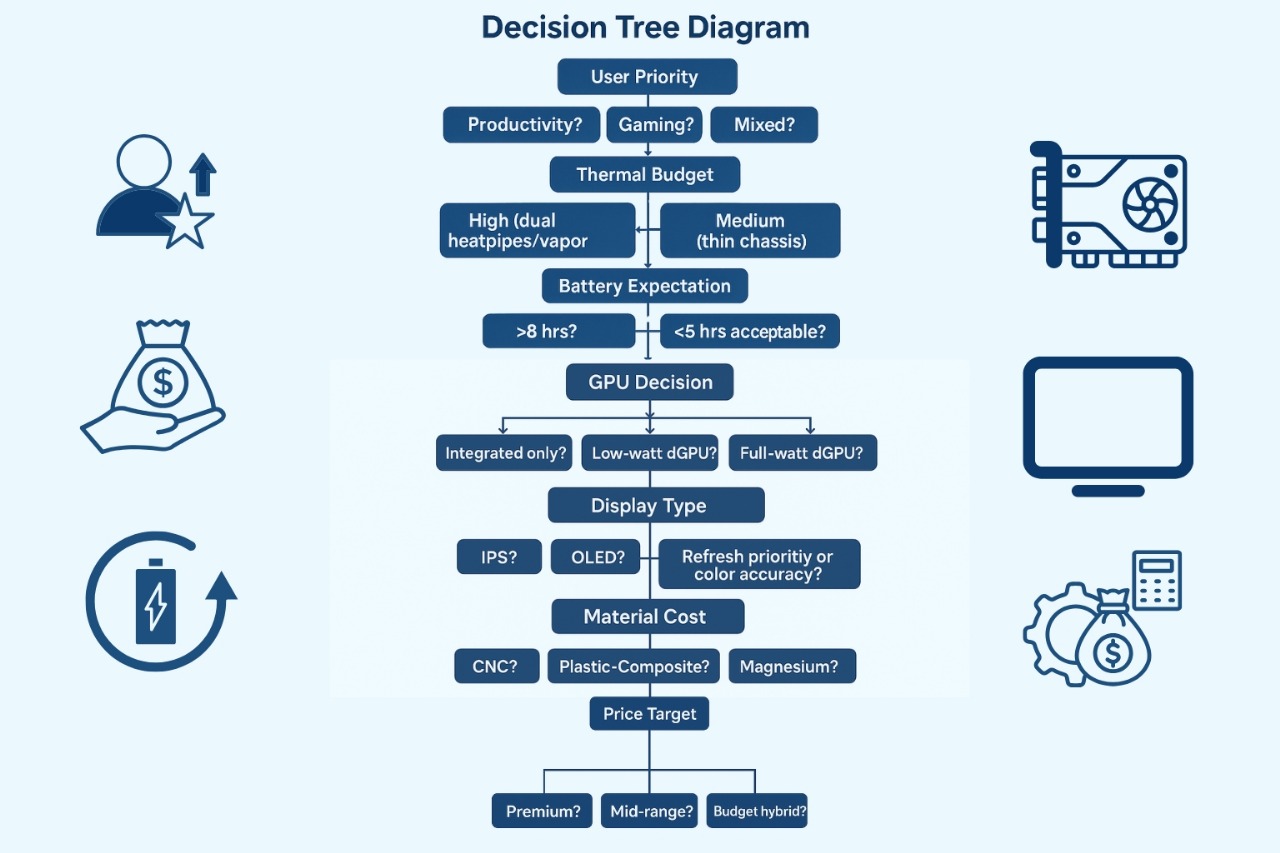
Behind every hybrid laptop is a decision tree filled with quiet arguments between engineering, finance, industrial design, and marketing. Engineering wants a thicker chassis to allow a 10–15% increase in sustained clocks; design wants it thinner because students and professionals equate thinness with modernity. Finance wants soldered RAM to cut manufacturing variability; support teams push back because users demand upgradeability. Marketing wants a discrete GPU in every model because it improves perception — even if thermal capacity can’t sustain its advertised boost clock for more than a minute. These tensions shape the machine far more than any spec sheet reveals. A laptop that appears to be “balanced” often reflects a series of compromises: a tuned fan curve here, a tighter PL1 limit there, a mid-tier panel chosen because it gives the SKU a psychological price anchor. The decision logic isn’t malicious — it’s a negotiation between human priorities and physics. When OEMs over-prioritize appearance, hybrids thermal-throttle under deadlines and competitive matches. When they over-prioritize cooling, buyers complain about weight and noise. True balance emerges only when the product team sets clear hierarchy: sustained performance → thermals → battery → design → marketing narrative. Few companies follow that order consistently.
Understanding OEM reasoning helps buyers decode which compromises were intentional and which were shortcuts. A laptop’s personality is formed long before it reaches the shelf — in meeting rooms where physics and perception collide.
⚠️ Anatomy of Failure
Hybrid laptops fail when companies misread human behavior — not when they misunderstand engineering. The biggest failure mode emerges from believing that users switch modes cleanly. In reality, people jump between tasks unpredictably: a lecture note turns into a research tab explosion, a spreadsheet session becomes a gaming break, a video render overlaps with a conference call. OEMs that optimize for isolated scenarios — “excellent battery life in productivity apps” or “great FPS when plugged in” — overlook the chaos of real usage. When engineering tunes for benchmarks instead of behavior, thermals collapse under mixed loads: two Chrome windows, Discord, a virtual machine, and a mid-level game running simultaneously. Another failure pattern comes from ignoring aging — hybrid laptops run hotter and more frequently at mid-loads, increasing dust accumulation and degrading thermal paste faster than traditional work laptops or dedicated gaming machines. The machine feels fantastic for six months, then slowly loses its edge through thermal drift. Lastly, hybrids fail when companies chase identity over consistency: marketing pushes them as creators’ machines and gaming companions, yet firmware updates arrive late, drivers regress performance, and batteries degrade due to aggressive fast-charging defaults. Failure is rarely dramatic; it’s accumulated friction.
Failures aren’t explosions — they’re gradual misalignments between promise and lived experience. Hybrids succeed only when designers anticipate messy, real-world usage rather than neat benchmark behavior.
🛒 Smart Buying Framework
Buying a hybrid laptop isn’t about chasing the highest spec — it’s about understanding what will stay consistent after two years of mixed workloads. The smartest buyers don’t start with CPU or GPU. They start with thermals because thermals determine how long your performance remains stable under study-work-gaming oscillation. A laptop that runs 10°C cooler under a 40-minute load will age better, sustain clocks longer, accumulate less dust, and push its battery through fewer aggressive charge cycles. The second principle is battery behavior under load. Many hybrid laptops 2025 market “all-day battery,” but collapse once a GPU or NPU activates. The best machines balance efficiency cores with intelligent task migration — browsing stays on low-power silicon, while rendering or casual gaming shifts to performance silicon only when necessary. The third pillar is display realism. Students and professionals often ignore this, yet your display is the component you interact with for thousands of hours. A mildly slower GPU is tolerable; a washed-out 60% sRGB panel is not. Finally, the overlooked factor: driver consistency. Hybrid laptops rely heavily on scheduler, GPU, and NPU updates. A laptop with strong long-term driver support will feel newer for far longer, outpacing raw specs.\
The right choice emerges when you define your top two priorities: portability + battery; thermals + gaming bursts; color accuracy + work reliability. Everything else flows from that clarity.
Smart Buying Checklist
| Priority | What to Check | Why It Matters |
|---|---|---|
| Thermals | Sustained wattage, fan noise, heatpipe/vapor chamber size | Determines long-term performance & lifespan |
| Battery | Mixed-load runtime, plug/unplug GPU behavior | Predicts real hybrid usability |
| Display | Color accuracy, refresh rate, brightness | Impacts daily productivity & gaming |
| Drivers | Update cadence, patch notes, firmware transparency | Ensures stability across workloads |
| Build | Serviceability, hinge strength, port layout | Affects reliability over years |
Follow the list. If a product fails more than one item, it’s a red flag. Prioritize the checks that map directly to your play style — competitive players value latency and sustained clocks; content creators value memory and multitasking.
🧩 Credibility, Expertise & Source Transparency
Credibility in tech is rarely lost through lies; it’s lost through omission. Users don’t distrust laptop brands because benchmarks vary or battery claims fluctuate — they distrust them because everything feels selectively revealed. Hybrid laptops sit at the center of this credibility problem. Their marketing promises “one device that adapts to you,” yet they rarely expose how those adaptation decisions are made. When a system dials back performance while you’re in a meeting, you assume it’s thermal management; in reality, it may be the AI predicting that battery endurance will matter more in your next class, or throttling itself because it recognized a pattern where your palms heat the chassis faster than average. None of this is malicious, but it’s not transparent either — and the gap between behavior and explanation is where trust collapses.
True expertise doesn’t come from quoting specs or echoing brand claims; it comes from understanding intention. When you study hybrid devices deeply, you notice the fingerprints of every internal team: engineering that wants to push boundaries, marketing that wants elegance, finance that wants predictable margins, and UX designers who want to hide complexity behind comfort. These interests don’t conflict — they collide. And hybrid laptops are the bruises left behind. When reviewers ignore this and simply recite surface-level impressions, the user never learns the truth: every feature is the output of negotiation, not innovation alone.
Transparency also isn’t about exposing secrets; it’s about exposing process. When a laptop’s AI decides your fan speed, the interface should show the decision context — ambient temperature, workload prediction, acoustic thresholds. When a laptop reduces brightness, it should reveal whether it’s for eye comfort or battery modeling. Not because users want to micromanage, but because clarity dissolves anxiety. A hybrid device that shifts behavior without explanation feels alive in the wrong way.
At Vibetric, credibility is earned by acknowledging uncertainty. No reviewer can know every internal variable, no engineer can guarantee perfection, no brand can deliver a laptop that suits all identities equally. But what we can do is expose intention, pattern, and probability — the three pillars that separate insight from speculation. The deeper we dig, the more we learn that the truth behind hybrid laptops isn’t a single narrative; it’s a system of motivations woven into silicon, firmware, cooling materials, UI decisions, and human biases.
If a laptop is going to be the center of your workflow, your relaxation, your entertainment, and your memory, it deserves transparency — not theater.
💭 The Vibetric Verdict
A hybrid laptop isn’t a machine anymore — it’s a negotiation between three versions of you: the focused student, the working professional, and the off-hours gamer who just wants to unwind without fighting thermals or frame dips. After exploring hundreds of interactions across silicon, firmware, psychology, and real-world behavior, one truth stands out: the best hybrid laptops 2025 aren’t the ones with the fastest silicon, but the ones that manage transitions elegantly. The shift from browsing to compiling code, from documentation to Premiere timelines, from spreadsheets to Valorant — that is where engineering either proves itself or collapses. Hybrid laptops succeed when they don’t remind you that you’re switching contexts; they fail when they make you wait, throttle too early, or demand a charger every three hours. The verdict is simple: a great hybrid laptop disappears into your routine, while a bad one constantly interrupts it. And in a world where attention is the rarest currency, the machine that stays out of your way wins.
If your laptop feels like a partner — silent, capable, predictable — it’s right for you. If it feels like a negotiation, it never will.
🔗 Stay Ahead of the Curve
At Vibetric, we don’t follow the noise — we decode it.
- Follow on Instagram: @vibetric_official
- Bookmark vibetric.com for weekly deep-dives.
- Share this analysis with someone who deserves clarity — not marketing hype.
🧠 No bias. No shortcuts. The Vibetric way.
❓ FAQ
- Are hybrid laptops 2025 good enough for gaming and studying on the same machine?
Yes — but only if the thermal system is built for sustained loads. Many models advertise performance, yet collapse during long study sessions with background apps open. The best ones maintain consistent clocks without cooking the keyboard deck.
- Why do some hybrid laptops drain battery fast even with efficient CPUs?
Because gaming GPUs, NPUs, and high-refresh displays activate more often than users realize. Background apps and adaptive AI engines can push the system out of low-power states.
- What matters more for hybrid use: CPU or GPU?
Neither. The real answer is thermal budget. A powerful CPU/GPU combo means nothing if the chassis can’t dissipate heat at the wattage required.
- Do hybrid laptops age faster due to mixed usage?
They can — especially if thermals aren’t well-managed. Heat accelerates battery wear, SSD throttling, and fan dust buildup. Good cooling delays all of this.
- Is 120Hz or 144Hz necessary for a hybrid laptop?
Not necessary — but extremely helpful. Higher refresh improves note-taking, scrolling, classwork navigation, and gaming fluidity equally.
- Are dedicated GPUs better than integrated ones for hybrid users?
Only if you truly game. Many students buy GPUs they barely utilize. Integrated GPUs + strong NPUs are becoming more capable for creation tasks.
- Should hybrid laptop buyers prefer metal or plastic builds?
Metal dissipates heat better and feels premium, but mid-range plastics stay cooler on laps. Choose based on your environment and usage posture.
- Why do laptops with similar specs feel different in daily use?
Scheduler tuning, RAM latency, SSD controller behavior, and firmware updates shift real-world responsiveness far more than raw specs.
- Do AI features actually help hybrid laptop users?
Yes — but inconsistently. Adaptive cooling and context-aware performance modes help, but AI camera features or noise suppression vary wildly across brands.
- How long should a hybrid laptop last?
With good thermals and reasonable workloads: four to five years. With poor thermals and heavy gaming: two to three years before noticeable degradation.
💬 What’s your take on this?
The comment section at Vibetric isn’t just for reactions — it’s where creators, thinkers, and curious minds exchange ideas that shape how we see tech’s future.
Creator Tools for Everyday Users 2026: Powerful Shift in Digital Making
Creator Tools for Everyday Users 2026: Powerful Shift in Digital Making Every morning now starts with a familiar tension: a spark of
AI Battery Optimization Is Finally Making Earbud Battery Life Reliable in 2026
AI Battery Optimization Is Revolutionizing Earbud Battery Life in 2026 The spec sheet still says ‘30 hours.’ What it doesn’t say is