
How to Spot an Overpriced Laptop — 4 Easy Checks Before You Buy
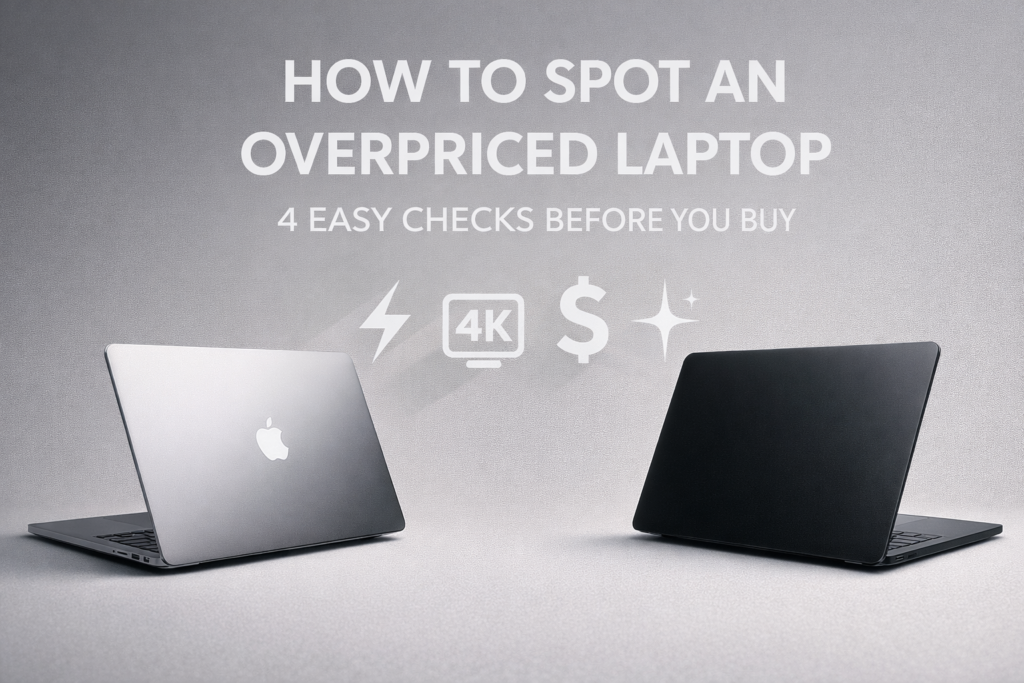
Laptops are a significant investment—whether you’re upgrading for work, school, or leisure, you want to make sure you’re getting your money’s worth. In 2025, the lines between premium features and overhyped marketing are blurrier than ever. It’s easy to feel like you’re paying for a shiny logo or a few extra features you’ll never use. So how can you tell if you’re getting a good deal or overpaying? Let’s break it down. Before you swipe your card, here are four checks that will help you spot an overpriced laptop.
The Shiny New Model: All That Glitters Isn’t Gold
We’ve all seen it—the latest, sleekest laptop on display with promises of revolutionary performance and futuristic features. While the marketing may sound convincing, is the extra price tag really worth it?
Here’s the catch—many “premium” laptops in the current-generation are priced much higher than their actual value. Manufacturers often play on brand prestige, flashy software bundles, and specs that sound good on paper but don’t always translate to better real-world performance. Let’s break it down and show you how to avoid overpaying for style and unnecessary specs.
The Hidden Truth Behind Overpriced Laptops
When a brand-new, high-tech laptop hits the shelves, many assume it justifies its hefty price tag. But here’s the truth: more often than not, you’re paying for things like marketing, brand premiums, and features that may not enhance your user experience. In the current-generation laptop market, understanding these nuances will help you make a smarter purchasing decision.
4 Easy Checks to Spot an Overpriced Laptop
Is the Processor Really Necessary?
Processors are one of the most expensive components in laptops, but do you really need the latest and greatest? For most everyday users, the ultra-powerful Apple M4 chip or Intel Core i9 from the current-generation aren’t necessary. Unless you’re working with heavy-duty applications like 3D rendering or professional video editing, a mid-tier chip like the Intel Core i7-13700H or AMD Ryzen 7 7730U will handle day-to-day tasks just fine. Overpaying for a top-tier processor often results in a laptop that’s overpriced for what you need.
Check: Assess your needs—if you’re not running resource-hungry software, you don’t need an M4 or Ryzen 9. Opt for a less expensive processor that still provides ample power for your tasks.
Display Resolution vs. Actual Use
The lure of 4K displays is strong, but ask yourself if you truly need it. In the current-generation, the latest displays might feature dazzling 4K OLED panels or even mini-LEDs, but these features are often overkill for most users. If you’re primarily using your laptop for web browsing, word processing, or watching videos, a 1080p Full HD display is more than sufficient. A 4K screen can look gorgeous, but it’s also an unnecessary cost boost for most tasks.
Check: Consider your usage—unless you’re a creative professional or gamer working with high-res content, a 1080p display will give you everything you need without the premium price tag.
Battery Life: Are You Paying for Marketing?
Battery life is often exaggerated in marketing, and many manufacturers boast about 15-20 hours of usage. In reality, most users don’t need that much juice, and real-world tests rarely match those claims. For example, while some current-generation laptops may advertise up to 21 hours of battery life, real-world performance can vary significantly based on your usage.
Check: Look at reviews from real users. Are people reporting that the battery lasts as long as advertised, or are there complaints about battery life draining faster than promised?
Disclaimer: Battery life varies greatly based on usage habits, settings, and power consumption, so be cautious when relying on manufacturer claims.
Brand Premium: Is It Just a Name?
Branding plays a significant role in laptop pricing, and in the current-generation, premium brands like Apple, Dell, and Razer continue to charge a hefty price for their name and customer service. While premium brands often offer exceptional build quality and support, the price can be inflated compared to less-known brands with similar specs.
Check: Compare laptops with similar specs from lesser-known brands such as ASUS, Lenovo, and Acer. These models often provide similar (or even better) performance for a much lower price, without the brand premium.
Real-World Examples: How These Checks Apply
Let’s take a look at some examples of overpriced laptops in the current-generation and compare them with more reasonably priced alternatives that provide similar performance.
| Feature | MacBook Air M4 | Lenovo Legion 7i | Acer Swift X |
|---|---|---|---|
| Processor | Apple M4 | Intel Core i9-13900HX | AMD Ryzen 9 7840U |
| Display | 13.6-inch 2560x1664 Liquid Retina | 16-inch 2560x1600 QHD | 14-inch 1920x1200 IPS |
| Battery Life | Up to 18 hours (market-range) | Up to 10 hours (market-range) | Up to 9 hours (market-range) |
| Price | Approx. $1,499 (market-range) | Approx. $1,799 (market-range) | Approx. $1,099 (market-range) |
| Target Audience | Everyday Users & Students | Gamers & Power Users | Everyday Users & Students |
Quick Insight: While the MacBook Air M4 offers excellent performance for basic and mid-level use, the Lenovo Legion 7i and Acer Swift X provide similar (or even better) performance for a fraction of the price. The only real difference? Branding and a few premium features most users won’t need.
Market Trends & Pricing Behavior
Laptop pricing behavior in the current-generation continues to be driven by a combination of technological innovation and brand perception. While newer processors and display technologies are becoming more affordable, the markups on brand names and non-essential features remain high. Expect the gap between premium and budget models to narrow further as manufacturers compete on value, not just fancy specifications. Additionally, hybrid devices that combine tablets and laptops are becoming more common, offering flexibility at a lower price point.
How Overpaying Affects You
Overpaying for an overpriced laptop can result in more than just financial regret. If you’re paying for specs and features you’ll never use, you may experience buyer’s remorse, especially when you realize that a lower-cost model would have sufficed. This can lead to frustration and diminished satisfaction with your purchase in the long run.
Value-Based Buyer Guide: Who Needs What
Here’s a breakdown of the best laptops for various types of users in the current-generation, based on usage needs and budget:
| User Type | Best Value Laptops | Why? |
|---|---|---|
| Everyday Users | Acer Swift X, ASUS VivoBook Pro 14, Lenovo IdeaPad 5 | Budget-friendly and reliable for basic tasks |
| Creators/Professionals | Dell XPS 17, MacBook Air M4, Microsoft Surface Laptop Studio | Best performance for creative workflows |
| Gamers/Enthusiasts | Alienware m17 R6, Razer Blade 15 Advanced, ASUS ROG Zephyrus G15 | Powerful specs for gaming and multitasking |
| Future-Proof Buyers | Apple MacBook Air M, Microsoft Surface Book 4, HP Spectre x360 15 | Premium builds with longevity and performance |
When Premium Is Worth It
For some users, a premium laptop is still the right choice. If you’re a professional who relies on specialized software or you need the best possible support and build quality, a premium laptop like the MacBook Air M4 or Razer Blade 15 Advanced may be worth the investment. These laptops offer superior customer support, extended software updates, and industry-leading materials that can make a real difference in performance and durability.
Insights from Real Buyers
We’ve gathered insights from real buyers on Reddit in 2025 to give you an idea of how users feel about overpriced laptops.
| User Type | Feedback Summary | Relevance |
|---|---|---|
| Everyday User | "Bought a MacBook Air M4 for everyday use, but it feels overpriced for my needs." | Shows the disconnect between price and necessity. |
| Creative Professional | "The MacBook Air M4 is great, but it costs way more than what I need for my work." | Creative professionals often pay more for the brand. |
| Gamer | "Alienware is awesome for gaming, but I wish I hadn’t spent so much on it." | Gaming laptops carry a premium for performance. |
| Budget Buyer | "Found a Lenovo Legion that does everything I need for half the price of a MacBook Air M4." | Highlights how budget-friendly laptops can meet needs without overpaying. |
What’s Next for Laptop Pricing?
Looking ahead, we can expect a shift in laptop pricing as technology becomes more standardized. While brand premiums will always exist, manufacturers will be forced to offer better value to stay competitive. The next generation of processors, including Intel’s Meteor Lake and AMD’s Ryzen 8000, will likely offer even better performance at lower prices, narrowing the gap between premium and budget laptops. We may also see more hybrid devices that blend laptops and tablets, offering more flexibility without the premium cost.
A Smarter Approach to Your Next Laptop
As tempting as the latest and greatest laptops can be, it’s important to approach your purchase with a discerning eye. Take the time to assess your actual needs, and don’t be swayed by brand names or extravagant claims. The right laptop for you is one that balances price, performance, and features, without overpaying for things you don’t need.
Vibetric Ending
In a world full of flashy claims and premium price tags, it’s crucial to stay focused on what truly matters. Smart shopping isn’t just about finding a good deal—it’s about finding the right laptop for your needs.
Want to See How Laptop Pricing Will Evolve in the Future?
- Follow vibetric_official on Instagram to keep up with the latest trends and insights into laptop technology.
- Bookmark Vibetric.com we continuously update our analysis as new developments emerge in the laptop market.
Subscribe for updates and receive ongoing, in-depth breakdowns and expert opinions on the latest laptop trends and technology.
Frequently Asked Questions: Insights to Help You Make the Right Laptop Choice
- How can I tell if a laptop is overpriced?
Look for discrepancies between the price and the actual value you’re getting—excessive branding, flashy features that aren’t needed, and inflated specs for basic tasks are red flags. Do some comparisons with similarly spec’d laptops to see if the price is justified. - Are Apple laptops always overpriced?
Not necessarily, but Apple laptops often come at a premium for their build quality, brand reputation, and customer support. If you don’t need specific macOS features or the ultra-high-end build, you may be paying more than you should for similar specs. - What’s the best laptop for basic use?
For casual users, laptops like the Acer Swift X, Lenovo IdeaPad 5, or ASUS VivoBook Pro 14 are great options. They offer reliable performance at a more affordable price, especially for tasks like web browsing, media consumption, and office work. - Should I prioritize processor power when buying a laptop?
For basic tasks, a mid-tier processor (like Intel Core i7 or AMD Ryzen 7) will work just fine. If you’re using resource-heavy applications (like video editing software or games), you’ll want a higher-end processor, but for most users, there’s no need to pay for top-tier chips. - Are 4K displays worth the extra cost?
Unless you’re into professional design or media creation, a 4K display is often overkill. A Full HD (1080p) display offers a great balance of quality and affordability for most users, while a 4K screen might just be an unnecessary cost boost. - How much battery life is actually necessary?
Most users don’t need a laptop with 15+ hours of battery life. Depending on your usage, 8–12 hours is more than enough for most workdays, so avoid paying extra for batteries that will rarely get fully utilized in real-world scenarios. - What features should I look for when buying a laptop?
Start by considering your main tasks: for productivity, go for a solid processor, decent RAM (8GB is often enough), and a good keyboard. For entertainment, focus on display quality and sound. Avoid overpaying for unnecessary features like premium materials or excessive storage. - Can I find a good laptop under $1,000?
Yes, definitely! There are many laptops under $1,000 that offer solid performance for everyday tasks. Models from brands like Lenovo, Acer, and ASUS offer great value at lower price points, with good processors, enough RAM, and long battery life.
What’s your take on this?
At Vibetric, the comments go way beyond quick reactions — they’re where creators, innovators, and curious minds spark conversations that push tech’s future forward.

Edge Computing Trends 2026 — The Powerful Shift Toward Distributed Intelligence
Edge Computing Trends 2026 — The Powerful Shift Toward Distributed Intelligence Cloud computing reshaped the last decade. Edge computing is quietly reshaping

Best Tech Gadgets 2026 — The Smart Devices That Truly Deliver
Best Tech Gadgets 2026 — The Smart Devices That Truly Deliver Every year begins with spectacle. Product teasers promise transformation. Launch events