
Hardware Innovation Slowdown in 2026: The Surprising Rise of Software Acceleration
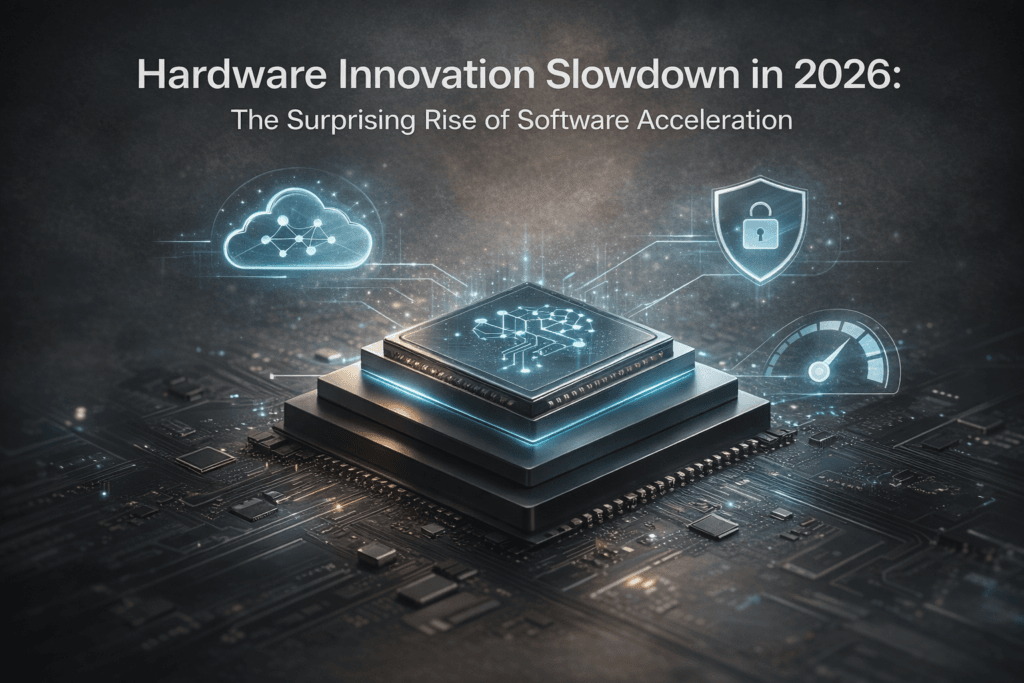
For over a decade, consumer technology moved in visible leaps. Processors doubled in speed. Displays sharpened dramatically. Battery life stretched meaningfully year over year. That era felt kinetic.
Now, the hardware innovation slowdown is unmistakable. Chip gains are incremental. Industrial design changes are subtle. Even flagship devices look and feel evolutionarily refined rather than radically reimagined.
And yet, performance doesn’t feel stagnant.
Because while hardware progress has moderated, software acceleration has quietly intensified.
The Plateau You Can Measure
Engineering constraints are no longer theoretical — they’re physical.
Silicon scaling has approached atomic limits. Thermal envelopes in smartphones and laptops restrict peak frequency expansion. Battery chemistry evolves slowly compared to transistor density of the 2010s. Manufacturing nodes improve, but not at the dramatic cadence users once experienced.
The hardware innovation slowdown isn’t about failure. It’s about maturity.
Most flagship devices today already exceed the computational needs of average workloads:
- 4K video editing on mobile
- Console-level gaming
- Multitasking across AI-powered applications
- Real-time language processing
When hardware surpasses practical demand, visible leaps naturally flatten.
That flattening changes where differentiation happens.
Where Acceleration Actually Lives Now
Software has become the new performance multiplier.
Optimization layers, AI inference engines, neural scheduling systems, and adaptive resource management now define speed more than raw clock rate. Instead of brute-force silicon gains, companies are extracting efficiency from existing architecture.
Consider how modern operating systems manage:
- Background task prioritization
- On-device AI processing
- Predictive caching
- Power-aware workload distribution
These are not cosmetic features. They reshape perceived responsiveness.
A device today may benchmark only marginally higher than last year’s model, yet feel significantly faster in daily use. That’s not marketing — it’s orchestration.
The hardware innovation slowdown shifted the competitive arena upward into the software stack.
The Perception Gap: Why Users Still Feel Progress
Interestingly, most consumers don’t track transistor density or fabrication nodes. They experience:
- Faster photo processing
- Smarter voice assistants
- More stable multitasking
- Longer sustained performance
These improvements are software-driven.
The human brain evaluates technology experientially, not architecturally. If a device predicts your next app launch, enhances images automatically, or optimizes battery drain invisibly, it feels advanced — regardless of whether its chip is dramatically more powerful.
This creates a paradox:
Hardware improvements have slowed, but perceived innovation hasn’t.
Software acceleration masks the plateau beneath it.
Silicon vs Software: Where Value Is Now Created
| Layer | Hardware-Led Era | Software-Led Era |
|---|---|---|
| Performance Gains | Higher clock speeds | AI workload optimization |
| Battery Life | Bigger cells | Smarter task scheduling |
| Camera Quality | Larger sensors | Computational photography |
| User Experience | Raw processing speed | Predictive behavior modeling |
| Differentiation | Spec sheet superiority | Ecosystem intelligence |
This shift explains why the hardware innovation slowdown doesn’t equate to stagnation. Value has migrated.
Hardware builds the ceiling. Software determines how close users get to it.
The Industry’s Quiet Strategy Pivot
Tech companies understand this transition deeply.
Investment focus has shifted toward:
- Proprietary AI frameworks
- Cross-device synchronization
- Cloud-augmented intelligence
- On-device machine learning models
- System-level efficiency tuning
Rather than selling dramatic hardware revolutions every year, brands are building ecosystems that improve continuously through updates.
A three-year-old device today often gains new capabilities via firmware and OS upgrades — something nearly impossible in the earlier hardware-dominant era.
In other words, innovation cycles are becoming cumulative rather than episodic.
The hardware innovation slowdown has encouraged longevity. And longevity strengthens ecosystems.
The Contrarian Angle: Slower Hardware May Be Healthier
There’s a subtle benefit to this shift.
When hardware leaps slow, consumer pressure to upgrade annually decreases. Devices last longer. Software teams optimize more carefully. Efficiency becomes a design principle rather than an afterthought.
It also forces engineering discipline.
Instead of chasing peak numbers for marketing slides, companies refine sustained performance, thermal stability, and long-term battery health. These are less dramatic — but far more meaningful.
The hardware innovation slowdown may actually be creating a more sustainable innovation model.
Progress Has Changed Shape
Innovation hasn’t disappeared. It has changed form.
The era of visible silicon leaps has matured into an era of invisible intelligence. Devices no longer rely on raw horsepower alone. They rely on orchestration — how intelligently that horsepower is deployed.
The hardware innovation slowdown signals a shift from vertical scaling to horizontal optimization. Hardware still matters deeply, but its role is foundational rather than theatrical.
What users feel now is not faster chips alone.
They feel smarter systems.
And smarter systems scale differently.
Stay Ahead with Vibetric
- Follow our Instagram @vibetric_official for sharp, architecture-level tech insight.
- Bookmark vibetric.com to track where innovation is actually moving.
- Stay tuned for deeper breakdowns on performance, AI, and ecosystem shifts.
What’s your take on this?
At Vibetric, the comments go way beyond quick reactions — they’re where creators, innovators, and curious minds spark conversations that push tech’s future forward.
AI Hardware Investment 2027: The Critical Shift Driving the Next Semiconductor Boom
AI Hardware Investment 2027: The Critical Shift Driving the Next Semiconductor Boom In 2023 and 2024, the AI conversation centered on models.
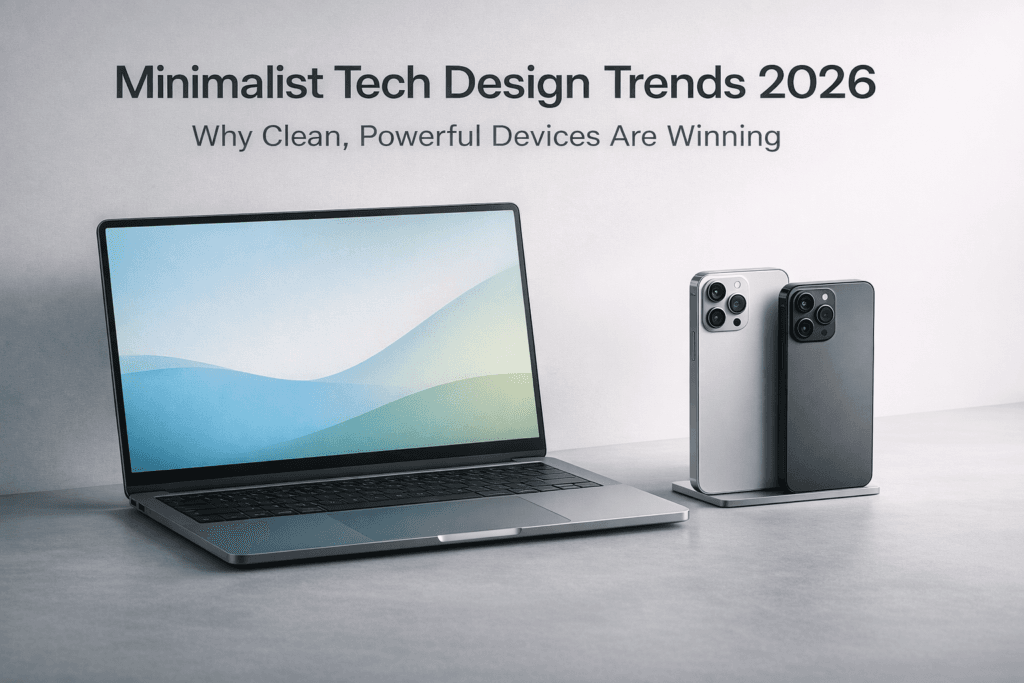
Minimalist Tech Design Trends 2026 — Why Clean, Powerful Devices Are Winning
Minimalist Tech Design Trends 2026 — Why Clean, Powerful Devices Are Winning For years, consumer technology competed on excess — more cameras,