
Global Technology Trends Across Markets: Why They Work Differently Worldwide
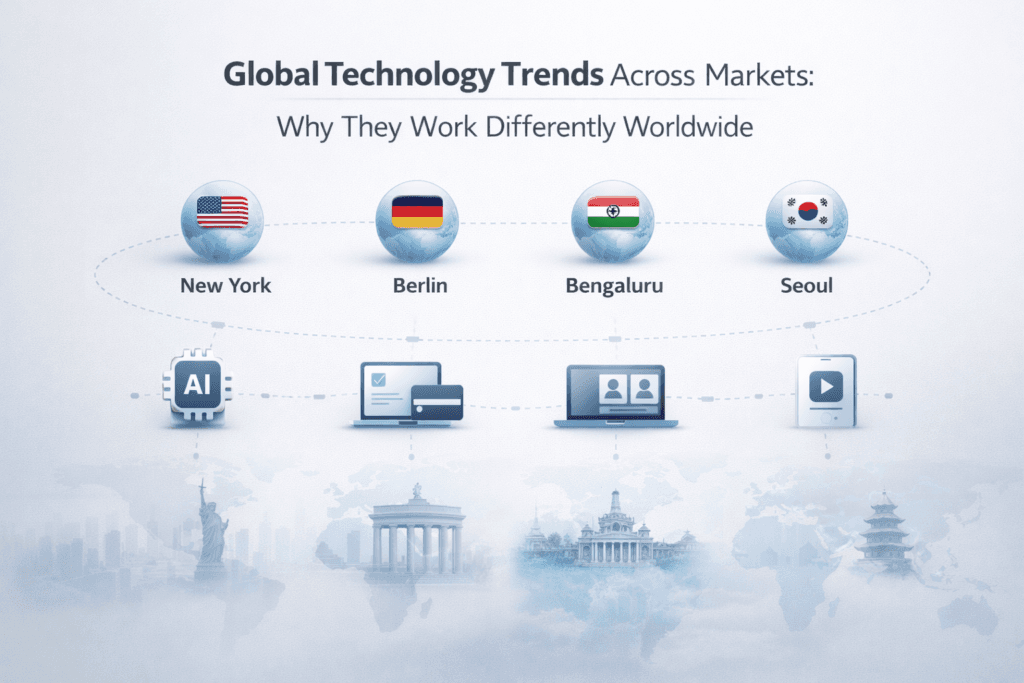
Scroll through tech headlines in New York, Berlin, Bengaluru, or Seoul, and the patterns feel eerily familiar. AI everywhere. Cashless payments rising. Remote work reshaping offices. Short-form video dominating attention. On the surface, global technology trends across markets appear synchronized—as if the world is running the same software update at once. Yet when these trends land locally, they mutate. Adoption speeds diverge. User behavior shifts. Outcomes surprise even seasoned analysts. The real story isn’t about what spreads globally—it’s about why it never works the same way twice.
The Illusion of a Single Global Tech Narrative
Tech discourse loves universality. Platform launches are framed as “global rollouts.” Trends are measured in worldwide user counts. Investor decks flatten geography into neat growth curves. This creates a powerful illusion: that global technology trends across markets move in lockstep, guided by the same incentives and constraints.
In reality, what travels globally is often interface-level similarity, not functional sameness. The app icons look alike. The features appear comparable. But beneath that surface lies a dense layer of cultural habits, regulatory frameworks, infrastructure maturity, and economic psychology that reshapes how each trend actually works.
The sameness you see is mostly aesthetic. The difference lives in behavior.
When the Same Technology Solves Different Problems
A crucial misunderstanding is assuming that a trend exists because of the same need everywhere. In practice, identical technologies are often adopted to solve entirely different local problems.
Take digital payments. In some markets, adoption accelerates because consumers distrust cash handling. In others, it’s driven by weak card infrastructure. Elsewhere, government policy nudges usage through incentives or mandates. The technology is global; the motivation is local.
This is why global technology trends across markets rarely converge in impact. One region sees efficiency gains. Another sees financial inclusion. A third experiences data centralization and platform dependency. Same rails, different destinations.
The Hidden Variable: Market Memory
Every market carries a form of institutional and consumer memory—past failures, legacy systems, historical shortcuts. This memory quietly dictates how new technologies are perceived.
Markets that leapfrogged legacy systems often show higher tolerance for experimental tech. Those with deeply entrenched incumbents resist disruption even when alternatives are superior. A region burned by past data misuse reacts differently to AI adoption than one still prioritizing speed over safeguards.
Global technology trends across markets don’t enter a vacuum. They collide with memory—and memory always wins.
Why Regulation Shapes Behavior More Than Innovation
Innovation headlines spotlight features and performance. But regulation often determines how a technology is actually used.
Two markets may deploy the same AI tools, yet one emphasizes automation while another emphasizes augmentation. Not because the tech differs, but because liability frameworks, labor laws, and compliance costs push usage in different directions.
Regulation doesn’t just restrict—it redirects. It defines which use cases are economically viable and which quietly die. This is why copying a trend from one market to another without adjusting for policy context almost always fails.
A Pattern That Repeats Across Global Tech Waves
Across decades of global technology trends across markets, a consistent pattern emerges:
| Phase | What Looks Global | What Turns Local |
|---|---|---|
| Launch | Product features | Initial user trust |
| Adoption | Download numbers | Usage frequency |
| Scaling | Platform dominance | Monetization behavior |
| Maturity | Market saturation | Social impact |
The early phases mask differences. The later phases expose them.
Culture Is Not a Feature Toggle
Tech platforms often treat cultural adaptation as cosmetic—language packs, regional content, localized marketing. But culture runs deeper than surface customization.
Cultural norms shape:
- How much friction users tolerate
- Whether sharing data feels risky or routine
- How authority and automation are perceived
- What counts as “value” versus “intrusion”
This is why global technology trends across markets fragment at scale. A feature that feels empowering in one culture may feel invasive in another. Engagement metrics alone can’t capture this divergence.
Real-World Scenarios Where Sameness Breaks Down
Scenario 1: AI Assistants at Work
In some markets, AI tools are framed as productivity partners. In others, they’re quietly seen as job threats. Adoption metrics may look similar, but depth of use and reliance differ dramatically.
Scenario 2: Social Commerce
The same shopping features exist globally, yet conversion behavior varies. Trust in peer recommendations, influencer authority, and platform mediation all change outcomes.
Scenario 3: Remote Work Tech
Collaboration tools spread worldwide, but their role shifts. For some teams, they replace offices. For others, they merely extend hierarchy into digital space.
These examples show how global technology trends across markets bend around local context rather than overwriting it.
What Data Often Misses—and Ethnography Reveals
Quantitative metrics excel at tracking reach. They struggle to explain meaning. Two markets can show identical engagement numbers while users feel fundamentally different about the product.
Ethnographic research—how people talk about tech, complain about it, or workaround it—often reveals the truth faster than dashboards. This qualitative layer explains why copy-paste strategies fail when expanding globally.
Global technology trends across markets only make sense when numbers are paired with lived experience.
The Counterintuitive Truth About “Late Adopters”
Markets labeled as slow adopters often end up extracting more durable value from technology. Why? Because delayed adoption allows observation, selective implementation, and adaptation without legacy baggage.
Meanwhile, early adopters may accumulate technical debt, social backlash, or regulatory corrections that reshape the original vision.
Being “behind” is sometimes a strategic advantage—one that reframes global technology trends across markets as asynchronous learning systems rather than races.
Where Platform Strategy Often Goes Wrong
Global platforms frequently optimize for uniformity because it scales operationally. But uniformity amplifies friction when local assumptions clash with global defaults.
The most successful platforms don’t chase identical outcomes across markets. They accept functional divergence while maintaining technical coherence. This balance—shared core, localized behavior—is harder to execute but far more resilient.
A Quiet Feedback Loop That Shapes the Future
Here’s a simplified way to understand why trends diverge:
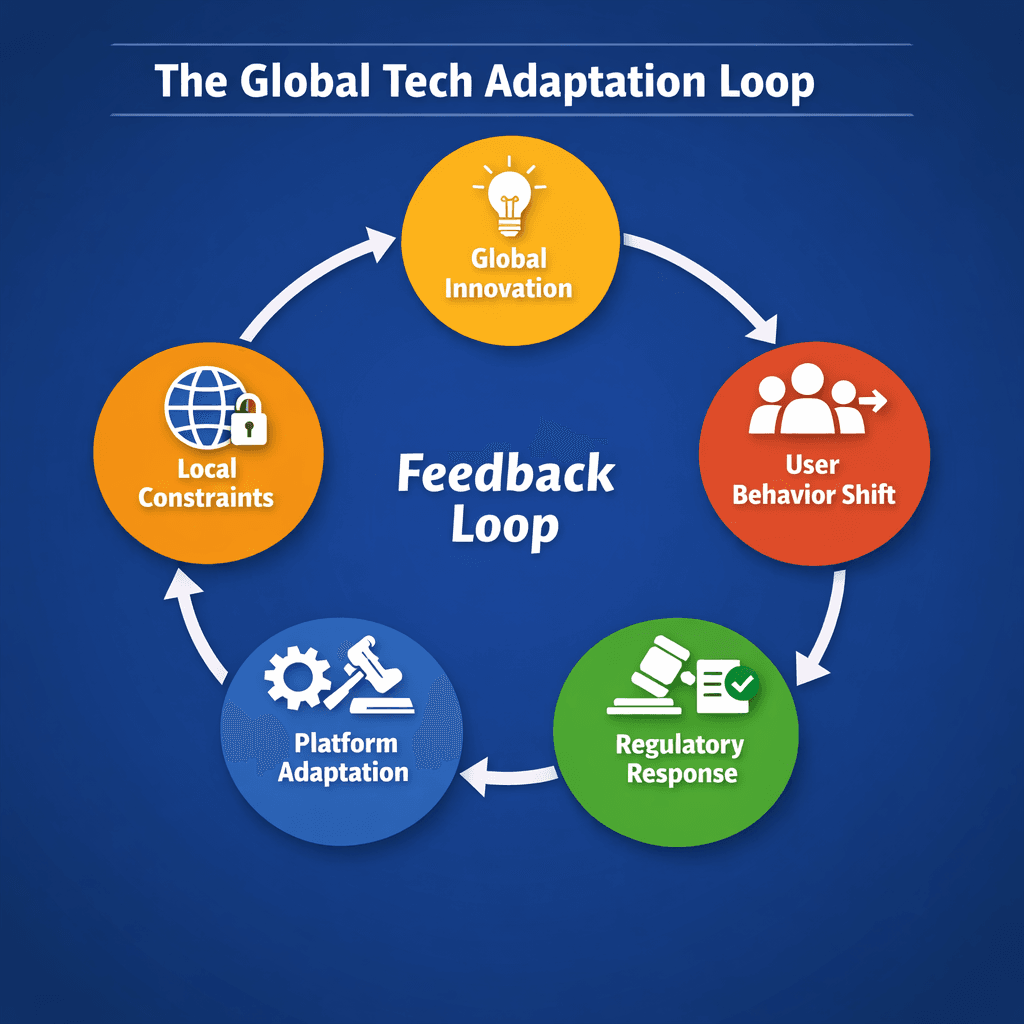
This loop repeats differently in every market. The starting point is global. Everything after is local.
What This Means for Builders, Investors, and Users
For builders, assuming universality is expensive. For investors, over-indexing on global metrics hides risk. For users, imported technology often carries invisible assumptions that don’t fit local realities.
Understanding global technology trends across markets isn’t about spotting what’s new—it’s about recognizing why the same thing feels different everywhere.
The Future Won’t Be More Uniform—It Will Be More Fragmented
As technologies mature, divergence accelerates. AI, automation, digital identity, and platform economies will increasingly reflect local priorities rather than global consensus.
The next decade won’t be defined by one dominant model, but by multiple coexisting interpretations of the same technological foundation. The winners will be those who design for difference, not sameness.
Closing the Loop Where We Started
Those identical headlines you scroll past every day aren’t lying—but they’re incomplete. Global technology trends across markets do spread fast, look similar, and share vocabulary. What they don’t share is meaning.
The real innovation isn’t in exporting technology. It’s in watching how each market quietly rewrites it.
Vibetric Ending
Technology doesn’t globalize behavior—it exposes it. And the more connected the world becomes, the more visible these differences grow. The future of tech won’t belong to the loudest trend, but to the platforms and people who understand context as deeply as code.
What’s Next for Global Technology Trends? Stay Ahead of the Curve
- Follow vibetric_official on Instagram to keep up with the latest trends and insights into global technology and market behavior.
- Bookmark Vibetric.com we continuously update our analysis as new developments emerge across global tech ecosystems.
- Subscribe for updates and receive ongoing, in-depth breakdowns and expert opinions on technology trends shaping different markets.
Questions Readers Ask Once the Pattern Becomes Clear
Because interfaces, features, and branding are standardized, masking deeper behavioral differences.
Local culture, regulation, infrastructure, economic incentives, and historical context.
More fragmented over time as local adaptations compound.
Not necessarily—it often redirects innovation toward different use cases.
Leapfrogging legacy systems, government policy, and consumer trust play major roles.
Only at a core technical level; behavior and outcomes will still diverge.
No. Late adopters often avoid early mistakes and extract more sustainable value.
As signals of reach, not guarantees of uniform impact or monetization.
A foundational one—it shapes trust, tolerance for change, and perceived value.
Sameness is superficial; difference is where the real insight lives.
What’s your take on this?
At Vibetric, the comments go way beyond quick reactions — they’re where creators, innovators, and curious minds spark conversations that push tech’s future forward.

Hardware Innovation Slowdown in 2026: The Surprising Rise of Software Acceleration
Hardware Innovation Slowdown in 2026: The Surprising Rise of Software Acceleration For over a decade, consumer technology moved in visible leaps. Processors

AI Infrastructure in 2026: The Critical Shift Reshaping Modern Technology
AI Infrastructure in 2026: The Critical Shift Reshaping Modern Technology For years, artificial intelligence was presented as decoration. Product launches highlighted AI-enhanced