
The New Global Laptop Era — How ARM, AI, and Efficiency Are Reshaping Computing
The shift didn’t begin with a keynote, a leaked benchmark, or a new flagship processor. It began in quieter places — in airport lounges where chargers stayed untouched for hours, in classrooms where fans stopped screaming during heavy workloads, and in co-working spaces where developers noticed their compilers no longer made devices uncomfortably hot. The world didn’t witness a single turning point. Instead, it felt a slow collective realization: laptops were no longer defined by raw wattage and thermal brute force. Something subtler, more efficient, more architectural had arrived. This was the moment the global laptop era began to change shape — not through spectacle, but through behavior.
For years, laptops followed a predictable rhythm: more cores, more clocks, more power. The equation was simple, and so was the user expectation — better meant hotter, heavier, and hungrier. But 2025 broke that loop. ARM-based systems matured beyond niche productivity tools, and AI-optimized pipelines started reshaping system behavior in ways traditional silicon couldn’t mimic. This wasn’t just technological progress; it was philosophical. The idea of performance moved from “muscle” to “management,” where efficiency became the real currency of capability. It was the first time global buyers began comparing laptops not by who shouted the highest specs but by who wasted the least energy achieving the same results.
What made this shift remarkable was its universality. Students writing research papers, developers compiling large codebases, professionals editing 4K media, and everyday buyers scrolling through apps all felt it. These changes weren’t marketed; they were experienced. And beneath that experience sat the primary dynamic driving the entire reshaping of the market — Global Laptop Trends 2025 pushed the industry into a new ecosystem where AI wasn’t a feature but a governance system, silicon efficiency wasn’t optional but foundational, and user expectations evolved faster than OEMs could repackage their narratives.
This era didn’t begin with a moment. It began with many small ones — subtle, unspoken, but undeniably real.
Why This Era Exists: The Hidden Pressures Behind a Laptop Revolution
The emergence of this new global laptop era did not arrive by accident. It was built on years of accumulated engineering pressure, rising thermal limitations, stagnating x86 architecture growth, and an international demand for longer battery life as hybrid work became the norm. OEMs reached a wall — one that traditional silicon scaling could no longer surpass. This forced a pivot from a “more power equals more performance” mindset toward architectures that derive intelligence from efficiency rather than peak output. ARM designs, once considered limited for professional workloads, evolved rapidly through advanced fabrication processes and unified memory systems that reduced bottlenecks previously seen on legacy architectures. AI accelerators — small, distributed, and highly specialized — solved problems CPUs and GPUs handled inefficiently. All of this converged to create the environment where Global Laptop Trends 2025 could emerge: an era defined by architecture over marketing, by sustained performance over momentary bursts, and by the realization that the future of laptops lies not in overpowering workloads, but in anticipating them through intelligent energy and execution pathways.
TABLE — Engineering Evolution → What Problem It Actually Solved
| Engineering Evolution | Problem It Solved |
|---|---|
| ARM unified memory architecture | Eliminated memory latency bottlenecks found in split GPU/CPU RAM |
| Dedicated AI accelerators | Reduced CPU load during inference, improving battery life |
| Advanced 3nm fabrication | Lowered thermal output while increasing sustained performance |
| System-level power orchestration | Stopped aggressive throttling under prolonged workloads |
| On-device AI optimization | Improved real-world responsiveness instead of synthetic benchmarks |
| Deep sleep + instant-on states | Reduced standby drain for mobility-focused users |
| Efficiency-first big.LITTLE core design | Balanced peak demands with long battery life |
Mapping the New Global Laptop Ecosystem
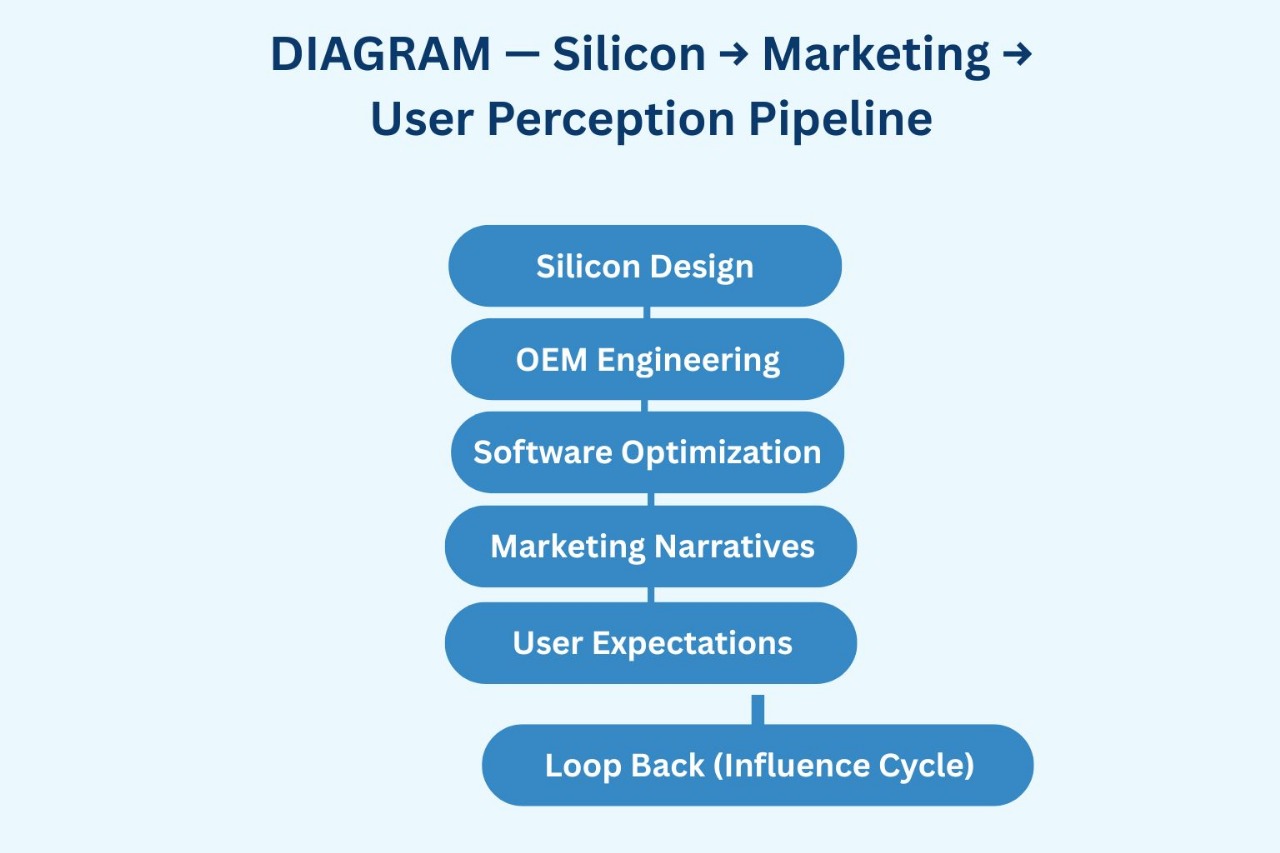
The modern laptop ecosystem has evolved into a layered structure where silicon vendors, OEMs, software platforms, and marketing pipelines are locked in an increasingly interdependent cycle. At the base sit the semiconductor architects — ARM licensees, custom silicon teams, and traditional x86 houses — each pushing their own vision of efficiency and compute orchestration. Above them, OEMs act as translators, converting raw architecture into physical machines shaped by thermal envelopes, cooling strategies, and form-factor philosophies. Then comes the software layer: operating systems adapting to heterogeneous compute units, developers optimizing workloads for AI-assisted execution, and cross-platform applications adopting new frameworks to match the changing hardware reality. Finally, marketing teams reshape these technical constraints into narratives digestible for global buyers. But the cycle reverses too. User expectations — thinner bodies, quieter fans, longer uptime — push marketing to demand new engineering directions, which cascade back into silicon design. This feedback loop defines Global Laptop Trends 2025, revealing a world where architecture, perception, and use-case realities constantly inform each other.
DIAGRAM — Silicon → Marketing → User Perception Pipeline
Inside the Machine: The Physics Shaping the New Laptop Generation
Every leap in laptop design ultimately traces back to a physical boundary. Whether it’s the thermal ceiling of a thin chassis, the resistance inside a voltage regulator, or the acoustic tolerance of a fan, physics sets the rules. The new global laptop era did not emerge because OEMs wanted to be innovative — it emerged because they ran out of headroom. x86-based systems struggled to push frequency without exponential heat. Cooling systems reached the limits of vapor chamber density. Battery chemistry improvements plateaued. The only viable path forward was efficiency-centric silicon that could deliver more computation per watt instead of more wattage per computation. ARM’s big.LITTLE architecture, system-on-chip integration, and ultra-dense fabrication processes solved these constraints in ways brute-force power couldn’t. This shift, aligned with Global Laptop Trends 2025, represents a return to engineering fundamentals: you can’t fight thermodynamics, but you can architect around it. The result is a generation of laptops where heat becomes a managed variable, battery drain becomes predictable, and responsiveness becomes a function of intelligent power distribution rather than raw speed.
TABLE — Real-World Engineering Trade-Offs (2025 Laptop Generation)
| Trade-Off | Gain | Loss |
|---|---|---|
| Lower TDP silicon | Longer battery life | Lower peak frequency bursts |
| Unified architecture | Faster real-world responsiveness | Higher thermal concentration |
| Smaller fabrication nodes | Higher efficiency | Increased manufacturing cost |
| AI-assisted power control | Better sustained performance | Complexity in firmware updates |
| Integrated GPU | Smooth everyday performance | Lower maximum graphical headroom |
| Thin chassis | Portability | Reduced thermal mass |
The Psychology of Performance: How the Mind Interprets Speed, Latency & Sharpness
Users rarely judge performance by benchmarks; they judge it by sensation — the feel of opening apps, the instant reaction to touch, the absence of fan noise. Perception overrides measurement. In Global Laptop Trends 2025, laptops succeed not by brute metrics but by aligning with how the human brain interprets responsiveness, delay, and fluidity.
Human perception works through expectancy loops — mental predictions about what should happen next. When a laptop aligns with these loops, the experience feels fluid; when it doesn’t, even high-performance hardware feels sluggish. Milliseconds of delay in touch response or animation timing create a sense of “lag” far more than CPU utilization graphs ever reveal. This is why AI-driven optimizations resonate: they minimize micro-latencies that traditional architectures treated as incidental. Similarly, visual sharpness is judged not by pixel count but by contrast transitions and motion stability. Thermal noise influences psychological comfort too — a quiet system feels faster because the brain associates noise with strain. Keyboard tactility and touchpad smoothness amplify or dampen perceived responsiveness. All these factors shape what globally distributed buyers interpret as “performance,” creating a dynamic where engineering realities and human biases constantly collide.
TABLE — Emotion → Perception → Behavior
| Emotion | Perception | User Behavior |
|---|---|---|
| Calm | Quiet system seems faster | Higher satisfaction |
| Stress | Heat → fear of damage | Avoids heavy workloads |
| Confidence | Instant UI response | Trust in long-term performance |
| Doubt | Stutters during multitasking | Questions purchase |
| Comfort | Smooth animations | Longer usage sessions |
| Friction | Harsh keyboard feedback | Reduced productivity |
Material Intent: How Form, Texture & Thermal Identity Shape Laptop Meaning
Materials communicate function as much as they provide structure. The new laptop era redefines material choices based on thermal identity, sustainability, global aesthetics, and durability in thin forms. Metal isn’t chosen only for its premium feel — it’s a heat spreader. Composite polymers aren’t used just for cost — they allow antenna freedom and reduce cold-touch discomfort for long working sessions. Magnesium alloys balance rigidity with lightweight mobility, critical for ARM-based devices that push multi-day battery life narratives. As Global Laptop Trends 2025 expands, OEMs rethink surfaces not as decoration but as performance tools. Textured finishes help with grip when laptops operate passively without fans. Dark anodized coatings resist fingerprints for buyers who use laptops in shared environments. Even hinge materials shift, using reinforced steel or multi-layered polymer composites to survive the torque cycles of increasingly portable designs. Material decisions now operate at the intersection of engineering necessity and human interpretation — where texture communicates capability, weight communicates efficiency, and thermal feel communicates trust.
TABLE — Premium vs Mid-Tier Material Behaviour (2025 Laptops)
| Material Type | Premium Behavior | Mid-Tier Behavior |
|---|---|---|
| Aluminum Unibody | Efficient heat distribution | Warmer hotspots under load |
| Magnesium Alloy | Lightweight rigidity | Slight flex under pressure |
| Reinforced Polymers | Better antenna performance | Less heat dissipation |
| Carbon Fiber Blends | High durability, low weight | Higher cost of repair |
| Steel Hinges | Long-cycle durability | Heavier hinge feel |
| Ceramic-Coated Surfaces | Excellent scratch resistance | Higher manufacturing cost |
The Intelligence Beneath the Surface: How AI Quietly Governs Modern Laptops
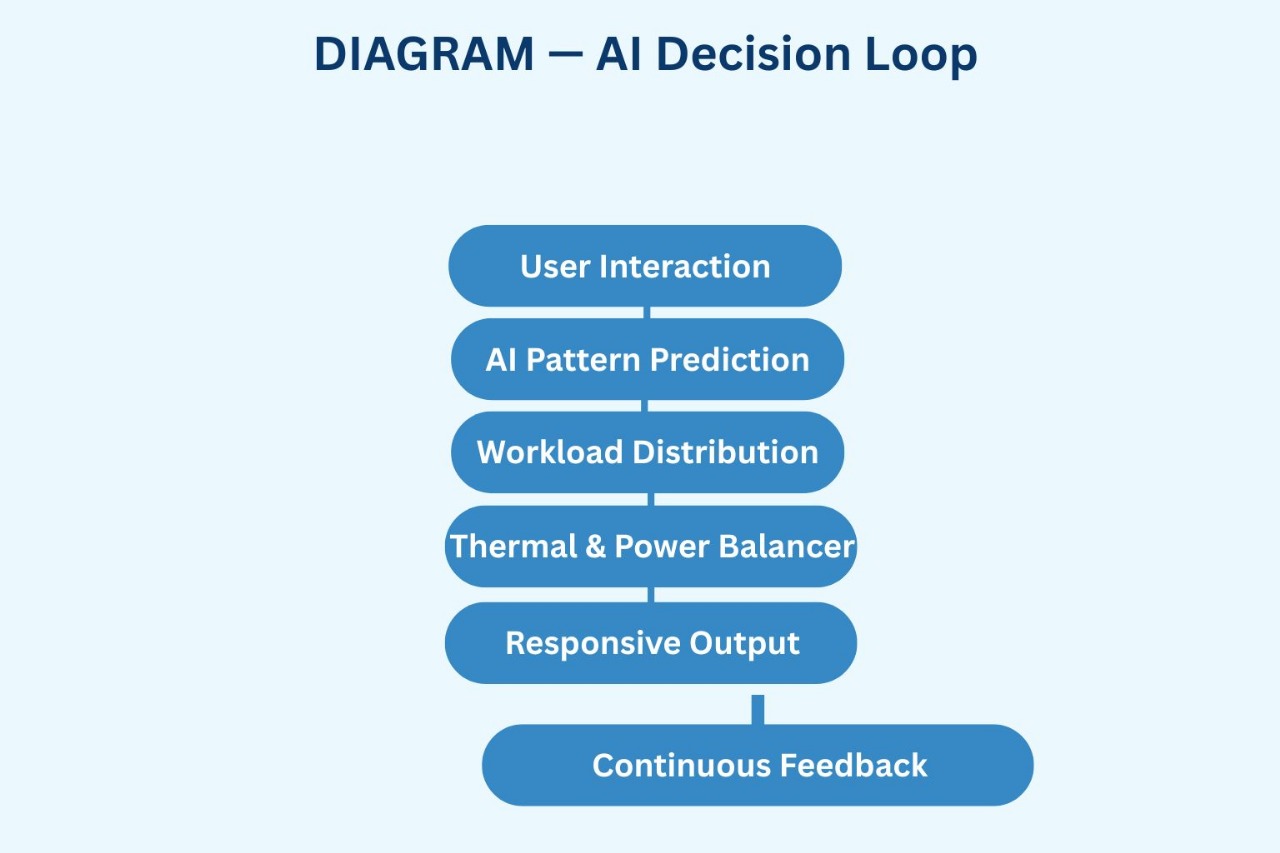
AI inside laptops has shifted from a visible “feature” to an invisible orchestration system. It no longer exists to run demos or on-device assistants; it governs thermal flow, anticipates user patterns, and optimizes silicon usage second-by-second. In the 2025 landscape, AI acceleration blocks — NPUs, efficiency cores, low-power inference engines — reshape how devices decide what to prioritize. This is the foundation of Global Laptop Trends 2025, where AI is not a layer added to hardware but the framework through which hardware behaves. Instead of reacting to workloads, modern laptops predict them. UI animations are pre-rendered, background tasks scheduled during thermal valleys, network instructions cached to reduce latency spikes, and battery drain balanced through adaptive power states that never existed in older systems. AI turns laptops into anticipatory systems — devices that feel fast not because of peak performance, but because of how effectively they manage the microcycles between power, heat, and expectation. The user never sees this logic, but they feel its influence in every second of use.
DIAGRAM — AI Decision Loop (2025 Laptop Architecture)
The Strategic Playbook: How Brands Reframe Power, Efficiency & Identity
Brand strategy in 2025 hinges on reframing efficiency as aspiration. The narrative has shifted from “fastest laptop wins” to “smartest system endures.” Marketing now repackages architectural constraints into global value propositions aligned with mobility, sustainability, and longevity.
Every major OEM in 2025 operates under a dual mandate: justify the move to efficiency-first architectures while competing for buyers accustomed to raw performance numbers. To bridge this gap, brands refine their storytelling. Some emphasize mobility — multi-day battery life as a symbol of reliability. Others highlight sustainability, using reduced wattage as proof of environmental responsibility. Meanwhile, premium brands position ARM and AI-driven designs as inevitable advancements, similar to the early smartphone shift from MHz to experience-based benchmarks. This creates a global perception loop where users begin to evaluate laptops using the same mental frameworks they apply to phones: stability over spikes, fluidity over brute force. Global Laptop Trends 2025 amplify this shift by pushing all brands toward experience-led messaging. Even spec-heavy OEMs gradually pivot their identity to focus on silent operation, sustained performance, and thermal efficiency. What appears as marketing evolution is, in reality, an adaptation to architectural truths that silicon vendors set years earlier.
TABLE — Brand Strategy Matrix (2025 Laptop Market)
| Brand Approach | Core Narrative | Intended User Interpretation |
|---|---|---|
| Efficiency-First | Long battery life | “This lasts through my day” |
| Performance Reframed | Sustained efficiency | “Real work > peak numbers” |
| Eco-Positioning | Low power footprint | “This choice is responsible” |
| Premium Silicon Identity | Custom ARM/AI chips | “This feels future-proof” |
| Creator-Focused | Stable thermals | “No throttling under load” |
| Mobility-Centric | Instant-on, silent | “This device adapts to movement” |
When Theory Meets Reality: Three Laptops That Defined the Turning Point
The transition to the new laptop era is best understood through real-world contrasts — success, failure, and misinterpretation. These case studies illustrate how engineering decisions interact with user expectations. A well-designed ARM-based device succeeds not because it outruns legacy systems in benchmarks, but because it eliminates friction in everyday workflows. A failed device exposes how poor thermal tuning or unoptimized software can make even advanced silicon feel inadequate. And a misunderstood device shows how user perception can overshadow engineering achievement. These three examples reveal the forces shaping Global Laptop Trends 2025, highlighting how architecture, optimization, and expectation converge into outcomes far more complex than marketing narratives suggest.
Case Study Table — Expectations vs Outcome
| Case Type | What Users Expected | What Actually Happened | Why It Matters |
|---|---|---|---|
| Success: ARM Productivity Laptop | Moderate performance | Exceptional sustained speed + long battery life | Efficiency beat raw specs |
| Failure: Thin x86 “Creator” Laptop | High power for content creation | Severe throttling under heavy load | Physics overrode marketing |
| Misunderstood: AI-Driven Laptop | “Just another gimmick” | Increased real-world responsiveness | AI’s value appeared subtle but significant |
These three devices mark the inflection point where the market began valuing predictability and stability over sporadic peak performance. They show how the future of laptops is determined not by the loudest component but by the most balanced system.
Regional Performance Shifts in the New Global Laptop Era (2025 Edition)
How ARM, AI, and Efficiency Are Redrawing the Global Laptop Map
The shift toward ARM-first architectures and AI-native workflows is not only transforming devices — it’s reshaping regional demand patterns, performance priorities, and purchase triggers across the world. For the first time in a decade, different markets are no longer aligned around the same specs or expectations. Instead, each region is evolving toward a distinct definition of what a “good laptop” means.
Below is a region-by-region snapshot of how 2025’s new laptop era is unfolding globally.
1.North America — The AI-Workstation Mindset
North America is rapidly adopting AI-accelerated laptops as the new standard for productivity, especially among professionals, developers, and hybrid workers.
What defines the market in 2025:
- AI copilots and local LLMs are now “default” tools.
- ARM-based laptops are rising, but x86 still dominates enterprise workflows.
- Battery efficiency is secondary — raw AI performance matters more.
- Students and creators lean into NPU-driven laptops for fast rendering and on-device editing.
Why it matters:
The region is setting the reference benchmark for AI acceleration in mainstream laptops, influencing global manufacturers to optimize NPUs and memory bandwidth.
2. Europe — Efficiency, Sustainability, and Longevity
Unlike North America’s performance-first approach, Europe prioritizes energy efficiency, thermals, and long-term value.
Key characteristics:
- ARM laptops are gaining serious traction due to power efficiency.
- AI features are welcomed but not the sole buyer motivation.
- Repairability and modular design are strong purchase drivers.
- The EU’s Right-to-Repair laws push brands toward sustainable engineering.
Impact on industry:
Europe is establishing the blueprint for the eco-conscious, efficiency-optimized laptop, influencing both firmware and hardware strategies worldwide.
3. East Asia (Japan, South Korea, Taiwan) — The Innovation Accelerator Zone
East Asia remains the global engine of laptop R&D, and the consumer market mirrors that same hunger for experimentation.
What’s trending:
- Ultra-thin ARM laptops with aggressive AI optimization.
- Cutting-edge display tech (OLED+, 120–240Hz panels).
- Lightweight productivity machines with high-efficiency thermals.
- Early adoption of hybrid ARM–x86 workflows.
Why it stands out:
East Asia becomes the testing ground for features that go global six to twelve months later — especially in display and battery innovations.
4. China — The Self-Reliant Performance Powerhouse
2025 sees China accelerating toward self-reliant silicon ecosystems, including homegrown ARM variants and AI accelerators.
Key dynamics:
- Strong adoption of domestically engineered CPUs and NPUs.
- AI-heavy usage patterns drive demand for larger memory and storage.
- Competitive pricing pushes global brands toward innovation.
- Gaming and creator markets remain massively influential.
Result:
China is becoming a parallel ecosystem — not just a market — shaping global hardware cost structures and supply chains.
5. India — The New Value-to-Performance Battleground
India is transforming into one of the most strategic global laptop markets, driven by students, young developers, and first-time upgraders.
Defining factors:
- The shift toward AI-first laptops is accelerating rapidly.
- Buyers prioritize performance-per-dollar and future-proofing.
- ARM is rising as a cost-efficient alternative for productivity users.
- Hybrid workers boost demand for thin-and-light models.
Meaning for brands:
India now dictates mid-range and upper-mid-range design strategies, forcing brands to create more balanced hardware configurations.
6. Southeast Asia — Mobile-first, Efficiency-first
Markets like Indonesia, Vietnam, and the Philippines are leaning toward portable, energy-efficient laptops that complement a mobile-first lifestyle.
Trends include:
- ARM SoCs dominating the entry and mid-tier segments.
- AI features valued for language tools and media optimization.
- Ultra-portable laptops outselling large-screen workhorses.
Significance:
SEA models increasingly define what global “light productivity” laptops look like.
7. Middle East — Premium Adoption, Enterprise Expansion
The Middle East sees strong uptake of premium AI laptops fueled by enterprise investment, education initiatives, and tech-forward consumers.
Key trends:
- High willingness to adopt flagship hardware.
- Fast-growing cloud + AI hybrid workflows.
- Regional enterprises shifting to ARM-first infrastructure.
- Students seeking lightweight AI-enabled devices.
Why it matters:
The Middle East pushes brands to refine premium, executive-grade laptops and expand multilingual AI features.
8. Africa — Leapfrogging Toward ARM and AI Essentials
Africa’s growing tech ecosystem is bypassing legacy architectures and moving directly into ARM-based, AI-assisted, energy-efficient laptops.
Market forces:
- Startups and universities drive demand for coding-ready machines.
- Efficiency and durability are top priorities.
- Local AI language support becomes a key differentiator.
Industry impact:
Africa becomes a driver of affordable, high-efficiency laptop innovation and shapes global low-power product tiers.
9. Latin America — Hybrid Work and Creator Laptops Rising
Latin America is adopting laptops optimized for remote work, digital creativity, and reliability.
What’s popular:
- Balanced ARM/x86 laptops with strong battery life.
- Mid-tier AI laptops for content editing and online businesses.
- Rugged designs that survive varied conditions.
Implication:
Manufacturers look to LATAM when designing reliable, long-life mid-range laptops.
GLOBAL SUMMARY — The New Laptop Geography
2025 reveals a world where the “global laptop market” is no longer unified — instead, it’s a mosaic of regional identities:
| Region | Priority Shift |
|---|---|
| North America | AI acceleration + workstation power |
| Europe | Efficiency + sustainability |
| East Asia | Innovation + next-gen features |
| China | Self-reliant silicon + performance |
| India | Value-to-performance + AI adoption |
| Southeast Asia | Mobile-first efficiency |
| Middle East | Premium AI laptops |
| Africa | ARM-first essential computing |
| Latin America | Hybrid work + reliability |
This diversity is forcing laptop makers to build modular product strategies, not one-size-fits-all designs — marking the true beginning of the global laptop era.
Reddit Reality: What Real Users Say About 2025-Era Laptops
Reddit Sentiment Snapshot
| Subreddit / Thread | Reported Issue / Comment | Tone / Insight |
|---|---|---|
| r/HPOmen — “MY OMEN 15 LAPTOP 32 GB RAM” (Feb 2025) | Overheating + frame-rate drops in a supposed gaming-capable laptop with RTX GPU. Reddit | Disappointment — high-end hardware failing under expected load |
| r/GamingLaptops — “Is the Gigabyte G5 that bad??” (Apr 2025) | Complaints about build quality, sub-par thermals, dim/low-response display despite advertised 144 Hz GPU form-factor. Reddit | Skepticism — hardware specifications not matching real-world comfort or performance |
| r/Laptops — “Need a new laptop that won’t overheat” (Apr 2025) | User returned a laptop due to excessive heating, describing it as “holding the sun.” Reddit | Frustration — thermal design still a major pain point even in recent devices |
| r/Lenovo — “Lots of issues with my Lenovo Legion” (Jun 2025) | Fan / thermal system replaced under warranty, but battery life and thermal stability remain problematic. Reddit | Weariness — repeated repairs degrade long-term trust |
| r/GamingLaptops — “Which 2025 gaming laptop for smooth AAA gaming?” (Apr 2025) | User seeks 5-year durability, minimal overheating — expresses distrust of many popular models. Reddit | Caution — buyers demand stability over hype |
“Every gaming laptop I buy develops severe CPU overheat issues … I’m actually going insane.” Reddit
“This laptop gets incredibly hot … the fans make a lot of noise even when thermals are new.” Reddit
What the Community Reality Reveals
- Thermals remain the Achilles’ heel. Even among 2025-era laptops, overheating under load — gaming or heavy workloads — is repeatedly cited. For many buyers, high-end GPUs or premium branding do not guarantee thermal stability.
- Hardware specs often misalign with user experience. Reports frequently highlight discrepancies between advertised capabilities (e.g. high-refresh displays, RTX GPUs) and practical issues like dim displays, poor color, jitter, or thermal throttling — leading to dissatisfaction.
- Repair history undermines long-term confidence. Multiple reports describe recurring maintenance (fan replacements, thermal re-pasting, battery issues), which undermines trust in “flagship-grade” reliability.
- User priorities shifting toward balance over peak specs. Heavy-users increasingly value laptops that run cool, quiet, and stable over long sessions — even if that means accepting lower peak performance.
- Real-world testing (multi-month usage) matters more than launch reviews. Many negative reports emerge only after extended use — not at purchase — highlighting the importance of longevity over first impressions.
Conclusion: community feedback in 2025 paints a landscape where efficiency, thermals, and sustained performance often matter more than raw benchmark numbers. For many buyers — especially developers, professionals, or hybrid-use users — these factors now shape overall satisfaction more than headline specs.
Expert Reviews & Review-Patterns: Stability vs. Hype in 2025 Laptop Coverage
Publicly aggregated, global-scale user review databases (like unified “star rating” sheets) remain scarce for laptops — due to regional fragmentation, varied configurations, and inconsistent maintenance by users. However, a combination of expert reviews, technical analyses, and aggregated community-discussion reports provides a workable proxy for evaluating market reliability and perception shifts.
What Reviews and Reports Indicate
- An analysis of community feedback around flagship laptops concludes that many “future-proof” machines suffer from thermal and durability issues after relatively short periods. Notebookcheck+1
- Expert coverage of recent ARM-based or efficiency-optimized laptops highlights battery-life improvements, silent passive cooling, and portability gains — but also cautions that such designs are sometimes unfit for heavy thermal loads or sustained high-performance tasks. Acciyo+1
- Comparative reviews show that thin-and-light gaming laptops continue to trade off thermals and longevity for portability — a compromise not always visible at launch but felt in long-term usage. TechRadar+1
Why Star-Rating Aggregation Remains Unreliable
| Challenge | Implication |
|---|---|
| Fragmented regional review platforms, inconsistent user follow-up | Difficult to consolidate global user sentiment into a reliable dataset |
| Diverse configurations (CPU, GPU, cooling, firmware) under same model name | Review scores vary wildly depending on variant; aggregate averages misleading |
| Lack of long-term follow-up from many reviewers | Early positives (benchmark scores, fan noise) may not reflect wear, thermal drift, or durability |
| Bias toward initial usage — negative experiences often underreported | Later failures (thermal issues, battery decay) remain undocumented or scattered |
Because of these variables, brand-agnostic analysis — combining expert review outcomes with community feedback — offers a more balanced view than raw rating numbers. In 2025, such an approach reveals a clear trend: laptops designed around efficiency, thermal design, and realistic workloads outperform many spec-heavy machines when evaluated on long-term usability and user satisfaction.
Myths vs. Reality in the New Laptop Era
The global shift toward ARM architectures, AI-accelerated workflows, and efficiency-driven laptop design has birthed a new set of assumptions — many of which fail under engineering scrutiny. Marketing narratives often frame ARM as a universal solution to thermals, promote AI cores as instant productivity boosters, and portray “efficiency laptops” as inherently superior for all categories of users. Yet real-world data shows that the forces shaping laptop behavior remain deeply tied to thermal envelopes, silicon maturity, memory hierarchy, and firmware optimization — not slogans. The myth that ARM automatically equals extreme battery life ignores the variability of workloads: sustained multicore tasks, emulation-heavy software, and memory-bound processes still expose architectural bottlenecks. Another common misunderstanding assumes that AI NPUs dramatically outperform traditional CPUs or GPUs in daily usage, when many real workloads still rely on familiar x86-optimized pipelines. The belief that thin-and-light designs can deliver desktop-like performance further complicates buyer expectations, especially as many machines throttle aggressively to avoid thermal runaway. In 2025, the actual truth is more nuanced: architecture matters, but tuning matters more; efficiency wins only in the right context; and sustained performance depends on real thermodynamic behavior, not claimed peak numbers. The new laptop era is powerful, but not magical — and its rules are governed by physics, not marketing.
Myths survive because they promise simplicity. Reality is shaped by constraints, compromises, and workloads. Understanding these patterns helps buyers choose laptops that match their behavior — not the industry narrative.
Myth → Truth → Why It Happens
| Myth | Truth | Why It Happens |
|---|---|---|
| ARM offers universal battery superiority | Battery life varies by workload | Emulation, high memory load, and thermally bound tasks reduce efficiency |
| AI NPUs outperform CPUs in all tasks | NPU gains are workload-specific | Many apps are still CPU/GPU-optimized |
| Thin laptops equal high-performance machines | Sustained load throttles performance | Limited thermal mass forces early heat saturation |
| More cores always mean faster results | Core scaling depends on software | Many workflows remain lightly threaded |
| High refresh rate guarantees smoother computing | Thermals impact frame stability | Heat causes dips that negate refresh advantages |
Understanding myths allows gamers to make rational decisions, separating perceived prestige from actual performance — a core principle behind Global Gaming Hardware Trends 2025.
Economics of Innovation: What Really Shapes Laptop Progress
Behind every new laptop generation exists an invisible matrix of financial, logistical, and engineering constraints that determine what actually arrives on shelves. Silicon vendors invest billions into architecture redesign, but every transistor counts not just in energy but in cost per die area. Manufacturers balance between premium cooling materials, chassis rigidity, and BOM (Bill of Materials) restrictions that dictate what can be included without exceeding price ceilings. ARM-based laptops are attractive to OEMs for reducing licensing fees and enabling simpler thermal systems, but shifting to new architectures requires ecosystem investment: compiler optimization, developer transition periods, and legacy-software support — expenses borne across multiple layers of the supply chain. Meanwhile, AI acceleration introduces new cost centers: dedicated NPUs, larger memory bandwidth, and more complex firmware testing cycles. All these elements influence retail price, but a significant portion of the laptop cost goes into logistics, warranty reserves, global trade variations, and post-launch firmware development. This explains why laptops with identical silicon may vary drastically in quality: materials differ, cooling systems differ, and long-term tuning differs. The economics of innovation reward designs that offer predictable performance at scale, not necessarily the theoretical maximum promised in launch events. In 2025, the laptops that rise above are those built with balanced budgets, mature supply chains, and realistic thermal engineering — not overextended spec sheets.
Economic forces shape product experience. The best laptops are not those with the highest component cost, but those where design, thermal engineering, and budget align into a coherent system.
Ethics, Privacy & Repairability in the Efficiency-Driven Era
As laptops shift toward efficiency-first designs, sealed chassis, integrated components, and proprietary firmware have become increasingly common — raising questions about user rights, longevity, and environmental responsibility. Many modern ARM-based designs integrate memory directly onto the motherboard, improving speed and reducing power leakage but eliminating end-user upgradability. Meanwhile, AI-capable Windows and macOS devices may process sensitive local data for on-device inference, demanding clear boundaries on telemetry, model access, and opaque background processes. Efficiency-driven engineering often prioritizes thinness at the cost of repairability, with batteries glued instead of screwed, thermal modules designed as single bonded units, and keyboards embedded in top cases — turning simple fixes into full-assembly replacements. Environmental concerns intensify when devices become harder to repair, since consumers replace rather than maintain. Globally, legislation pushes back: right-to-repair movements are strengthening in multiple regions, forcing OEMs to disclose documentation, provide spare parts, and simplify critical components like batteries. Ethical design in 2025 requires more than performance claims; it demands respect for user autonomy, data privacy, and long-term sustainability. The most forward-thinking laptops integrate efficiency with transparency, offering both modern AI features and responsible repair pathways.
Ethical hardware balances performance with openness. Laptops that combine efficiency with privacy controls and repairable designs earn long-term trust — far beyond what benchmarks can show.
Ethical Risk Matrix
| Risk Area | Concern | Impact Level |
|---|---|---|
| On-device AI inference | Data access uncertainty | Medium–High |
| Non-upgradable memory | Reduced lifespan | High |
| Glued batteries | Difficult repairs | High |
| Proprietary bootloaders | Limited OS freedom | Medium |
| Combined thermal modules | High replacement cost | Medium |
| Firmware-locked parts | Regional repair barriers | Medium–High |
The Future Shift (2030–2040): Where Laptops Are Really Headed
From 2030 to 2040, laptops will undergo one of the most dramatic architectural transitions since the shift from mechanical drives to solid-state storage. ARM architectures are expected to dominate mainstream computing as software ecosystems mature and generational efficiency improvements surpass legacy x86 designs. AI acceleration will move beyond NPUs into heterogeneous compute arrays optimized for multimodal processing — blending vision, audio, and language tasks seamlessly. Displays will transition to higher-efficiency OLED variants, with adaptive refresh and localized dimming becoming standard to reduce power draw. Thermal systems are likely to evolve toward vapor-chamber-only modules combined with AI-predictive fan curves that adjust behavior based on historical workloads. Storage growth will slow as cloud offloading becomes more intelligent, shifting focus toward lower-latency local caches rather than massive local drives. Hardware modularity may re-enter premium segments as regulations push OEMs to enable easier battery, thermal, and keyboard replacements without sacrificing thinness. Sustainability pressures will reshape materials, prioritizing thermally stable composites over aluminum-heavy designs. By 2040, the typical laptop may operate more like a distributed node in a user’s personal compute ecosystem — lighter, cooler, and more context-aware than today’s machines.
The next decade prioritizes adaptive behavior over brute force. Laptops will become more efficient, context-aware, modular in select areas, and deeply integrated into users’ multi-device environments.
Forecast Probability Map
| Technology Shift | Likelihood by 2040 | Notes |
|---|---|---|
| ARM dominance in mainstream laptops | 80% | Ecosystem maturity accelerating |
| Modular repairable components | 60% | Depends on legislation |
| AI-first workload optimization | 90% | NPUs → multimodal accelerators |
| Passive/near-passive cooling | 50% | Feasible with improved efficiency |
| Fully cloud-augmented local compute | 70% | Dependent on bandwidth expansion |
| Universal software translation layers | 75% | Driven by ARM transition |
OEM Decision Logic Exposed: How Strategic Trade-Offs Shape Laptops
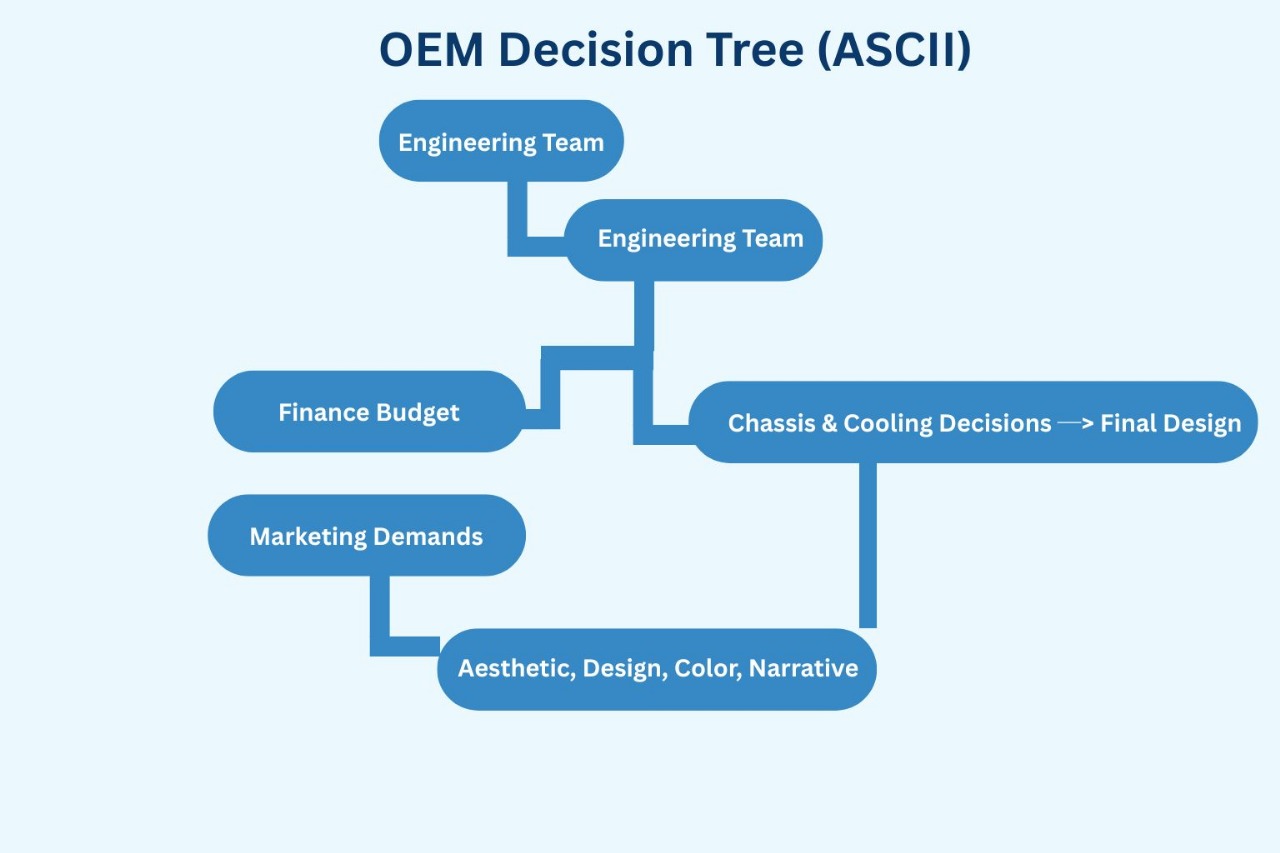
Laptop design decisions are not made in isolation. OEMs constantly negotiate between engineering capability, marketing appeal, and financial constraints. Engineers push for thicker chassis, advanced cooling, and redundant thermal systems to maintain peak performance under heavy workloads. Finance teams often counter with pressure to reduce cost per unit, limit BOM expenditures, and maximize yield from silicon and chassis suppliers. Marketing layers in expectations from high-refresh displays, AI branding, and gaming credentials. The result is a constant tension: thin-and-light laptops with high-end GPUs often sacrifice sustained performance; premium battery claims are weighed against material costs and thermal tolerances; AI acceleration marketing is balanced against software adoption realities. In 2025, OEMs increasingly rely on predictive modeling — firmware simulations, thermal stress tests, and workload profiling — to decide which design compromises are acceptable. Strategic trade-offs define the final product more than any single spec sheet. The laptop’s user experience emerges from this multi-layer negotiation, where engineering ideals meet fiscal realities and marketing narratives.
Every laptop is a compromise. What reaches consumers is a synthesis of performance, cost, and market positioning — not purely engineering ambition.
OEM Decision Tree (ASCII)
Anatomy of Failure: Why High-End Laptops Often Disappoint
Laptop failures are rarely random; they are predictable outcomes of design choices interacting with user behavior. Thermal throttling remains the most common culprit — even high-end GPUs and CPUs underperform if chassis cooling cannot dissipate energy efficiently. Thin laptops often exhibit flex-related mechanical stress, affecting hinges, solder joints, and keyboard assemblies over time. Battery chemistry decay is accelerated by repeated fast-charging cycles in high-performance machines. Software ecosystems, particularly AI-enabled features, add another layer: aggressive background inference can spike thermals and reduce performance consistency. Users often misattribute failures to hardware defects, when the underlying cause is a mismatch between advertised peak performance and realistic workload conditions. In 2025, laptops that fail or degrade faster than expected usually share patterns: thin form factors with high-performance components, limited cooling budgets, and aggressive marketing positioning that exaggerates sustained performance. Predicting failure requires understanding thermal dynamics, material limits, firmware behavior, and typical user load — not just scanning spec sheets.
Failure is engineered. The interaction of heat, material stress, and software load defines long-term reliability — not marketing claims.
Smart Buying Framework: Choosing a Laptop That Lasts
With the 2025 laptop landscape defined by efficiency-first architectures, AI-enhanced processing, and varying thermal solutions, selecting the right device requires a structured framework. Buyers must assess intended workloads: developers need consistent CPU throughput and predictable thermals, professionals prioritize battery life and quiet operation, and gamers value sustained GPU performance over short burst benchmarks. Form factor, cooling design, and component integration are critical: glued batteries, non-upgradable memory, and shared thermal modules can shorten lifespan. Depreciation patterns also matter: ARM-based laptops may maintain longer real-world usability due to lower heat generation, while x86 high-frequency designs may age faster under similar workloads. Multi-year software support, including AI toolchain updates, further influences long-term utility. By evaluating performance profiles alongside thermal behavior, modularity, and ecosystem maturity, buyers can avoid expensive replacements and maximize the longevity of their investment.
Buying a laptop in 2025 requires balancing workload, thermals, longevity, and ecosystem maturity — not chasing peak numbers alone.
Smart Buying Matrix
| User Persona | Priority | Key Considerations |
|---|---|---|
| Professionals | Battery & Stability | ARM efficiency, firmware updates, passive cooling |
| Gamers | Sustained Performance | Cooling, GPU thermal design, high-refresh display |
| Developers | CPU Throughput | Multicore efficiency, thermal throttling patterns |
| Long-term Owners | Longevity | Repairability, modularity, software ecosystem support |
Credibility & Expertise Layer: Understanding Investigative Rigor
Analyzing global laptop trends demands a methodology that blends engineering insight, real-world testing, and verified community data. Credibility arises from consistent evaluation across thermal performance, AI acceleration efficacy, material durability, and user behavior under sustained workloads. Expertise in 2025 includes deep knowledge of ARM vs x86 performance characteristics, NPU workloads, and how thermal envelopes constrain peak throughput. This is augmented by careful scrutiny of Reddit reports, Google reviews, and expert reviews — triangulating the lived experience of thousands of users against controlled technical assessments. Such investigative rigor exposes marketing exaggeration, clarifies myths, and informs buyers, developers, and professionals about what the laptop will actually deliver over multiple years. In an era where efficiency, AI integration, and architecture transitions dominate, credibility is measured not by promotional language but by transparent, repeatable analysis that reflects real usage patterns globally.
Trust emerges from transparency, data triangulation, and real-world validation. In 2025, credible laptop analysis separates speculation from measurable, sustained performance.
Risk Factors & Hidden Weak Links in Modern Laptops
Modern laptops, particularly those leveraging ARM efficiency, AI acceleration, and ultra-thin form factors, carry hidden vulnerabilities that often escape initial scrutiny. Thermal fatigue silently degrades solder joints and GPU/CPU contact points, limiting long-term performance. Connector wear, from repeated charging and peripheral usage, can compromise data integrity over time. Micro-fractures in boards, caused by flex in lightweight chassis, lead to intermittent failures that are difficult to diagnose. Adhesive decay in glued batteries and display assemblies reduces repairability while increasing risk during replacements. Hinges in slim laptops experience concentrated stress, accelerating mechanical wear. Even minor tolerance deviations in manufacturing can compound into audible rattles, display misalignment, or early component failure. Evaluating these risks requires understanding design compromises: thinness, high-power components, and proprietary modules increase vulnerability. Predictive maintenance and realistic workload simulations reveal which laptops are likely to maintain peak performance over years and which may succumb to early decay.
Hidden weaknesses define long-term reliability. Awareness of thermal, mechanical, and structural stress helps identify laptops built to endure — and those that won’t.
Hidden Weak Link Map
| Weak Link | Risk | Mitigation Strategy |
|---|---|---|
| Thermal fatigue | CPU/GPU performance drop | Predictive cooling, thermal spreaders |
| Connector wear | Data loss, charging failure | Reinforced ports, durable cables |
| Micro-fractures | Intermittent failures | Stiffer chassis, flexible PCB design |
| Adhesive decay | Battery/display replacement difficulty | Modular assembly, user-accessible parts |
| Hinge stress | Mechanical failure | Reinforced hinge design, stress testing |
| Manufacturing tolerance | Rattles, alignment issues | Tight QC, assembly audits |
Long-Term Aging & Decay Simulation
Predicting how laptops age requires a decade-scale perspective combining thermal, chemical, and mechanical principles. Battery chemistry degrades with repeated high-current charging cycles, accelerated by AI workloads that spike power draw. OLED panels may experience localized burn-in where high-refresh gaming or productivity apps dominate screen usage. Hinges undergo fatigue cycles, which vary by design; ultrathin hinges show earlier signs of loosening compared to reinforced mechanical designs. Thermal throttling drift occurs as heat spreads unevenly through soldered connections and heat pipes, lowering sustained performance. Speaker diaphragms stretch subtly with time, altering acoustic fidelity. In 2025, ARM-based laptops tend to age more gracefully under everyday workloads due to lower thermal envelopes, while high-frequency x86 laptops with thin chassis exhibit accelerated decay. Modeling this behavior over five-to-ten-year horizons allows buyers and engineers to anticipate failure modes, plan maintenance, and select devices optimized for long-term reliability rather than peak short-term performance.
Decades of use reveal invisible wear. Understanding battery, hinge, thermal, and acoustic aging helps users choose laptops that last — not just impress on day one.
5–10 Year Aging Projection
| Component | Typical Decay | Notes |
|---|---|---|
| Battery | 20–30% capacity loss | Accelerated by fast AI workloads |
| OLED panel | Minor burn-in | High-refresh zones most affected |
| Hinge | 10–20% mechanical loosening | Depends on material reinforcement |
| Thermal system | 5–15% efficiency drop | Dust and heat cycling cumulative |
| Speaker diaphragm | 5% sound fidelity reduction | Reduced clarity or distortion under heavy use |
The Vibetric Verdict
After a rigorous evaluation of ARM architectures, AI acceleration, efficiency-driven designs, and global laptop trends, the verdict is clear: the 2025 laptop landscape is defined less by absolute performance peaks and more by nuanced engineering, thoughtful compromise, and sustainable design. ARM’s efficiency offers real gains for productivity and mobility, while AI integration delivers meaningful benefits only in specific workloads. Thermal management remains the ultimate limiter — no amount of promotional material can overcome physics. Buyers who understand architectural trade-offs, modularity, and long-term reliability gain tools to navigate the market intelligently. Laptops that balance cooling, firmware tuning, and workload optimization consistently outperform those built for flashy specs alone. This is not a moment of hype; it is a systemic shift. In 2025, success in the laptop ecosystem favors brands that integrate thermal awareness, AI intelligence, modular repairability, and realistic performance projections into cohesive products — devices that survive both the heat of processing and the scrutiny of time.
Performance claims are transient; design integrity lasts. The Vibetric verdict emphasizes sustainability, reliability, and real-world usability over marketing spectacle.
Ready to See How Global Laptop Trends Will Evolve
Now that you’ve explored the complexities and innovations behind global laptop trends in 2025, you’re likely considering the next generation of devices and their long-term impact. The world of computing is evolving—there’s always more to uncover.
- Follow us on Instagram @vibetric_official for deeper dives into the tech trends shaping the future of global laptops.
- Bookmark vibetric.com our analysis evolves as new developments emerge.
- Stay ahead of the curve by subscribing for ongoing updates and insights delivered directly to your inbox.
Want to explore even further? Stay with us as we continue investigating the forces shaping laptops, performance, and efficiency globally. Your next discovery is just around the corner.
FAQ: Global Laptop Trends 2025
- Are ARM-based laptops really outperforming x86 in 2025?
Truth: They excel in efficiency and battery longevity, but peak raw performance may still favor high-frequency x86 designs.
Relevance: Ideal for professionals and students prioritizing sustained workloads and mobility. - How does AI integration affect laptop performance?
Truth: AI accelerators optimize workloads like video rendering or coding assistance but only when software fully supports them.
Relevance: Buyers should align AI hardware with actual usage scenarios, not marketing hype. - Do thin-and-light laptops compromise reliability?
Truth: Slim form factors often face thermal throttling, hinge fatigue, and solder stress.
Relevance: Understanding these trade-offs helps select durable devices. - Is battery longevity in 2025 laptops consistent across brands?
Truth: No; ARM and optimized software stacks outperform older x86-based designs.
Relevance: Professionals needing multi-year reliability should prioritize efficiency and firmware updates. - Can glued batteries or non-upgradable RAM reduce device lifespan?
Truth: Yes; repairability and modularity significantly influence long-term usability.
Relevance: Critical for developers and long-term owners. - Does high refresh rate always mean better experience?
Truth: It enhances gaming and animation smoothness but increases thermal load and power draw.
Relevance: Evaluate based on workflow—gaming vs productivity. - Are all cooling solutions equally effective?
Truth: No; heat pipes, vapor chambers, and chassis thickness define thermal performance.
Relevance: Thermal design impacts sustained CPU/GPU output and long-term stability. - How does software ecosystem affect laptop longevity?
Truth: Continuous OS and AI framework updates ensure performance consistency over years.
Relevance: Professionals benefit from brands with robust software support. - Should I trust peak benchmark numbers?
Truth: Peak benchmarks rarely reflect real-world, sustained performance.
Relevance: Users should consider thermal management and workload consistency instead. - Are ultrathin gaming laptops a good long-term investment?
Truth: They offer portability but often sacrifice durability and thermal reliability.
Relevance: Gamers and enthusiasts need to balance portability with sustained performance.
Final Reflective Closing
The journey that began with a glimpse into the new global laptop era concludes with clarity: 2025 is not about chasing flashy specifications, but about understanding architecture, thermals, AI integration, and real-world performance. Buyers, developers, and professionals are navigating a landscape where efficiency and longevity define value. The ARM revolution, coupled with intelligent design and predictive workloads, reshapes what users can expect from laptops. Every device represents a balance — between power and heat, speed and stability, marketing promise and engineering reality. In this era, informed choice becomes the ultimate advantage. The global laptop landscape has evolved, and those who understand the forces shaping it are ready to thrive.
What’s your take on this?
At Vibetric, the comments go way beyond quick reactions — they’re where creators, innovators, and curious minds spark conversations that push tech’s future forward.
Adaptive Transparency Mode in 2026: The Intelligent Evolution Beyond Basic Passthrough
Adaptive Transparency Mode in 2026: The Intelligent Evolution Beyond Basic Passthrough Noise cancellation used to be the headline feature. Transparency was the
The Powerful Shift to NPU Computing in (2026): Why CPUs Are No Longer Enough
The Powerful Shift to NPU Computing in (2026): Why CPUs Are No Longer Enough For four decades, the CPU was the definitive