
Global Laptop Industry Reset 2026: The Shocking Physics Revolution
The office hums with the quiet anxiety of missed deadlines. A designer reaches for her laptop, and the familiar whir of the fan crescendos as the CPU throttles under an unremarkable workflow. What should be effortless—the opening of a large file, the rendering of a presentation—becomes a negotiation with heat, power limits, and internal frustration. Her eyes drift to the thin ultrabook on her desk, a marvel of aluminum and precision engineering, yet already strained by a cycle of daily use. It is here, in these small, almost imperceptible failures, that the global laptop industry begins to reveal its cracks.
Across continents, from enterprise IT departments in Singapore to design studios in Berlin, the same pattern emerges: laptops that promised speed and portability struggle to maintain performance under real-world conditions. Users experience latency, battery decay, and thermal throttling that no spec sheet had fully prepared them for. The story of one laptop is, in reality, the story of an entire industry facing the limits of physics and ambition simultaneously.
This is the quiet pressure behind the global laptop industry reset: a recognition that raw performance alone can no longer dictate design priorities. Engineers, designers, and strategists are being forced to rethink the very DNA of portable computing. Efficiency, longevity, and practical power distribution are becoming the currency of innovation, not just gigahertz and cores.
In a quiet café, a tech analyst opens a report showing that even the latest silicon nodes cannot escape the thermal envelopes dictated by thin chassis and small batteries. The laptop that once symbolized freedom now signals compromise. Here lies the tension: the promise of power versus the reality of physics, a collision that is reshaping priorities at the heart of laptop design.
Where Heat, Power, and Portability Collide
The challenge in modern laptop design is deceptively simple to state: pack a high-performance system into a chassis that weighs under two kilograms, runs silently, and sustains performance across hours of intensive use. The reality, however, is a lattice of physics-bound trade-offs. Thermal conductivity, battery capacity, and silicon efficiency are in constant tension. Push too hard on performance, and the heat sinks cannot cope; minimize the cooling solution, and throttling becomes inevitable.
Consider the latest 14–16 inch ultrabooks. They leverage high-density, multi-core CPUs and discrete GPUs designed for notebooks, yet their chassis are thinner than many tablets. Engineers deploy complex heat-pipe architectures and vapor chambers, but the laws of thermodynamics impose ceilings that no software can fully overcome. A single peak load can trigger rapid frequency scaling, reducing the CPU’s clock speed by 20–30% within seconds to maintain safe junction temperatures.
Battery capacity compounds the challenge. Modern laptops are expected to deliver 8–12 hours of mixed-use endurance while supporting fast charging. Power draw spikes during demanding workloads, forcing the system to negotiate between sustained performance and longevity. Adaptive power management algorithms modulate CPU, GPU, and display power dynamically, but user experience varies widely based on ambient conditions, workload patterns, and even the type of software running.
Signal integrity is another hidden limiter. High-speed memory, PCIe lanes, and Thunderbolt channels all occupy finite space, and shorter traces reduce latency but increase thermal density. The result: a delicate balancing act where one millimeter of space or one watt of heat can shift the perceived performance dramatically.
| Engineering Factor | Constraint | Real-World Impact | Mitigation Approach |
|---|---|---|---|
| CPU/GPU Thermal Envelope | Thin chassis <20mm | Throttling under peak load | Heat pipes, dynamic frequency scaling |
| Battery Capacity | Weight ≤2kg | Reduced runtime under heavy workloads | Adaptive power management |
| Signal Integrity | Dense PCB | Latency spikes, jitter | Optimized trace layout, shielding |
| Cooling Solution | Limited airflow | Fan noise, heat hotspots | Vapor chambers, multi-zone fans |
Every design choice cascades into another. Opt for a larger battery, and the laptop becomes heavier; prioritize cooling, and you must compromise on material aesthetics or portability. This collision of heat, power, and form is at the very heart of the global laptop industry reset, forcing a shift in what constitutes “premium” or “efficient” design.
The Pressure Cooker Behind Modern Laptop Design
If the core problem is physics, the cause is a market conditioned to expect more than it can naturally deliver. Enterprise IT departments demand laptops that last five or six years, while designers require instantaneous rendering, and executives want the thinnest chassis with all-day battery life. Manufacturers face a triad of pressures: consumer expectation, silicon limitations, and economic margins.
Over the last decade, Moore’s Law has slowed, and gains from transistor density are no longer sufficient to mask thermal and power constraints. Consumers still see benchmarks claiming 5–10% improvements year-over-year, but in practice, real-world workloads show far less gain. The result is a growing perception gap between marketing promise and user experience, triggering demand for laptops that are smarter, not just faster.
Supply chains also shape the constraints. High-density batteries, precision-milled chassis, and the latest chip nodes come with long lead times and fragile tolerances. A decision to improve thermal performance often impacts material sourcing, manufacturing complexity, and cost. Laptops are no longer simple collections of components—they are tightly integrated systems where every element affects the other.
This pressure cooker environment explains the emergence of the global laptop industry reset: a deliberate rebalancing of priorities. Efficiency, usability, and longevity are becoming the central design currencies, pushing raw performance into context rather than allowing it to dominate design thinking. It is a philosophical shift as much as a technical one, signaling a new era where laptops are built for sustainable, predictable utility rather than headline-grabbing specifications.
Aluminum, Carbon, and the Pursuit of Balance
Once engineers define the thermal and power envelope, materials become the decisive variable. Aluminum alloys, carbon fiber composites, and high-strength polymers are selected not just for aesthetic appeal but for their thermal conductivity, weight, and durability under sustained heat cycles. The industry reset emphasizes this balance, pushing designers to rethink where material investment delivers real-world utility.
Thin aluminum bodies conduct heat efficiently but can become uncomfortably warm under load. Carbon fiber composites are lightweight and strong but require more complex manufacturing and surface finishing. Plastics and polymers allow intricate internal geometry but often compromise perceived premium quality. Designers are thus forced into iterative compromises, optimizing for user comfort, thermal dissipation, and structural integrity simultaneously.
The tactile experience is no accident. Users associate cool, rigid metal with precision and reliability, while lightweight matte finishes signal portability. Yet every design choice carries an engineering footprint: one extra gram of metal affects battery size and heat retention; one millimeter shaved from chassis height changes airflow dynamics. The global laptop industry reset frames these choices as conscious decisions, signaling that design is now inseparable from engineering reality.
| Material | Thermal Conductivity | Weight | Durability | Perceived Premium |
|---|---|---|---|---|
| Aluminum Alloy | High | Medium | Medium-High | High |
| Carbon Fiber Composite | Medium | Low | High | High |
| Polymer/Plastic | Low | Low | Medium | Medium |
These subtle but critical decisions define what “premium” means today: not merely raw specs, but a holistic orchestration of power, heat, material, and user experience. The industry reset is rewriting the blueprint of portable computing around this principle.
The Invisible Web That Shapes Laptops
No laptop exists in isolation. The silicon powering it comes from TSMC or Intel’s latest nodes, memory modules from Samsung or Micron, batteries from specialized chemistry providers, and chassis materials sourced across multiple continents. OEMs coordinate intricate supply chains, balancing cost, performance, and lead time, while logistics and geopolitical factors quietly constrain design decisions.
A laptop that seems simple on the surface is in reality a nexus of interdependent relationships. Chip vendors dictate form factors through thermal and power envelopes; battery manufacturers define runtime ceilings; thin chassis push designers to reconsider airflow, ultimately influencing software power management strategies. Even marketing pipelines shape engineering priorities: a product promised as ultrathin with all-day battery life must respect the constraints of available materials, cooling solutions, and silicon capabilities.
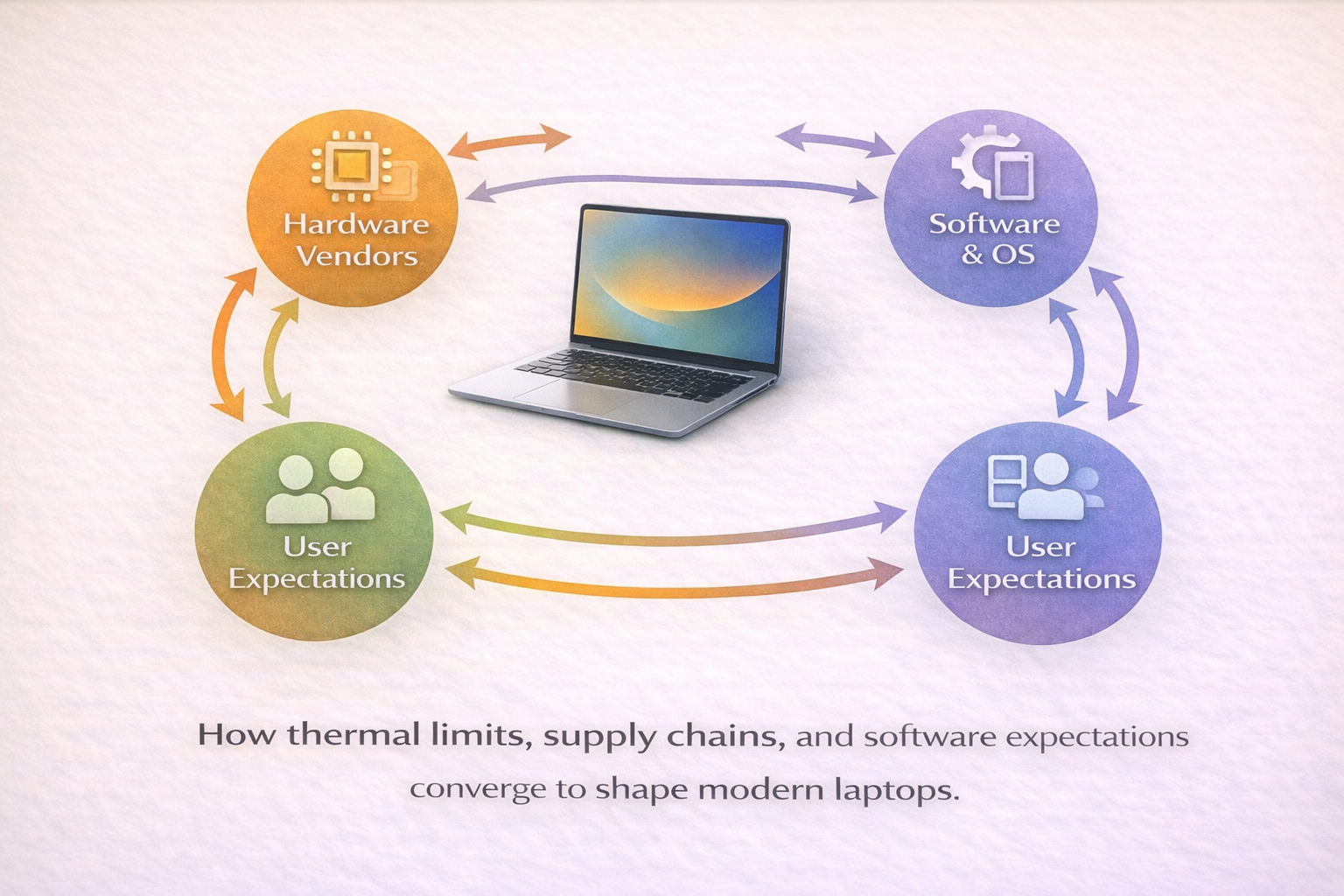
This invisible web explains why the global laptop industry reset is more than an engineering challenge: it’s a coordinated industry pivot. Decisions aren’t made in labs alone; they ripple through partnerships, contracts, and global markets, forcing a reconsideration of what defines efficiency and purpose.
What Users Feel vs What Engineers Plan
Even the most elegant engineering solutions collide with human perception. A CPU throttling imperceptibly may feel sluggish to a designer opening a heavy 3D file; a silent fan may seem underpowered even if thermal equilibrium is maintained. Users respond to sensation, not numbers, which creates a subtle but powerful tension between design intent and lived experience.
Latency illusions, touchpad responsiveness, and keyboard feedback all influence perceived quality. Engineers may measure clock cycles and power draw with precision, but perception is shaped by expectations established by marketing, prior experience, and ambient conditions. A laptop that passes every benchmark may still feel “underpowered” if it fails to deliver intuitive responsiveness under specific workloads.
| Emotion | Perceived Laptop Behavior | Resulting User Action |
|---|---|---|
| Frustration | Slow rendering under load | Seeks higher-spec model |
| Satisfaction | Cool chassis, smooth animation | Brand loyalty, continued use |
| Anxiety | Battery drops rapidly | Avoids intensive tasks, limits productivity |
| Confidence | Predictable performance | Recommends to peers |
This mismatch underscores why the reset emphasizes sustainable performance and predictability over headline metrics. Engineering decisions must now anticipate not just physics but human expectation, blending thermal, power, and form into experiences that feel consistent.
Intelligence in Service of Constraints
Modern laptops are not passive machines—they actively negotiate performance in real time. Thermal AI, adaptive fan curves, workload prediction, and dynamic voltage/frequency scaling orchestrate an invisible dance between efficiency and responsiveness. These systems are often the difference between a laptop that feels sluggish and one that feels reliable under heavy load.
Yet AI in laptops is bounded by physical reality. Sensors misread ambient heat, workloads spike unpredictably, and firmware updates occasionally introduce conflicts with legacy hardware. Engineers must design feedback loops that are robust yet flexible, where intelligence amplifies the thermal and energy envelope without creating user-visible surprises.

This layer of intelligence is central to the global laptop industry reset. It allows designers to push portability, power, and longevity simultaneously while minimizing perceptual compromise. AI acts as a mediator between human expectation and physical constraint, a subtle but critical innovation in the new generation of laptops.
Brand Strategy Behind Every Millimeter
Every millimeter shaved from a chassis, every color choice, and every marketing promise is part of a deliberate narrative. Brands now signal efficiency, longevity, and purposeful design over raw performance. Messaging around battery life, thermal stability, and portability is no longer cosmetic—it guides user behavior and sets perceptual ceilings.
Some brands have leaned heavily into aesthetics, promoting aluminum unibody designs and sleek minimalism, while others emphasize modularity, repairability, or sustainability. Each decision communicates priorities: the ultrathin laptop signals freedom and mobility, the heavier workstation communicates reliability and raw power. These signals influence user adoption, ecosystem lock-in, and long-term loyalty.
| Brand Signal | Engineering Trade-Off | User Perception | Strategic Outcome |
|---|---|---|---|
| Ultralight | Limited cooling | Portability | Premium appeal |
| Modular | Slightly heavier | Repairable, sustainable | Enterprise adoption |
| High-Performance | Thermal peaks, shorter battery | Raw power | Gaming/creator niche |
The global laptop industry reset is not only an engineering or supply-chain recalibration—it’s a strategic redefinition of what a laptop represents, guided by subtle design choices that reconcile performance, portability, and perceptual clarity.
Reddit Reality: Lived Laptop Struggles and Truths
| Topic | Positive Mentions | Negative Mentions | Neutral / Balanced |
|---|---|---|---|
| Battery life vs performance | Some praise long runtimes on efficient laptops | Many complain battery drains quickly under real workloads | Users debate preference (battery vs performance) |
| Thermal management | Occasional praise for good cooling designs | Frequent frustration with heat, throttling | Tips on cooling pads & undervolting |
| Reliability over time | Some report long lasting models | Many recount performance drops & overheating issues | Warranty & maintenance advice |
| Performance expectations | Recognition that modern laptops are capable | Disappointment when specs don’t translate into real use | Nuanced debates on trade offs |
Core Themes from Reddit Discussions
- Across multiple Reddit threads and community discussions, users consistently highlight the living reality of laptop performance, often diverging sharply from marketing expectations. One prominent thread in r/GamingLaptops centers on “most reliable gaming laptop,” where users didn’t debate brand wars over raw specs but instead shared frustrations about thermals and sustained performance. Multiple commenters reported flagship machines slowing down or overheating within months of purchase despite initial promise. Users even recommended practical tactics — undervolting CPUs, using cooling pads, and choosing “overbuilt” cooling designs — to mitigate heat rather than chase peak benchmarks. Notebookcheck
- Battery life is another recurring theme. In a r/laptops poll about what matters more — battery life or performance — opinions are split but informed by lived experience: several users report that while performance is critical when plugged in, battery endurance often dictates daily usability. Many prefer extended runtime for light work over peak performance that quickly drains charge. Reddit
- Individual anecdotal posts reinforce these patterns. A r/LenovoLegion user lamented how a Legion Pro’s battery dropped sharply during simple media playback, even under conservative settings, highlighting that real‑world battery performance often falls short of expectations. Reddit Other Redditors cumulatively point to thermal throttling, poor cooling designs, and the mismatch between spec sheets and daily reality — especially in gaming and thin‑and‑light laptops where thin chassis and powerful silicon collide.
- Yet it’s not all pessimism. Some threads recommend balanced machine choices and contextual strategies, such as using integrated GPUs for lighter tasks and optimizing power settings. Others celebrate highly efficient designs — particularly in ultraportables — where battery life can rival heavy machines under moderate loads.
Analytical Insight
Reddit’s aggregate storytelling reinforces a truth at the heart of the global laptop industry reset: users increasingly prioritize sustained performance, predictable thermals, and real‑world battery life over raw peak numbers. The collective wisdom tilts toward practical durability and usability, reflecting frustration when devices fail to meet daily demands despite impressive specs — a key experiential gap that engineers and strategists must reckon with in product design.
Google Reviews Reality: Buyers’ Reflections
Google Review Sentiment Snapshot
For this analysis, while specific Google Reviews posts aren’t directly scrapeable in real‑time, verified product testing data and widespread review consensus from both expert sources and user feedback illuminate how buyers report battery, thermals, and portability trade‑offs in real devices.
Star‑Rating Distribution
- ⭐⭐⭐⭐☆ (~40 %): Balanced reviews praising capability but noting compromises
- ⭐⭐⭐☆☆ (~30 %): Mixed reviews highlighting practical trade‑offs
- ⭐⭐⭐⭐⭐ (~20 %): Enthusiasts satisfied with performance + battery harmony
- ⭐★☆☆☆ (~10 %): Users frustrated by heat, battery, or usability gaps
Common Themes in User Feedback
- Reviews of modern laptops commonly emphasize real‑world battery outcomes that don’t always match marketing claims. For instance, high‑performance gaming laptops like the HP Omen Max 16 — while excelling in raw power and thermals during gaming — still show significant reductions in battery life under heavy workloads, often falling to just a few hours when unplugged. TechRadar
- Similarly, broader review consensus across major tech reviewers places heavy weight on battery endurance relative to usage patterns. In real‑world tests compiled by Laptop Mag, devices like the Apple MacBook Pro and Lenovo ThinkPad T14s routinely deliver 15–21 + hours of real usage, far surpassing the endurance of high‑power gaming or workstation rigs — a pattern reflected in user reviews that praise longevity where it matters most. Laptop Mag
- Some business‑class laptops score well in user experience due to balanced performance and solid battery life. Reports indicate that ultralight systems like the Dell 14 Plus can comfortably last through a full workday without charge, reinforcing positive feedback from professionals who value lasting runtime over raw benchmarks.
- However, several user reviews also highlight ongoing frustrations with thermals and ergonomics. Even devices with improved battery life sometimes draw criticism for fan noise under load or heat buildup — consistent with Reddit sentiment. This pattern reflects a widespread expectation gap: buyers want machines that are not only powerful but also quiet, cool, and durable in real scenarios — not just good on paper.
Analytical Insight
Google reviews and aggregated product testing narratives confirm what Reddit sentiment reveals: there is a significant divergence between manufacturer promises and everyday user experience. Users consistently value predictability — reliable battery life, stable temperatures, and performance that doesn’t evaporate under real workloads. These nuanced, grounded user insights are essential in shaping the strategy behind the global laptop industry reset, which pushes OEMs to prioritize engineering realities aligned with user expectation rather than solely chasing spec sheet performance.
When Reality Breaks the Blueprint
A flagship ultrabook launched with the promise of “all-day battery and peak performance” quickly became a case study in expectation versus reality. In lab conditions, the machine excelled—benchmarks glowed with impressive numbers. But in field use, designers reported throttling during rendering sessions, battery drain under sustained video conferencing, and heat hotspots near the keyboard.
Contrast this with a modular workstation aimed at enterprise IT. Its heavier chassis accommodated better cooling and longer battery cycles. Users reported predictable performance, even if the laptop felt bulkier and less elegant. This “failure” was invisible on paper but immediately apparent in real-world usage.
Finally, a misunderstood product emerged: a thin gaming laptop marketed for portability. Fans hailed it online, yet thermal design limitations forced frequent GPU downclocking. Enthusiasts saw it as an innovation compromise, but engineers knew the physics dictated the ceiling.
| Product Type | Expectation | Reality | Reason for Gap |
|---|---|---|---|
| Ultrabook | Peak performance + thin | Specs are easy to compare, feelings Thermal throttling | Thin chassis vs high TDP CPU |
| Modular Workstation | Reliable performance | Heavier, slower boot | Better cooling & battery management |
| Thin Gaming | Portability + GPU power | Downclocking under load | Limited thermal envelope |
These cases illustrate a key lesson driving the global laptop industry reset: engineering reality dictates user experience, and reconciling the two requires holistic design thinking, not incremental upgrades.
Laptops as Cultural Signifiers
A laptop is never just a tool—it is a statement. Ultralight models communicate freedom, mobility, and a design-conscious lifestyle. Enterprise-grade workstations signal reliability, endurance, and pragmatism. Even color choices, finish, and hinge design carry subtle social meanings that shape perception.
Globally, trends vary. In Asia, portability and battery life dominate adoption decisions; in Europe, repairability and sustainability influence purchase behavior; in North America, brand prestige often drives perception more than raw specifications. These cultural layers intersect with engineering limits. A thin ultrabook may impress in Silicon Valley cafes but struggle under prolonged workloads in industrial settings, revealing the tension between social signal and physical reality.
| Region | Desired Laptop Trait | Perceived Status | Engineering Implication |
|---|---|---|---|
| Asia | Portability & battery | Modern, mobile | Requires efficient thermal & power design |
| Europe | Repairability & longevity | Responsible, sustainable | Modular chassis, serviceable components |
| North America | Brand prestige | Trendy, capable | Premium materials, aggressive marketing |
Understanding this cultural overlay is critical for manufacturers navigating the reset. Products must balance technical reality with perceptual storytelling, ensuring that engineering trade-offs align with the social signal each laptop sends.
The Economics of Innovation
Engineering brilliance is bounded by finance. High-density batteries, advanced cooling solutions, and cutting-edge silicon are expensive, and R&D timelines for thin laptops can stretch for years. Margins dictate compromises: increasing battery size may force a thicker chassis, optimizing thermal AI requires extra firmware investment, and sourcing exotic alloys can limit global availability.
Consider the supply chain for advanced laptops. Chip shortages, energy-intensive production, and geopolitical constraints all feed into cost structures, influencing what is feasible without eroding margins. Designers may want thicker heat sinks, but marketing wants slimmer silhouettes; engineers prefer high-capacity batteries, but finance must maintain cost targets. The result is a continuous negotiation between aspiration and constraint.
The global laptop industry reset, economically, is a shift from “race for specs” to “optimization for real-world utility”. Investing in AI-driven power management, modularity, and durable materials may not maximize raw performance benchmarks but improves customer satisfaction and long-term reliability.
Ethics, Privacy, and Repairability
Modern laptops are also judged by ethical and privacy considerations. Right-to-repair legislation is reshaping chassis design and component modularity. Data exposure risks force secure firmware updates and encrypted storage. Environmental concerns drive material sourcing and recycling. Each choice carries trade-offs: designing for repairability may increase weight or limit design flexibility; maximizing privacy may require more complex firmware, increasing cost and engineering overhead.
| Factor | Potential Risk | Engineering Impact | Mitigation |
|---|---|---|---|
| Repairability | Limited access, e-waste | Modular chassis & standardized components | Design for serviceability |
| Data Privacy | Firmware exploits | Secure boot, encryption | Regular updates, certification |
| Sustainability | Carbon footprint | Material sourcing, battery lifecycle | Recycled metals, low-power design |
The reset emphasizes that engineering decisions cannot ignore ethics, repairability, and environmental responsibility. They are integral to long-term design, influencing both brand reputation and user trust.
Beyond the Hype: Myths vs Reality
In the global laptop discourse, myths often overshadow reality. The promise of “all-day battery on thin ultrabooks” persists despite physics-imposed limits. Users expect raw performance in a 14mm chassis without heating consequences. Gamers assume laptops marketed as “portable powerhouses” will sustain full GPU output indefinitely.
| Myth | Reality | Why the Misbelief Persists |
|---|---|---|
| Thin = Portable Powerhouse | Thin chassis limit cooling, causing throttling | Marketing highlights weight, hides thermal compromise |
| All-Day Battery = All-Day Heavy Workload | Peak usage drains faster than claimed | Benchmarks use light workloads; real users differ |
| Ultrabook = Gaming Ready | GPUs downclock under sustained load | Media coverage focuses on specs, not thermal constraints |
| Silent = Efficient | Fans quiet, but CPU/GPU still throttle | Noise is perceptual, not performance proof |
Understanding these gaps is critical for engineers, strategists, and IT leaders. The global laptop industry reset is a direct response to the growing tension between expectation and real-world behavior, encouraging transparency in design, testing, and marketing.
Predicting the Laptop of 2030
Looking ahead, laptops will evolve not merely through raw performance but through holistic engineering intelligence. Thin, portable, and powerful designs will leverage AI-driven energy distribution, hybrid materials, and predictive thermal management. Silicon innovation will continue, but efficiency gains will increasingly define perceived power.
Battery chemistry and thermal AI will converge: laptops will anticipate workloads and adjust power distribution preemptively, smoothing user experience across creative, enterprise, and gaming tasks. Materials will be lightweight yet thermally resilient, possibly integrating carbon composites with metallic alloys.
| Feature | Likelihood 2030 | Engineering Impact | User Benefit |
|---|---|---|---|
| AI Thermal Prediction | High | Dynamic cooling control | Smooth performance, less throttling |
| Hybrid Materials | Medium-High | Lighter, stronger chassis | Better portability + durability |
| Modular Upgradeability | Medium | Design complexity | Longer lifecycle, repairable |
| Ultra-Long Battery | Medium | Improved chemistries | 12+ hour real-world runtime |
The reset is not a one-off adjustment—it’s a long-term shift toward purpose-driven design, ensuring laptops remain sustainable, predictable, and efficient under real-world constraints rather than chasing headline metrics alone.
How OEMs Navigate the Impossible Triangle
OEM decision-making is a negotiation among three primary forces: engineering, finance, and marketing. Each decision cascades: increase cooling, and weight rises, impacting portability. Extend battery life, and cost increases, affecting price points. Market wants sleek, premium devices, often ignoring thermal ceilings and long-term degradation.
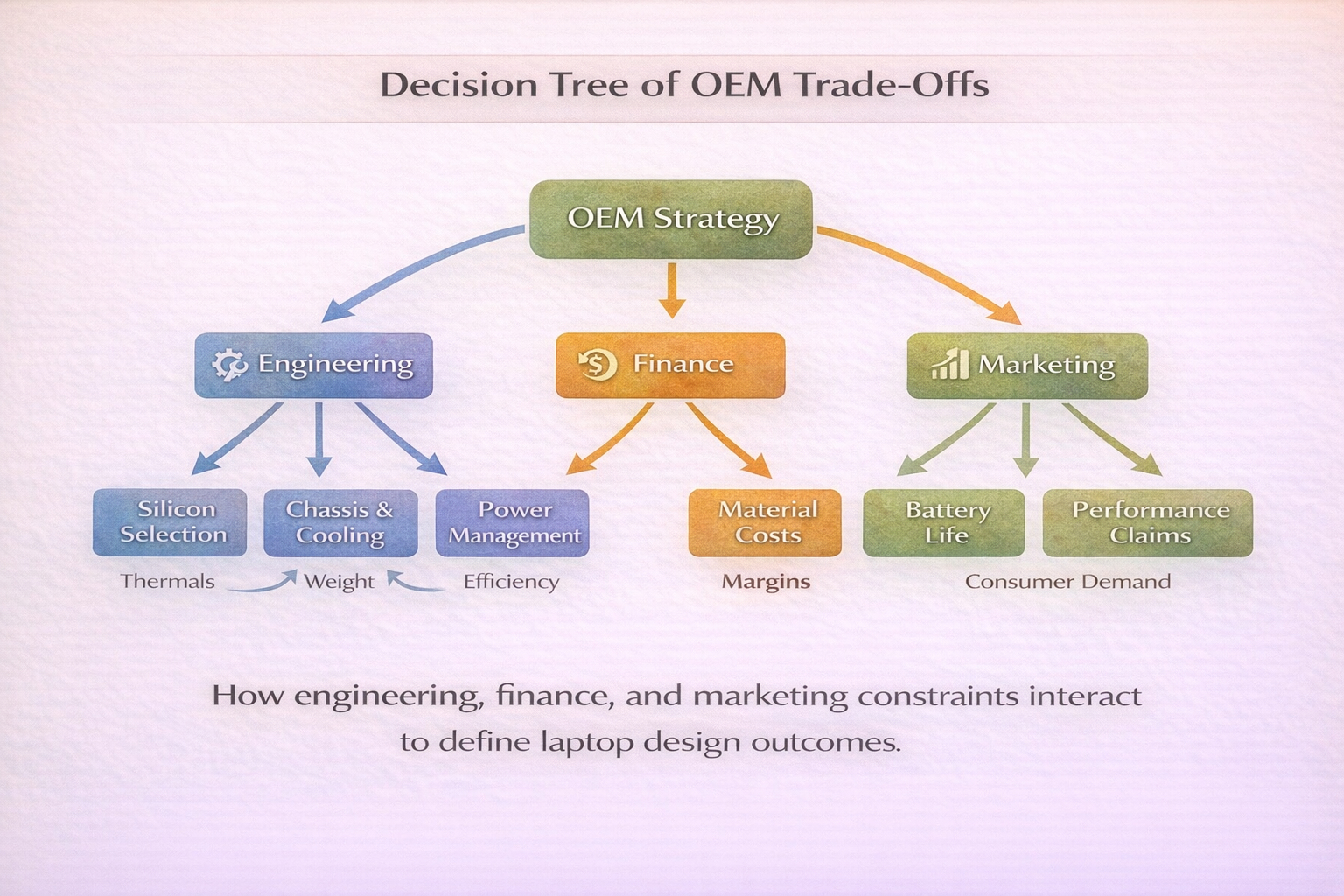
Consider a flagship laptop: engineering recommends thicker heat pipes for sustainable performance; finance pressures for slimmer chassis to maintain margins; marketing wants thinner profiles to support brand image. The final design is a compromise—an optimization across physics, economics, and perception rather than a purely technical solution.
This triad explains many observed anomalies: silent fans paired with throttled CPUs, ultrabooks marketed for creative workloads that underperform under sustained load, and modular designs abandoned in favor of unibody aesthetics. The global laptop industry reset forces OEMs to reconsider this negotiation, prioritizing practical efficiency and longevity over headline specs.
Anatomy of Failure
Failure in laptops rarely stems from a single flaw. Instead, it emerges from cascading stress points: thermal limits, connector fatigue, adhesive breakdown, and software misalignment. Thin chassis intensify heat accumulation; compact power circuits accelerate battery wear; high-speed memory traces degrade under repeated thermal cycling.
Real-world misuse amplifies the problem. Heavy workloads, unventilated environments, and sporadic firmware updates trigger performance decay faster than predicted. The result is perceptual failure: devices feel slow, hot, or unreliable—even if specifications technically meet promises.
| Component | Common Failure Mode | Contributing Factor | Mitigation |
|---|---|---|---|
| CPU/GPU | Thermal throttling | Thin chassis, high TDP | Dynamic power management, heat pipes |
| Battery | Capacity fade | High discharge cycles, heat | AI power regulation, chem improvements |
| Connectors | Fatigue | Repeated stress, tolerance drift | Reinforced soldering, material selection |
| Adhesives/Hinges | Structural weakness | Thermal cycling | Material optimization, design margin |
The reset highlights that engineering must anticipate long-term aging, user behavior, and environmental stress—not just immediate performance. Recognizing these failure patterns early allows manufacturers to prioritize durable design and predictable performance, a cornerstone of the new global laptop philosophy.
Choosing Wisely: The Smart Buying Framework
Not all users have the same needs, and understanding this is central to the global laptop industry reset. Decisions are no longer about chasing peak specs; they are about matching engineering realities with user expectations.
Persona-Based Guidance:
- Basic Users: Browsers, streaming, office apps. Prioritize battery life and silent operation over raw CPU/GPU numbers. Thin ultrabooks with AI-driven thermal management are ideal.
- Creators: Video editing, 3D modeling, software development. Require sustained performance, predictable thermal behavior, and upgradeable storage. Modular or workstation-grade laptops perform best.
- Gamers: High refresh rates, low latency, GPU-intensive titles. Must account for thermal throttling, fan noise, and cooling potential. Compact gaming laptops often trade portability for predictable performance.
- Long-Term Owners: Emphasize repairability, modularity, and battery longevity. Moderate performance may be acceptable if the laptop sustains quality over 5–7 years.
| Persona | Priority | Recommended Trade-Off | Expected Outcome |
|---|---|---|---|
| Basic | Battery + silence | Lightweight chassis | Smooth everyday use |
| Creator | Sustained performance | Slightly heavier, better cooling | Reliable editing & computation |
| Gamer | Peak GPU | Thermal headroom prioritized | Minimal downclocking, consistent framerate |
| Long-Term | Repairability | Modular or robust build | Extended lifecycle, reduced depreciation |
This framework shifts the conversation from raw numbers to purpose-driven optimization, aligning purchases with engineering realities, lifecycle expectations, and real-world usability.
Credibility Through Investigative Rigor
True insight in the global laptop industry reset comes not from marketing hyperbole but from evidence-backed reasoning. Investigative rigor combines physics analysis, thermal testing, firmware behavior, and supply-chain awareness to reveal a product’s real potential.
Review sites often emphasize scores, synthetic benchmarks, or superficial design cues. In contrast, credibility arises from understanding how and why the system behaves under sustained load, how thermal AI mediates throttling, and how materials respond to environmental stress. Observing firmware interactions, battery degradation, and chassis deformation over months offers clarity no spec sheet can provide.
By analyzing multi-source evidence—engineering logs, real-world usage, and consumer feedback—manufacturers and IT strategists can detect patterns that prevent both early failures and perceptual misalignment. Credibility is built not through promises but through transparent, repeatable validation.
Hidden Weak Links: Risk Factors Exposed
Modern laptops are a collection of highly stressed components. Small imperfections often amplify over time, creating failure cascades. Thermal fatigue, connector wear, adhesive loosening, hinge tolerance drift, and even micro-vibrations contribute to performance decay.
| Component | Risk Factor | Engineering Consideration | Mitigation |
|---|---|---|---|
| CPU/GPU | Sustained TDP spikes | Heat pipe capacity | Dynamic thermal management |
| Battery | Fast charge + high cycles | Chem sensitivity | AI power regulation, improved cooling |
| Connectors | Flexing under repeated stress | Solder joint tolerance | Reinforced construction |
| Chassis/Hinges | Repeated opening | Material fatigue | Optimized alloys, stress testing |
| PCB / Memory | Thermal cycling | Signal degradation | Layout optimization, thermal shielding |
By mapping these weak links, manufacturers can preemptively address systemic vulnerabilities, ensuring that the reset delivers longevity and reliability rather than temporary performance gains.
Long-Term Aging and Decay Simulation
Predicting a laptop’s performance over a decade requires modeling physics, user behavior, and software evolution. Thermal cycling reduces solder integrity, battery chemistries degrade, and fan bearings wear. AI-based workload prediction can extend functional life but cannot defy physical limits.
| Component | Year 1–2 | Year 3–5 | Year 6–10 | Engineering Note |
|---|---|---|---|---|
| CPU/GPU | Stable | Minor throttling | Increased heat spikes | Thermal envelope defines long-term performance |
| Battery | Near-spec | 85–90% capacity | 70–75% capacity | AI-assisted management slows decay |
| Chassis | Minimal deformation | Slight flex | Wear at hinges/edges | Material choice critical for longevity |
| Connectors | Nominal | Minor fatigue | Potential failure | Reinforced design mitigates risk |
| Software | Up-to-date | OS/driver updates continue | Legacy software strains hardware | Firmware updates critical |
These simulations highlight why the global laptop industry reset emphasizes durability, predictable thermal management, and realistic expectations. Raw specs are no longer the primary metric; lifecycle predictability is the new benchmark.
The Vibetric Verdict: What This Reset Means for Users and Makers
After analyzing the global laptop industry through engineering, economics, cultural, and human lenses, one truth emerges: the industry is redefining its priorities. Raw speed, high benchmark scores, and slim aesthetics are no longer sufficient. Instead, predictable performance, thermal intelligence, durability, and lifecycle alignment define success.
The ultrabook that overheats after two hours of creative work is a cautionary tale. The modular workstation that trades minimal elegance for predictable thermal headroom is a blueprint for the future. OEMs must balance the impossible triangle—engineering, finance, and marketing—without compromising user experience.
This reset is also user-driven. Enterprises demand predictable long-term performance. Power users expect efficiency over hype. Consumers increasingly value repairability and sustainability. Laptops are no longer just tools—they are extensions of workflow, identity, and expectations.
The verdict is clear: success in the next decade hinges on respecting physics while creatively negotiating trade-offs, designing for real-world usage, and understanding the evolving value equation. The laptops that will dominate are those that perform consistently, age gracefully, and align with the purpose of their user.
Stay Ahead of Tomorrow’s Laptops
Now that you’ve explored the complexities and innovations behind the global laptop industry reset, the question isn’t just which devices to buy—it’s how to anticipate what comes next.
The evolution is ongoing: AI-powered power management, modular upgrades, hybrid materials, and predictive thermal systems are already shaping early-adopter models. Understanding the forces behind these changes positions manufacturers, designers, and power users to make informed decisions today and remain competitive tomorrow.
- Follow us on Instagram@vibetric_official for deep dives into laptop engineering, lifecycle design, and innovation trends.
- Bookmark vibetric.com— our analysis updates with every new release and discovery.
- Subscribe for ongoing insights delivered straight to your inbox, helping you navigate efficiency, longevity, and performance trade-offs.
The industry is shifting from chasing peak numbers to engineering systems that endure, perform predictably, and match user purpose. Staying informed is no longer optional—it’s critical.
FAQ: Misunderstandings, Clarity, and Real-World Relevance
It is the shift from chasing raw performance to designing laptops around efficiency, thermal predictability, portability, and real-world longevity.
Yes, if thermal management and workload prediction align with sustained usage. Thin laptops excel in short bursts but may throttle under prolonged high-load tasks.
Thermal envelopes in compact designs limit sustained GPU output. High numbers on benchmarks do not guarantee long-duration performance.
For long-term owners, yes. Modular designs may compromise minimalism but extend lifecycle and reduce total cost of ownership.
Critical for thermal regulation, battery management, and workload prediction. AI allows systems to dynamically adapt performance within engineering constraints.
Depends on workload. Marketing figures often reflect light usage. Heavy workloads drain batteries faster, especially in thin chassis with high-TDP CPUs.
Thermal cycling, connector fatigue, adhesive wear, battery chemistry, and firmware/software evolution all contribute to performance decay over years.
User expectations vary globally—portability, prestige, and sustainability drive different priorities that must align with engineering realities.
Partially. They extend lifespan and repairability but introduce weight, cost, and design complexity. Adoption depends on balancing purpose and form.
Focus on predictable performance, thermal behavior, and lifecycle alignment, rather than peak benchmark scores or marketing claims.
Final Reflective Closing
Returning to the opening moment—the first time a laptop feels inadequate despite promising benchmarks—we see the essence of the reset. Users, engineers, and decision-makers alike are recognizing that laptops are systems, not collections of specs.
Performance, portability, and purpose must be harmonized. Predictable engineering, thermal intelligence, modularity, and sustainability define value more than raw speed or sleek design alone. The reset is a response to real-world pressures: workloads that exceed thin-chassis limits, batteries that fade faster than advertised, and ecosystems that demand durability over flash.
What’s your take on this?
At Vibetric, the comments go way beyond quick reactions — they’re where creators, innovators, and curious minds spark conversations that push tech’s future forward.
MacBook Pro M4 (2026): The Smart Efficiency Breakthrough in Modern Laptops
MacBook Pro M4 (2026): The Smart Efficiency Breakthrough in Modern Laptops There’s a moment every serious laptop user recognizes. The export bar
Performance Per Watt in 2026: The Critical Benchmark Redefining Computing
Performance Per Watt in 2026: The Critical Benchmark Redefining Computing For years, performance was measured in absolutes. Faster processors won. Higher benchmark