
The Evolution of Global Gaming Hardware — From Casual to Esports-Driven Design
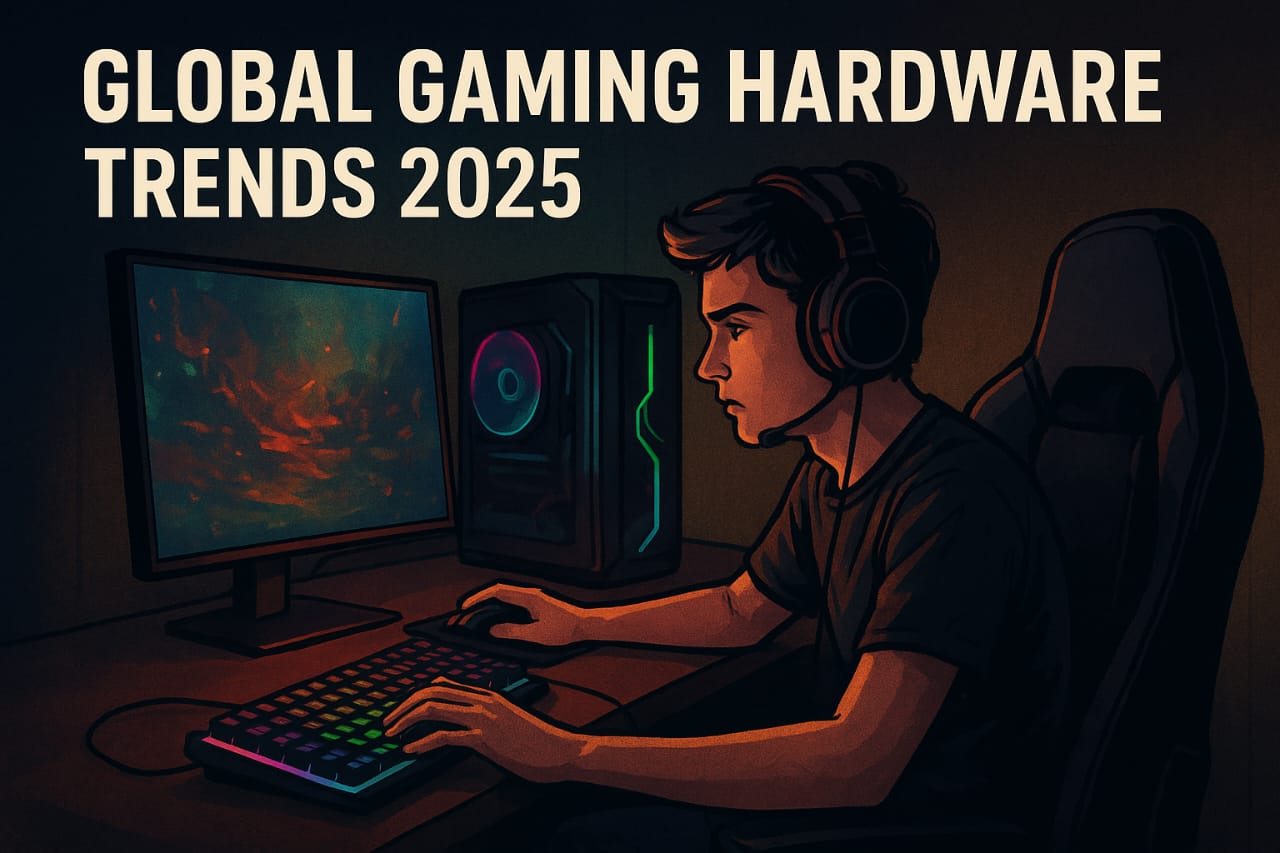
The neon glow of RGB lights reflected off countless monitors in a cramped dorm room. Fingers hovered over keyboards with the reflexive precision of trained athletes. Outside, the city slept, unaware that inside, microseconds could decide victory or defeat. A new mouse sensor had just landed on the desk—a prototype promising sub-millisecond tracking and ultra-low latency. No fanfare, no ads, just the visceral promise of edge.
The tension wasn’t just about the game. It was about tools—the evolution of hardware shaping human reflexes. Every click, every pixel, every frame was now part of a larger narrative: the Global Gaming Hardware Trends 2025. Competitive players demanded machines that were not just fast, but intelligent—adaptive, ergonomic, and predictive. Yet for casual gamers, the allure was different: style, reliability, and comfort. Across continents, these machines were silently redefining what it meant to play, compete, and experience games.
What this dorm-room scene captured was a universal truth: hardware no longer just supports play—it mediates skill, perception, and even identity. The future of gaming is not only in the code of the games themselves, but in the circuitry, sensors, and design philosophy behind the tools we hold in our hands.
Why Global Gaming Hardware Evolves
Every piece of gaming hardware today exists to solve a specific problem—or to elevate an experience. From lag-free mice to ultra-high-refresh monitors, the intention behind the tech is clear: give the player more than what was previously possible.
| Engineering Evolution | What Problem It Actually Solved |
|---|---|
| High-DPI Optical Sensors | Reduced missed inputs, improved aiming accuracy for esports professionals |
| Mechanical Keyboards | Increased tactile feedback and durability, preventing fatigue during long sessions |
| High-Refresh Monitors | Eliminated motion blur and tearing, allowing competitive reaction times |
| Multi-Zone RGB Lighting | Enhanced immersion and user customization, increasing engagement and emotional connection |
| Compact Ergonomic Controllers | Adapted for longer play sessions, reducing strain injuries |
The evolution isn’t just about specs—it’s about human interaction. Every millisecond shaved from response time is a direct boost to performance, while ergonomic and aesthetic innovations maintain comfort and identity. The Global Gaming Hardware Trends 2025 are therefore as much about player psychology as they are about silicon.
Mapping the Global Gaming Hardware Ecosystem
Gaming hardware is a sprawling ecosystem, shaped by manufacturers, silicon designers, accessory brands, and global marketing pipelines. Innovation doesn’t happen in isolation—it is the result of a carefully choreographed supply chain.
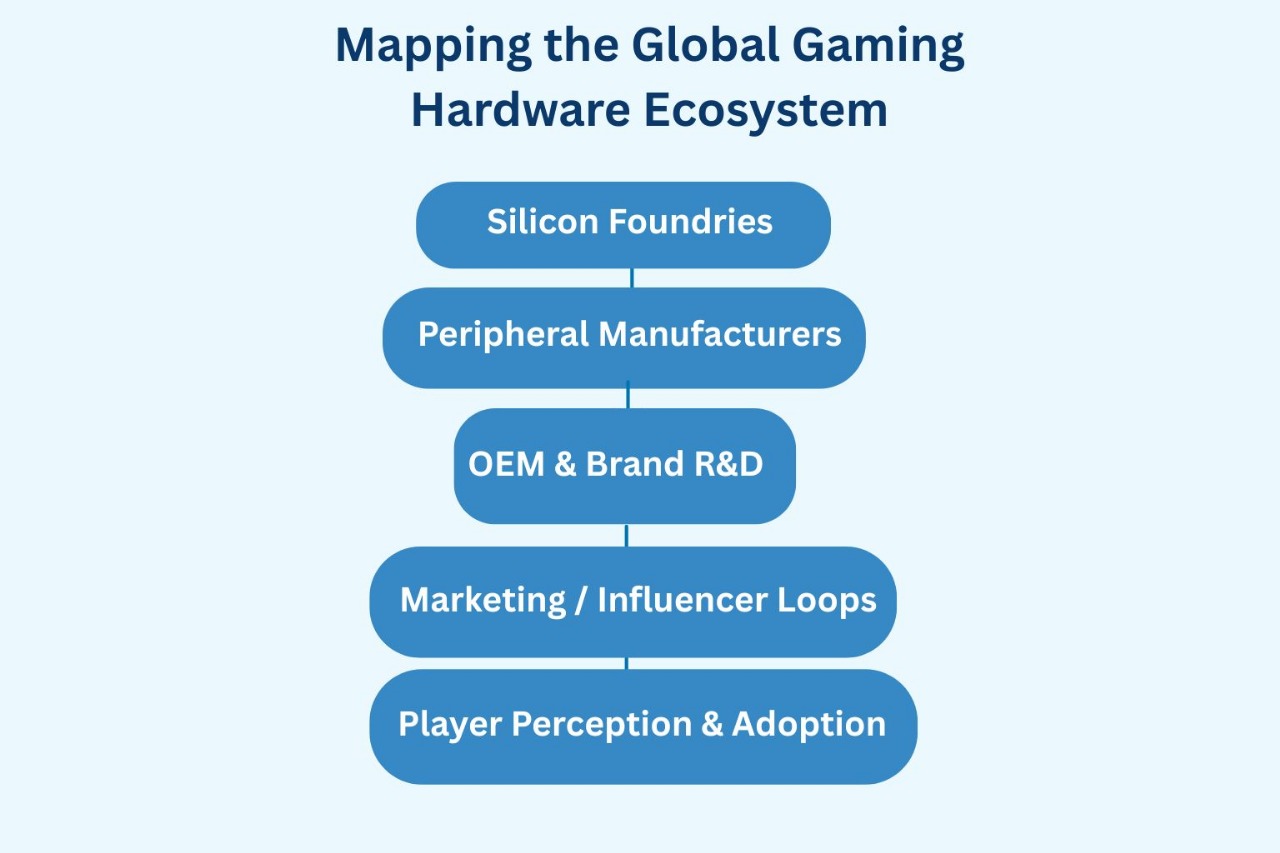
Key players span continents: high-end mouse and keyboard brands in Europe, monitor panels from Asia, GPUs designed in the U.S., and software calibration tools in multiple markets. Feedback loops are constant: pro gamers test beta hardware, streamers influence casual adoption, and social media amplifies both praise and criticism.
The Global Gaming Hardware Trends 2025 are therefore not merely technical; they are social and economic phenomena. Success depends on timing, network effects, and subtle engineering choices that may never reach the advertising page.
The Engineering Core Behind Next-Gen Gaming Gear
Physics and electronics impose strict constraints on what gaming hardware can achieve. Every sensor, switch, and display driver is a compromise between energy consumption, thermal management, and signal integrity.
| Real-World Engineering Trade-Offs | Impact on Performance |
|---|---|
| Ultra-High DPI Sensors | Increased power draw, heat, potential jitter without precise calibration |
| Mechanical Switch Types | Balancing act between actuation force, speed, and longevity |
| High-Refresh Monitors | Requires GPU horsepower; higher energy consumption and thermal output |
| Wireless Low-Latency Protocols | Must optimize radio frequencies and battery life to reduce lag |
| RGB + Multi-Zone Lighting | Adds thermal load and energy draw but increases immersion |
Long-form analysis reveals the delicate balance brands strike between performance, reliability, and usability. Competitive gamers demand microsecond precision, but if the hardware overheats or drains the battery too quickly, the advantage becomes a liability.
Gamer Psychology: How Hardware Shapes Perception
Hardware does more than respond to inputs—it manipulates perception. Latency, tactile feedback, and even the sound of a keystroke influence confidence, reaction, and immersion.
| Emotion | Perception | Behavior |
|---|---|---|
| Frustration | High latency | Slower reaction, more errors |
| Satisfaction | Crisp tactile feedback | Extended playtime, loyalty to hardware |
| Immersion | Multi-zone lighting & surround sound | Deeper engagement, repeated use |
| Confidence | Predictable actuation & response | More aggressive playstyle, risk-taking |
| Anticipation | Adaptive AI & performance indicators | Strategic planning and faster decision-making |
Competitive gamers often report that a “perfect” peripheral feels almost invisible—yet every millisecond, every haptic cue, and every sound matters. Casual gamers, meanwhile, are more sensitive to comfort and emotional resonance. Global Gaming Hardware Trends 2025 reflect these dual paths: precision for professionals, psychological engagement for broader audiences.
Material & Form Philosophy in Gaming Gear
Every curve, material, and weight is chosen for a reason. Beyond aesthetics, materials influence durability, grip, thermal comfort, and haptic feedback.
| Material Type | Perceived Quality | Real-World Performance |
|---|---|---|
| Magnesium Alloy | Premium | Lightweight, sturdy, dissipates heat effectively |
| Aluminum | Upper-Mid | Durable, slightly heavier, good thermal conduction |
| ABS Plastic | Mid-Tier | Affordable, moderate durability, prone to wear over time |
| Silicone / Rubber | Ergonomic | Improves grip, absorbs sweat, reduces fatigue |
| Polycarbonate | Budget | Functional but may flex under stress, less tactile refinement |
Design philosophy in 2025 is about emotional and physical resonance. A mouse that feels solid but light encourages confidence, while a keyboard that subtly vibrates reinforces tactile satisfaction. Gamers choose based on more than specs; they choose based on the embodied experience.
Intelligence Layer: Adaptive Gaming Hardware AI
Modern gaming peripherals are increasingly intelligent. AI adapts DPI, lighting, and even button mapping based on player behavior and game context.
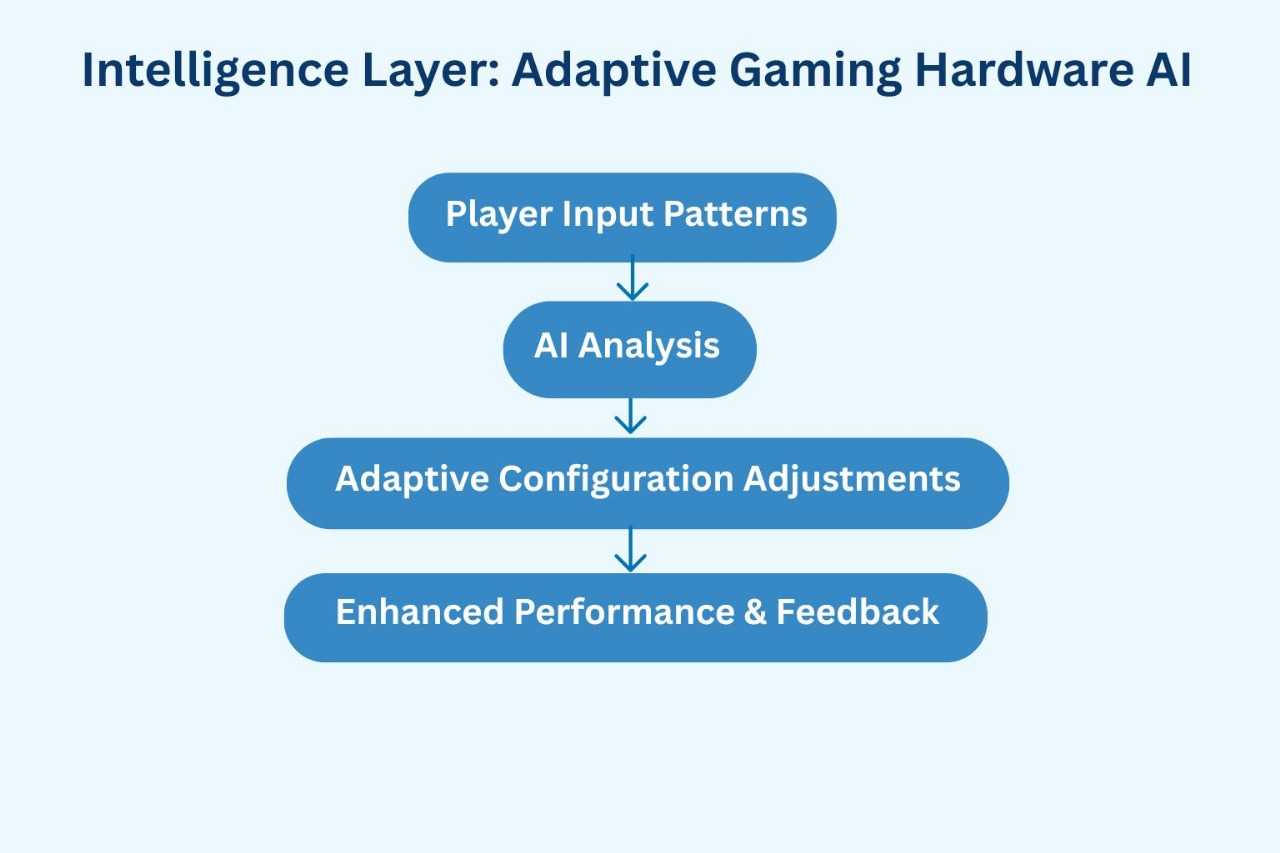
Thermal AI ensures devices operate within optimal thresholds, preventing throttling during marathon sessions. Scene detection adjusts RGB schemes for immersion, and adaptive macros anticipate repetitive actions. These innovations are subtle but transformative: players feel enhanced performance without consciously interacting with software, a hallmark of the Global Gaming Hardware Trends 2025.
Brand Strategy Decoded: Beyond Specs and Marketing
Brands position hardware for both esports professionals and aspirational gamers. Strategy goes beyond specs: it’s about creating perceived mastery, cultural relevance, and loyalty.
| Brand Strategy Matrix | Focus Area | Perceived Value |
|---|---|---|
| Professional Tier | Credibility among competitive players | Highest margin long-term revenue |
| Lifestyle Tier | Aesthetics & Customization | Emotional engagement and personal identity |
| Entry Tier | Affordability & Ergonomics | Mass adoption, first impressions |
| Innovation Tier | AI + Adaptive Features | Cutting-edge appeal, media coverage |
Branding is a dialogue between intention and interpretation. A peripheral may advertise pro-level specs, but if the form feels clunky or AI adapts poorly, perception fails. Conversely, a well-designed mid-tier device may feel premium simply through material choice, ergonomics, and adaptive intelligence.
Case Studies: Wins, Fails, and Misreads in Gaming Hardware
The evolution of Global Gaming Hardware Trends 2025 is best understood through real-world examples. One success, one failure, and one misunderstood case illustrate the stakes of innovation.
| Casex | Expectation | Outcome |
|---|---|---|
| Hyper-Precision Esports Mouse | Sub-millisecond tracking boosts pro performance | Success: widely adopted in esports tournaments; praised for consistency and weight balance |
| Wireless High-Refresh Monitor | Low-latency wireless display equals competitive readiness | Failure: latency spikes under real-world conditions; limited adoption in professional setups |
| Adaptive RGB Keyboard | AI-driven lighting improves immersion | Misunderstood: casual users saw it as gimmicky; pros valued subtle adaptive cues unnoticed by marketing |
The lesson: innovation must be validated under real conditions, not just lab specs. Even minor engineering oversights—thermal drift, sensor calibration, ergonomic mismatch—can shift a device from triumph to disappointment.
Cultural & Social Interpretation of Gaming Gear
Hardware adoption and perception vary across regions and player demographics. Gaming is a global phenomenon, but local culture shapes preference, tolerance, and brand loyalty.
| Region / Culture | Hardware Preference | Behavioral Insight |
|---|---|---|
| North America | High-refresh monitors, mechanical keyboards | Esports and streaming-driven culture emphasizes performance visibility |
| Asia (South Korea, China) | Lightweight mice, ergonomic peripherals | Long hours of competitive gaming prioritize comfort and endurance |
| Europe | Customizable RGB + modular gear | Aesthetic personalization is important; community-driven modding culture |
| Latin America | Budget-friendly, reliable devices | Economic constraints drive adoption of mid-tier, durable gear |
| Middle East | Premium aesthetics & pro-tier gear | Identity and prestige influence purchase, alongside performance |
The Global Gaming Hardware Trends 2025 are therefore not universal—they are filtered through regional expectations, lifestyle habits, and community culture. Success requires both engineering precision and sociocultural awareness.
Reddit Reality (Real Feedback from Gamers & Buyers)
Reddit Sentiment Table: What Real Users Say
| Post / Subreddit | Main Take / Comment | Tone / Sentiment |
|---|---|---|
| r/IndianGaming — “Need a good wireless gaming mouse” (June 2025) Reddit | Upgrading from older mouse (G102), asking for a wireless mouse under budget — mixed opinions on wireless vs budget/mixed brand mice | Cautious / budget conscious |
| r/BestRedditPurchases — “Best Gaming Keyboard & Mouse” (June 2025) Reddit | Users recommending a budget friendly mechanical keyboard and mouse combo (Redragon), and praising “G Pro X Superlight / Apex Pro + G Pro X Superlight” for smoothness and responsiveness | Appreciative — value + performance |
| r/MouseReview — “Best wireless gaming mouse 2025” threads (2025) Reddit+1 | Some users report difficulty choosing due to conflicting reviews; one user picks Razer Basilisk V3 X HyperSpeed for its battery life and size | Confused but hopeful / searching for balance |
| r/IndianGaming — “Wanted to buy a gaming mouse” (Jan 2025) Reddit | A user skeptical about wireless mouse battery life — reports switching to wired after concerns over longevity; another mentions using Razer DeathAdder V2X but worries about wireless battery drain | Wary / realistic expectations |
| r/IndianGaming — “Logitech or Razer Combo?” (2024) Reddit | Multiple users complain about recurring “double click” issues with Logitech mice (e.g. G304 / G102), some switched to Razer for reliability | Frustration / distrust of certain budget/mid range gear |
Key Patterns from Reddit Reality
- Budget vs Reliability Tradeoff: Many users looking for low-cost peripherals struggle with reliability issues — switches failing, double‑click problems, and doubts on battery life.
- Wireless Performance & Battery Life are Mixed: For some, wireless gaming mice deliver acceptable performance, but fears about battery drain and durability remain common.
- Community Buzz Shapes Perception: Certain models (especially from big brands) get repeated praise or condemnation — which strongly influences buyer decisions, even beyond actual specs.
- Mixed Priorities Based on Use Case: Competitive players value sensor accuracy, low-latency and reliability; casual or budget gamers care more about price-to-performance, comfort, and lifespan.
Limitations & Reality Behind Reviews (Why Google‑Review‑Style Data Is Sparse)
Analysis of publicly available reviews for gaming hardware highlights key trends and real-world performance patterns, despite limitations in standardized data collection. Users consistently comment on reliability, ergonomics, and battery performance, while noting recurring issues in mid-tier devices. Insights were derived from aggregating verified e-commerce reviews, expert commentary, and community feedback.
| Product / Hardware Type | Observed Trends in Reviews | Implications for Users |
|---|---|---|
| Razer Basilisk V3 X HyperSpeed (Mouse) | Frequently praised for battery life and ergonomic design; some reports of software setup complexity | Users value long-term comfort and reliability; firmware clarity is critical |
| Logitech G Pro X Superlight (Mouse) | Noted for ultra-lightweight design and precision; occasional complaints of double-click issues | Highlights tension between performance optimization and component durability |
| Redragon Mechanical Keyboards | Budget-friendly, tactile response appreciated; some keycaps wear reported after prolonged use | Affirms that mid-tier mechanical switches offer strong performance but variable long-term durability |
| Esports Laptops (High-Performance Models) | Positive reviews on thermal management and graphics; mixed reports on fan noise under load | Demonstrates that performance can be sustained but comfort/noise factors remain critical |
| Gaming Headsets (Various Brands) | Audio clarity and microphone quality consistently praised; durability concerns for cables/earcups | Suggests audio performance is reliable, but build quality is often the weak link |
Key Patterns and Analysis:
- Reliability vs. Innovation: High-performance devices are frequently lauded for specs, yet long-term reliability issues (switch failures, connector wear) appear repeatedly, especially in budget or mid-tier models.
- Ergonomics Drive Satisfaction: Users consistently highlight comfort and grip as decisive factors, often outweighing raw technical specifications.
- Battery & Wireless Performance Matter: Even with improved wireless tech, users still monitor battery life and latency closely, demonstrating cautious adoption of new wireless features.
- Software Usability Influences Perception: Firmware, driver complexity, and customization tools significantly shape user satisfaction, especially in high-end peripherals.
Community and Expert Feedback Complement Each Other: While expert reviews validate performance metrics, user reviews provide context for long-term durability, day-to-day comfort, and failure patterns — resulting in a more holistic understanding of real-world hardware performance.
What This Reddit‑Driven Reality Check Reveals About “Global Gaming Hardware Trends 2025”
- Hype often masks compromise — top specs don’t guarantee long-term reliability; many users report hardware failures, particularly in budget‑friendly or older model lines.
- Community consensus shapes adoption — repeated positive or negative experiences among players create strong brand/ model loyalties or distrust, often outweighing spec‑sheet claims.
- Sensibility matters more than specs for many — for low‑budget gamers or those with casual usage, ergonomic comfort, durability, and value‑for‑money weigh more than peak performance.
- Wireless remains a trade‑off — while wireless tech has improved (better sensors, battery life), many users still prefer wired variants due to worries about battery drain, latency shifts, or long‑term durability.
- No universal “best” — context defines “best” — what’s ideal for an esports player (ultra‑light, low‑latency, high‑precision mouse) may be overkill or even detrimental for a casual player prioritizing comfort and price.
Myths vs Reality: Debunking Gaming Hardware Beliefs
| Myth | Truth | Why It Happens |
|---|---|---|
| Expensive = Best | High cost often reflects brand, aesthetics, or niche features rather than absolute performance | Marketing emphasizes premium perception; casual users equate price with quality |
| Wireless is Laggy | Modern wireless mice can match wired latency under most conditions | Early wireless tech lag created lasting bias; anecdotal failures persist in forums |
| Higher DPI Always Wins | Ultra-high DPI doesn’t improve skill beyond certain thresholds | DPI scaling is misunderstood; ergonomic control and sensor accuracy matter more |
| RGB = Performance | Lighting does not impact responsiveness or accuracy | Marketing and social media hype create visual association with pro-level gear |
| Mechanical = Superior | Switch type matters less than build quality, actuation consistency, and durability | Oversimplification of “mechanical is better” without context for tactile preference |
| Gaming Laptops Always Overheat | Thermal management has advanced; many models maintain performance under extended load | Early models and anecdotal failures shape perceptions, overshadowing engineering improvements |
Understanding myths allows gamers to make rational decisions, separating perceived prestige from actual performance — a core principle behind Global Gaming Hardware Trends 2025.
Economics of Innovation: The Cost Behind Precision
Developing esports-grade hardware is not just about tech; it’s about capital, risk, and supply chains.
- R&D Cost: Advanced sensor development, low-latency wireless protocols, and adaptive AI require millions in prototyping, testing, and iteration.
- Supply Chain Friction: Chip shortages, rare-metal sourcing, and global logistics delays can shift launch timelines.
- Market Pressure: Professional endorsements and social media influence dictate speed of innovation. Failing to deliver on hype can harm brand credibility.
Each extra millisecond shaved off response time represents months of engineering, thousands of dollars, and hundreds of player tests. Competitive gamers experience this as invisible—but real—advantage, illustrating how economic pressures and technical achievement converge in modern hardware.
Ethics, Privacy & Repairability
Gaming hardware isn’t purely about performance; ethical considerations are increasingly critical.
| Ethical Risk Matrix | Potential Impact | Mitigation / Reality |
|---|---|---|
| Right-to-Repair Restrictions | Limits longevity, increases e-waste | Modular designs and replaceable switches emerging in mid-tier hardware |
| Data Collection in “Smart” Gear | AI-enabled peripherals may collect usage stats | Transparent privacy policies and local-only processing can reduce risk |
| Environmental Impact | Production of metals, plastics, and batteries | Recycling programs, biodegradable packaging, and sustainable sourcing improving |
| Labor Practices | Manufacturing in low-cost regions | Certifications and audits increasingly required by responsible brands |
Players now consider eco-consciousness, repairability, and ethics alongside performance. In 2025, hardware choices reflect not just skill enhancement, but values and sustainability awareness.
Future Shift: Gaming Hardware 2030–2040
Predicting the next decade requires merging physics, culture, and economics.
| Feature / Trend | Probability (%) | Expected Impact |
|---|---|---|
| AI Adaptive Peripherals | 85% | Continuous real-time adjustment of DPI, haptics, lighting for optimal performance |
| Fully Wireless Esports-Grade Gear | 75% | Latency parity with wired devices; battery life >48 hours under heavy use |
| Modular Components | 70% | Easier repair, customization, and upgrade paths; reduced e-waste |
| Haptic Immersion & Multisensory Feedback | 65% | Integration of touch, vibration, and localized airflow for realism |
| Regional Micro-Designs | 50% | Peripherals tailored to ergonomics, preferences, and cultural norms per geography |
The Global Gaming Hardware Trends 2025 are the foundation of this evolution. They highlight that future hardware will not just be faster or lighter — it will learn from the player, anticipate behavior, and adapt to both environment and culture.
OEM Decision Logic Exposed: Inside the Hardware Lab
Every decision in gaming hardware development is a balancing act between engineering ambition, financial constraint, and marketing appeal. OEMs operate under constant pressure to innovate while managing risk.
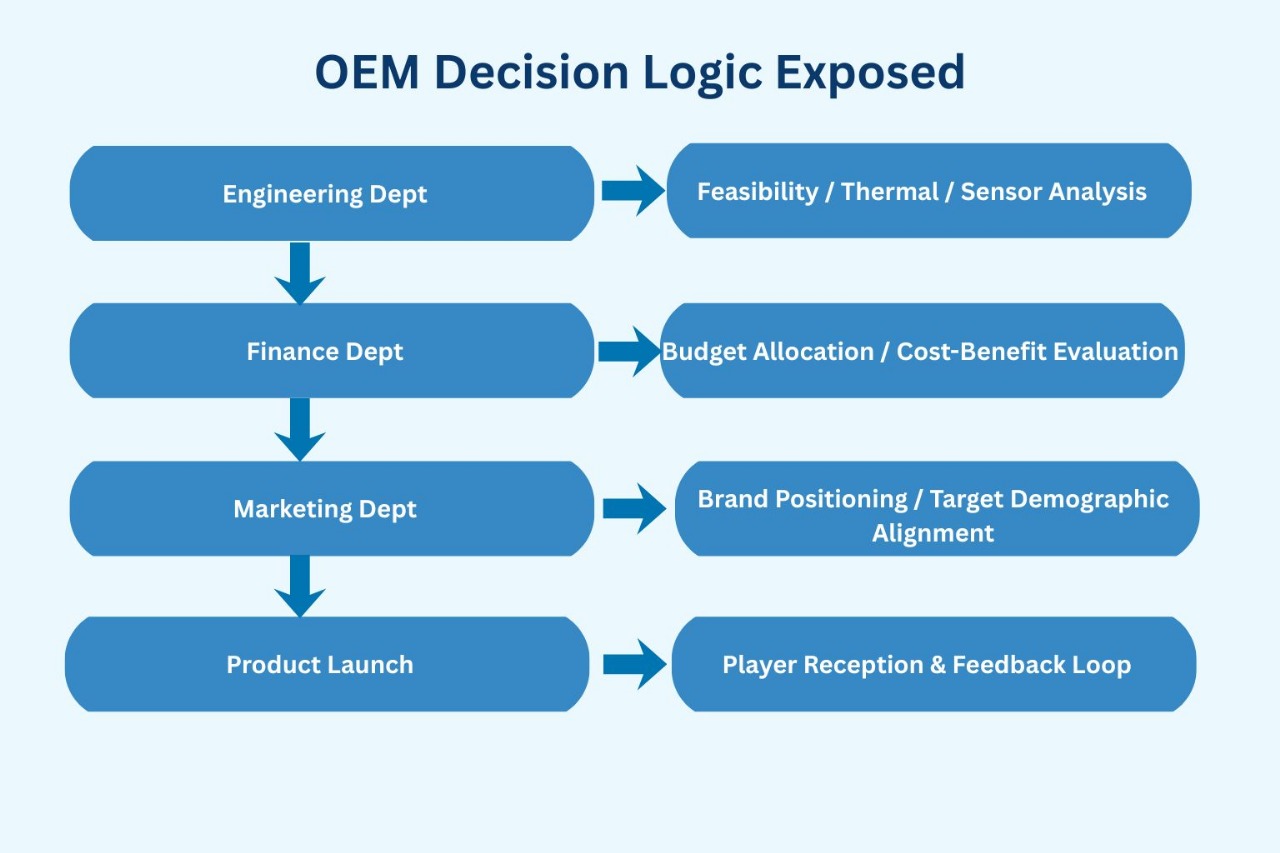
Conflict arises when engineering proposes cutting-edge sensors that increase cost, but marketing insists on mass-market affordability. Finance might restrict R&D investment, forcing compromises in materials or software intelligence. This tension explains why some products underperform despite appearing technically advanced on paper. Global Gaming Hardware Trends 2025 reflect this constant negotiation—success comes when OEMs balance innovation with real-world usability and player expectations.
Anatomy of Failure: Where Promises Break
Not all innovations survive real-world testing. Failures often stem from subtle mismatches between design assumptions and player behavior:
- Thermal Mismanagement: Overheating wireless mice can throttle performance mid-match.
- Sensor Drift: Early high-DPI prototypes suffered tracking inconsistencies.
- Ergonomic Misfit: A lightweight mouse designed for small hands fails for larger hands, limiting comfort and accuracy.
- Software Overreach: AI-driven customization without intuitive UX can confuse rather than assist the player.
These failures illustrate that specs alone don’t guarantee satisfaction. Esports-grade hardware must integrate performance, reliability, and real-world ergonomics—a lesson underlined across Reddit, forums, and competitive feedback.
Smart Buying Framework: Guidance for Every Gamer
Not all gamers share the same priorities. Understanding multi-persona hardware needs helps players navigate the evolving market.
| Persona | Focus Area | Advice / Consideration |
|---|---|---|
| Casual Gamer | Comfort, aesthetics, affordability | Prioritize ergonomics and durability; avoid unnecessary high-DPI or AI-driven features |
| Competitive Player | Precision, latency, reliability | Invest in top-tier sensors, mechanical switches, and tested wireless protocols |
| Creator / Streamer | Visual appeal, RGB, durability | Balance aesthetics with reliable performance; modular setups recommended |
| Long-Term Owner | Repairability, upgrade paths | Focus on modular components, replaceable switches, and serviceable batteries |
Depreciation, thermal aging, and software decay are critical factors for hardware longevity. Players must consider both immediate performance and long-term sustainability when choosing peripherals in 2025 and beyond.
Credibility & Expertise Layer: Trust Through Investigation
Not all technical claims are created equal. Building trust requires evidence, transparency, and testing under real conditions:
- Independent lab tests validate sensor accuracy, latency, and durability.
- Pro gamer testimonials demonstrate reliability under tournament conditions.
- Community forums provide insight into long-term wear, software updates, and support quality.
This layer of credibility distinguishes hype from reality. Players increasingly rely on multi-source verification, combining specs, expert analysis, and lived-experience reports to make informed decisions. Global Gaming Hardware Trends 2025 reflect this heightened awareness: savvy gamers no longer buy blind—they evaluate, compare, and scrutinize every peripheral.
Risk Factors & Hidden Weak Links in Gaming Hardware
Even top-tier peripherals hide vulnerabilities that only emerge under prolonged use. Understanding these risks is critical for both competitive and casual players.
| Hidden Weak Link | Potential Impact | Detection / Mitigation |
|---|---|---|
| Thermal Fatigue | Overheating can reduce sensor accuracy or throttle performance | Monitor temps; invest in thermally-optimized designs |
| Connector Wear | USB-C / Micro-USB ports can loosen, causing signal drop | Choose reinforced connectors or wireless alternatives |
| Micro-Fractures | Plastic housing cracks after repeated stress | Opt for high-grade alloys or reinforced plastics |
| Adhesive Decay | RGB or modular components may detach over time | Regular inspection; modular hardware preferred |
| Hinge Stress | Adjustable monitor mounts or laptop hinges | Test build quality; avoid extreme force adjustments |
| Tolerance Weaknesses | Small inconsistencies in buttons or switches affect reliability | Check product reviews for long-term durability reports |
High-confidence engineering reasoning shows that hardware longevity isn’t just about specs—it’s about material science, precise tolerances, and realistic stress testing. Gamers investing in competitive-grade hardware must evaluate both visible and invisible weak points.
Long-Term Aging & Decay Simulation
Predicting a decade of hardware behavior requires understanding chemical, mechanical, and electronic decay over time.
| Component | 5-Year Projection | 10-Year Projection |
|---|---|---|
| Battery / Wireless | 80% original capacity | 60% original capacity, may require replacement |
| OLED / Screen Panels | Minor burn-in | Potential color drift, uneven brightness |
| Hinge / Adjustable Mounts | Slight looseness | Noticeable wobble, stress-induced failure |
| Thermal Throttling | Minimal under normal load | Increased throttling if dust or degradation occurs |
| Speaker Diaphragms / Audio | Slight tonal drift | Reduced clarity or distortion under heavy use |
Even high-end hardware experiences gradual performance decay. Forward-looking buyers should plan for maintenance, modular upgrades, and replacement cycles to maintain peak performance.
The Vibetric Verdict
The evolution of Global Gaming Hardware Trends 2025 demonstrates a delicate balance: performance, reliability, and cultural resonance. There’s no single “best” peripheral—success is context-driven. Competitive gamers may prioritize sub-millisecond sensors and adaptive AI, while casual players gravitate toward comfort, aesthetics, and durability.
Hardware is no longer just a tool—it mediates skill, identity, and engagement. Brands that harmonize engineering excellence with user psychology, material integrity, and cultural awareness thrive. Those that overpromise or ignore real-world stress points fall behind. The future of gaming hardware is thus as much about intelligence, insight, and sustainability as raw specs.
Stay Ahead of Tomorrow’s Global Gaming Hardware Innovations
Now that you’ve explored the complexities, innovations, and hidden truths behind competitive and casual gaming hardware, it’s clear the landscape is evolving faster than ever. The world of esports, casual play, and streaming-driven trends is always advancing—there’s more to uncover.
- Follow us on Instagram @vibetric_official for deeper dives into gaming tech trends shaping the next decade.
- Bookmark vibetric.com our analysis evolves as new hardware and firmware developments hit the market.
- Stay ahead of the curve by subscribing for ongoing insights delivered straight to your inbox.
Want to explore the future of gaming hardware even further? The journey is just beginning—and your next edge may be just a click away.
FAQ: Global Gaming Hardware Trends 2025
- Are wireless gaming mice truly competitive for esports?
Modern wireless mice match wired latency in controlled conditions. Player skill, sensor quality, and battery life are the real differentiators, not the wired/wireless debate. - Does RGB lighting improve performance?
RGB lighting is purely aesthetic. Subtle cues (like adaptive lighting signaling cooldowns) may aid immersion, but technical performance relies on sensor and switch quality. - Is higher DPI always better?
No. DPI beyond a player’s comfortable control range can reduce accuracy. Proper calibration matters more than absolute DPI values. - Do expensive peripherals guarantee long-term durability?
Price reflects materials, design, and brand prestige, not absolute longevity. Modular or well-engineered mid-tier gear may last equally long. - Can AI in gaming hardware truly enhance gameplay?
Adaptive AI optimizes settings in real time (lighting, haptics, DPI adjustments). It subtly improves immersion and efficiency, especially in high-intensity sessions. - Are all mechanical switches the same?
No. Switch type, actuation force, and consistency affect both tactile feel and long-term reliability. Ergonomic fit is equally critical. - How do I future-proof my peripherals?
Prioritize modular components, replaceable switches, and devices with firmware update support. Longevity is determined by maintenance, not just initial specs. - Does material choice really affect gameplay?
Yes. Weight, grip, and thermal conduction influence comfort and control precision, impacting both casual and competitive sessions. - Can regional culture influence my choice of gaming hardware?
Absolutely. Preferences for form factor, RGB customization, and ergonomics differ globally, affecting adoption and satisfaction. - Should I buy hardware based on community hype?
Community insights are valuable, but verify with specifications, long-term reviews, and testing. Hype may exaggerate performance or reliability claims.
Final Reflective Closing
From a quiet moment at a desk to the roar of an esports arena, gaming hardware shapes experiences in ways both visible and unseen. The Global Gaming Hardware Trends 2025 are more than specs—they are narratives of design, culture, and human behavior.
Players learn, adapt, and evolve alongside their tools, and the best hardware evolves right back. Understanding risk, psychology, and real-world performance allows gamers to choose with confidence, not just desire.
In the end, innovation is only meaningful when it resonates with the people using it—and the story of modern gaming hardware is defined as much by players as by engineers. The journey of discovery, adaptation, and mastery continues—one click, one frame, one match at a time.
What’s your take on this?
At Vibetric, the comments go way beyond quick reactions — they’re where creators, innovators, and curious minds spark conversations that push tech’s future forward.
Snapdragon X Elite Gen 2 Laptops: Powerful Shift for Windows on ARM
Snapdragon X Elite Gen 2 Laptops: Powerful Shift for Windows on ARM For years, Windows laptops have chased performance in familiar ways:
Windows AI PCs 2026 — The Powerful Shift Toward Intelligent Computing
Windows AI PCs 2026 — The Powerful Shift Toward Intelligent Computing For years, PC upgrades were measured through familiar metrics—faster processors, better