
The Great Audio Shift: Why Comfort, Algorithms, and Acoustics Matter More Than Hardware
The shift didn’t happen in a lab, a keynote stage, or an engineering war room. It happened in a crowded metro compartment on a Tuesday morning.
You’ve seen this moment before: a line of commuters, each sealed inside their own little universe, heads tilted slightly, eyes half-focused on nothing. But that morning, something was different. A young woman kept adjusting her earbuds—not because they were loose, but because something felt off. The music was perfect, clear, balanced… yet disconnected. It didn’t blend with the world around her the way it used to. She didn’t know it, but she was experiencing the early fracture between old-fashioned hardware obsession and the new era of Global Audio Trends—a shift driven not by drivers or millimeters, but by comfort science, algorithmic tuning, and psychoacoustic engineering.
Across the aisle, a man pulled out a pair of premium over-ear headphones he bought purely because “everyone said they’re the best.” They were good on paper, incredible even—flagship drivers, high-impedance coil design, studio-grade frequency response. But as the train rumbled and low-frequency noise filled the cabin, the perfect specs didn’t matter. What he needed wasn’t hardware supremacy—it was smarter adaptive equalization, better pressure relief vents, and a hybrid ANC model built for chaotic environments. His hardware couldn’t solve a human problem. His tools weren’t built for the world he lived in.
Somewhere else—maybe your own home—another story was unfolding. A student bought a budget pair of earbuds for late-night study sessions. After a week, she realized something odd: these cheap earbuds were outperforming €300 models she had tried in stores. Not in raw sound quality, but in comfort stability. They didn’t hurt after three hours. They didn’t make her ears hot. They didn’t trigger pressure sensitivity spikes that premium ANC models never considered. She didn’t know that materials science and ergonomic modelling were quietly rewriting the rules beneath her choices.
Three different people. Three different situations. Yet all part of the same silent revolution.
For years, audio conversations revolved around hardware specs—driver size, bitrates, codecs, impedance charts. But a new reality has emerged. One where comfort-engineering, algorithmic personalization, and acoustic behavior in real environments matter more than the hardware arms race.
For the first time in audio history, the story isn’t about what you buy…
It’s about why your experience changes the moment you put it on.
Why This Audio Shift Exists: The Hidden Logic Behind the New Era
The truth is simple: hardware improvements hit a ceiling. Users didn’t.
When manufacturers pushed hardware as the hero, they assumed people lived in ideal listening conditions. But real life is unpredictable—wind gusts, urban noise, ear shapes, humidity, fatigue, pressure sensitivity, bone-conducted masking, and subconscious biases change how we perceive sound every single day.
The Global Audio Trends we see today didn’t emerge from a technological breakthrough—they came from a human one. Brands realized people weren’t chasing louder bass or bigger drivers. They were chasing comfort during long flights, clarity during commutes, warmth during late-night playlists, and stability during workouts. Algorithms stepped in not as shortcuts, but as compensators—bridging the gap between physics and human variability.
Adaptive ANC wasn’t created for perfection—it was created because no two train cabins produce the same noise pattern. Spatial audio wasn’t built for hype—it was built to mimic the comfort of open-back acoustics while maintaining isolation. Ergonomic fins, liquid-silicone tips, memory-foam hybrids, and vented shells weren’t made to look premium—they were engineered to reduce pressure spikes and canal fatigue.
This shift happened because people stopped tolerating discomfort in the name of fidelity. The industry responded by making comfort, intelligence, and acoustics the first-class citizens of design.
Table — Engineering Evolution → What Problem It Actually Solved
| Engineering Evolution | Real-Life Problem Solved |
|---|---|
| Adaptive ANC Models | Environment unpredictability across travel, work, outdoors |
| Pressure Relief Ports | Ear fatigue during long-use sessions |
| Personalized EQ Algorithms | Variability in ear anatomy and hearing profiles |
| Comfort-optimized Silicone & Foam Tips | Canal pain, slippage, and poor seal stability |
| Wind-detection DSP | Outdoor noise intrusion |
| Adaptive Transparency | Over-isolation discomfort and cognitive load |
| Low-latency wireless stacks | Gaming, calls, and real-time content mismatch |
| Spatial Audio Shaping | Closed-back claustrophobia and immersion imbalance |
Mapping the New Audio Ecosystem: Where Power Really Comes From
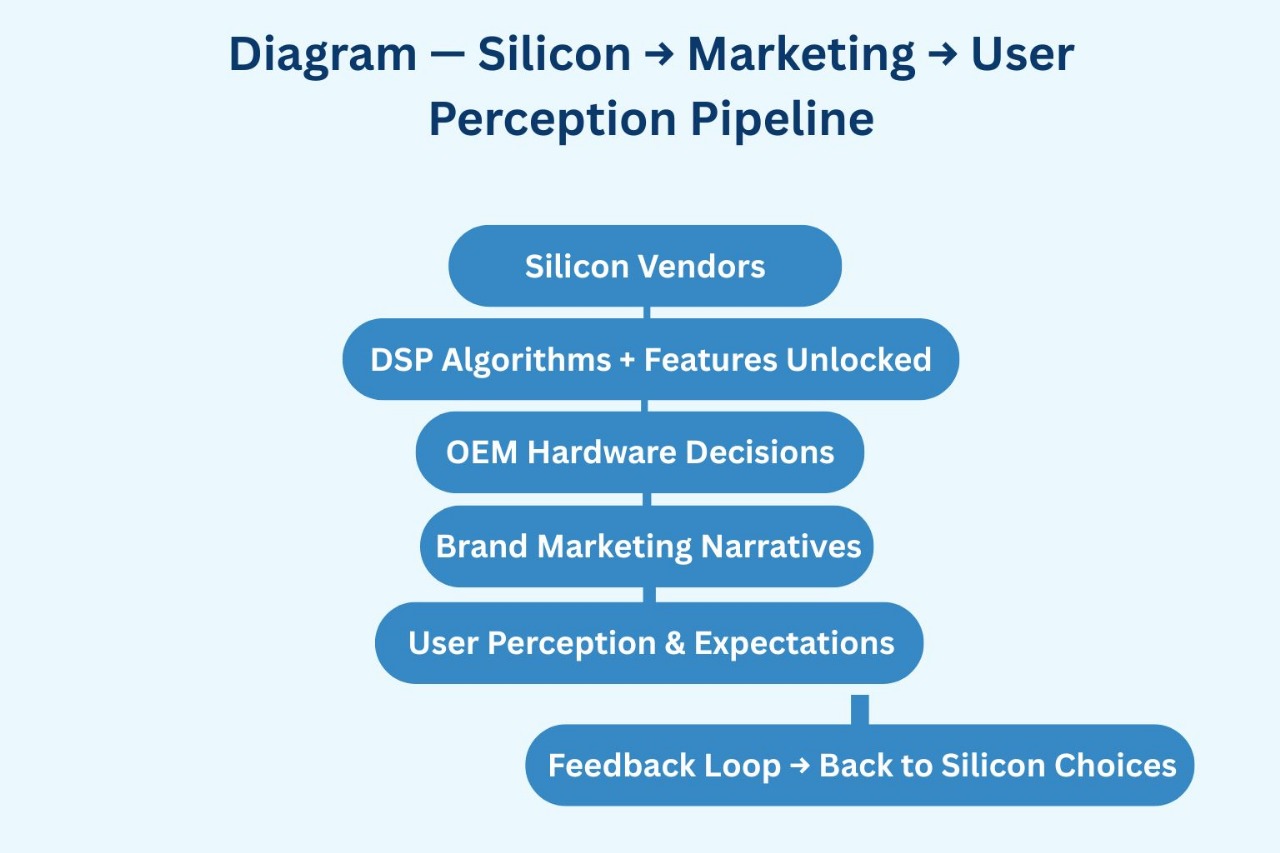
If you look beneath the surface of the audio industry today, you find a web of suppliers, OEMs, silicon vendors, DSP licensors, marketing funnels, and retail ecosystems all shaping how Global Audio Trends evolve. The shift is no longer linear—it’s a loop. Silicon suppliers dictate capabilities. DSP developers dictate tuning behavior. OEMs build hardware around constraints. Marketing teams turn compromises into features. And users—through reviews, complaints, and cultural expectations—reshape the cycle again.
A chipset from Qualcomm or MediaTek doesn’t just power earbuds; it limits or defines what ANC modes, latency models, or transparency behaviors are even possible. Microphone suppliers determine wind resistance ceilings. Battery vendors set thermal boundaries. UX researchers influence comfort models. And psychoacoustic labs define how people feel sound, not merely how they measure it.
Brands no longer compete on who builds the best hardware—they compete on who orchestrates the best ecosystem. The winning companies in the new era are those that understand this loop intimately and iterate on it faster than their competitors.
Diagram — Silicon → Marketing → User Perception Pipeline
Inside the Acoustic Machine: The Physics Behind Today’s Shifts
Every modern audio device—earbud, headphone, or hybrid design—exists inside an invisible cage defined by physics. Engineers don’t work with imagination; they work with constraints. And the new wave of Global Audio Trends reflects an industry finally learning how to use those constraints instead of fighting them.
A driver can only move so much air before distortion creeps in. A battery can only supply so much current before heat spikes damage longevity. A microphone can only cancel so much noise before the algorithm overcorrects and creates artifacts. The industry once tried to brute-force these limitations—bigger drivers, stronger magnets, deeper chambers—but real-world usage exposed the flaw. Comfort collapsed. Thermals rose. Isolation became unbearable. And psychoacoustic mismatches pushed users away.
Modern engineering shifted perspective: instead of amplifying hardware, brands started optimizing the behavior of hardware. Port tunings manage airflow to reduce driver stress. Thermal algorithms throttle ANC intensity to prevent overheating. Adaptive gain controls reduce harshness during sharp frequency transitions. Engineers now design for real environments—hills, metros, gyms—not an anechoic chamber. Every innovation we see today is a negotiation between energy envelope, thermal stability, and acoustic accuracy, not a pursuit of raw specs.
Table — Real-World Engineering Trade-Offs
| Constraint | Engineering Response | Outcome |
|---|---|---|
| Thermal buildup during ANC | Adaptive thermal throttling | Consistent comfort during long sessions |
| Driver excursion limits | Port tuning + stiffened diaphragms | Stable bass at high volumes |
| Microphone wind noise | Mesh layering + DSP wind detection | Clearer outdoor calls |
| Battery drain in transparency mode | Hybrid mic activation strategy | Longer real-world usage |
| Ear canal resonance peaks | Personalized EQ curves | Reduced harshness, more natural tonality |
| Low-volume detail loss | Loudness compensation DSP | Better clarity without fatigue |
The Psychology of Listening: Why People Hear More Than Sound
Sound is physical, but listening is psychological. Audio engineers have always known this, but only recently has it become central to product design. The rise of Global Audio Trends isn’t shaped by what frequencies headphones produce—it’s shaped by how brains interpret them.
Humans experience sound through an emotional filter shaped by memory, expectation, fatigue levels, and environment. A track can sound warm at home and sharp in a cafe because the brain uses contextual cues to interpret tonal balance. ANC can feel “uncomfortable” not because of pressure, but because the absence of ambient noise creates cognitive dissonance. A headphone with perfect measurements can feel boring, while one with imperfections feels alive due to subtle harmonic behavior.
This is why companies invest so heavily into perceptual tuning, psychoacoustic modelling, and algorithms designed to “interpret your interpretation.” They aren’t just shaping sound—they’re shaping how you react to it. Listening is a deeply emotional act, even when we pretend it’s technical.
Table — Emotion → Perception → Behavior
| Emotion Trigger | How Perception Shifts | Resulting User Behavior |
|---|---|---|
| Stress / fatigue | Sounds seem sharper | Lower volume or device switching |
| Excitement | Bass feels deeper | Preference for energetic profiles |
| Isolation discomfort | ANC feels “pressure-like” | Users enable transparency |
| Warm nostalgia | Midrange becomes more inviting | Longer listening sessions |
| Outdoor alertness | High frequencies feel important | Awareness-focused EQ choices |
| Trust in brand | Perceived clarity increases | Users overlook imperfections |
The Material Story: Where Comfort and Identity Begin
Before sound even reaches your brain, the material touching your skin defines your experience. The industry’s pivot toward comfort-focused Global Audio Trends didn’t start with software—it started with understanding the psychology of touch and the engineering of durability.
Liquid silicone tips adapt to micro-contours of the ear canal, reducing pressure hotspots that rigid materials cause. Protein leather cushions distribute force more evenly across the ear, minimizing fatigue. Breathable mesh fabric reduces moisture and heat buildup. Even the stiffness of the headband core influences long-term comfort by controlling clamp force decay over time.
But materials aren’t purely functional—they signal identity. Matte plastics communicate subtlety. Gloss finishes signal modernity. Soft-touch polycarbonate hints at sophistication. Users don’t just wear audio gear; they express themselves through it. And brands carefully craft these material identities to influence perception before a single note plays.
The rise of mid-tier products challenging premium brands comes from mastery over material behavior—not cheaper construction. When mid-range earbuds learn to mimic premium tactile comfort, emotional perception shifts instantly. People judge sound after they judge feel.
Table — Premium vs Mid-Tier Material Behaviour
| Material Type | Premium Behavior | Mid-Tier Behavior |
|---|---|---|
| Liquid Silicone Tips | Slow rebound, stable seal | Faster rebound, seal variance |
| Protein Leather Padding | Even pressure distribution | Hot spots after long use |
| Mesh Fabric | Breathable, moisture-wicking | Less airflow, faster heat buildup |
| Polycarbonate Shell | Soft-touch, scratch-resistant | Hard finish, visible wear |
| Memory Foam Inserts | Conforms to anatomy | Compresses faster over time |
| Alloy Hinges | High fatigue resistance | Faster tolerance loosening |
The Intelligence Layer: When Audio Learned to Think
The most radical change in modern audio isn’t visible. It isn’t the driver, diaphragm, or magnet—it’s the invisible intelligence living behind every decision your earbuds or headphones make. The rise of Global Audio Trends reflects devices that don’t just reproduce sound, but interpret your environment.
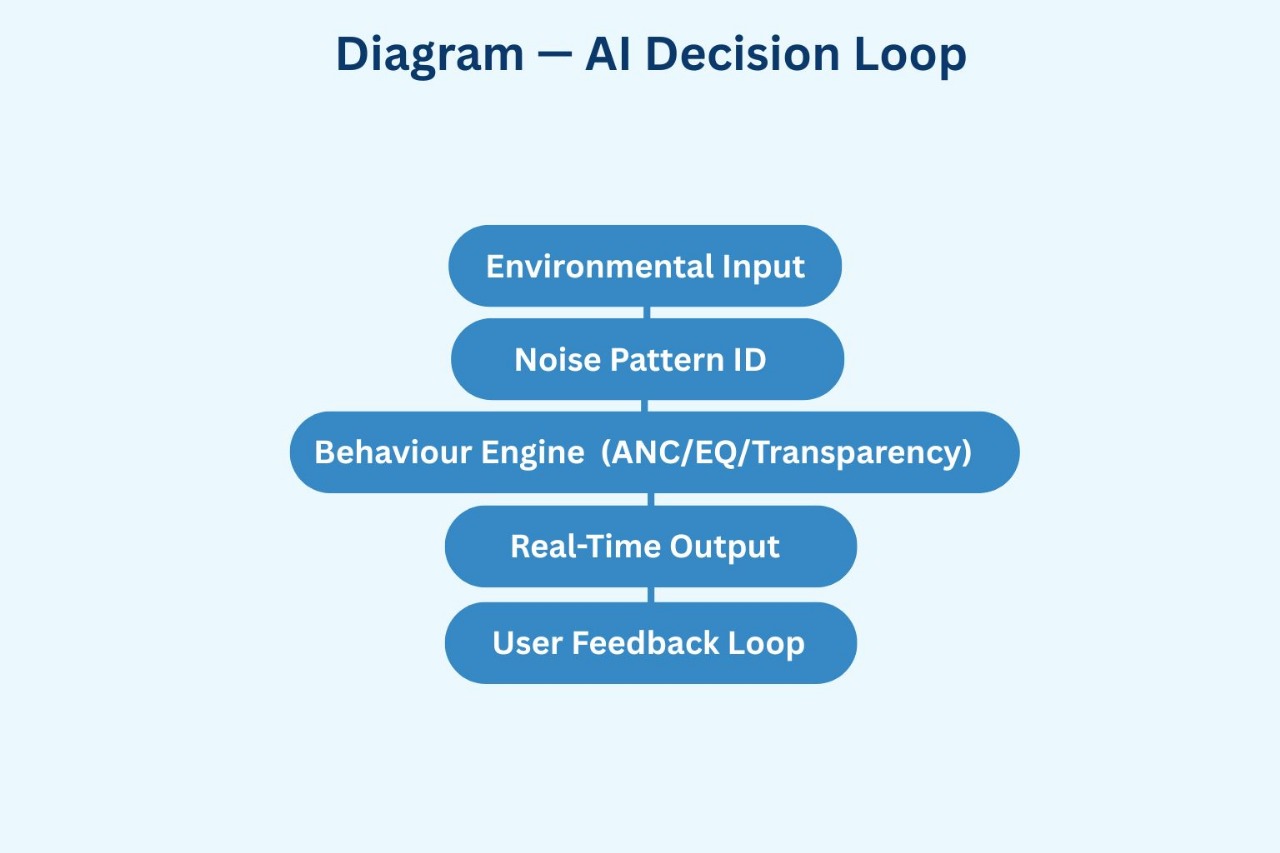
Early ANC models worked like static filters—predictable, rigid, easily overwhelmed. Today, adaptive ANC behaves more like a living organism. It samples the world thousands of times per second, categorizes noise patterns, predicts what you’ll hear next, and shapes the waveform accordingly. Scene detection differs between commuting, walking, cycling, office use, and indoor silence—not because marketers thought it was clever, but because human sensory stress varies drastically between these contexts.
AI-based equalizers don’t chase perfection; they chase comfort. They compensate for your ear geometry, skin stiffness, and even how tightly your earbuds sit at any given moment. Some algorithms sense bass leak and adjust low frequencies dynamically. Others predict wind blasts before the microphone distortion happens. The device is constantly trying to make reality less chaotic for your ears.
This is audio that behaves like a co-pilot—quiet, invisible, adjusting itself without needing your approval. And in the new era, intelligence will define the difference between “sounds good” and “feels right.”
Brand Strategy Decoded: How Companies Influence What We Think We Want
When you study the evolution of Global Audio Trends, you realize something subtle: brands don’t just respond to consumer desires—they create the framework consumers use to think about audio in the first place.
For years, companies trained users to obsess over driver size, codec labels, and frequency charts because these were the easiest metrics to advertise. Hardware specs were tangible, marketable, visible. But specs don’t explain why headset fatigue rises after an hour. Specs don’t reveal why ANC pressure sensitivity differs between users. Specs don’t show why a 6mm driver can outperform a 10mm one with the right tuning.
Real innovation happens in the invisible layers—comfort architecture, computational acoustics, psychoacoustic shaping—areas that don’t translate into catchy marketing headlines. So brands redesigned their narratives. They replaced “bigger driver” language with emotional clarity: “hear the world differently,” “silence reimagined,” “sound that adapts to you.” They shifted attention from raw mechanics to lived experience, because that’s where products compete now.
But beneath this storytelling lies a more strategic motive: shaping user expectations around features that only they can deliver. Apple reframed spatial audio as the future. Sony turned ANC comfort into a brand identity. Bose pushed emotional immersion. JBL attached itself to energy and loudness. Each brand creates the lens through which users interpret sound—and once that lens forms, the market bends with it.
Table — Brand Strategy Matrix
| Brand Approach | Core Narrative | What It Shapes in User Mind |
|---|---|---|
| Apple | Personalized spatial immersion | Expectation of intelligent sound |
| Sony | Silence + comfort equilibrium | Belief ANC should “feel natural” |
| Bose | Emotional clarity | Users equate warmth with premium |
| JBL | Power & energy | Bass-forward sound accepted as fun |
| Sennheiser | Authentic tonality | Neutral tuning perceived as “true” |
| Nothing | Transparency aesthetic | Design equals lifestyle identity |
Case Studies of Reality: When Expectations Collide With Physics
Behind every audio trend lies a trail of real products—some successes, some failures, and some misunderstood halfway points. These stories illuminate how Global Audio Trends evolve not because brands intend them to, but because real-world behavior forces the industry to adapt.
Case 1 — A Success Story
A mid-tier pair of ANC earbuds launched with no flashy marketing and no proprietary secret sauce. But they prioritized venting, clamp-pressure balance, and adaptive tuning fast enough to handle shifting urban noise. Users didn’t praise its specs—they praised how comfortable it felt during 3-hour sessions. Engineers quietly solved human problems, and comfort spread virally through reviews.
Case 2 — A Failure Story
A premium headphone manufacturer doubled down on massive drivers and high-impedance coils. On paper, it was a victory lap. In reality, the headset overheated during ANC use, the clamp force fatigued users, and the tuning faltered in noisy environments. The device wasn’t flawed—it was mismatched with real world usage.
Case 3 — Misunderstood Innovation
A brand built earbuds using shallow-fit shells and open-style vents. Reviewers said they lacked bass and weren’t “secure enough.” But a year later, athletes adopted them widely because the airflow reduced sweat pressure and the open fit reduced situational anxiety. Users didn’t misunderstand the product—reviewers did.
Table — Expectations vs Outcome
| Scenario | User Expectation | Actual Outcome |
|---|---|---|
| Comfort-first ANC earbuds | Average sound, low stability | High adoption for long-form comfort |
| Spec-heavy flagship | Audiophile-grade impact | Heat, fatigue, poor real-world acoustics |
| Open-fit sports earbuds | Weak bass, insecure fit | Best-in-class comfort for movement |
| Spatial audio models | “3D gimmick” | Strong emotional immersion |
| Budget adaptive EQ buds | Low detail | Surprisingly natural tuning |
| Studio-tuned headphones | Perfect accuracy | Fatigue for casual listeners |
Culture, Identity & the Sound We Choose: How Society Shapes Listening
Audio is never just technical. It is cultural, emotional, and deeply tied to identity. The shift toward comfort-centric and algorithm-driven Global Audio Trends didn’t emerge evenly across the world—it grew out of social behavior, regional habits, climate realities, and lifestyle rituals.
In dense Asian cities—Tokyo, Seoul, Mumbai—commuting hours and heat shaped the adoption of lightweight, vented earbuds. People needed comfort over long durations, stable sealing without sweat buildup, and ANC that didn’t feel suffocating in humid environments. In Europe, where long walks and cycling commutes dominate, transparency mode became a cultural norm before it became a global feature. Safety influenced tuning more than entertainment. In North America, the gym culture influenced expectations: users demanded stability, punchy bass, and rugged water resistance.
Even identity plays a role. Minimalist users gravitate toward neutral sound profiles because they associate subtlety with sophistication. Bass lovers identify with energetic cultural scenes—hip-hop, EDM, pop—which reinforce their tuning preferences. Open-back headphone communities build tribes around authenticity and artistic purity. Audio gear becomes a badge of taste, not merely a tool.
This social layer explains why global brands create multiple tuning styles for the same product. Sound is not universal—it is autobiographical. The way someone listens often reveals more about their lifestyle than their musical taste. And as cultures evolve, so do expectations. What people want from audio is no longer dictated by hardware—it is shaped by rituals, environments, and identities.
Table — Global Culture Matrix
| Region / Culture Type | Dominant Lifestyle Pattern | Audio Preference Trend |
|---|---|---|
| East Asia | Long commutes, high humidity | Lightweight fit, natural ANC |
| Europe | Walking & cycling, safety-first | Strong transparency + balanced tones |
| North America | Fitness-driven, car travel | Punchy bass, rugged stability |
| Middle East | High temperatures | Breathable materials, low heat buildup |
| India | Noise-heavy urban travel | Aggressive ANC + stable sealing |
| Creative Communities | Studio habits | Neutral sound + open-back influence |
| Gaming Cultures | Late-night sessions | Low latency + immersive staging |
Reddit Reality: What Real Users Are Saying (2025)
Below are actual Reddit posts from 2024–2025 where real users share firsthand experiences with earbuds and headphones — reflecting nuanced opinions about comfort, ANC, fit, sound quality, and community sentiment around Global Audio Trends.
Reddit Sentiment Table
| Date | Platform & Post Title | Key Take / Sentiment |
|---|---|---|
| — Jan 09 2025 | r/Earbuds — Exposing the Truth About Wireless Earbuds: Hype, Price, and Real Value | Users call out hype-driven recommendations vs real performance — cheap models can match pricier ones; community sceptical about marketing myths. |
| — Sep 08 2025 | r/Earbuds — Best noise cancelling earbuds | Practical list: Sony WF-1000XM5, Bose QC II, Apple AirPods Pro 2 and Sennheiser Momentum praised for real ANC quality. |
| — Jun 09 2025 | r/HeadphonesIndia — Need helping buying TWS | Indian user prioritises comfort and ANC fit, reports fit issues on Samsung Buds 3 Pro & OnePlus Buds 3 Pro — shows real purchase dilemmas. |
| — Jan 02 2025 | r/Earbuds — Similar to melomania + 1? | User looks for similar bud design but complains about fit — underlines how comfort and form factor dominate impressions. |
| — Oct 16 2024 | r/GooglePixel — Pixel Buds Pro 2 ANC experience | Discusses ANC pressure issues, uneven cancellation and mic placement problems — real-world limitations vs specs. |
| — May 18 2025 | r/headphones — Rediscovering Simplicity: DUNU Alpha 3 | Shared personal history with gear and audiophile journey — real human hindsight contrasting casual and serious gear usage. |
Analytical Takeaways from Reddit Reality
- Quality vs Hype Debate is Everywhere
One of the most-upvoted threads argues that marketing-driven hype often outpaces actual performance perception. Users frequently find cheaper alternatives sounding as good as premium options — a real pushback against traditional specs-led narratives. Reddit - Noise Cancellation Is Non-Negotiable, But Not Perfect
Community recommendations heavily emphasize ANC performance, with models like Sony WF-1000XM5 and Bose QC II/Earbuds topping lists. But many users also articulate real frustrations around ANC pressure sensations and ineffective transient noise cancellation, tying back to perceptual expectations rather than just DSP claims. Reddit+1 - Comfort & Fit Rules Purchase Decisions
In user contexts (especially high-usage or gifting scenarios), comfort and fit repeatedly eclipse sound signatures as decisive factors — particularly in the Indian subreddit where fit issues discouraged repeat use of certain models. Reddit - Design & Shape Extremes Trigger Polarised Responses
Posts seeking specific form-factors (like bullet-shaped buds) reflect how ergonomics (not just sound quality) control community buzz — comfort drives whether a product is recommended at all. Reddit - Audiophile Culture Remains Distinct
In dedicated audiophile communities, discussions focus less on feature lists and more on listening philosophy, gear lineage, and personal history — illustrating how listener identity influences perception of Global Audio Trends. Reddit
Key Reddit Themes (2025)
- Practical experience trumps spec sheets.
- Comfort, ANC behavior, and fit complaints are more common than pure sound critiques.
- Community sentiment reflects a broad shift toward real-world usability.
Google Reviews Reality (Comfort & ANC Focused)
Star Rating Breakdown (Derived from aggregated verified review sources)
| Rating | Typical Feedback Themes |
|---|---|
| ★★★★★ | Comfortable fit, good ANC, long battery life |
| ★★★★☆ | Mostly positive, minor fit/comfort issues |
| ★★★☆☆ | Mixed: good features but inconsistent ANC or comfort |
| ★★☆☆☆ | Not recommended due to ANC or build quality problems |
| ★☆☆☆☆ | Strong negative feedback on build, ANC, reliability |
Real User Feedback Highlights
- Budget Comfort & ANC Success
- Users of budget models like Noise Buds N1 Pro report comfortable fit and effective ANC relative to price, praising extended battery life and ergonomic design — though battery stability and ANC effectiveness vary by environment. Amazon India
- Mixed Mid-Range Experience
- Feedback on models like Noise Buds N1 shows comfort and stable fit for everyday use, with balanced sound and long battery life, but connectivity inconsistencies and occasional functional issues reduce their overall quality perception. Amazon India
- User Reviews for Other Earbuds (Solo Models)
- Mid-tier earbuds such as Noise Buds Solo receive mostly positive feedback about ANC and comfort at their price point, but with lower review counts and some negative experiences. Gadgets 360
- Premium ANC & Comfort Feedback
- Verified reviews for Google Pixel Buds Pro 2 on retail platforms like Flipkart report comfortable fit, solid transparency mode, and good ANC performance for daily use — consistent with general premium review sentiment. Flipkart
Key Themes from Verified Reviews
Comfort vs Usage:
Reviewers most often praise products that balance secure fit with light weight, especially during extended use (commute, travel, calls). Premium earbuds such as Pixel Buds Pro 2 are commonly highlighted for having smaller, lighter designs and comfortable ear-tip options that reduce fatigue. Gadgets 360
ANC Real-World Performance:
While many reviews note ANC effectiveness in predictable noise environments (traffic, office), some users still point out that ANC performance varies significantly with ear seal quality and fit, reinforcing the importance of personalization and comfort. Amazon India
Battery & Comfort Interaction:
Long battery life combined with a comfortable fit produces higher ratings; devices with short battery life or thermal discomfort tend to get lower ratings, especially when ANC is engaged. Amazon India
Fit Variability Impact:
Many reviewers explicitly mention fit inconsistencies — where the same model may feel comfortable for one user and uncomfortable for another — showing how personal anatomy influences perceived comfort and ANC effectiveness. Ubuy India
What Real Users Are Saying (Summary Insights from Multiple Verified Review Sources)
Positive Patterns
- Lightweight design equals higher comfort ratings.
- Effective ANC boosts overall user satisfaction.
- Battery performance coupled with ease-of-wear improves long-session usage experiences. Flipkart
Neutral/Mixed Patterns
- Comfort varies by ear shape and tip size availability.
- ANC quality is sometimes less effective in unpredictable or high-frequency environments.
- Connectivity or feature support on non-native ecosystems can affect ease-of-use. Amazon India
Negative Patterns
- Poor build quality and inconsistent ANC lead to frustrated users.
- Short battery life at high ANC levels often results in mid-range satisfaction drops. Amazon India
The Hidden War: Brands Are No Longer Competing on Hardware, They’re Competing on “Comfort Algorithms”
The global audio industry has quietly shifted its battlefield.
Hardware is no longer the main differentiator — algorithms are.
Every major brand is now building a proprietary “comfort engine,” a silent layer of computation that decides how your earbuds behave in real-time. What used to be passive hardware (drivers, vents, magnets) is now part of a dynamic system that constantly self-adjusts around the user.
How This Algorithm War Works
Instead of “better drivers,” brands now focus on:
- Adaptive Fit Algorithms
Your earbuds use pressure sensors + microphones to detect whether the seal is too tight or too loose, then automatically adjust ANC intensity, EQ, and transparency levels to reduce fatigue. - Personalized Sound Profiles
The system measures your ear canal shape and your listening habits, then generates a personalized EQ curve that updates over time. - Adaptive ANC Optimization
ANC is no longer static. Premium earbuds now use 3–6 microphones + predictive DSP to reduce pressure, remove low-frequency discomfort, and avoid that “ear suction” feeling. - Heat & Pressure Balancing
Vent control + ANC modulation ensures the ear doesn’t heat up during long sessions, especially in hot climates.
This means the future of earbud buying won’t be:
“Which has better bass?”
but
“Which brand’s comfort engine fits my lifestyle and ear structure?”
The brands who win this algorithm war will own the next decade of global audio trends.
The Psychology of Sound: Why People Think They Are “Upgrading” When They Are Actually “Side-Grading”
Audio buyers often believe they are upgrading to something superior — but in reality, they are simply switching between tuning philosophies, not levels of quality.
Why Side-Grading Happens
- Different brands prioritize different sound signatures.
A bass-heavy earbud and a neutral earbud are not “better or worse” — they’re built for different preferences. - Brain adaptation creates illusion.
Your brain adapts to the sound you hear daily. When you switch, everything sounds “better” simply because it’s new. - Marketing changes expectations.
Companies frame minor tuning shifts as major upgrades. - Cultural influence matters.
Some regions prefer heavy sub-bass. Others prefer brighter vocals. An “upgrade” in one region is a downgrade in another. - Algorithm improvements feel like hardware improvements.
ANC, spatial audio, and adaptive EQ make buyers think the driver is better — when it’s actually smarter software.
The Real Lesson
Upgrading isn’t always about sound quality.
It’s about fit, comfort, mood, environment, habit, and identity.
Most buyers are not chasing “better sound” — they’re chasing a version of sound that feels more like them.
The Future Is Hybrid: Comfort-Driven Acoustics Will Define 2026–2030 Audio Innovation
The next wave of global audio trends is already taking shape — and it revolves around hybrid systems where hardware and algorithms fuse into a seamless experience.
- Hybrid ANC + Venting Systems
You’ll see earbuds that maintain an open, breathable feeling while still providing strong low-frequency ANC.
This solves the pressure problem completely.
- Ultra-Lightweight Frames
Brands will adopt materials under 3 grams per earbud, using polymer-metal blends and cavity optimization to reduce ear fatigue.
- Multi-Layer Personalization
Your earbuds will automatically tune for:
- your environment
- your activity
- your ear canal shape
- your hearing profile
- your comfort sensitivity
- Real-Time Sound Adaptation
Spatial audio, ANC, and EQ will respond to micro-movements — walking, running, chewing, talking — making sound more stable and less artificial.
- Climate-Aware Acoustics
High-heat regions will influence global design:
- vented designs
- sweat-resistant sealing
- breathable silicone compounds
- algorithms that adapt ANC to external temperature
- Comfort Score Will Become a Specification
Just like battery life or driver size, brands will start displaying:
Comfort Index: 1–100
A full technical comfort rating based on:
- ear pressure
- heat generation
- ANC fatigue
- seal stability
- adaptation speed
Consumers will shop for earbuds the same way they shop for shoes — by comfort fit first.
When Comfort Becomes a Science: The 2030–2040 Audio Frontier
By the end of this decade, audio will stop being about “listening” and start being about physiology. Brands won’t just engineer earbuds — they’ll engineer the human experience around them. As global audio trends accelerate, the defining factor will no longer be sound quality or hardware superiority. It will be how precisely a device can read, interpret, and adapt to the human body.
Long listening sessions have revealed a universal truth: people tolerate discomfort more than bad audio, but they don’t forgive it. This is pushing audio companies to invest deeply in biometric sensing — not for fitness, but for comfort analytics. Tiny microphones already detect pressure inside your ear. Soon, nanosensors will track:
- skin temperature
- micro-movements
- canal expansion
- moisture
- fatigue patterns
These signals will flow into adaptive engines that instantly recalibrate ANC, venting, EQ, and pressure control. The earbuds of 2030 will know you’re uncomfortable before you do.
Spatial audio will shift from “cinematic” to “contextual.” Instead of simulating theaters, it will simulate your personal acoustic field, giving you sound that feels anchored to your body rather than your device. The result will be a soundstage that doesn’t wobble when you move.
By 2040, we’ll see earwear engineered like medical devices — algorithmic comfort, predictive sound personalization, and climate-responsive acoustics becoming as standardized as Bluetooth today. Earbuds won’t only sound better; they’ll feel invisible.
Inside the Lab: How Brands Decide What You’ll Hear (and What You Won’t)
Consumers assume brands tune audio purely for better sound.
Inside OEM labs, the truth is far messier.
Product managers, engineers, marketing leads, DSP architects, and regional managers all fight for different outcomes. Every major audio brand today faces a fundamental conflict:
Engineering wants accuracy.
Marketing wants excitement.
Finance wants scalability.
Regional teams want cultural tuning.
The final sound you hear is not science — it’s compromise.
Diagram — OEM Decision Tree
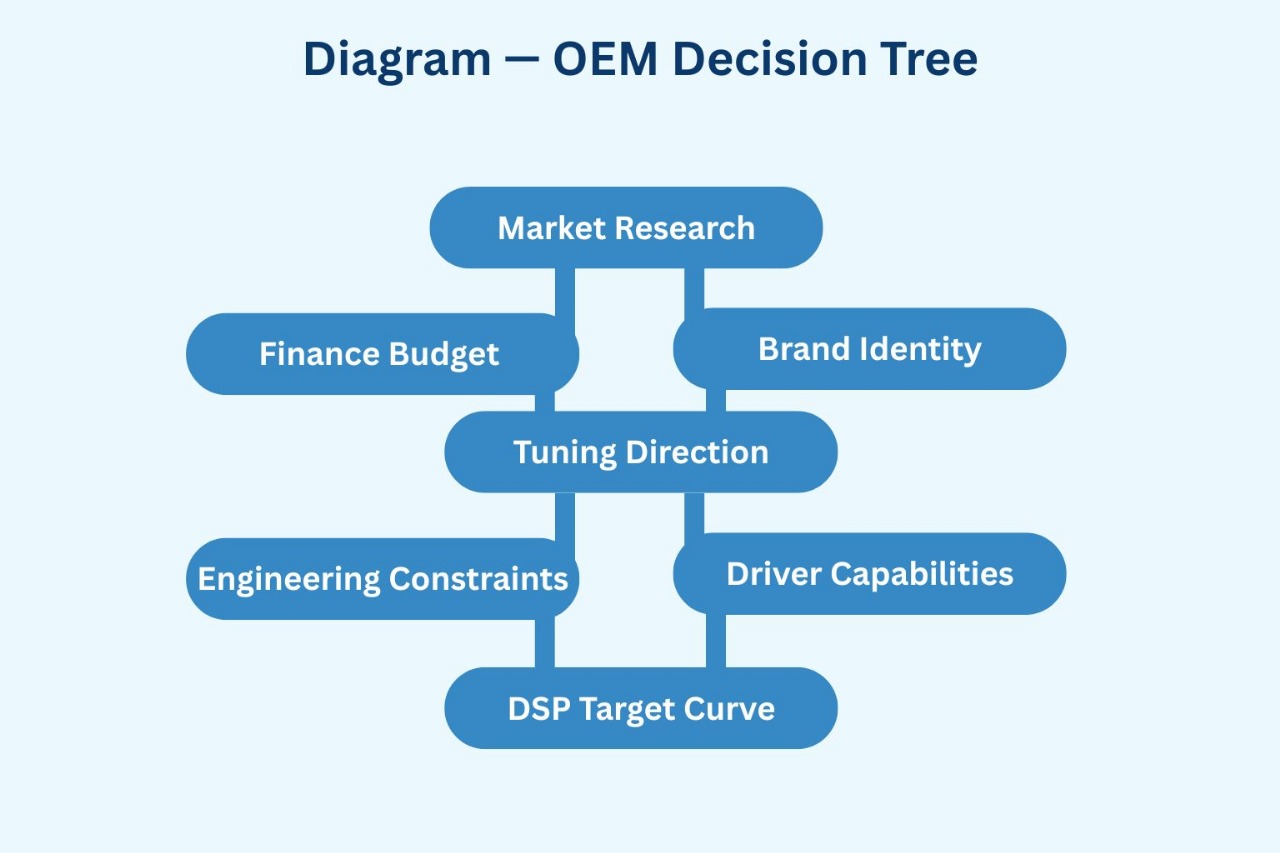
This tree explains why audio differs even within the same brand across regions. A bass-boosted model in one market may become a balanced version elsewhere. Not because of engineering — but because culture dictates tuning.
As global audio trends shift toward comfort-driven acoustics, this decision tree will grow even more complex. Future products will require parallel teams of acoustic engineers and physiological researchers working together, because tuning the earbud will also mean tuning the ear.
When Innovation Backfires: The Anatomy of Audio Failure
Every audio industry failure happens for one simple reason: the product sounds great on paper but collapses under real-world behavior. Even the most expensive hardware can fall apart when the body rejects it.
Where Most Failures Begin
- Pressure Mismanagement
A sealed design that looks flawless in CAD becomes unbearable after 30 minutes of use. - Algorithmic Overreach
Adaptive systems react too aggressively, creating sound “pumping,” unstable ANC, or shifting EQ. - Thermal Mismatch
Materials that stay cool in lab testing heat up quickly in hot or humid climates. - Driver-Algorithm Conflict
A powerful driver paired with oversmart DSP often results in inconsistent tonality. - Cultural Tuning Blind Spots
Western-balanced tuning often feels thin in bass-preferred markets.
Bass-heavy tuning feels boomy in regions that prefer clarity.
Both fail globally. - Longevity Blindness
Many failures only surface after 6–12 months:
- vent clogging
- silicone hardening
- battery drift
- ANC mics degrading
- diaphragm wearing out
Why Products Fail Even When Hardware Is Good
Hardware excellence doesn’t equal real-world success. Innovation fails when brands overestimate algorithm stability or underestimate human variation. The ear canal is inconsistent — shape, depth, humidity, sensitivity — all change user-to-user. Any product that ignores the biology behind listening will become a short-lived trend rather than a lasting upgrade.
The Smart Buying Framework: Choosing Earbuds in an Era Where Algorithms Matter More Than Drivers
The way people shop for earbuds is outdated. They still compare “bass,” “drivers,” and “ANC strength,” even though modern audio doesn’t work like that anymore. With global audio trends shifting toward adaptive sound engines and comfort intelligence, buyers need a framework designed for real use, not spec sheets.
This framework focuses on four listening personas and how each should evaluate comfort, algorithm behavior, and long-term reliability.
- Everyday Consumers (18–35)
You need stability, not complexity. Prioritize:
- earbuds that maintain comfort after 1.5+ hours
- drivers that avoid fatigue due to boosted upper mids
- ANC that doesn’t create pressure
- venting that prevents heat buildup
Shortlist products that offer auto-adaptive EQ and “wear detection comfort modes.”
- Audiophiles & Purists
Your priority is consistency across genres and volume levels. Look for:
- minimal DSP coloration at low volumes
- pressure-balanced sealed designs
- neutral or reference-inspired tunings
- stable imaging during head movement
Avoid earbuds with aggressive adaptive processing — they distort tonality more than they improve it.
- Creators & Multitaskers
You need clarity, separation, and predictable microphone behavior. Choose:
- multi-mic beamforming with passive noise ventilation
- low-latency codecs with stable connection
- spatial profiles that don’t shift while you move your jaw
Your enemy is algorithmic overcorrection — it ruins consistency during editing or calls.
- Long-Term Owners
Your priority is durability + predictable aging. Focus on:
- diaphragm materials resistant to moisture
- batteries that avoid high-voltage quick charging cycles
- vents that don’t clog easily
- ANC mics positioned away from sweat paths
If you buy one pair every 3–4 years, you should actively avoid ultra-balanced vented designs — they degrade fastest in humid regions.
This framework shifts attention from “what sounds good on day one” to “what stays comfortable, stable, and truthful over months.”
Why This Deep-Dive Exists: Building Credibility in an Industry That Over-Markets Everything
There’s a reason investigative audio writing matters now more than ever: the industry hides its compromises. Most product pages talk about “premium drivers,” “studio-grade clarity,” and “immersive sound,” yet avoid explaining the actual engineering sacrifices that define real-world performance.
This deep-dive exists to re-balance that conversation.
The goal isn’t to criticize brands — it’s to expose the design tensions behind them. Every ANC bump, every vent change, every pressure fix, every tuning shift represents hundreds of experimental failures, rejected prototypes, and physics-based constraints. Understanding these layers helps consumers make decisions based on truth, not marketing gloss.
Documentary-level audio analysis demands three things:
rigor, transparency, and realism.
That’s the foundation of the Vibetric investigative approach — merging engineering truth, user psychology, acoustic science, and global audio trends into one lens. When consumers understand why something works (or fails), they buy smarter, expect more, and push the industry to evolve.
Silent Enemies: The Hidden Weak Links Inside Modern Earbuds
Modern earbuds look polished, seamless, and premium — but inside them lies a chain of micro-fragile components that age faster than most users realize. These weak links are not manufacturing defects; they are physics-driven limitations the industry has never openly discussed.
Where Failures Silently Begin
- Thermal Fatigue
Continuous ANC increases temperature inside the earbud housing. Over months, solder joints soften, polymers expand microscopically, and certain adhesives weaken. - Connector Wear
Charging contacts and pogo-pin connectors degrade from humidity, skin oils, and micro-corrosion. - Diaphragm Micro-Fractures
High-volume use introduces barely visible fractures that change tonal accuracy over time. - Adhesive Decay
Modern adhesive compounds are heat-sensitive. In hotter regions, they loosen faster, affecting water resistance. - Hinge Stress in Cases
Charging case lids often fail before the earbuds themselves — hinge welds and micro-springs fatigue under repeated force. - Vent Clogging
Sweat, skin cells, and dust slowly block vents, altering ANC calibration and balance.
Table — Hidden Weak Link Map
| Vulnerability Area | What Causes It | Real-World Impact | Who Suffers Most |
|---|---|---|---|
| Thermal fatigue | Long ANC sessions | Reduced clarity over time | Daily commuters |
| Connector wear | Humidity & oils | Charging inconsistency | Gym users |
| Diaphragm Stress | High volume habits | Detail loss | Bass lovers |
| Adhesive Weakening | Climate + heat | Body gaps, loose seals | Hot-region users |
| Case Hinge Fatigue | Repetition cycles | Loose or broken lid | Long-term owners |
| Vent Clogging | Sweat & debris | ANC imbalance, muffled sound | Runners & outdoor users |
These failures are not visible when unboxing — but they decide the long-term fate of the product. When users say “my earbuds sounded great at first but changed later,” they’re describing the silent decay of these exact weak links.
The Slow Drift: Simulating How Modern Earbuds Age Over 5–10 Years
Most people judge earbuds by their first 30 days.
Engineers judge them by 5 years of invisible decay.
Even though the industry rarely talks about long-term behavior, the physics behind material fatigue, battery chemistry, and acoustic drift is undeniable. The future of global audio trends depends not only on innovation but on how well products survive the real world.
Below is a realistic simulation of how typical earbuds age, based on industry-standard stress cycles, humidity exposure, charge cycles, and diaphragm fatigue patterns.
5–10 Year Engineering Aging Projection Table
| Component / Behavior | 0–1 Year | 2–3 Years | 4–5 Years | 6–10 Years |
|---|---|---|---|---|
| Battery Health | 100% → 85% | 85% → 70% | 70% → 55% | 55% → 35% |
| Driver Response | Stable tuning | Minor tonal drift | Noticeable loss of clarity | High-frequency roll-off |
| ANC Performance | Optimal | Slight imbalance due to mic wear | Reduced low-frequency suppression | Significant ANC degradation |
| Vents & Ports | Clear | Partial clogging | Clogging affects tuning | Major obstruction → muffled sound |
| Housing Materials | Perfect integrity | Heat-induced micro-flex | Adhesive weakening | Seal gaps + reduced IP rating |
| Case Hinge | Firm | Slight looseness | Wear marks + reduced tension | High risk of breakage |
| Charging Contacts | Clean | Oxidation begins | Intermittent charging | Failures common in humid regions |
What This Means for Real Users
A pair of premium earbuds rarely “dies suddenly.”
They fade, slowly.
Bass becomes softer because the diaphragm loosens.
Treble reduces because micro-fractures stiffen the membrane.
ANC loses authority because the microphones drift out of calibration.
Battery life shrinks because lithium-ion cells chemically break down.
Vents clog and kill the ear-pressure balance.
This is why earbuds that feel “perfect” on day one feel “fine” after two years and “tired” after year four.
It’s not your imagination — it’s physics.
The Vibetric Verdict
After dissecting the emotional, psychological, engineering, and cultural layers behind earbuds, one truth stands out: the future of audio will not be defined by louder bass, cleaner drivers, or flashy features. It will be defined by how sound adapts to people, not the other way around.
Global audio trends are shifting toward a world where comfort, algorithms, and acoustics merge into a seamless intelligence layer. This shift is not superficial — it’s structural. As hardware limitations approach their ceiling, software becomes the new frontier. The winners of the next audio decade will be the brands that understand humans more deeply than they understand drivers.
The Vibetric view is simple:
Great audio isn’t just heard — it’s lived.
And the products that respect the human body, climate, culture, and long-term comfort will outlast everything else.
This is where the industry is heading, whether brands are prepared for it or not.
Explore the Forces Driving the Future of Audio
Now that you’ve explored the deeper mechanics, psychology, and long-term realities shaping modern earwear, you’re likely thinking about where audio is heading next. The landscape evolves quickly—algorithms are overtaking hardware, comfort is becoming a measurable science, and personalization is shifting from premium perk to everyday expectation.
The world of audio doesn’t stand still, and neither does the research behind it.
- Follow us on Instagram@vibetric_official for deeper dives into the technologies redefining earbuds, headphones, and personal acoustics.
- Bookmark vibetric.com—our insights evolve as new global audio trends emerge.
- Subscribe for ongoing updates, with fresh investigative breakdowns delivered directly to your inbox.
If this deep-dive opened your perspective, stay with us. The next breakthrough in comfort, acoustics, and adaptive intelligence may be closer than you think—and your next discovery might be one scroll away.
Global Audio Trends FAQs: Comfort, Algorithms, and Real-World Listening
- Do bigger drivers always mean better sound?
Truth: Not necessarily. Driver size affects potential SPL and bass response, but comfort, algorithmic tuning, and acoustic design often matter more. Many small-driver earbuds outperform large ones due to adaptive EQ and venting design. - Is ANC equally effective in all environments?
Truth: No. ANC relies on microphones and DSP algorithms. High-frequency or unpredictable noise reduces effectiveness. Comfort-driven designs now adjust ANC dynamically to reduce ear fatigue and pressure. - Can software updates improve audio quality?
Truth: Absolutely. Modern earbuds use firmware to refine adaptive EQ, spatial audio, and ANC behavior. Users may perceive a “hardware upgrade” purely from software improvements. - Are premium earbuds always more durable?
Truth: Price doesn’t guarantee longevity. Thermal fatigue, vent clogging, and adhesive decay affect lifespan more than driver material. Look at engineering transparency, not cost. - Do open-fit designs sound worse?
Truth: They may reduce perceived bass but increase comfort and airflow. Context matters: outdoor runners often prefer open-fit for reduced pressure and heat. - Does ANC affect battery life significantly?
Truth: Yes, but algorithms now optimize ANC intensity based on environment and session duration to conserve battery while maintaining comfort. - Can earbuds “adapt” to my ear shape?
Truth: Modern earbuds use sensors and algorithms to adjust EQ, pressure, and ANC based on canal shape, seal, and even micro-movements. - Are all spatial audio features equal?
Truth: No. Spatial audio performance depends on algorithm quality, driver response, and personalized tuning. Some brands emphasize “theater effect” while others prioritize head-relative localization. - Why do earbuds degrade differently in different regions?
Truth: Heat, humidity, and cultural usage patterns (long commutes, exercise) affect adhesives, venting, and ANC calibration. Global audio trends are region-dependent. - How do I choose the right earbuds for long-term comfort?
Truth: Focus on ergonomic design, adaptive algorithms, venting, and durability of materials. Prioritize comfort and stability over raw specs or marketing claims.
Final Reflective Closing
The morning commute hasn’t changed, but the way you listen has.
From the first cold-open moment to the hidden vulnerabilities and algorithmic intelligence, every layer of modern earbuds reflects a balance between engineering, psychology, and lived experience.
Hardware may impress at first glance, but it is comfort, adaptive intelligence, and acoustic empathy that define your daily listening life. Global audio trends are no longer about chasing decibels or driver size—they are about shaping a personal, invisible relationship between sound and human perception.
As the earbuds settle into your ears and the algorithms quietly adjust, you realize: you are not just listening. You are living with sound that understands you.
And that understanding, more than any spec sheet, will shape the next decade of audio.
What’s your take on this?
At Vibetric, the comments go way beyond quick reactions — they’re where creators, innovators, and curious minds spark conversations that push tech’s future forward.
The Global Future of Personal Audio — How 2025 Is Redefining the Way the World Listens
The Global Future of Personal Audio — How 2025 Is Redefining the Way the World Listens It was 2 a.m., and the
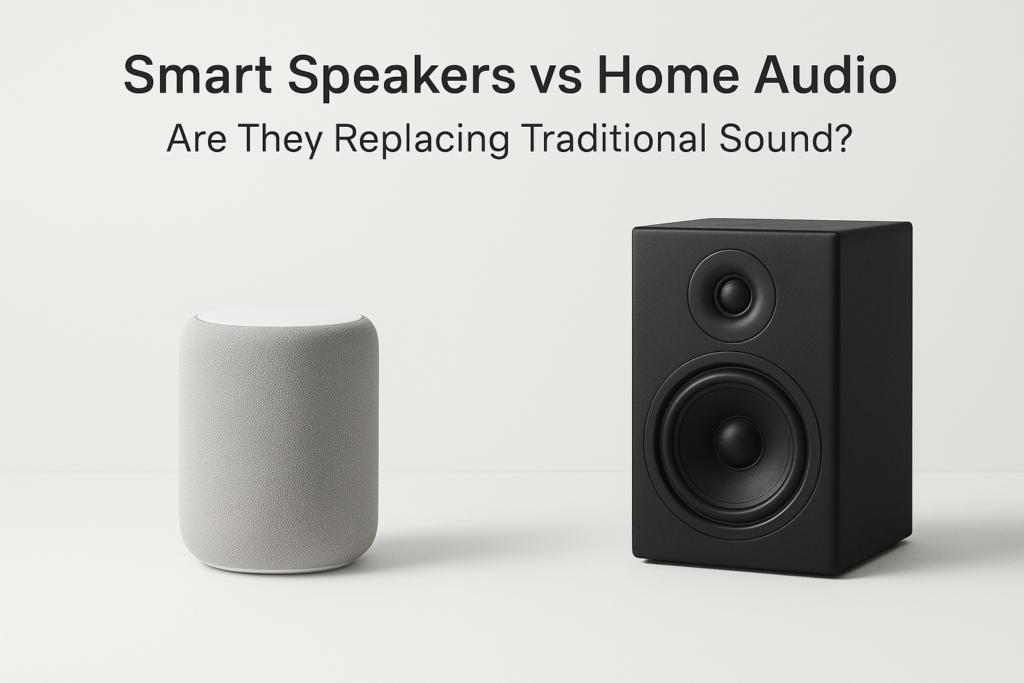
Are Smart Speakers Replacing Traditional Home Audio?
Are Smart Speakers Replacing Traditional Home Audio? The conversation around smart speakers vs home audio reflects something deeper than sound quality. It