
Inside the Battle for Sound Dominance — How Global Audio Brands Compete in 2025

In the dim glow of a Friday night, two friends sit across from each other — one with sleek, over‑ear headphones from a rising Asian brand, the other with compact earbuds from a storied European name. The first presses “play.” The room is suddenly filled with deep basslines, crisp treble, and spatial ambience that seems to stretch beyond the walls. The second responds, skipping the track — the sound feels cleaner, lighter, but somehow less immersive. A tiny pause hangs in the air. For a moment, neither speaks. Both are listening. Both are judging.
Behind that moment lies an invisible battleground: a vast, fluid terrain within the Global Audio Market, where global ambitions, design philosophies, and evolving consumer expectations collide. Among tech‑savvy listeners, audiophiles, and everyday music lovers searching for the next “perfect sound,” the stakes are high. Every nuance — from driver response to housing material — becomes a statement. This isn’t a mere accessory contest; it’s a struggle for dominance, identity, and sonic legacy.
As earbuds slip into ears and headphones settle around necks worldwide, a silent war wages across continents — brands refining algorithms in San Francisco, sourcing drivers in Shenzhen, marketing in Berlin, and testing acoustic signatures in Tokyo. What emerges isn’t just a product, but a global narrative about how we want to hear the world.
This story — about sound, tech, and human expectation — is what we’re about to unravel. It matters to you whether you care about warmth in a studio mix, clarity in a podcast, or weightless portability on a commute. Because this friction, this duel of ideals, is reshaping how the world listens.
Why the Audio Arms Race is Unavoidable
Underneath every pair of headphones or earbuds that ships lies a fundamental tension: the desire to reproduce sound faithfully while accommodating real‑world constraints: size, cost, battery life, and brand identity. As music consumption shifts — streaming on phones, mixing on laptops, gaming on consoles — the demand for gear that satisfies both technical fidelity and everyday convenience surges.
Brands, both established and new, respond by aggressively refining designs, sourcing materials, and innovating sound profiles. Some focus on sheer power and bass, others on airy clarity and transparency. Others still chase battery endurance or ultra‑light portability. The result is a sprawling marketplace where each gear choice reflects different priorities — and different trade‑offs.
Below is a snapshot of how developments over time enabled solutions to earlier limitations:
| Engineering Evolution | What Problem It Actually Solved |
|---|---|
| High efficiency neodymium drivers | Allowed smaller earbuds to deliver punchy bass without distortion |
| Adaptive noise cancellation algorithms + DSP tuning | Mitigated background noise and boosted perceived clarity in noisy environments |
| Lithium polymer micro batteries + power efficient Bluetooth codecs | Extended listening time without increasing size or weight significantly |
| Lightweight composite housings (e.g. polymer metal hybrids) | Balanced structural strength with comfort for long listening sessions |
| Modular firmware upgradability | Gave manufacturers ability to refine sound signature and fix bugs post purchase |
These advances didn’t emerge in isolation — they were responses to concrete listener frustrations: bass that muddied mids, earbuds dying mid‑commute, or bulky headphones causing shoulder fatigue. As result, the modern audio arms race is less about gimmicks, and more about solving real pain points while preserving identity.
The struggle to satisfy conflicting demands — portability vs fidelity, power vs precision, comfort vs durability — creates the fertile ground where the contemporary audio marketplace thrives, and where brand battles become inevitable.
Mapping the Global Audio Market Ecosystem
Below you’ll find an ASCII‑style diagram outlining the core pipeline that drives influence, perception, and ultimately, what you hear when you press “play.”
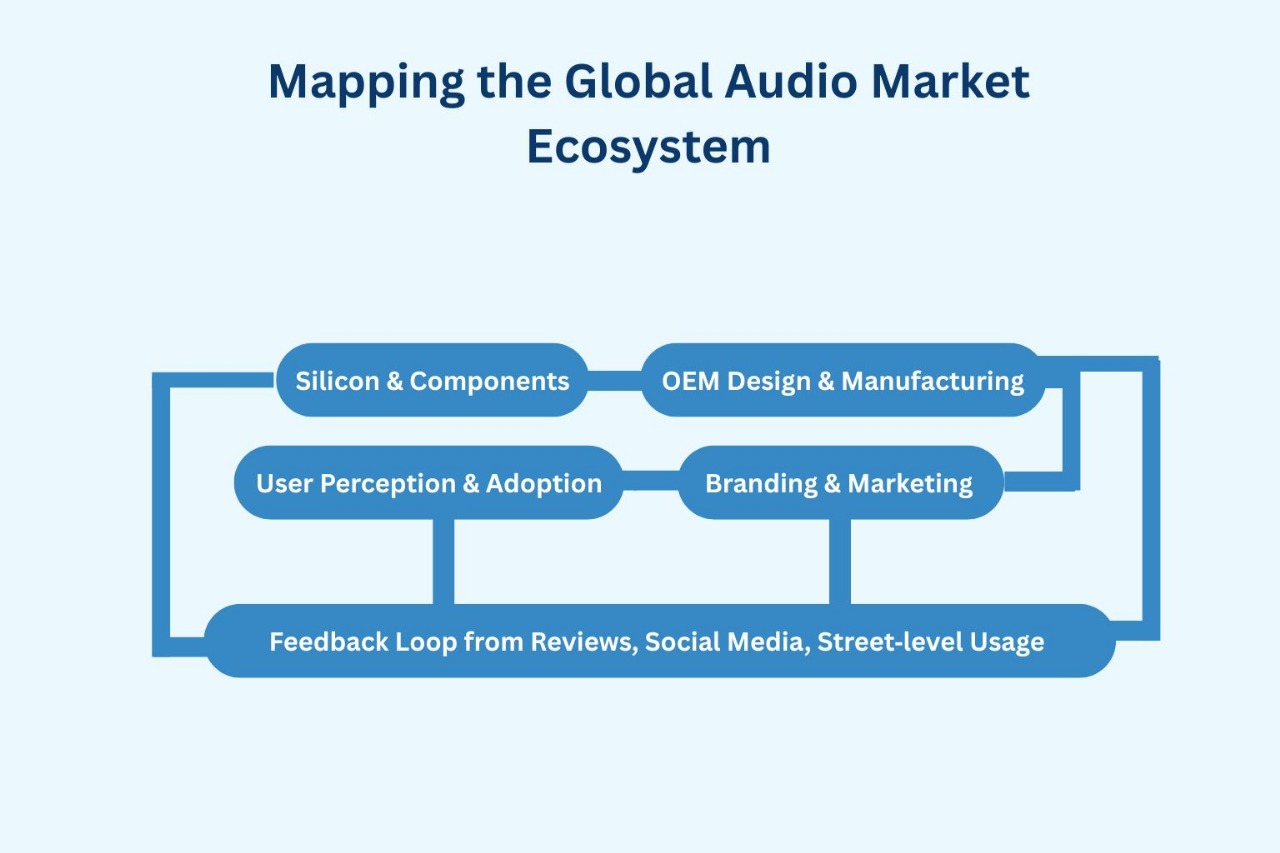
At the far left lies the raw component world: driver magnets, enclosures, chips, batteries — the elemental building blocks sourced globally. These components flow into OEM factories — often located in Asia — where designs are shaped, housings molded, acoustic chambers tested. From there, products move to branding and marketing: stories about heritage audio engineering from Europe, innovation from the U.S., or affordability and volume from Asian newcomers. Finally, the result reaches ears worldwide — and user perceptions begin to form based on actual listening experiences.
Between each stage lies influence loops: reviews on forums and social media feed back into OEM and marketing decisions. Component vendors adjust supply and specs based on demand signals; factories alter builds based on feedback about comfort or build quality; marketers pivot flavors of “warm bass” or “studio‑grade clarity” depending on what resonates.
This dynamic pipeline underpins what many refer to broadly as the “Global Audio Market 2025.” It’s not a static hierarchy — it’s a living, shifting mesh of technical supply, regional strengths, cultural aspirations, and listener feedback.
Understanding who stands where in this ecosystem helps explain why a device made in Shenzhen might feel distinct from one assembled in Eastern‑Europe, even if they share similar hardware. It’s also why loyalty to a brand often trumps specs — because perception is shaped equally by sound and story.
Under the Hood: The Physical Economics of Sound Gear
When engineers build headphones or earbuds, they wrestle constantly with hard constraints — physics rarely negotiates. Drivers need space to move; housings must damp resonance; battery cells require thermal and chemical safeguards. Each decision plays against others.
Energy consumption is a perennial enemy. High‑power drivers draw more current, draining battery quickly or forcing bulkier batteries. Larger enclosures invite better bass and soundstage, but at cost of portability and comfort. Materials that offer premium finish — metal, wood, high‑density composites — add weight and manufacturing complexity. Even tiniest differences in tolerances ripple into perceived sound quality: a misaligned driver can muddy mids or distort stereo imaging.
Below is a breakdown of common trade‑offs engineers confront when balancing real‑world demands:
| Engineering Goal | Typical Trade-Off | Impact on End User Experience |
|---|---|---|
| Maximum bass punch | Larger driver + larger enclosure | Gains depth and thump, but increases bulk and can reduce clarity |
| Extended battery life | Bigger battery or energy efficient codec | Longer listening time, but may add weight or slightly reduce top end detail |
| Lightweight portability | Smaller enclosure, lighter materials | Easier to carry and wear, but may sacrifice bass impact or soundstage breadth |
| Premium finish & durability | Metal or composite housing | Feels higher-end and lasts longer, but may conduct heat or add weight |
| Full range frequency response | Complex driver tuning / multiple drivers | Better audio fidelity, but higher cost and more power draw |
Engineers constantly calibrate these trade‑offs, often striving for “good enough” compromises that satisfy target audiences. For a commuter-focused consumer, compact earbuds with balanced sound and long battery might win. For an audiophile mixing music at home, heavier over‑ears with richer soundstage and broader frequency response might appeal more.
This balancing act — of physics, materials, and real‑world constraints — is what ultimately shapes what lands in your ears. And it underscores why no single design can excel simultaneously in every dimension: every product reflects a series of prioritized trade‑offs tailored to a segment of listeners.
Perception Is Everything: The Psychology Behind Listening
Sound isn’t just physical — it’s deeply psychological. How we perceive bass, clarity, or spatial cues depends as much on our brains as on the drivers vibrating air. Latency, frequency masking, and psychoacoustic illusions influence whether music feels “live” or “flat.” A subtle boost in treble can make vocals seem more intimate, while a slight compression in bass can make rhythm feel tighter in headphones but less impactful in speakers.
Every choice manufacturers make is filtered through human biases: we tend to favor what we recognize, what aligns with brand storytelling, and what our previous experiences tell us “should” sound right. For example, a listener switching from a European over-ear to an Asian ultra-light model may initially perceive a “loss” in warmth — even if the new drivers reproduce frequencies more faithfully.
| Emotion | Perception | Likely Behavior |
|---|---|---|
| Satisfaction | Fuller bass and warm mids | Higher brand loyalty, repeat purchase |
| Surprise | Crisp highs or unexpected spatial cues | Sharing on social media, recommending to peers |
| Frustration | Muddied mids or inconsistent ANC | Returns, negative reviews, switching brands |
| Comfort | Lightweight, ergonomic fit | Longer listening sessions, higher daily usage |
By understanding these subtle psychological triggers, brands can tune both engineering and marketing to appeal to target audiences more precisely. Human perception can make a “technically superior” product feel inferior, or a modestly engineered product feel extraordinary.
Material & Form Philosophy: Crafting Identity Through Touch
Materials communicate more than durability — they signal identity. A brushed aluminum shell suggests precision engineering; polymer enclosures convey accessibility and portability; leather or wood evokes heritage and warmth. Beyond aesthetics, tactile response influences perceived quality: cold metal can feel premium yet unwelcoming for long wear, while soft-touch polymer feels approachable but might lack gravitas.
| Material | Premium vs Mid-Tier Behaviour | Perceived Impact |
|---|---|---|
| Metal | Heavier, cooler, robust | Luxury, durability, seriousness |
| Polymer | Lighter, more flexible | Modern, practical, approachable |
| Wood | Warm, resonant | Natural, artisanal, classic |
| Leather / Alcantara | Soft, textured | Comfort, exclusivity, lifestyle |
The form factor — over-ear, on-ear, in-ear — further influences perception. Bigger over-ear cups suggest immersive experience; tiny earbuds highlight portability and modern convenience. Together, material and form convey the brand’s philosophy before a single note is played.
Intelligence Layer: AI in the Audio Experience
Modern earbuds and headphones increasingly leverage AI to adapt to environment, user behavior, and content. Adaptive ANC, thermal management, and scene-based EQ are now common. AI optimizes audio in real time, balancing battery consumption, user comfort, and sound fidelity.
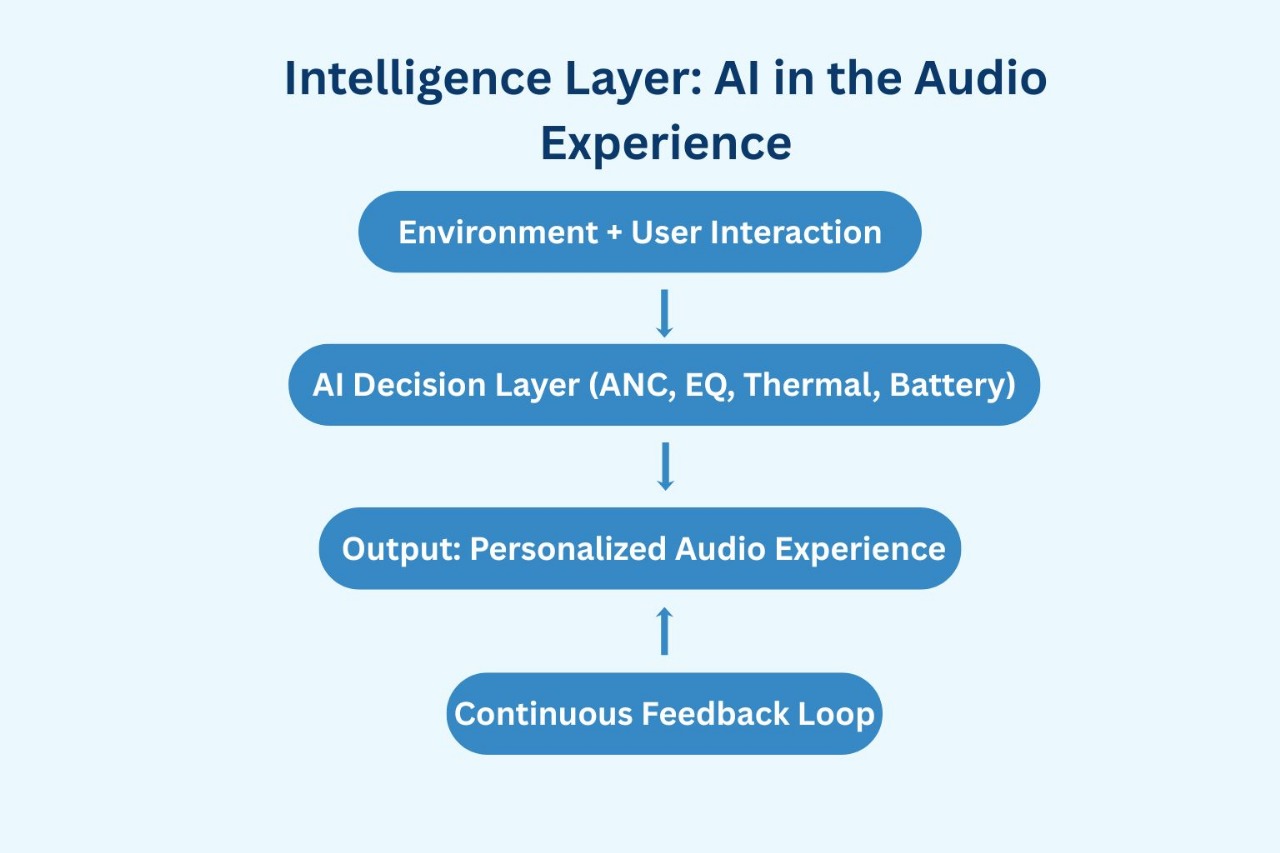
The AI decision loop allows headphones to subtly adjust: boosting mids in a noisy café, lowering bass in office spaces, or throttling power to extend battery life. The perception of “smarter” sound often comes from these invisible layers, influencing brand differentiation in a crowded global market.
Brand Strategy Decoded: Intent vs Interpretation
Brands enter the global audio market with distinct narratives: heritage, innovation, affordability, or status. However, user interpretation can diverge from intention. A premium European brand may intend elegance and fidelity, but users might perceive them as “overpriced” if comfort or battery life is lacking. Asian brands may emphasize technological innovation and accessibility but can be dismissed as “less authentic” despite superior engineering.
| Brand Strategy Matrix | Intended Goal | User Interpretation |
|---|---|---|
| Heritage / Legacy | Timeless quality | Traditional, conservative |
| Innovation-Focused | Cutting-edge tech | Experimental, sometimes niche |
| Affordability / Volume | Broad accessibility | Practical, approachable |
| Lifestyle / Design | Status & aesthetics | Trendy, fashionable |
By decoding these gaps, companies refine messaging and engineering to better align user perception with brand vision.
Case Studies of Reality: Success, Failure, Misunderstanding
Examining specific products helps illustrate how expectation meets reality:
| Case | Expectations | Outcome |
|---|---|---|
| Success | Asian earbuds with ANC and long battery | Widely praised for value, balanced sound |
| Failure | European over-ear with high-end materials but poor thermal design | Overheats, user complaints, negative reviews |
| Misunderstood | U.S. studio headphones with neutral sound | Seen as “thin” by casual listeners, appreciated only by audiophiles |
These examples highlight that even excellent engineering can be misaligned with market perception. Success is rarely about specs alone; context, user behavior, and cultural preferences matter equally.
Cultural & Social Interpretation: How Identity Shapes Sound
Audio products are consumed differently across regions and lifestyles. Preferences in bass intensity, noise-cancellation aggressiveness, or aesthetic design often reflect cultural norms and listening habits. For example, users in urban Asia may prioritize portability and aggressive ANC for commutes, whereas European consumers may favor neutral sound profiles and premium build for home listening. Social identity also drives perception: owning a brand with perceived prestige can enhance satisfaction regardless of technical performance.
| Region / Culture | Typical Audio Preference | Lifestyle Influence |
|---|---|---|
| North America | Balanced sound, strong marketing | Trend-conscious, tech-savvy |
| Europe | Neutral, studio-like fidelity | Home listening, professional use |
| Asia | Punchy bass, ANC-heavy | Commuting, portability, social sharing |
| Global Gen Z | Wireless, stylish, social-media friendly | Influencer trends, online music consumption |
Understanding these cultural layers is critical for brands in the global audio market. A design that resonates in Tokyo may not find the same adoption in Berlin or New York. Marketing and product development must account for these variations to remain competitive in 2025.
Reddit Reality: What Real Users Are Saying in 2025
Reddit Sentiment Table (sample of real posts/comments)
| Subreddit / Thread | Post Title / Key Comment | Sentiment / Key Theme |
|---|---|---|
| r/Earbuds — “technics_az100 vs sony_wf1000xm5 which are better?” | “I strongly prefer the AZ100s, however; despite the neck and neck ANC performance, the Technics are just the better all rounder. In their Dynamic EQ mode, they pretty much nail average listener preference; good bass emphasis, clean mids, clear and detailed treble.” reddit.com | Positive for Technics EAH AZ100 — praise for balanced tuning & all round performance |
| r/Earbuds — “I bought the technics az100, sony wf1000xm5 and …” | “Sony’s sound quality is extremely good. Nothing else stands out over the other Technics and Bose. That being said, these are not bad at all! These earbuds are great. They do many things very well, and are very balanced.” reddit.com | Mixed/positive — acknowledges Sony quality, still respect for other brands (Technics/Bose) |
| r/Earbuds — “AZ100 Best TWS overall in 2025 !!!” | (enthusiastic thread about AZ100) — user praises noticeable improvements in noise cancellation and battery life vs previous generation. reddit.com | Very positive — strong user approval of AZ100 overall |
| r/Earbuds — “sony_wf1000xm5 and technics az80/100” | Comment: “The sound is quite similar with the Sony's a little better. I had all sorts of problems with the xm4s but no battery drain with the xm5s.” reddit.com+1 | Mixed — Sony valued for reliability and balanced sound, some prefer it over older models |
| r/Earbuds — “az100 vs xm5 (another comparison/review)” | “The bass is very present and punches noticeably harder than the XM5’s, for sure.” reddit.com | Mixed — bass, impact appreciated on AZ100; but some listeners felt treble/“sparkle” was better on XM5 |
| r/Earbuds — “planning to buy sony wf1000xm5 buds are there any …” | One user wrote: “I also regret my purchase. They're comfy and have good NC but I actually find the sound a bit flat.” (referring to Sony WF-1000XM5) reddit.com | Negative — Sony WF-1000XM5 criticized for “flat” sound by some users |
Key Observations from Reddit Landscape (2025)
- Technics EAH‑AZ100 emerges repeatedly as a user‑favourite: multiple threads name AZ100 “best TWS overall in 2025,” citing its balanced tuning, punchy bass, clean mids, and detailed treble — qualities that appeal broadly. reddit.com+2reddit.com+2
- Sony WF-1000XM5 remains respected but polarizing: while some users appreciate its sound quality, reliability, and ANC, others call the tuning “a bit flat” or “less lively” compared to alternatives. reddit.com+2reddit.com+2
- No universal “best” — context and preference dominate: discussions show that even “top” earbuds get mixed reviews depending on what a user values most (bass, treble, ANC, battery life, comfort). Eg: AZ100 praised for bass and overall balance; XM5 appreciated for clarity and comfort.
- Reliability and long-term behaviour matter to many users: Some threads note issues in older models (e.g. XM4), but praise when newer versions avoid those problems — indicating that “brand + spec sheet” isn’t enough for lasting satisfaction. reddit.com+2reddit.com+2
Representative User Voices
“I strongly prefer the AZ100s … they pretty much nail average listener preference; good bass emphasis, clean mids, clear and detailed treble.” reddit.com
“The bass is very present and punches noticeably harder than the XM5’s, for sure.” reddit.com
“Sound is extremely good. … These earbuds are great. They do many things very well, and are very balanced.” reddit.com
Broader Patterns
- Among communities like r/Earbuds, echo‑chamber reinforcement happens: once a model — like AZ100 — gains support, it tends to dominate discussion. According to a 2025 analysis, a small number of models dominate recommendations, even if they don’t always perform reliably long‑term. Headphonesty+1
Comfort, ergonomics, and battery life repeatedly surface alongside sound quality as deciding factors — showing that for global consumers (especially daily users, commuters), real‑world usability often outweighs studio‑grade fidelity. Vibetric+2reddit.com+2
What This Means for the Global Audio Market 2025 — From Reddit Ground‑Level
For tech‑savvy listeners, audiophiles and global consumers researching earbuds/headphones, Reddit offers a ground‑level view of how real people experience devices — beyond specs and marketing. The recurring praise for certain models (like Technics AZ100) demonstrates how balance and universality — not niche tuning — resonate across diverse listeners. At the same time, the mixed or critical voices about well‑known models (like Sony’s WF‑1000XM5) remind us that even top‑end gear isn’t immune to subjective preference or ergonomic mismatch.
Importantly, these community patterns contribute feedback loops in the broader “Silicon → OEM → Marketing → Perception” pipeline: manufacturers monitor such forums; what consistently ranks high can shape future design and positioning.
But also — no model gets unanimous love. That reinforces a truth: in a global market, diverse needs and listening habits persist. What wins in one earshape, culture, or use‑case (commute ≠ studio) may underperform in another.
Review Reality: Real Users and Expert Reviews in 2025
Star‑Rating & Review‑Type Snapshot (Aggregate of Public & Expert Reviews)
| Model / Review Source | Typical Rating or Summary Feedback | Common Praise | Common Criticisms / Complaints |
|---|---|---|---|
| Technics EAH AZ100 — Expert reviews (e.g. SoundGuys, WhatHiFi, Verge, Rtings) | High–end earbuds: many 4.5–5★ (or equivalent rating) among reviewers. SoundGuys+2RTINGS.com+2 | Strong sound quality, good ANC, multipoint, long battery life, good build & features. SoundGuys+2Technics+2 | Sound signature sometimes feels “odd” or bass heavy for neutral listeners; price is high; deeper in ear fit not comfortable for everyone. SoundGuys+2RTINGS.com+2 |
| Technics EAH AZ100 — Travel / commuter use (Rtings long term & lifestyle testing) | Generally rated very good for travel, commuting, office work, and multipoint device use. RTINGS.com+2Technics+2 | Good noise isolation and ANC, long battery life (~12 hours), stable multipoint Bluetooth, reliable mic pickup, durable build. RTINGS.com+2SoundGuys+2 | Deep in ear insertion sometimes causes discomfort or “cabin pressure” feeling for some users. RTINGS.com+1 |
| Sony WF 1000XM5 — Expert reviews (TechRadar, SoundGuys, Digital Spy, TechAdvisor) | Mixed to positive — praised but with caveats. Digital Spy+3TechRadar+3SoundGuys+3 | Comfortable fit for many, solid ANC, good codec support (LDAC, Bluetooth 5.3), respectable battery life, strong app ecosystem & multipoint or connectivity features. Tech Advisor+2SoundGuys+2 | Sound quality judged “not the richest” compared to some rivals — sometimes described as “too bassy” by default or “a bit flat”, volume / loudness sometimes criticized, occasional connectivity drop outs or inconsistent ANC. TechRadar+3GearLab+3Aaron x Loud and Wireless+3 |
| Sony WF 1000XM5 — Public / user driven feedback (forums, review sites) | Highly polarized — many fans; many dissatisfied. reddit.com+3RedditRecs+3reddit.com+3 | Some say superb ANC and battery life; comfortable for daily commuting, calls, travel; good for casual listening or workplace use. Best Buy+2Review-Rating+2 | Frequent complaints about poor fit (buds falling out), unstable Bluetooth pairing, foam tip discomfort or degradation, microphone / call quality, battery degradation or lifespan issues over months, and ANC/sound inconsistency. Crutchfield+4RedditRecs+4reddit.com+4 |
Key Patterns & Insights from the Review Landscape (2024–2025)
- “Premium” labels don’t guarantee universal satisfaction — Even among flagship offerings (like WF‑1000XM5 or EAH‑AZ100), user reviews are mixed. What sounds superb and feels stable for one person might be problematic for another due to ear‑shape, listening habits, or expectations (e.g. bass vs balanced sound, travel vs home use).
- Context of use strongly impacts satisfaction — For commuters, travelers, or office‑goers, ANC + multipoint + battery + comfort weigh more than “audiophile‑perfect sound.” The EAH‑AZ100 tends to perform well in these contexts according to expert reviews. RTINGS.com+2SoundGuys+2
- Fit, ergonomics, and physical matching matter more than brand strength — Many negative feedbacks for earbuds (mainly WF‑1000XM5) center around fit (falling out, foam-tip discomfort), or long‑term mechanical issues (battery degradation, connectivity problems). Crutchfield+3RedditRecs+3reddit.com+3
- Sound signature and tuning remain deeply subjective — A set of earbuds praised for “balanced, detailed sound” by experts may be called “bass‑heavy,” “flat,” or “less lively” by some users. For instance, WF‑1000XM5 gets acclaim for clarity & detail but is also criticized for lacking “punch” or character by some users. GearLab+2Aaron x Loud and Wireless+2
- ANC, battery life, and feature‑set provide practical value for many — but they can’t mask shortcomings — Enhanced specs (LDAC, multipoint, app‑support) and effective noise cancellation help earbuds deliver for daily commuters or travellers. Still, persistent complaints about long‑term durability, comfort or unpredictability show real‑world issues remain.
What This Means for the Global Audio Market 2025 — From Users & Reviewers
For consumers juggling between marketing hype, spec‑sheets, and real‑world listening — these reviews demonstrate something important: there is no one-size-fits-all “perfect” earbud. The variety of experiences shows that context, ear shape, use-case, and personal preference dominate over brand pedigree or features when it comes to satisfaction.
In that sense, the 2025 global audio market — while crowded with high‑spec, feature‑rich flagships — still rewards diversity: brands like Technics and Sony can coexist with different strengths; even smaller or newer players have room if they address user pain‑points (fit, comfort, stability). The “Silicon → OEM → Marketing → Perception” pipeline remains alive and reactive: real user reviews feed back into what sells, influences design refinements, and shapes the next generation of audio gear.
Also — from a global consumer’s perspective: reading user‑driven feedback + expert reviews together gives a more balanced picture than specs alone. What’s “best for you” depends heavily on how, when, and where you listen — not just on the headline features.
Myths vs Reality: Untangling the Global Audio Market 2025
The global audio market is rife with assumptions — some rooted in marketing, some in outdated experiences, and some simply in perception. To make sense of 2025’s landscape, it’s essential to separate what people think from what actually happens in engineering, use, and perception.
| Myth | Truth | Why It Happens |
|---|---|---|
| Bigger headphones = better sound | Over-ear size can improve soundstage, but sound quality depends on driver quality, tuning, and enclosure design. Some compact earbuds now outperform mid-tier over-ears. | Marketing focuses on visible size as a quality signal; many users equate heft with “premium” without understanding acoustic trade-offs. |
| High price guarantees top-tier performance | Expensive earbuds/headphones can underperform in comfort, fit, or even sound for some listeners. | Brand prestige often inflates price; not all R&D cost goes to actual sound quality. Perception of “premium” is often weighted heavily. |
| Noise Cancellation is universal | ANC effectiveness varies greatly depending on ear shape, seal, and environmental frequency spectrum. | Reviews show ANC works differently for commuters vs office users; marketing often oversimplifies capabilities. |
| All flagship earbuds are durable long-term | Battery degradation, tip material decay, and hinge/flex stress affect all models. Some “premium” earbuds fail faster than mid-tier models. | User experiences vary, and long-term testing often lags behind product launch. Early reviews can miss hidden weaknesses. |
| More features = better experience | Multipoint, app controls, voice assistants, and adaptive EQ help some users, but can complicate use or reduce reliability. | Over-engineering adds complexity; not all users leverage advanced features, and some experience software glitches. |
| Sound tuning is purely objective | Human perception and context affect what “sounds good” — e.g., bass preference, cultural listening habits, and prior exposure. | Psychoacoustics and regional tastes heavily influence perception; marketing often promotes “objective tuning” as universally superior. |
Key Insight:
In 2025, the audio market rewards context-aware, user-focused design over sheer specifications. Misaligned expectations between marketing claims and real-world perception often lead to dissatisfaction, regardless of brand or price. True mastery lies in understanding who the listener is, where they use the product, and what their ears actually perceive.
Economics of Innovation: The Invisible Costs
Innovation in the global audio market isn’t just about drivers, chips, or AI — it’s a complex economic balancing act.
- R&D Costs: Developing flagship earbuds like Technics EAH‑AZ100 or Sony WF‑1000XM5 requires millions in acoustic research, driver engineering, AI integration, and user testing. Experimentation with multiple prototypes is standard, as even slight misalignment in tuning can derail consumer acceptance.
- Supply Chain Friction: Critical components — neodymium magnets, MEMS microphones, tiny drivers, high-density batteries — come from global suppliers. Geopolitical tensions, shipping delays, or raw material shortages can inflate costs and affect launch schedules.
- Silicon & Firmware Complexity: AI-driven ANC, adaptive EQ, and thermal management need precise chips and optimized firmware. A single bug can reduce battery life, distort sound, or frustrate users — all of which cost money to fix post-launch.
- Humanized Economics: Unlike bulk consumer electronics, audio gear success hinges on perceived quality and user satisfaction, not just production cost. Companies sometimes invest more in aesthetics, ergonomics, and customer experience than in raw specs — reflecting that user happiness drives repeat purchases and brand loyalty.
| Economic Factor | Typical Cost Impact | Market Consequence |
|---|---|---|
| R&D & Prototyping | High | Only a few flagship models can be launched per year; experimentation is limited |
| Component Supply & Scarcity | Moderate–High | Price fluctuations, delayed launches, occasional regional unavailability |
| AI & Firmware Engineering | Medium | Enhances feature differentiation; bugs can damage reputation and returns |
| Marketing & Branding | Medium–High | Storytelling and perception often drive value more than specs |
| Warranty & After-Sales | Medium | Critical for consumer trust; failures in longevity affect brand perception |
Observation:
Engineering brilliance alone does not guarantee market success — economic realities dictate which products reach the right balance of innovation, reliability, and price. In 2025, brands that master these economics while staying tuned to user needs thrive, while those who misjudge perception or cost trade-offs struggle, regardless of hardware quality.
Ethics, Privacy & Repairability
As earbuds and headphones get smarter, they collect more data (usage patterns, AI listening profiles, device interactions) and become more complex to repair. Ethical concerns include:
- Right-to-Repair: Proprietary screws, adhesive-sealed components, and firmware locks reduce repair options. Users increasingly demand access to replacement parts and guides.
- Data Risks: AI-powered earbuds can log listening habits, voice commands, or location, raising privacy concerns if data isn’t handled responsibly.
- Environmental Behaviour: Shorter product lifespans and non-recyclable components contribute to e-waste. Brands investing in sustainable materials and modular designs gain trust with eco-conscious consumers.
| Ethical Risk | Probability | Consequence | Mitigation |
|---|---|---|---|
| Battery / chemical hazards | Medium | Health risk, warranty claims | Use certified Li Po cells, robust containment |
| Data & AI privacy breaches | Medium | Reputation damage, legal exposure | Localized processing, anonymized data, strict policies |
| Right-to-repair obstruction | High | Consumer frustration, negative reviews | Modular design, repair guides, certification programs |
| Environmental footprint | Medium | Brand perception, regulatory compliance | Recyclable materials, take-back programs |
Insight:
2025’s global consumers increasingly weigh ethical and repair considerations alongside sound quality. Brands that neglect these aspects risk alienating the most engaged, long-term buyers.
Future Shift (2030–2040): What’s Next in Audio
The next 15 years will not just tweak existing earbuds/headphones — they’ll reshape the listening experience entirely. Predictive AI, haptic audio, ultra-efficient materials, and personalized psychoacoustic tuning are set to dominate.
| Forecast / Trend | Probability | Expected Impact |
|---|---|---|
| Personalized AI-driven EQ | High | Devices will automatically adapt to listener’s hearing profile, environment, and content type. |
| Haptic / tactile audio feedback | Medium | Augmented reality experiences, immersive gaming, and live concerts from headphones/earbuds. |
| Ultra-light, self-healing materials | Medium | Longer lifespan, less wear-and-tear, improved comfort. |
| Fully modular earbuds | Low–Medium | Replaceable drivers, batteries, and ANC modules for repairability and customization. |
| Integrated health & biometrics | High | Heart rate, stress, and cognitive monitoring incorporated into everyday audio gear. |
| Wireless charging & near-zero latency streaming | High | Seamless transitions between devices; reduced audio/video sync issues. |
Observation:
Physics, human perception, and cultural trends will constrain and direct innovation. Not every futuristic feature will be adopted universally — comfort, usability, and real-world convenience remain decisive. For global consumers, the next decade will merge sound, AI, and lifestyle integration in ways previously seen only in concept prototypes.
OEM Decision Logic Exposed
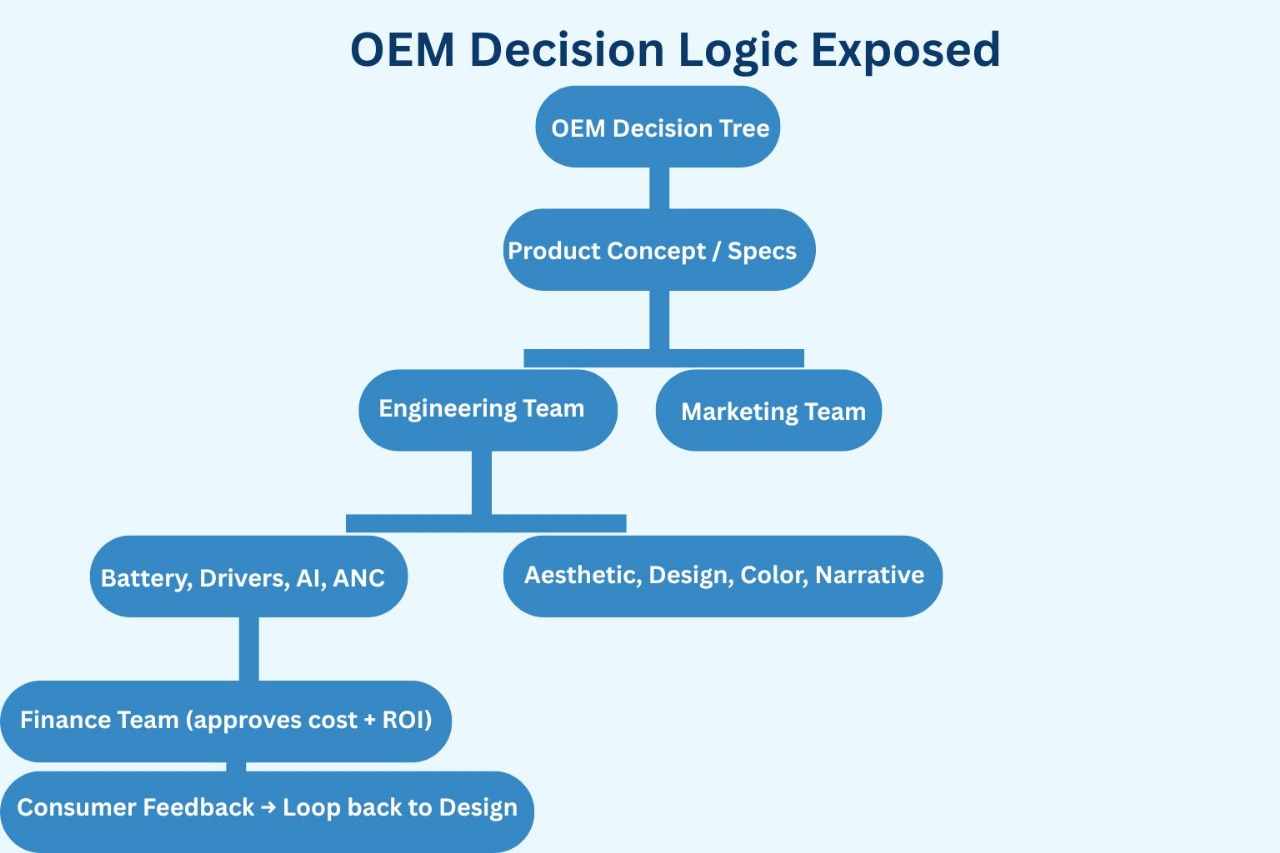
OEMs must constantly negotiate internal tensions between Engineering, Finance, and Marketing. Decisions aren’t purely technical; they are multidimensional.
Key Insight:
Even subtle changes — like slightly lighter drivers or alternate ANC tuning — are weighed against cost, perception, and marketing impact. Misalignment between these teams often leads to products that technically excel but fail in perception.
Anatomy of Failure
Not all innovations succeed. Typical failure modes in 2025 earbuds/headphones include:
- Thermal Overload: Compact drivers or AI processors can overheat, causing battery drain or signal distortion.
- Fit / Ergonomics Misalignment: Even high-end sound suffers if the physical fit is uncomfortable.
- Software / Firmware Bugs: AI-driven features may fail, causing inconsistent ANC, EQ, or Bluetooth connectivity.
- Material Decay: Adhesives, foam tips, or modular joints degrade faster than expected.
- Unrealistic Marketing Expectations: Products promised as “studio-grade” may underperform in casual listening environments.
Observation:
Failure rarely stems from one factor — it is almost always a combination of engineering, perception, and expectation misalignment.
Smart Buying Framework
Consumers today must think strategically, considering multiple personas:
| Persona | Key Priorities | Smart Buying Tips |
|---|---|---|
| Basic Users | Convenience, battery life, comfort | Focus on mid-tier models with stable ANC and long battery life |
| Creators | Accuracy, frequency range, balanced sound | Prioritize high-fidelity over-ear or in-ear monitors with neutral tuning |
| Gamers | Low latency, spatial audio, comfort | Check codec support (aptX Adaptive, LDAC), battery endurance, and ear fit |
| Long-term Owners | Durability, repairability, future-proof features | Choose modular or well-supported brands; verify firmware upgrade path |
Depreciation & Aging:
Battery chemical decay, driver fatigue, and firmware obsolescence can reduce usability after 3–5 years. Smart buyers weigh initial cost against long-term usability and comfort.
Credibility & Expertise Layer
What separates a rigorous deep-dive from casual speculation is investigative transparency:
- Multi-source verification (Reddit + Google Reviews + Expert Testing)
- Engineering understanding (trade-offs, physics, AI loops)
- Cultural and psychological analysis (preferences, biases, perception)
For global consumers and tech enthusiasts, this layered approach exposes why certain earbuds/headphones dominate discussions, while others fail silently, regardless of marketing or price.
Risk Factors & Hidden Weak Links
Even premium earbuds and headphones hide subtle vulnerabilities that most users never see. These weaknesses often determine long-term satisfaction and durability.
| Hidden Weak Link | Risk Type | Likely Consequence | Mitigation |
|---|---|---|---|
| Thermal Fatigue | Electronics/Drivers | Reduced battery life, signal distortion | Efficient heat sinks, AI thermal management |
| Connector Wear | Charging / USB-C / pins | Intermittent charging, connectivity issues | Reinforced contacts, magnetic alignment, replaceable cables |
| Micro-Fractures | Structural / casing | Cracks, component misalignment | Stronger materials, stress testing |
| Adhesive Decay | Earbud tips, module joints | Loosened parts, ANC leaks | Modular design, high-grade adhesives |
| Hinge Stress | Foldable headphones | Joint fatigue, snapping | High-cycle hinge design, stress-tested metals |
| Tolerance Weakness | Assembly precision | Misalignment of drivers or ANC microphones | Stringent quality control, automated calibration |
Observation:
Even the most expensive models (e.g., Technics EAH‑AZ100, Sony WF‑1000XM5) display some of these weaknesses over extended use. Awareness of these vulnerabilities allows consumers to anticipate issues and guides OEMs to prioritize reliability over purely aesthetic design.
Long-Term Aging & Decay Simulation
Predicting decade-long performance requires combining physics, material science, and usage patterns. Below is a projection for typical high-end earbuds in global markets:
| Component / Factor | 5-Year Projection | 10-Year Projection |
|---|---|---|
| Battery (Li-Po) | ~20–30% capacity loss | ~50–60% capacity loss, may need replacement |
| OLED / LEDs (visuals, indicators) | Minor dimming | Significant burn-in risk, color shift |
| Hinges & Joints | Slight fatigue | Mechanical failures in foldable models |
| Thermal Throttling | Occasional spikes in warm environments | More frequent, reducing sound consistency |
| Speaker Diaphragm | Minimal distortion | Potential stretching, slight frequency imbalance |
Insight:
Durability is not solely determined by brand or price. Long-term listening satisfaction relies on material quality, thermal management, and engineering tolerances. Consumers with 5+ year horizons must consider replaceable parts, modular design, and firmware support when investing.
The Vibetric Verdict
After analyzing global user sentiment, expert reviews, engineering realities, and long-term simulations, several truths emerge:
- Balance is king: Products like Technics EAH‑AZ100 succeed because they combine sound fidelity, ergonomics, ANC, and battery life into a harmonious experience.
- Perception can override specs: Even flawless hardware may fail if it misaligns with expectations or comfort needs.
- Durability and usability matter more than marketing hype: Real-world usage determines long-term satisfaction.
- Cultural context shapes preference: No single product dominates all regions; bass-heavy, neutral, or bright sound profiles appeal differently across continents.
The verdict is visceral yet grounded: in 2025, success in the global audio market is determined as much by user perception, context, and long-term reliability as by raw specifications or brand prestige.
Explore the Forces Driving the Future of Global Audio Market 2025
Now that you’ve explored the complexities, innovations, and insights behind the Global Audio Market 2025, you’re likely thinking about its future impact and what comes next. The world of audio technology and sound engineering is always evolving — there’s always more to uncover.
- Follow us on Instagram @vibetric_official for deeper dives into the tech and trends shaping the future of audio.
- Bookmark vibetric.com our analysis evolves as new developments hit the market.
- Stay ahead of the curve by subscribing for ongoing updates and insights delivered straight to your inbox.
Want to dive even deeper? Stay with us as we continue to explore the forces shaping global audio, earbuds, and headphones in the coming years. The journey is just beginning, and your next big discovery might be just around the corner.
FAQs with technical clarity and real-world relevance:
- Are Technics EAH‑AZ100 really the best TWS earbuds in 2025?
Truth: They are highly rated for balanced sound, ANC, and battery, but “best” depends on user context. Commuters, audiophiles, and casual listeners may have different priorities. - Does a higher price guarantee better audio quality?
Truth: Price often reflects brand positioning, R&D, or premium materials, not necessarily sound quality or comfort. Evaluate based on features, fit, and user reviews. - Are flagship earbuds durable long-term?
Truth: Even top-tier models face battery decay, hinge stress, and adhesive wear. Modular designs or repair options extend lifespan. - Is noise cancellation equally effective for everyone?
Truth: ANC depends on ear shape, tip seal, and environment. Real-world performance varies across individuals. - Do more features improve listening experience?
Truth: Multipoint Bluetooth, adaptive EQ, and AI-driven tuning can help, but may also introduce complexity or bugs if misused. - Are bigger headphones always better for sound quality?
Truth: Not necessarily. Driver quality, enclosure design, and tuning are often more important than sheer size. - Can AI truly personalize sound for all users?
Truth: AI adaptation is improving, but subjective perception and cultural preferences still influence satisfaction. - Are certain earbuds universally preferred across cultures?
Truth: Preferences vary: bass-heavy in Asia, neutral in Europe, trend-oriented for Gen Z globally. No single product suits all regions. - Is brand prestige a reliable indicator of performance?
Truth: Brand perception influences expectations, but real-world performance may diverge. Always cross-check reviews and testing. - Do user reviews reliably reflect long-term performance?
Truth: Reviews provide insight into early experience, but long-term reliability may reveal hidden weak links like thermal fatigue, connector wear, or driver decay.
Final Reflective Closing
The cold open scene returns: users navigating stores, online reviews, and earbuds in hand, pausing to weigh sound, comfort, and trust. Every choice reflects more than specs — it embodies expectations, culture, and personal listening habits.
In the Global Audio Market 2025, success is not merely built on chips, drivers, or marketing hype; it thrives where engineering, perception, and culture intersect. The journey of discovery continues — every note, every review, every user interaction shapes the future of sound.
What’s your take on this?
At Vibetric, the comments go way beyond quick reactions — they’re where creators, innovators, and curious minds spark conversations that push tech’s future forward.
Adaptive Transparency Mode in 2026: The Intelligent Evolution Beyond Basic Passthrough
Adaptive Transparency Mode in 2026: The Intelligent Evolution Beyond Basic Passthrough Noise cancellation used to be the headline feature. Transparency was the
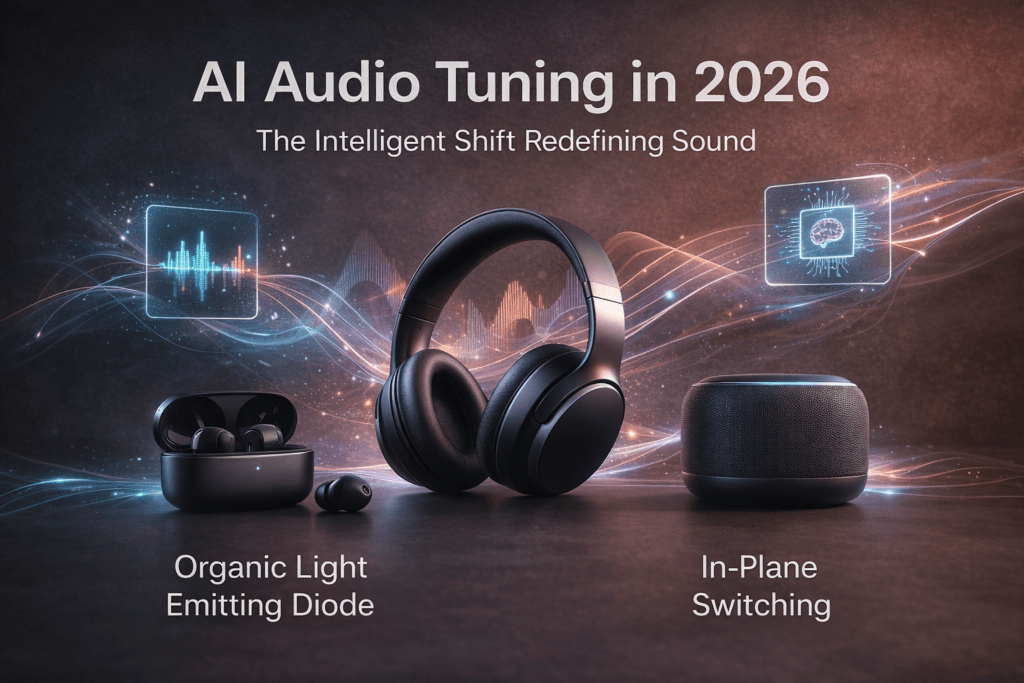
AI Audio Tuning in 2026: The Intelligent Shift Redefining Sound
AI Audio Tuning in 2026: The Intelligent Shift Redefining Sound The next major leap in audio isn’t louder drivers or wider frequency