
Why Gaming Headsets Don’t Sound Like Music Headphones
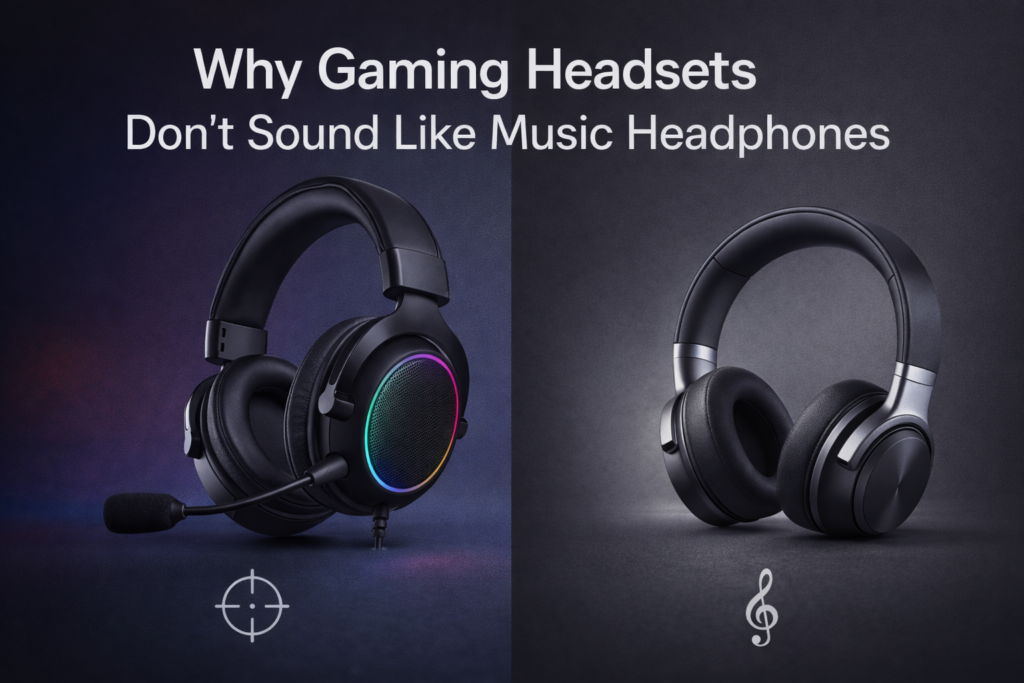
At first glance, gaming headsets and music headphones appear to serve the same purpose: delivering sound directly to your ears. Yet anyone who has tried listening to music on a gaming headset — or gaming with studio-grade music headphones — quickly notices a stark difference. This contrast isn’t accidental. The divide between gaming vs music headphones reflects fundamentally different design goals, tuning philosophies, and user expectations.
Understanding why gaming headsets don’t sound like music headphones reveals how audio priorities shift depending on whether immersion, competition, or musical fidelity comes first.
Different Goals, Different Sound Signatures
The biggest reason gaming headsets sound different lies in their tuning. Gaming audio prioritizes positional awareness — footsteps, reloads, environmental cues, and directional accuracy. To achieve this, manufacturers often boost treble and upper mids while slightly reducing bass clarity.
Music headphones aim for balance and tonal accuracy. Vocals, instruments, bass texture, and soundstage cohesion matter more than directional sharpness. This core distinction defines the gaming vs music headphones debate: one emphasizes information, the other emotion.
In gaming headsets, exaggerated highs help pinpoint enemies. In music headphones, those same highs can sound harsh or fatiguing during long listening sessions.
Bass: Impact vs Texture
Gaming headsets often feature boosted bass for cinematic impact — explosions, gunfire, and environmental effects feel more dramatic. However, this bass is usually broad and less detailed, prioritizing punch over precision.
Music headphones, especially those tuned for accuracy, focus on bass texture rather than volume. Sub-bass separation, mid-bass control, and decay matter more for reproducing instruments accurately. In the gaming vs music headphones comparison, bass is where casual listeners often notice the difference first.
What feels exciting in a game can feel muddy or overpowering in a music track.
Soundstage and Imaging Priorities
Soundstage design also differs significantly. Gaming headsets emphasize imaging — the ability to locate sounds precisely in a 3D space. Virtual surround sound, DSP processing, and directional tuning help simulate spatial awareness.
Music headphones focus more on natural soundstage width and depth. Instead of pinpoint accuracy, they aim for a cohesive, realistic presentation where instruments feel layered and spacious.
This explains why gaming headsets may sound “wide but artificial” for music, while music headphones may feel less precise in competitive shooters.
Microphones, DSP, and Compromises
Gaming headsets integrate microphones, onboard processing, and software enhancements. These features add convenience but introduce compromises. DSP tuning alters the original audio signal, prioritizing clarity over purity.
Music headphones usually avoid heavy processing, preserving the integrity of the recording. In the gaming vs music headphones comparison, added features often come at the cost of raw sound fidelity.
The all-in-one nature of gaming headsets makes them versatile, but rarely audiophile-grade.
Build Choices Reflect Use Cases
Gaming headsets are built for long sessions — lightweight materials, breathable ear pads, and flexible clamping force. Durability and comfort often outweigh acoustic refinement.
Music headphones, especially studio or audiophile models, invest more in driver quality, enclosure design, and acoustic damping. These elements improve tonal accuracy but may sacrifice the gamer-friendly comfort or mic integration.
Neither approach is wrong — they simply reflect different priorities.
Mini Comparison Snapshot: Gaming vs Music Headphones (2025)
| Aspect | Gaming Headsets | Music Headphones |
|---|---|---|
| Tuning | Emphasized highs, punchy bass | Balanced or neutral |
| Priority | Positional accuracy | Tonal accuracy |
| Bass Style | Impact-focused | Texture-focused |
| Processing | DSP, virtual surround | Minimal processing |
| Mic Integration | Built-in | External or none |
| Ideal Use | Competitive & immersive gaming | Music, mixing, casual listening |
Why “One Headphone for Everything” Rarely Works
Many users expect a single headset to excel at both gaming and music. In reality, the gaming vs music headphones divide exists because audio design is inherently trade-off driven. Enhancing footsteps weakens musical warmth. Boosting bass impact blurs detail.
Some premium hybrid models attempt to bridge the gap, but they still lean toward one use case. True balance remains difficult without compromise.
Closing Insight
Gaming headsets don’t sound like music headphones because they’re not meant to. They’re tools optimized for awareness, reaction time, and immersion rather than musical accuracy. Music headphones prioritize emotion, balance, and realism over competitive advantage.
Recognizing this distinction helps users choose the right tool for their needs — and avoids disappointment driven by mismatched expectations. In the end, the debate around gaming vs music headphones isn’t about which is better, but which is built for your primary purpose.
Choose the Right Sound for Your Setup
- Follow our Instagram @vibetric_official for deep dives into audio tuning and headphone technology.
- Bookmark vibetric.com for comparisons across gaming, studio, and lifestyle audio gear.
- Stay informed on how sound design impacts real-world listening and gameplay experiences.
What’s your take on this?
At Vibetric, the comments go way beyond quick reactions — they’re where creators, innovators, and curious minds spark conversations that push tech’s future forward.
Ray Tracing in 2026: The Powerful Shift From Experimental to Standard Graphics
Ray Tracing in 2026: The Powerful Shift From Experimental to Standard Graphics The technology spent years as a benchmark showcase. Now it’s
Spatial Audio Default in 2026: The Quiet Shift Redefining Immersive Sound
Spatial Audio Default in 2026: The Quiet Shift Redefining Immersive Sound There was a time when surround sound required a living room