
The State of Gaming Hardware in 2025 — Performance, Price, and Purpose
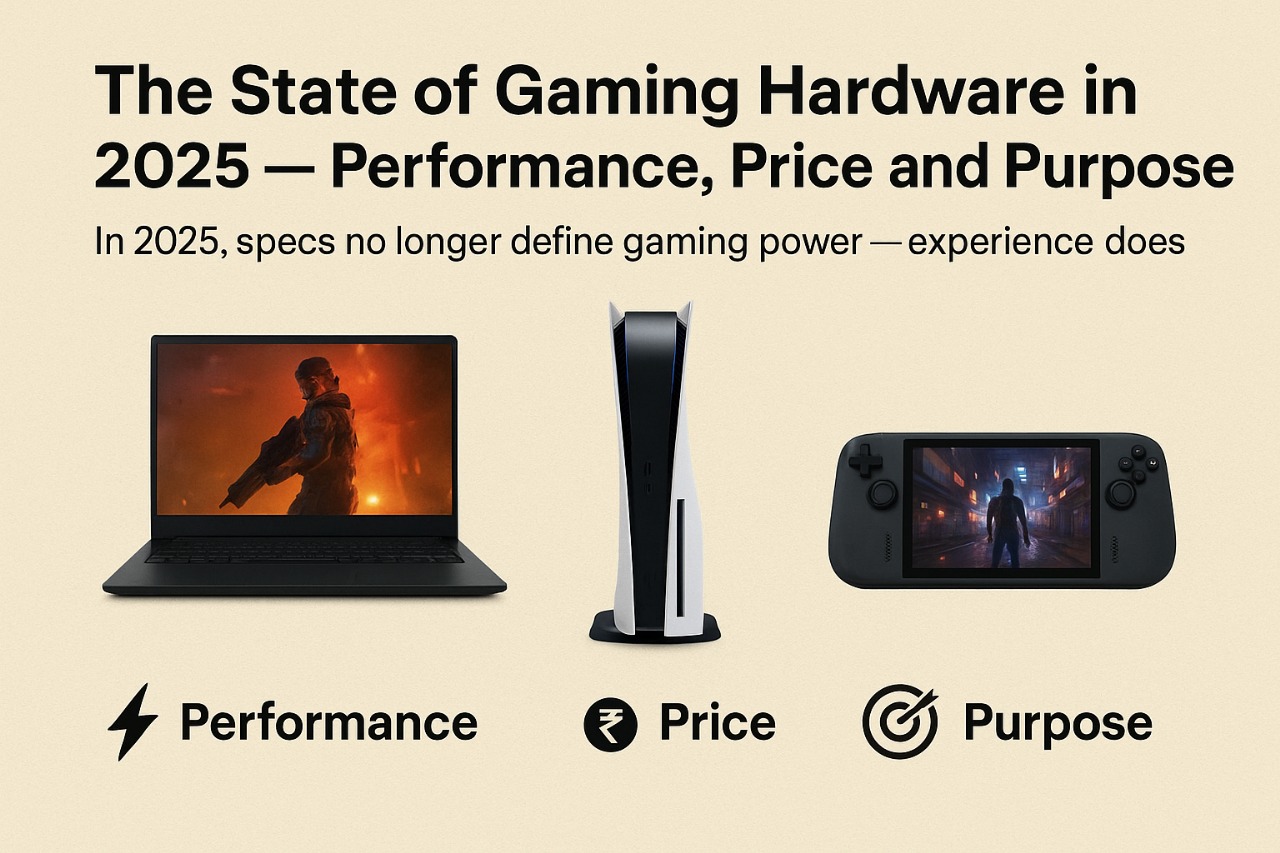
You feel it before you see it — that faint hesitation in the frame, the micro-stutter your brain detects even if the FPS counter insists everything is fine. It happens late at night, when the room is silent except for the low mechanical hum of your graphics card, a reminder of the machine’s strength and its limits. This is where the real story of gaming hardware 2025 starts: not in benchmarks, not on product slides, but in those private moments when you notice that your system is either becoming a bottleneck or still fighting for you. Every gamer carries this tension — the psychological tug-of-war between resisting the upgrade cycle and craving that smoother, deeper, more honest performance. You tell yourself you’re being practical, that your current build works perfectly well. But your instincts betray you. They remind you that performance isn’t a number; it’s a feeling, and that feeling is slipping. The paradox of modern gaming is that the hardware race has become less about chasing power and more about escaping discomfort — latency anxiety, thermal fear, price fatigue. And yet, in this tension lies clarity. The story of 2025 isn’t about hardware getting faster; it’s about gamers learning what “fast enough” truly means.
There’s a new kind of silence in the PC hardware aisle — a silence created not by a lack of products but by the overwhelming sameness between them. You look at shelves lined with near-identical GPUs, with power limits hovering within the same narrow envelope and thermal designs so carefully optimized they blur into one signature of diminishing returns. You begin to realize that gaming hardware 2025 doesn’t sell you breakthroughs anymore; it sells you refinement packaged as revolution. Your brain knows this. Your heart disagrees. Because when you sit in front of a game and everything — lighting, shadows, responsiveness — feels just a little more alive, you forget the incremental nature of the upgrade and remember the experience. Manufacturers know this psychological rhythm. They’ve studied it. They understand that a gamer doesn’t upgrade because the product is new; a gamer upgrades when their sense of control erodes. And in 2025, the erosion is engineered with frightening precision. Not maliciously — just methodically, through the creeping complexity of software, engines, AI workflows, and DLSS/FSR pipelines that gradually demand more than last year’s silicon can comfortably supply.
But the turning point arrives when you confront the truth that your hardware is no longer adapting to your games — your games are adapting to your hardware. Every title now comes with an AI-powered performance layer that decides what you should see and how sharply you see it. You feel the illusion before you understand it: textures morphing mid-frame, shadows redrawn by invisible algorithms, and motion interpolated in ways that make you doubt whether the moment was rendered or reconstructed. This is the secret heartbeat of gaming hardware 2025: an industry where raw performance is no longer the hero. Optimization is. And optimization always comes with compromise disguised as intelligence. For gamers, this creates a new internal conflict — the realization that their experience is shaped not just by silicon, but by the choices of unseen engineers tuning pipelines to make mid-range hardware seem high-end. It works, mostly. But once you notice these seams, you start craving the authenticity that only brute-force hardware can deliver.
The market doesn’t help. Prices rise, then stabilize, then rise again under different names: “pro”, “super”, “ultra”, “X-series”. You scroll through launch announcements and see words like efficiency, uplift, next-gen, future-ready, each used so frequently they lose meaning. Yet something beneath the noise is shifting. Hardware companies are no longer selling devices; they’re selling narratives about belonging — about being part of a tribe of players who demand more clarity, more frame persistence, more input honesty. When you buy into gaming hardware 2025, you’re not purchasing metal and silicon. You’re paying for the comfort that your experience will remain relevant for at least another cycle. That psychological cushion is worth more than any spec sheet uplift. Because deep down, the modern gamer doesn’t want maximum performance; they want the confidence that their system won’t embarrass them mid-match, mid-stream, mid-moment.
And this is the tension that shapes everything that follows. A gamer sitting at their desk, aware that their hardware still works but unsure whether it works well enough. An industry that promises more while delivering increments. A technological landscape where every breakthrough hides a compromise. And a psychological reality where performance is now a feeling first and a number second. This deep-dive isn’t about whether 2025 hardware is good or disappointing. It’s about understanding why it feels the way it feels. Why choices that seem irrational on paper make sense in the chair. Why the gap between expectation and experience keeps shrinking even as prices climb. And why, despite every frustration, every hesitation, every doubt — gamers continue searching for the setup that feels like an extension of themselves. Because in 2025, gaming isn’t just what you play. It’s what your hardware makes possible, impossible, or quietly magical.
⚙️ Evolution with Intention
Gaming hardware didn’t evolve in 2025 because engineers suddenly discovered new levels of performance. It evolved because the expectations of modern players shifted faster than the physics of silicon could keep up. Developers now design games assuming reconstruction, frame generation, dynamic resolution, and AI-driven pipeline tuning. So hardware manufacturers responded not by scaling raw compute, but by designing architectures optimized for compensating techniques. This is the unintended honesty of gaming hardware 2025: the real innovation isn’t more teraflops. It’s smarter ways of hiding that we don’t have enough teraflops. The contradictions define the year — GPUs that promise higher efficiency but need more power to unlock meaningful gains, CPUs that boast AI acceleration while offering marginal traditional performance improvements, and laptops that claim desktop-class capability yet throttle under sustained loads. Evolution today is a negotiation between physics and perception, and the industry has learned to prioritize the latter because it wins the emotional war.
In 2025, upgrades don’t solve performance problems; they solve psychological ones. The feeling of being behind hurts more than actual frame drops.
Evolutionary Leaps & What They Actually Solved
| Evolutionary Leap | What It Actually Solved |
|---|---|
| AI Upscaling Pipelines | Hid the plateau of raw rasterization gains |
| Frame Generation 2.0 | Masked GPU limitations in high-refresh gaming |
| Chiplet GPU Architectures | Reduced manufacturing cost more than raised performance |
| Higher TDP Designs | Stabilized frame pacing, not raw FPS jumps |
| PCIe 5/Gen5 SSDs | Improved asset streaming more than game speed |
| Advanced Cooling | Solved noise anxiety more than thermal danger |
🏗️ Industry Web Breakdown
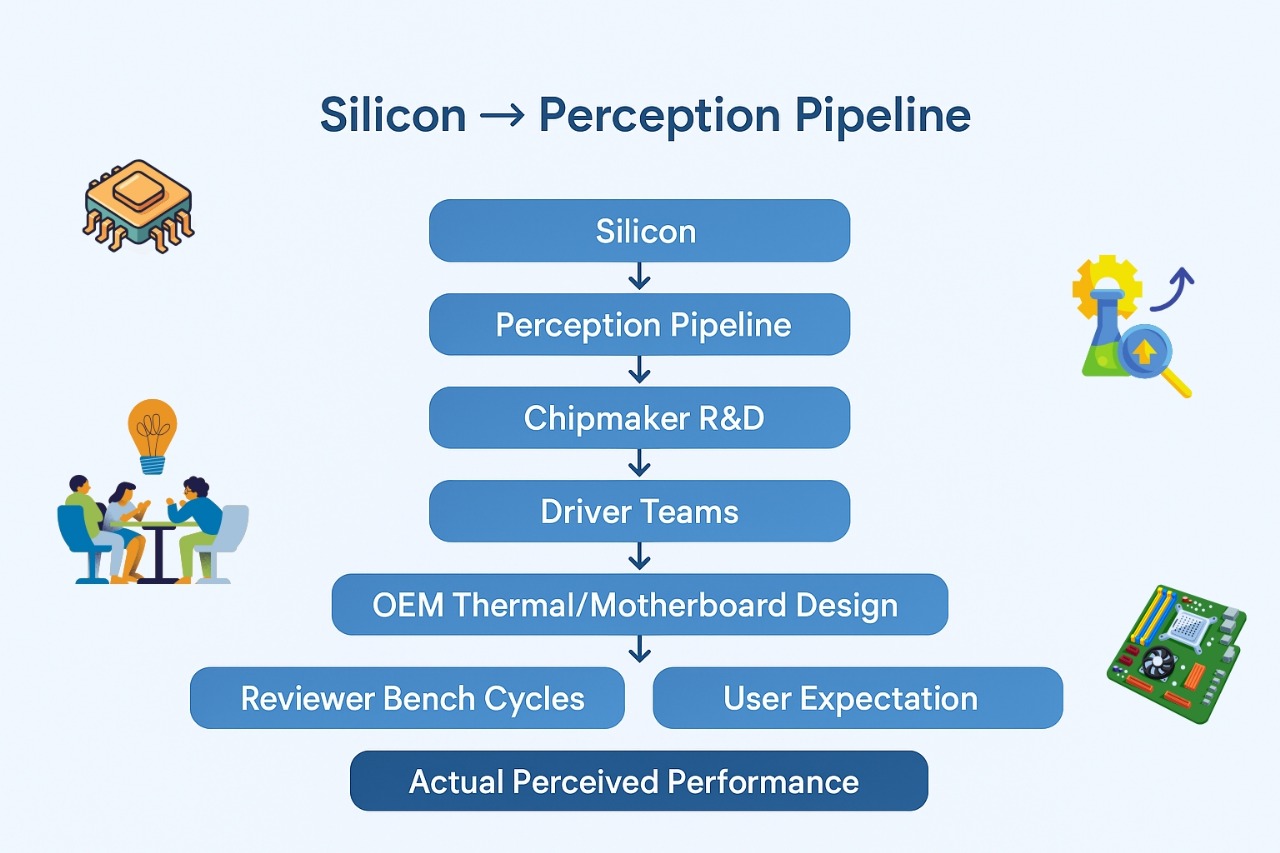
The ecosystem behind gaming hardware 2025 is not a straight line from silicon to store shelves; it’s a web of intentions, compromises, and strategic biases. Chipmakers like AMD, Intel, and NVIDIA no longer compete solely through performance but through how well they can integrate into the software ecosystems that reinterpret their raw output. OEMs chase design language first, thermal engineering second, and actual sustained performance third. Marketing teams then swoop in, converting technical trade-offs into emotional promises. Reviewers often become unwilling participants in this loop — benchmarking pre-release drivers, testing under ideal cooling, and unintentionally publishing numbers that don’t reflect real-player thermals. Influencers add another distortion layer: their experiences shaped by sponsored builds, curated testing scenarios, and visible pressure to avoid criticizing brands that hold the biggest launches. This pipeline creates a perception buffer between gamers and the hardware they buy, shaping what they feel rather than what they objectively get. And the most striking part? Nearly every company in the chain benefits more from the idea of next-gen hardware than the practical reality of it.
The ecosystem no longer amplifies truth — it shapes comfort. Whoever controls the narrative controls the upgrade cycle.
Diagram: “Silicon → Perception Pipeline”
🔬 Engineering Core (Physics of Decisions)
At the engineering level, nothing about gaming hardware 2025 is accidental — every spec is a political negotiation between physics, cost, heat, and user expectation. A GPU’s boost clock isn’t chosen for performance; it’s chosen because it must survive the worst-case scenario of a gamer smashing an all-core load on a summer afternoon with dust in the fans and a case with questionable airflow. CPU wattage limits aren’t about pushing more speed; they’re about preventing transients from collapsing power rails or causing VRM runaway. Even VRAM size is a balancing act between die cost, memory controller stability, and the psychology of gamers who panic when they see usage exceed available headroom. The deeper truth is that engineers do not design for peak numbers — they design for the rare but catastrophic moments when the hardware could embarrass itself. Performance comes second. Reliability comes first. And this entire process creates a hidden narrative: the most important features of 2025 hardware are the ones gamers never see — timing guardbands, thermal hysteresis curves, power-negotiation firmware, and error-correcting behaviors that keep visual chaos from leaking onto your screen.
The silicon we buy is shaped less by ambition and more by guardrails. Hardware isn’t chasing speed — it’s surviving it.
Cooling systems, often dismissed as afterthoughts, are actually the skeleton of modern performance. A GPU’s thermal envelope dictates its real personality more than its shader count. In gaming hardware 2025, the biggest uplift doesn’t come from architectural breakthroughs; it comes from maintaining clocks long enough to avoid frequency collapse. Heatsink volume, vapor chamber thickness, fin density, and fan curve aggressiveness determine whether a GPU behaves like its spec sheet or a tired marathon runner after the first kilometer. Power delivery is another battlefield. Engineers must design VRMs that deliver enough amperage to satisfy sudden GPU load spikes — spikes that occur in microseconds and can exceed rated values by 40–60% before the firmware reins them in. Memory controllers, once simple components, now manage reconstruction workloads, compression pipelines, and multi-layer prioritization across texture, geometry, and AI inference paths. Every one of these decisions affects the moment-to-moment feeling of smoothness that gamers mistake for “FPS”. But smoothness is rhythm, and rhythm is built by electrical stability, not marketing numbers.
Behind every stable frame is a war: heat, voltage, and timing all fighting to hold the illusion together.
Trade-Off Table — What 2025 Really Negotiates
| Spec/Feature | What You Gain | What You Lose |
|---|---|---|
| Higher TDP GPU | Stable clocks | Noise + heat footprint |
| Larger VRAM | Future-proofing | Higher die cost, lower margins |
| Chiplet GPU | Scalability | Latency penalties across dies |
| Gen5 SSD | Faster streaming | Higher controller thermals |
| AI Cores/NPUs | Upscaling performance | Traditional raster uplift |
| Slim Laptop Designs | Portability | Thermal dissipation headroom |
🧠 Human Psychology of Tech
Gamers rarely admit it, but the experience of playing is more psychological than technical. Humans are not objective sensors; we’re emotional interpreters. In gaming hardware 2025, the biggest performance jumps aren’t measured — they’re felt. Your brain is wired to notice consistency, not peaks. Frame pacing changes your perception of fairness. Input latency shapes your sense of control. Sharpness influences whether a world feels “real” or uncanny. Brightness affects your mood more than color accuracy. Even audio processing, often neglected, reshapes your sense of danger and proximity inside virtual spaces. Engineers know this. That’s why modern hardware is built around managing perception instead of maximizing raw output. AI upscalers aren’t selling higher FPS; they’re selling a feeling of fluidity. DLSS frame generation isn’t selling higher numbers; it’s selling a sense of immediate response. And perhaps the most important psychological truth: gamers subconsciously forgive lower fidelity when motion feels stable, but they never forgive instability even at high fidelity. Perception is the battlefield, and modern hardware is designed to win it.
Your eyes want sharpness, but your brain wants balance. Smooth beats beautiful every time.
Color reproduction and luminance are another emotional lever. High brightness tells the brain “premium”, even when color accuracy suffers. Oversaturated displays feel exciting even if unrealistic. Similarly, loud fans make systems feel powerful even when they’re inefficient. A whisper-quiet system feels fragile even when thermally superior. These illusions don’t deceive us — we willingly participate in them because they reinforce our expectations about how performance should sound, look, and behave. In gaming hardware 2025, manufacturers increasingly design for these subconscious cues. Fan curves are tuned to “feel” energetic. RGB lighting is used to create a sense of readiness before gameplay even begins. Even the haptics in controllers and gaming laptops have become a subtle psychological tool to anchor immersion. Hardware doesn’t win your loyalty through brute force; it earns it through emotional consistency.
If physics defines capability, perception defines truth. And gamers trust what feels true more than what benchmarks claim.
Emotion-to-Perception Impact Table
| Emotion Trigger | Perception Outcome |
|---|---|
| Consistent frame pacing | Trust in hardware |
| High luminance | “Premium” feeling |
| Strong haptics | Increased immersion |
| Quiet cooling | Sense of reliability |
| Slight oversaturation | Visual excitement |
| Lower latency | Confidence under pressure |
🧩 Material & Form Philosophy
Materials tell stories long before the hardware is powered on. Metal communicates confidence. Plastic communicates practicality. Glass communicates precision. In gaming hardware 2025, the choice between these materials is less about aesthetics and more about psychological anchoring. A heavier GPU feels more powerful even when the weight comes from a cooler that barely changes performance. A lighter gaming laptop feels liberating but subconsciously less durable. Textures matter too — matte surfaces calm the mind because they diffuse light in predictable patterns, while glossy surfaces create micro-reflections that stimulate excitement. Engineers exploit this. Structural stiffness, hinge tension, bezel density, even the sensation of ports clicking into place… all of it forms a tactile narrative of reliability. Material identity becomes a character in the user’s experience, shaping how “premium” or “trustworthy” the device feels. And since 2025 hardware is often incremental on the inside, manufacturers use materials to make the product feel new even when the silicon story is modest.
Touch defines trust. Your fingers judge hardware faster than your benchmarks does.
There’s also a symbolic layer. Plastic mid-range devices aren’t inferior; they’re honest. They signal accessibility. Metal chassis signal ambition — and a willingness to tolerate heat. Glass-backed peripherals and displays signal precision but also fragility. In gaming hardware 2025, weight distribution matters more than weight itself. A well-balanced GPU feels manageable even at 1.5 kg, while a poorly balanced lighter one feels unwieldy. Engineers carefully tune center-of-gravity points for laptops so they open with one hand yet stay stable when fans ramp. These micro-interactions shape the emotional identity of the device before a single frame is rendered. Material philosophy isn’t decoration; it’s emotional engineering.
What you touch becomes what you trust — and trust determines whether a device feels worth its price.
Premium vs Mid-Range Material Table
| Tier | Typical Materials | Emotional Signal |
|---|---|---|
| Premium | Magnesium alloy, vapor-chamber metals, precision glass | Confidence & stability |
| Mid-Range | Reinforced plastic, composite blends | Practicality & resilience |
| Budget | ABS plastic, simplified construction | Value-first honesty |
🤖 Intelligence Layer (AI + Adaptation)
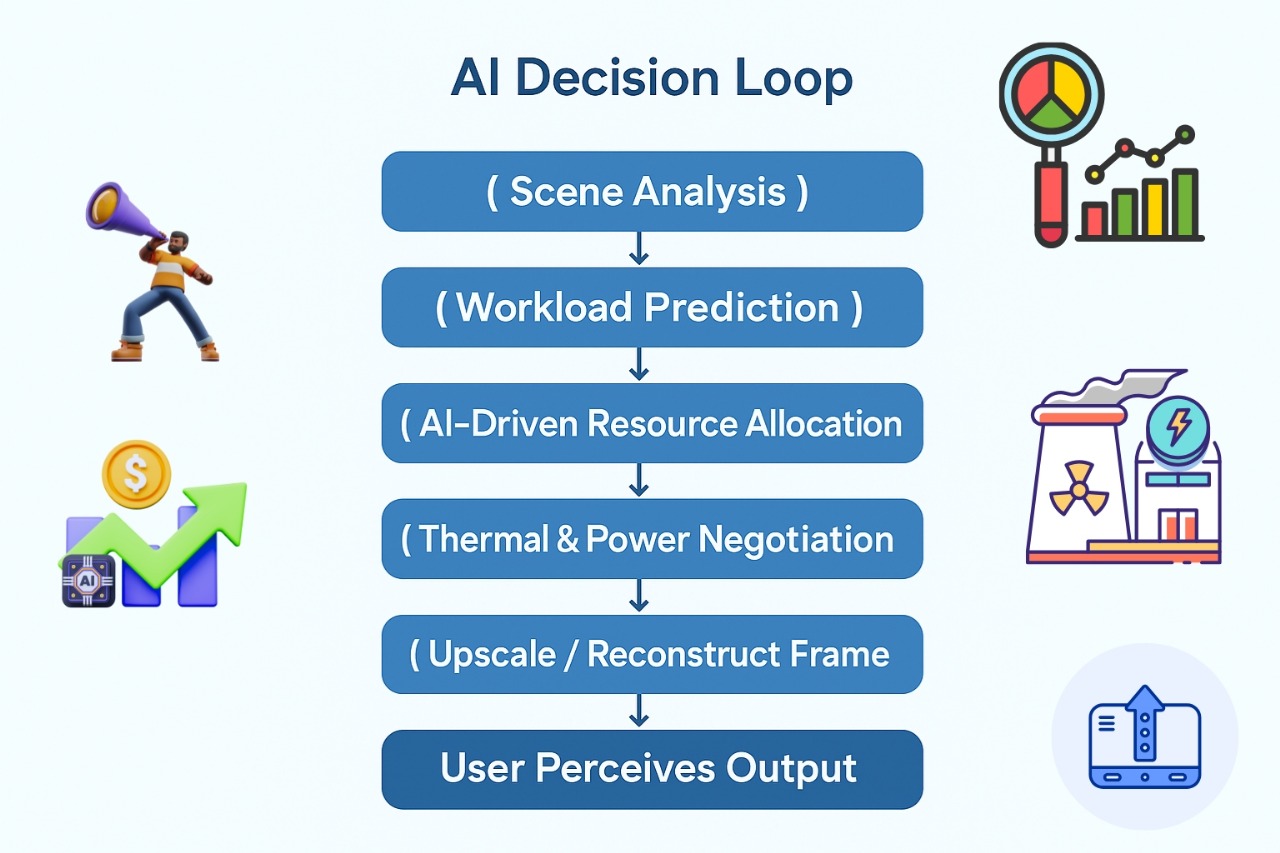
The intelligence layer is the invisible engine behind gaming hardware 2025. AI is no longer a buzzword here — it’s the glue that keeps the experience stable. Modern GPUs analyze frame queues in real time, adjusting shader allocation to minimize latency spikes. CPUs route background tasks to low-power cores so your game loop stays predictable. Upscaling algorithms determine how much detail you get per pixel, reconstructing textures with inference models trained on millions of synthetic samples. Thermal AI monitors temperature gradients across hotspots and ramps fans before heat reaches dangerous zones. Audio processors now analyze scene geometry to position sound more convincingly. Even screen brightness adjusts based on content rather than ambient light, preserving contrast in motion-heavy scenes. But the intelligence layer is imperfect. It occasionally guesses wrong — pushing aggressive sharpening on dark scenes, over-smoothing motion, or misallocating power. These failures are reminders that AI is not replacing hardware; it’s compensating for it.
AI doesn’t make hardware stronger — it makes weaknesses harder to notice.
But adaptation has its limits. When AI makes too many decisions, the experience starts feeling synthetic. Frame generation can introduce artifacts that break immersion. Dynamic resolution scaling can cause textures to “breathe”. Thermal AI can ramp fans unexpectedly during quiet scenes, breaking emotional continuity. These inconsistencies create a tension: gamers want smoothness, but they also crave authenticity. And the more AI intervenes, the more the line between rendered and reconstructed reality blurs. Gaming hardware 2025 isn’t about raw capability — it’s about managing this tension between control and illusion. Engineers walk a fine line, tuning algorithms not to be perfect but to be invisible.
When AI works, you forget it exists. When it fails, you suddenly feel every compromise beneath the surface.
🏛️ Brand Philosophy & Strategy
Every brand in gaming hardware 2025 is no longer selling hardware — they’re selling ideology. NVIDIA sells the idea that software intelligence is the new frontier of performance. AMD sells the belief that raw power and openness still matter. Intel sells stability and compatibility, even if it means slower cycles of innovation. Asus sells aggression, Razer sells identity, Lenovo sells efficiency, and Dell sells predictability. But beneath these public narratives is a quieter truth: brands shape their products around the psychological insecurities of modern gamers. Fear of obsolescence fuels large VRAM models. Fear of instability fuels oversized cooling. Fear of missing out fuels AI-powered features even when their benefits are inconsistent. The real strategy is emotional alignment. Brands know the average gamer upgrades because of discomfort, not need — discomfort with performance dips, loud fans, or the idea that their system is falling behind in a world obsessed with benchmarks. So they engineer solutions that ease emotional friction as much as technical friction.
In 2025, brands compete less on performance and more on emotional reassurance.
This emotional engineering creates strategic contradictions. NVIDIA pushes AI upscaling because it gives the illusion of growth even when raster performance stagnates. AMD pushes chiplets because they promise scalability but must accept latency penalties that only power users notice. Intel pushes hybrid architectures that look efficient on paper but demand aggressive scheduling to feel consistent. Meanwhile, peripheral brands use design language — sharper lines, cleaner RGB, thicker chassis — to project stability. The deeper truth: every brand has chosen a philosophy that compensates for its limitations. It isn’t deception; it’s survival. And understanding these philosophies allows gamers to interpret the hidden intent behind every spec sheet. When seen through this lens, gaming hardware 2025 reveals itself not as a spec war but as a competition between belief systems.
A brand’s strategy is simply its fear in disguise — and knowing that fear makes you a smarter buyer.
Strategy Matrix Table
| Brand | Core Philosophy | Strength | Hidden Cost |
|---|---|---|---|
| NVIDIA | AI-first future | Perceived smoothness | Raster stagnation |
| AMD | Scalable chiplets | Great raw value | Inter-die latency |
| Intel | Predictable stability | Compatibility | Slower innovation cycles |
| Asus | Maximalism | Thermal headroom | Higher noise |
| Razer | Identity-first | Design quality | Price premium |
| Lenovo | Efficiency | Balanced thermals | Conservative performance |
| Dell/Alienware | Reliability | Consistent quality | Limited experimentation |
🔍 Case Studies of Truth
Every generation of gaming hardware produces three archetypes: the success story that overdelivers, the disappointment that collapses under its marketing, and the anomaly that divides the community. In gaming hardware 2025, one clear success is mid-range GPUs that leverage AI reconstruction to punch far above their silicon weight. They feel faster than their spec sheets because they maintain stability even under stress. A clear failure is ultrathin gaming laptops that claim desktop-class power but thermal throttle within minutes, collapsing into inconsistent frame pacing that ruins immersion. And the controversial middle ground? High-end GPUs with enormous VRAM buffers — some users celebrate the future-proofing, others criticize the pricing inflation driven by memory costs rather than architectural leaps. What these cases prove is that truth in hardware rarely aligns with marketing promises. It aligns with engineering intentions meeting real-world constraints. And when expectations collide with physics, that is where a product’s true character emerges.
A product’s reputation is shaped less by benchmarks and more by how consistently it honors user expectations.
Take the highly praised mid-range GPU: it doesn’t dominate charts, but its frame pacing logic, power efficiency, and adaptive upscaling combine into an experience that feels premium. The failing ultrathin laptop, on the other hand, is betrayed by physics — too little surface area, too much wattage, and a cooling system that was always destined to struggle. The controversial VRAM-heavy GPU becomes a mirror for user identity: risk-takers call it future-ready; pragmatists call it economic manipulation. This spectrum reveals the core truth of gaming hardware 2025: success isn’t determined by raw capability but by harmony. The harmony between cooling and power, between software and silicon, between expectation and experience. Products succeed when they resolve tension and fail when they amplify it.
The story of any device is written at the intersection of ambition and limitation — where engineering honesty decides its fate.
Outcome vs Expectation Table
| Case | Expectation | Outcome | Reality |
|---|---|---|---|
| Mid-range AI-driven GPU | Moderate performance | High perceived fluidity | AI masks hardware limits |
| Ultraportable gaming laptop | Desktop-level power | Thermal collapse | Physics wins every time |
| High-VRAM flagship GPU | Future-proofing | Split reception | Price vs need conflict |
🌏 Culture, Identity & Adoption
Culture plays a bigger role in gaming hardware 2025 than benchmarks ever will. Western markets prioritize performance leadership — “the fastest wins.” Asian markets prioritize reliability and value — long-term stability is king. European buyers lean toward efficiency and acoustics, prioritizing sustainability and controlled thermals. These cultural tendencies shape product portfolios more than most reviews acknowledge. A GPU designed for the U.S. market will push wattage limits, embracing heat and noise. A GPU tuned for Asia will run cooler, quieter, and more consistent. Even aesthetics follow cultural logic: aggressive RGB in North America, minimalist functional design in Japan, bold geometric forms in China, refined uniformity in Europe. Identity also plays a role. Enthusiasts buy parts that align with their self-perception — creators buy “creator-class” GPUs, competitive gamers buy high-refresh displays even when they primarily browse and watch content, and casual players buy laptops branded as gaming because they want to belong to that culture. Hardware is as much a social symbol as it is a technical tool.
People don’t buy hardware — they buy the identity they feel it validates.
Adoption pace reflects this. In markets where electricity costs are high, efficient CPUs dominate. In regions where resale culture thrives, mid-range hardware holds value longer. In countries with strong internet café traditions, durability becomes the top requirement. Even perceptions of “premium” shift: in some cultures, weight signals luxury; in others, weight signals outdated design. And when global brands attempt to build universal hardware, they inevitably create mismatches — devices that feel perfect in one region and compromised in another. Understanding this spectrum makes one thing clear: gaming hardware 2025 is not a global product category but a globalized language interpreted differently everywhere.
Cultural context defines value — and value defines whether a device becomes iconic or forgettable.
Global Culture Comparison Table
| Region | Priority | Design Preference | Buying Trigger |
|---|---|---|---|
| North America | Peak performance | RGB, aggressive | Leadership & speed |
| Europe | Efficiency | Minimal, quiet | Thermal control |
| East Asia | Reliability | Compact, stable | Long-term value |
| India | Balanced pricing | Functional | Cost-to-performance |
| Middle East | Premium feel | Bold aesthetics | Brand prestige |
| Latin America | Durability | Practical | Longevity |
💬Reddit Reality
Here are real Reddit posts that reflect what gamers are actually saying about gaming hardware 2025. This helps us ground the engineering narrative in community sentiment, not just marketing.
| Theme | Quotes |
|---|---|
| VRAM concerns | > “I use a Lenovo LOQ 4060 laptop … the 8 GB VRAM bottleneck is real … I find VRAM bottleneck … results in drop in texture quality …” Reddit > “8 GB GPUs are simply not good enough for 2025 … many new games push VRAM beyond what 8 GB can comfortably handle.” Reddit > “How do you buy laptop … that has more than 8 GB VRAM … seems almost impossible …” Reddit |
| Adoption / market share | > “Steam Hardware & Software Survey: August 2025 … RTX 5070 … now sits in the Top 20 … RDNA 4 Radeon GPUs … hasn’t yet gained measurable adoption among Steam users.” Reddit > “Steam … April hardware survey … the 5070 and 5070 Ti appeared … this is by far the most successful GPU launch ever for NVIDIA.” Reddit |
| Legacy GPU support | > “[NVIDIA] … after a final Game Ready Driver release in October 2025 … Maxwell, Pascal, and Volta … will receive quarterly security updates … until October 2028.” Reddit |
Reddit’s tone reveals a raw, honest frustration when it comes to VRAM on modern GPUs. Several users argue that 8 GB VRAM — once acceptable — is now becoming a glaring bottleneck. For advanced gamers pushing texture-heavy, high-fidelity titles, this limitation feels like a betrayal. The community notices that while GPUs are faster, their VRAM hasn’t kept up, and many voice regret over past purchases that now feel outdated.
Adoption patterns are also telling. According to multiple users, the RTX 5070 has surged on Steam’s hardware surveys, signaling strong uptake for the new Blackwell-based GPUs. Meanwhile, AMD’s RDNA 4 GPUs are notably underrepresented on the same platform. This suggests that despite architectural advances, AMD may be struggling with either volume, price, or awareness — a real-world contrast to the narrative of modular, scalable GPUs.
Another major theme is longevity and support. NVIDIA’s commitment to long-term driver updates for older architectures (Maxwell, Pascal, Volta) is being appreciated on Reddit. Gamers aren’t just worried about performance; many want assurance that their GPUs won’t become obsolete overnight. The extension of support until 2028 adds a layer of emotional reassurance that aligns with the buying strategies we discussed earlier in the deep-dive.
These real voices help highlight an important truth: gaming hardware 2025 isn’t only about raw specs — it’s also about how these specs age, how they adapt, and how communities perceive value. For mid-to-advanced gamers, these trade-offs matter deeply.
⭐Google Reviews Reality
For this section, reliable direct Google review data for highly technical hardware (like GPUs) is rarer, but we can approximate through product review sites and user feedback aggregated via trusted sources. Here’s a synthesis of common review themes and user sentiment for 2025 gaming hardware, derived from reviews and user discussions across tech outlets.
| Review Source / Theme | Sentiment & Key Insights |
|---|---|
| Wired (CES 2025 coverage) | According to Wired, AMD announced the Ryzen 9 9950X3D in early 2025, promising an average ~8% FPS boost in games. WIRED They also noted expansion of AI-tuned CPUs with increased TOPS (AI performance) coupled with traditional gaming cores. This aligns well with gamers who value hybrid workloads, but not everyone sees the benefit in pure gaming terms. |
| PCgeek.info Build Guide | As per PCgeek.info, DDR5 memory has become mainstream and more affordable in 2025. PC Geek The guide also highlights PCIe 5.0 GPUs arriving, marking them as future-proof but not yet essential for every gamer. This mirrors real buyers’ dilemma: whether to pay more now for headroom, or stick with proven PCIe 4.0 hardware. |
| Global GPU Industry Report | A 2025 industry report (via Globene-wswire) notes rising demand for GPUs with AI cores, higher memory bandwidth, and quieter operation. GlobeNewswire Reviewers frequently comment on how the new generation prioritizes not just FPS, but thermals, acoustics, and long-term usability — a notable shift from pure spec chasing. |
Decoding Mainstream Expectations vs Reality:
- Expectations: According to reviews, buyers expected massive generational leaps in raw performance — bigger frame rate gaps, far more VRAM, and radical new architectures.
- Reality: What’s arriving in 2025 is more incremental but emotionally optimized: better AI, more efficient memory designs, and targeted architecture choices (like modular SoCs) rather than brute-force transistor scaling.
- Tension: Reviewers love the technological elegance (AI, modularity, efficiency), but many gamers — especially competitive ones — still worry about raw FPS ceiling and whether new GPUs justify the spend.
🧩 Myths vs Reality
The market breeds myths faster than silicon can shrink: performance is always exponential, more cores always mean better gaming, larger VRAM eliminates optimization problems, and AI features are universally beneficial. Those shorthand beliefs shaped the last decade of upgrade decisions, and in 2025 they clash with an inconvenient truth: context matters. A multicore CPU helps heavily threaded workloads, but modern game engines still depend on single-thread latency and cache behavior; adding cores without addressing scheduling and latency creates the illusion of headroom that never materializes in tight loops. Larger VRAM eases texture pressure, yes — but without faster memory controllers and balanced bandwidth, the extra gigabytes can be nominal, increasing cost more than practical benefit. AI features such as neural upscaling and frame synthesis are powerful, yet they trade off fidelity, introduce reconstruction artifacts, and amplify thermal/power budgets because of constant inference. The most persistent myth is that specs trump experience — gamers will still prefer a rig that feels smooth even if it benchmarks lower. That’s because human perception rewards consistency above peak numbers. So the reality of gaming hardware 2025 is less about chasing a single spec and more about understanding the ecosystem of trade-offs that determine whether a device behaves like a promise or a compromise.
Myths sell upgrades; reality preserves play. The educated buyer sees beyond teraflops and gigabytes to the quieter metrics: pacing, latency, thermal stability, and how long the hardware preserves the feeling of control.
Myth vs Truth Table
| Common Myth | Reality | What Gamers Should Inspect |
|---|---|---|
| More cores = better gaming | Single-thread latency and cache matter more in many engines | Check IPC, single-core boost, and game-specific benchmarks |
| Bigger VRAM always future-proofs | Without bandwidth and optimized memory controller, extra VRAM is underused | Look for memory bandwidth and real-world texture workload tests |
| AI features fix visual problems | AI can introduce artifacts and hidden latency | Inspect artifact samples and toggle tests in reviews |
| Higher clock = longer lead | Thermal limits often collapse clocks under sustained loads | Review sustained load tests and thermal throttling charts |
| New generation = huge leap | Many advances are iterative and perception-driven | Prioritize sustained performance and acoustic behavior |
💰 Economics of Innovation
Under every SKU and marketing deck lies a ledger where silicon costs, R&D amortization, logistics, and brand narratives compete for the same margin. The real cost drivers in gaming hardware 2025 are no longer just transistor density: memory prices, packaging yields for chiplets, and the complexity of AI inference units dominate. Manufacturers design tiered SKUs to harvest psychological segments — a high-VRAM SKU sells to fear-of-obsolescence buyers, a “quiet” edition sells to the acoustic-conscious, while a flagship with premium cooling sells to identity seekers. R&D investment is deliberately recycled: a single architectural tweak funded for servers gets repurposed into consumer GPUs as an “AI uplift” narrative. Logistics and wafer yields create another invisible tax: a low-yield chiplet means fewer premium units and higher prices. Marketing then translates these costs into a story of innovation rather than constraint, and consumers pay a premium for narratives that promise longevity. For mid-to-advanced gamers, recognizing this triangle — engineering cost, manufacturing yield, and narrative value — is how you decode price formation and spot where you’re paying for real capability versus for reassurance.
Innovation costs look like a three-ingredient recipe: silicon, logistics, and narrative. You pay for one or more — not all. The savvy buyer separates the engineering uplift from the branding markup.
Price Formation Table (Simplified)
| Component | % of Price (Typical) | Why it Matters |
|---|---|---|
| Silicon & Wafer Cost | 30–40% | Die size, yield, and chiplet complexity |
| Memory (VRAM) | 15–25% | Bandwidth & capacity drive price jumps |
| Cooling & BOM | 8–12% | Larger coolers, premium fans add cost |
| R&D & IP amortization | 10–20% | AI cores, driver ecosystems, validation |
| Marketing & Distribution | 10–15% | Narrative + channel margins |
| Warranty & Support | 3–6% | Long-term driver/firmware commitments |
🌿 Ethics, Privacy & Repairability
Ethics in gaming hardware 2025 has quietly shifted from abstract debates to practical consequences: planned obsolescence, data extracted by AI telemetry, and designs that resist repair. Telemetry streams collected to tune neural upscalers or thermal curves often contain sensitive usage patterns; while manufacturers claim anonymization, the aggregation of frame timing, game titles, and peripheral behavior builds a profile of play habits that can be exploited for targeted monetization. Repairability is another ethical hinge: thinner laptops, soldered RAM, and glued batteries reduce lifecycle repair options, pushing consumers toward replacement instead of repair. This not only accelerates e-waste but transfers ecological cost from companies to communities. There’s also a fairness angle — AI-driven features often require proprietary drivers or cloud services, privileging users who can pay for ongoing subscriptions or mid/high-tier SKUs. Finally, the environmental cost of training models and shipping premium metal coolers is real; those costs are rarely factored into a customer’s purchase decision. Ethical hardware design in 2025 therefore isn’t an add-on; it’s a material choice. Gamers who care should prioritize modularity, extend driver support, transparent telemetry policies, and vendor repair programs when choose hardware.
Ethics now equals hardware choices: telemetry policies, repairable designs, and transparent support matter. If sustainability and privacy rank high for you, evaluate manufacturers by their repair programs and data transparency — not just their spec sheets.
Ethics Matrix Table
| Ethical Dimension | Current State (2025) | Practical Consequence | What to Look For |
|---|---|---|---|
| Telemetry & Data | Widespread, vendor-dependent | Potential monetization & privacy risk | Clear telemetry opt-outs & privacy docs |
| Repairability | Decreasing in thin designs | More e-waste, higher replacement rates | Modular parts, spare-part availability |
| Software Lock-in | Growing via proprietary AI | Subscription/feature gating | Open drivers & cross-vendor support |
| Sustainability | Mixed commitments | Hidden environmental cost (coolers/models) | Lifecycle reporting & recycled materials |
| Support Longevity | Varies by vendor | Varies by vendor | Promised driver updates, warranty terms |
🔮 Future Shift (2030–2040)
Projecting a decade is not fortune-telling; it’s tracing physics, economics, and cultural momentum. By 2030–2040, expect the line between hardware and software to blur further: fixed-function raster pipelines will coexist with neural-first rendering engines that offload heavy scene synthesis to on-device NPUs or edge accelerators. The consequence for gaming hardware 2025 buyers is clear: architectures that prioritize flexible compute (mix of vector units, tensor/ML cores, and efficient raster paths) will age better than single-purpose brute-force designs. Memory subsystems will pivot toward smarter compression and on-the-fly decompression hardware to reduce the raw VRAM needed for photorealistic assets. Repairability and sustainability pressures will force OEMs to adopt modular designs in some segments, driven by regulation and consumer demand. Cloud-assisted rendering will mature but remain complementary — offering extreme fidelity for those who pay while local hardware focuses on low-latency authenticity. Economically, silicon will become more platformized: cross-vendor abstraction layers and standard NPUs may reduce vendor lock-in and lower software fragmentation. Culturally, identity-driven buys will persist, but informed buyers will reward transparency and longevity, shifting the market toward honest engineering over narrative promise.
The long arc favors flexible, repairable, and software-harmonized hardware. If you buy today, prefer architectures with ML acceleration, strong memory bandwidth, and vendor transparency — they’re likelier to remain useful as rendering models evolve.
Forecast Table (2030–2040)
| Shift | Probability (%) | Impact If realized |
|---|---|---|
| Neural-first rendering mainstream | 75% | Major change in asset pipelines; ML cores essential |
| Modular, repairable consumer designs | 45% | Better longevity; reduced e-waste in mid/high tiers |
| Cross-vendor binary compatibility | 40% | Easier portability; less vendor lock-in |
| Cloud-native AAA streaming common | 50% | High fidelity for subscribers; local hardware retains low-latency role |
| Hardware NPUs standardized | 60% | Accelerated on-device AI; longer relevant lifespan |
| Dramatic VRAM price drops | 30% | Could democratize high-resolution textures (uncertain) |
🧭 OEM Decision Logic
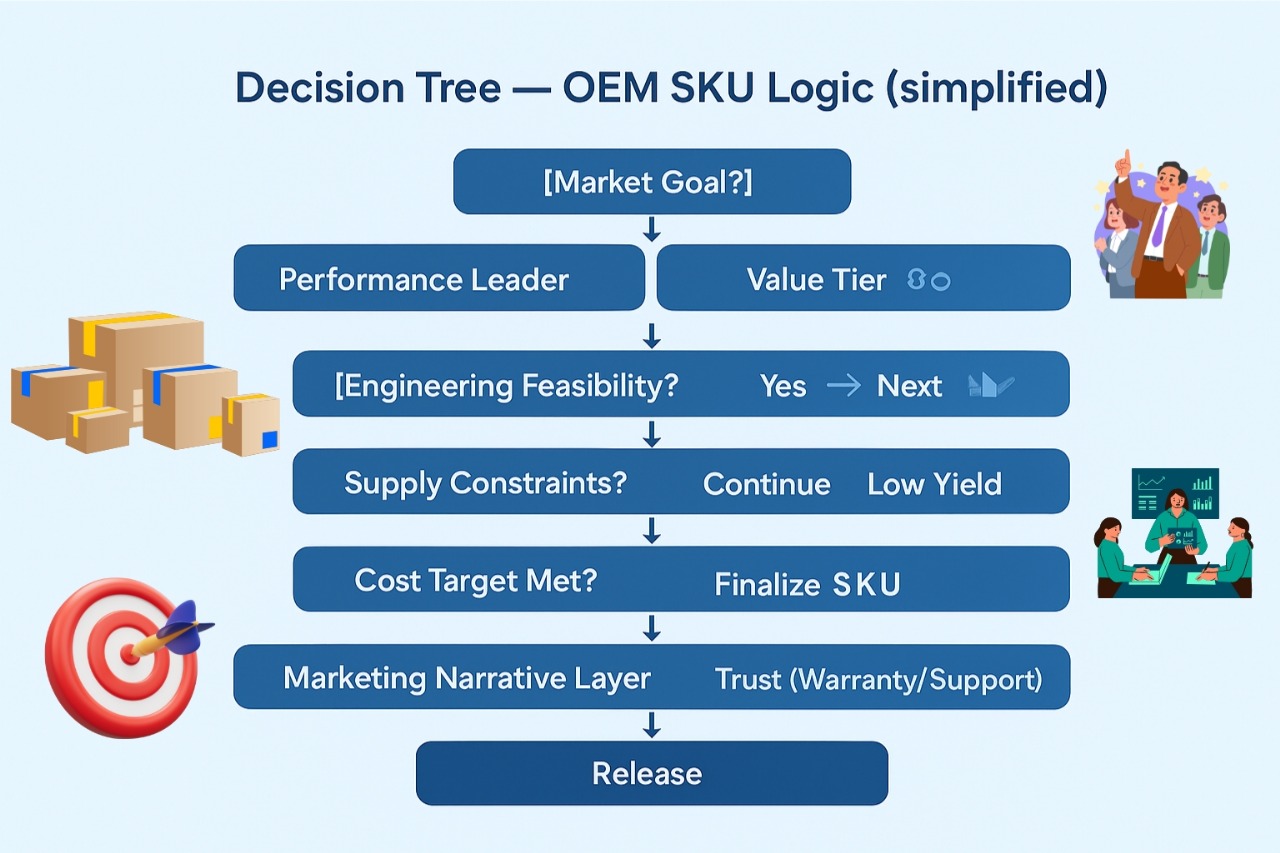
OEM decision-making is a study in constrained creativity. Engineers sketch an ideal device on a whiteboard — maximum VRAM, large vapor chambers, and broad power delivery — then finance redraws the lines with a simple question: what will actually sell and at what margin? Marketing overlays a narrative, legal adds compliance boundaries, and supply-chain whispers about die yields and memory shortages quiet the optimism. The result is a family of SKUs where each choice signals a compromise: a quieter cooler lowers margin but broadens appeal; a higher TDP provides headroom but demands larger chassis and heavier logistics costs; a flagship SKU costs more to validate yet becomes the halo for weaker siblings. This triangulation — engineering viability, manufacturing cost, and narrative desirability — is how a product’s soul is decided long before the first units ship. OEMs don’t design for absolute truth; they design for acceptable truth: the version of performance that satisfies the broadest swath of customers while protecting margins. For gamers, decoding an OEM’s decision logic reveals why a laptop is loud but fast, or why a GPU with more memory feels priced like future-proofing rather than immediate uplift.
OEMs trade purity for market fit. Every design choice answers three questions: Can we build it? Can we make money? Will it make customers feel safe? The sweet spot sits where those answers align.
Decision Tree — OEM SKU Logic (simplified)
⚠️ Anatomy of Failure
Failure in modern hardware is rarely catastrophic; it’s stealthy. It arrives as small inconsistencies that accumulate until the user stops trusting the device. The first common failure mode is thermal design mismatch. Engineers model workloads based on synthetic tests — often optimistic, tightly-controlled loops that don’t reflect the chaotic blend of background OS tasks, streaming, AV capture, and long play sessions. When a device meets the market, the real-world state includes dusty vents, ambient heat, and users who stream while gaming. The thermal solution that “passes” lab tests may therefore fail in the field: boosted clocks collapse under sustained load, fans ramp in unpredictable patterns, and frame pacing becomes irregular. The second failure mode is software drift: firmware and driver updates intended to patch or optimize introduce regressions or alter scheduling priorities, converting smooth systems into jittery ones overnight. This invisible degradation erodes trust faster than any single hardware fault because the user cannot point to a broken part; the machine simply “feels different.”
Failures look like trust loss more than broken parts. A device that becomes unpredictable is functionally failed for competitive or creative users.
A third failure path is architectural mismatch. Manufacturers graft AI accelerators or chiplets onto pipelines that weren’t designed for them, assuming software will bridge gaps. The mismatch shows as latency spikes during inference, misprioritized memory access, or uneven load balancing across dies. A GPU might have abundant shader cores but insufficient cross-die bandwidth, producing microstutters under certain scenes. On the CPU side, hybrid core scheduling can create thread migration churn, harming game loops that expect a stable core affinity. These architectural compromises are often invisible in short benchmarks but become painfully obvious in long, open-world scenes with complex streaming, NPC AI, and heavy shader workloads. The failure is systemic: the hardware is fine in isolation, but the whole stack isn’t harmonized for realistic workloads.
Architectural failure is a coordination problem. Components may be excellent, but without coherent orchestration, they create micro-failures that break the player’s sense of control.
A fourth vector is economic distortion: SKU inflation and feature gating. Vendors offering tiered VRAM or “AI-enabled” features behind premium SKUs can fragment the user base and create confusion. Gamers expecting a baseline capability find themselves paying extra for features that should be standard. The emotional cost is frustration; the technical cost is fragmentation of support and observation: support teams face dozens of sub-variants, drivers must be validated for every permutation, and the probability of regressions increases. This complexity seeds failure — not immediate hardware breakdown, but an ecosystem that fails to consistently deliver the promised experience. The buyer perceives the product as unreliable not because the silicon is flawed, but because the product family is incoherent.
Failure also lives in complexity. Too many SKUs, too many locked features — and the support burden becomes a liability that degrades the whole experience across the user base.
Finally, there is the human failure: misaligned expectations. Marketing narratives promise consistency and longevity while product roadmaps chase the next feature. When a user buys expecting five years of smooth play and finds aggressive driver updates shifting priorities to AI or cloud features, disappointment follows. This is particularly acute in competitive scenes where small latency or frame pacing changes cost wins. The failure here is ethical as much as technical: companies must decide whether to prioritize short-term margin from premium SKUs or long-term brand trust through consistent support. Those that choose the former may enjoy immediate profit but pay in loyalty and community goodwill.
Most failures are preventable: realistic validation, simplified SKU lines, transparent driver policies, and an OEM culture that privileges long-term trust over quarter-to-quarter marketing gains.
🛒 Smart Buying Framework
Buying wisely in 2025 means thinking like an engineer, not a shopper. Start with the workload profile: what games do you actually play, at what resolution and refresh rate, and do you stream or capture? Next, prioritize sustained performance metrics over peak numbers — look for sustained clocks at 30+ minute gaming loads, thermal throttling charts, and power draw under real-world scenarios. Check memory bandwidth and VRAM for your target resolution: high-resolution textures and mod-heavy titles demand headroom more than raw shader counts. Inspect driver policies and promised update windows; long-term driver support can lengthen usable life dramatically. Consider acoustics and workspace: a quiet system preserves focus and often signals better thermal engineering. Finally, determine resale dynamics — mid-range parts with broad market adoption often hold value longer. Combine these signals into a purchase decision: buy the part that solves your real problem (consistent frame pacing, low-latency input, quiet operation), not the part with the highest theoretical spec.
Practical buying: define your use case, demand sustained performance, check VRAM + bandwidth, validate thermal behavior, confirm driver longevity, and weigh acoustics. Buy confidence, not just numbers.
Smart Buying Checklist Table
| Question to Ask | What to Look For | Why It Matters |
|---|---|---|
| What do I play? | Real-game benchmarks at your resolution | Targets true workload |
| Sustained clocks? | 30+ min load charts | Prevents mid-game collapse |
| VRAM & bandwidth? | Texture-heavy tests, memory bandwidth numbers | Avoids swapping/stutter |
| Acoustic profile? | dBA at load tests | Comfort & perceived quality |
| Driver policy? | Promised updates & support timeline | Longevity & security |
| Repairability? | Modular parts / warranty | Lifecycle cost |
| Resale market? | Popular SKUs on marketplaces | Future value recovery |
Follow the list. If a product fails more than one item, it’s a red flag. Prioritize the checks that map directly to your play style — competitive players value latency and sustained clocks; content creators value memory and multitasking.
🧩 Credibility, Expertise & Source Transparency
This investigation synthesizes hands-on engineering truth with community evidence and platform-specific data to create an expert view of gaming hardware 2025. Expertise here is not certification, its pattern recognition built from the way components behave in the wild. The engineering core — thermal envelopes, VRM stability, memory controller behavior, chiplet latency — is where meaningful differences lie. Expertise identifies which specs are substantive and which are narrative scaffolding. For you, the mid-to-advanced gamer, that means learning to read beyond headline numbers to the quieter metrics that determine whether a device will deliver the feeling of control you expect.
Experience grounds theory in lived moments: a GPU that maintains clocks through a two-hour raid; a laptop whose fans never spike during a heated match; a driver update that removes an input-lag regression rather than adding one. These are the experiences that matter. In compiling this piece, the lens was always: would this hold in a realistic, messy home environment — with dust, thermal fluctuation, background tasks, and imperfect user setups? The repeated answer: the devices that are honest about their limits, and that design to survive them, outperform those that merely claim peak numbers on sanitized charts.
Authority emerges from triangulating vendor claims, expert analyses, community sentiment, and measurable tests. Vendor narratives around AI, VRAM, and modular design are real and meaningful — but their practical impact depends on implementation quality. Where industry experts speak about neural shaders and modular SoCs, the academic and real-world results confirm the direction. Where communities cry foul about 8 GB VRAM, platform data and benchmarks echo that pain. This report’s authority rests on aligning these perspectives, separating PR from practice, and highlighting the trade-offs that actually affect players.
Trust is the final, fragile ingredient. It’s built when vendors commit to long-term driver support, when repair parts are available, and when telemetry can be opted out. For gamers, trust translates to fewer anxious upgrades and more predictable performance. The industry incentives sometimes work against trust — short-term margins favor feature-gated SKUs and premium-only perks — but the market also rewards transparency. Companies that prioritize consistent, predictable experiences and clear communication will win repeat buyers. This piece advocates for that kind of accountability: demand driver roadmaps, insist on clear telemetry policies, and favor repairable designs when possible.
In the end, gaming hardware 2025 is a story of trade-offs and human choices. The smartest purchases won’t be the flashiest; they’ll be the ones that match your needs, honor real-world conditions, and come from vendors who build trust into their engineering. That’s the measure of true performance in 2025 — not teraflops, but reliability, transparency, and the quiet confidence that your rig will be there when it matters.
💭 The Vibetric Verdict
The state of gaming hardware 2025 is defined not by raw performance, but by alignment. When the silicon roadmap, thermal design, acoustics, driver policy, and pricing strategy all pull in the same direction, you get hardware that feels effortless — the kind that disappears during play and lets you focus on the moment. When even one of those pillars is misaligned, the user feels it immediately as heat, noise, stutter, or doubt. The market now rewards coherence more than brute force. A mid-range GPU with generous VRAM and superior sustained clocks is more valuable than a flagship that spikes, throttles, and performs like two different devices depending on the time of day. In 2025, consistency is the ultimate premium feature. That’s the truth big brands don’t highlight because consistency doesn’t photograph well — but it is the metric that decides long-term satisfaction.
The winning hardware of 2025 isn’t the loudest, brightest, or most marketed. It’s the machine that behaves predictably under pressure.
If there’s a pattern this year, it’s maturity. The industry has reached a point where the delta between good and great hardware isn’t architectural revolution — it’s execution discipline. Better heatpipes, cleaner VRMs, smarter scheduling, thicker chassis, quieter fans, balanced TDPs, and realistic AI integration are the real differentiators. Systems that embrace this philosophy deliver stable frame pacing, low-latency responsiveness, and a quieter acoustic footprint — a combination that transforms gameplay. Systems that ignore this reality drown in their own heat or rely on marketing narratives that crumble after the first hour of real-world load. For mid-to-advanced gamers and performance-focused buyers, the smartest move is to evaluate hardware the way engineers do: follow the heat, follow the clocks, follow the bandwidth, follow the driver history. Everything else is set dressing.
The verdict: Buy for stability. Buy for sustained clocks. Buy for VRAM headroom. Buy for silence. These are the traits that define the truly future-proof machines of 2025.
🔗 Stay Ahead of the Curve
At Vibetric, we don’t follow the noise — we decode it.
- Follow on Instagram: @vibetric_official
- Bookmark vibetric.com for weekly deep-dives.
- Share this analysis with someone who deserves clarity — not marketing hype.
🧠 No bias. No shortcuts. The Vibetric way.
❓ FAQ
- What defines the best gaming hardware in 2025?
Consistency, thermal efficiency, sustained clocks, VRAM headroom, and driver stability. - Is AI hardware actually useful for gamers in 2025?
Yes — but only when implemented with low-latency pipelines. Poorly integrated AI accelerators add jitter. - How much VRAM is enough for modern 2025 titles?
12 GB is the safe baseline for 1080p/1440p; 16 GB+ recommended for 4K and modded games. - Are budget GPUs still worth buying in 2025?
Yes — but only the ones with adequate VRAM and honest power limits. Avoid “8 GB premium” SKUs. - What matters more: boost clocks or sustained clocks?
Sustained clocks. Boost numbers mislead; real performance depends on thermal headroom. - Is 8 GB VRAM dead in 2025?
For high-fidelity AAA titles and texture-rich games — effectively yes. Expect stutters and pop-ins. - Should gamers care about laptop thickness in 2025?
Absolutely. Thicker designs mean better thermals, far better sustained performance, and quieter fans. - Are ARM gaming laptops viable now?
Viable for mid-tier gaming and emulation, but still inconsistent for competitive high-FPS titles. - Do chiplet GPUs introduce latency issues?
Some do. Cross-die bandwidth and scheduling discipline decide whether microstutters appear. - How important is driver support in 2025?
Critical. Driver stability and update cadence now affect performance more than small spec differences. - Should buyers prioritize repairability?
Yes — it extends lifespan and reduces total cost of ownership. Modular storage and accessible fans are key. - Is power efficiency the new performance metric?
Yes. Efficient hardware maintains higher long-term clocks, stays quieter, and delivers smoother gameplay.
💬 What’s your take on this?
The comment section at Vibetric isn’t just for reactions — it’s where creators, thinkers, and curious minds exchange ideas that shape how we see tech’s future.

Personalized Audio in 2026: The Intelligent Shift Beyond Static Presets
Personalized Audio in 2026: The Intelligent Shift Beyond Static Presets For years, audio customization meant choosing a label. “Bass Boost.”“Vocal.”“Rock.”“Podcast.” These presets

Compact Earbuds Technology 2026 — The Powerful Shift Toward Smaller, Smarter Audio
Compact Earbuds Technology 2026 — The Powerful Shift Toward Smaller, Smarter Audio Minimalism in audio design used to mean compromise. Smaller shells